
New Mexico is a state full of stories, legends, and secrets. Some of the biggest historical mysteries in New Mexico have puzzled experts and locals for decades.
People can find tales of lost treasures, unexplained disappearances, strange creatures, and even famous ghost stories.

Rumors about Spanish gold hidden in the mountains still circulate. The unexplained crash in Roswell sparked UFO theories.
The state is also home to legends like the Chupacabra and the weeping ghost known as La Llorona. These mysteries make the Land of Enchantment a place where history and the unknown meet.
Anyone curious about the strange side of New Mexico’s past will find plenty of puzzling cases and unanswered questions. Every story leads to more searching, more guessing, and a sense of wonder about what still waits to be discovered.
The Las Cruces Bowling Alley Massacre
The Las Cruces Bowling Alley Massacre stands as one of the most shocking crimes in New Mexico’s history. Two unidentified gunmen entered Las Cruces Bowl in 1990, leaving behind a cold case that still draws attention from true crime fans and law enforcement.
Overview of the Incident
On the morning of February 10, 1990, two armed men entered the bowling alley just as it was opening for business. Several staff and children were inside preparing for the day.
The gunmen forced seven people, including a 13-year-old girl and a 2-year-old child, into the office area. They demanded money from the safe.
After robbing the victims, the attackers shot all seven people at close range. One of the suspects then set fire to a desk in the office before fleeing.
The arson likely aimed to destroy evidence, but firefighters arrived quickly and stopped the building from burning down. Emergency services responded within minutes after a 911 call from one of the survivors.
More details can be found in this overview of the Las Cruces Bowling Alley Massacre.
Victims and Unsolved Mysteries
The shooting left five people dead and two seriously wounded. The victims included employees, family members, and young children.
Among the survivors was a young girl who called 911 despite her injuries. The attackers left no clear motive other than robbery, but the level of violence shocked investigators.
The case remains unsolved and is one of the biggest unsolved murders in New Mexico. The community still remembers the victims.
The bowling alley, long since closed, stands as a reminder of the tragedy.
Investigation and Forensic Science
Law enforcement launched a large investigation immediately after the murders. Police gathered evidence from the office and interviewed witnesses.
They released composite sketches of the suspects based on survivor statements. Detectives and forensics teams used ballistics, fingerprints, and early DNA techniques.
Key forensic evidence did not identify the suspects. The fire had little impact on the evidence, but the attackers left few traces behind.
The Las Cruces Bowling Alley Massacre has become a well-known cold case. The crime remains officially unsolved, and law enforcement encourages the public to come forward with any new information.
For a detailed investigation summary, visit this Las Cruces Bowling Alley Massacre article.
West Mesa Bone Collector Case
The discovery of a mass grave on Albuquerque’s West Mesa shocked New Mexico in 2009. Eleven women’s remains were found, raising fears of a serial killer.
Discovery of the Mass Grave
In February 2009, a woman walking her dog found a human bone near the outskirts of Albuquerque. She first thought it belonged to an animal, but authorities confirmed it was human.
When police started digging, they uncovered a larger crime scene on the West Mesa. Investigators found the remains of 11 women and one unborn baby buried in the area.
The site spread over several acres, showing someone went to great lengths to hide the bodies. Many people called the unknown suspect the “West Mesa Bone Collector.”
Heavy rains earlier that year may have exposed the remains, helping the case get discovered after years hidden underground. Several agencies worked together on the search, using forensic experts and specialized equipment.
The large, isolated desert area made the investigation difficult.
The Victims and Missing Persons
The victims ranged from teenagers to women in their twenties and early thirties. Most were Hispanic, and many were reported missing from Albuquerque between 2001 and 2005.
Some reportedly had histories linked with drugs or street work, making them more vulnerable and less likely to be quickly missed. Identifying all the remains took time due to decomposition and harsh conditions.
Police examined missing persons cases going back years to find matches, using dental records and DNA to name each victim. Their families had waited years with no answers.
The list of missing women from the area suggested there might be other victims not found or identified yet. Some families and advocates believe more bodies might still be buried nearby.
The case drew national attention as a possible instance of a New Mexico serial killer at work. See more details at the West Mesa murders page.
Cold Cases and Investigative Challenges
The investigation soon grew cold, with no arrests for the murders. Police interviewed several suspects over the years, but nobody was charged.
Some leads pointed to possible serial offenders, but the evidence was never strong enough. The West Mesa’s isolated location made witness accounts rare and limited security footage or tips.
Forensic science confirmed the identities of the victims, but couldn’t identify the killer due to the lack of physical evidence like fingerprints or DNA tying a suspect to the scene. The age of the remains added more challenges to solving this case.
Experts have said that keeping track of missing persons and sharing information nationwide might help find answers one day. For more background, visit this overview of the West Mesa Bone Collector case.
The Disappearance of Tara Calico
Tara Calico’s case is one of New Mexico’s most talked about unsolved mysteries. She was a college student who vanished during a bike ride, leaving behind only questions and a chilling clue that made headlines.
Timeline of Events
On September 20, 1988, 19-year-old Tara Calico left her home in Belen, New Mexico, for a morning bike ride. She usually took this path along Highway 47.
On this day, she borrowed her mother’s neon pink Huffy bike because her own had a flat tire. Tara told her mother she would be back by noon for tennis practice.
By the afternoon, Tara had not come home. Her worried mother searched for her and called the police.
Tara was last seen at about 11:45 a.m., riding the pink bicycle with yellow cables and sidewalls. Tire tracks and part of a broken cassette were found near the road, but there were few other clues.
Despite a large search and a continuing investigation, no trace of Tara or the bike was ever found.
The Polaroid Photo Clue
In June 1989, a year after Tara’s disappearance, someone found a Polaroid photo in a convenience store parking lot in Port St. Joe, Florida. The picture showed a young woman and a boy, both bound and gagged, lying in the back of a van.
The girl in the photo had similar features to Tara Calico. Tara’s mother believed the girl in the photo was her daughter, based on a visible scar and her appearance.
The FBI analyzed the photo, but results were not conclusive. Some experts agreed with Tara’s family; others did not.
The boy in the photo was also never identified. The Polaroid photo clue continues to be one of the most debated pieces of evidence in Tara’s case.
Legendary Lost Treasures of New Mexico
New Mexico is known for stories about lost treasure, secret gold, and mysterious mines. These stories include real people and locations, drawing treasure hunters and curious minds even today.
Victorio Peak and the Doc Noss Gold
Victorio Peak stands inside the White Sands Missile Range, near the Hembrillo Basin. In the late 1930s, Doc Noss claimed he found a hidden cache of treasure here.
He said he discovered a cavern packed with gold bars, old gold coins, and valuable artifacts, some maybe dating back to Spanish explorers or the period of Emperor Maximilian. Doc Noss’s search for gold took a turn when he ran into trouble with partners and lost his life over the secret.
Many searches for the Victorio Peak treasure have happened, but no official haul has ever been proven. The peak’s location inside a restricted area, plus the legend’s mystery, keeps people questioning what really lies underground.
The Lost Padre Mine
The Lost Padre Mine is another famous story of hidden Spanish treasure. According to legend, Spanish priests found gold in the mountains along the Jornada del Muerto in the 1700s.
These priests, called padres, ran the mine in secret with local Native American labor. When dangers from Apache attacks increased, the priests hid the entrance, and the exact location was lost over time.
Some believe the mine may still hold gold bars, silver, and old religious artifacts. Many treasure hunters try to match trails and clues, but the mine’s secret remains locked away, adding to New Mexico’s reputation for lost treasures.
The Mystery of Arthur Rochford Manby
Arthur Rochford Manby is remembered for his dramatic death, ties to local folklore, and his reputation as a mysterious and controversial figure. His story includes claims of secret societies, rumors, and a case that has never been solved.
Background and Legacy
Arthur Manby was a British immigrant who settled in Taos, New Mexico in the early 1900s. He became known for his bold business deals and land acquisitions.
Locals described him as a shrewd businessman, sometimes going to great lengths to get what he wanted. His mansion in Taos was large, with 19 rooms.
Residents in Taos often shared stories about his unusual lifestyle and fierce personality. Over time, he became the subject of local legends.
Manby’s estate was mysterious. Some people believed he was connected to powerful people or even to a secret society.
His reputation for intimidation and secrecy made him a memorable character in the region’s history. Today, he is remembered through tales and accounts that blend fact with folklore.
Unsolved Murder and Secret Society Links
On July 3, 1929, someone found Manby’s body headless in his Taos mansion. The gruesome scene sparked theories about murder, identity theft, and escape.
Officials declared his death a murder, but the case was never solved. The body was in such bad shape that some wondered if it was really him.
Rumors of secret societies and enemies circled for years. Authorities did little to investigate, which caused his family and the British Consulate to demand answers.
Later, they exhumed the body, but doubts about its identity remained.
Today, his story is one of New Mexico’s oldest and most chilling cold cases. People in Taos still talk about the case, connecting it to hidden networks and the strange details of his life and death.
This has turned Manby into a legendary figure in New Mexico folklore and crime history.
New Mexico’s Ghosts and Haunted Legends
People in New Mexico often tell stories about haunted places and ghostly visitors. Many tales come from the state’s long history, including its old hotels, historic theaters, and abandoned ghost towns.
Famous Ghost Stories
Some of the most talked-about ghost stories in New Mexico come from historic buildings and towns. The KiMo Theatre in Albuquerque is known for its tragic past and tales of a small boy’s spirit causing mischief, flickering the lights, and moving items backstage.
Santa Fe’s La Fonda Hotel is another hotspot for spooky happenings. Guests report seeing apparitions and feeling sudden chills in old hallways.
The Luna Mansion in Los Lunas brings stories of a woman in a 19th-century dress walking through rooms at night. Even whole towns such as Madrid and Dawson are considered haunted, where abandoned streets are said to echo with paranormal activity.
The Roswell Incident remains one of the nation’s biggest unsolved mysteries, with many people connecting its folklore to possible spirits and supernatural events.
Notable haunted places:
| Location | Notable Activity |
|---|---|
| KiMo Theatre | Child ghost, strange noises |
| La Fonda Hotel | Apparitions, cold spots |
| Luna Mansion | Woman in old-fashioned dress |
| Dawson Ghost Town | Restless spirits |
Supernatural Encounters
Visitors and locals share many different supernatural experiences from around New Mexico. At the St. James Hotel in Cimarron, staff and guests have seen shadowy figures and doors opening without cause.
Some have even heard unexplained footsteps in empty hallways. The old mining town of Dawson is best known for its haunted cemetery, where people report ghostly miners walking among the gravestones.
In places like Eagle Nest Lodge, guests have felt invisible presences and heard faint voices late at night. People interested in New Mexico’s folklore often seek out these haunted sites.
Some come hoping to see real ghosts, while others just want to explore the rich history and legends of the region. Staff at these haunted locations often keep lists of unexplained experiences shared by guests.
Apache Chief Victorio and the Hembrillo Basin Battle
The Hembrillo Basin battle in 1880 marked a turning point in the struggle between Apache warriors and the United States Army. The legacy of Chief Victorio, the bravery of the Buffalo Soldiers, and the search for lost artifacts make this event stand out in New Mexico’s history.
Chief Victorio’s Legacy
Chief Victorio led a group of Chiricahua and Mescalero Apaches during the late 1800s. He was known for his tactical skills and deep knowledge of the land.
When the U.S. Army tried to force his people back to their reservation, Victorio refused to surrender. The Battle of Hembrillo Basin began on April 5, 1880, in the heart of southern New Mexico.
Victorio and around 150 Apache warriors used the terrain to outsmart two companies of the Ninth Cavalry, known as the Buffalo Soldiers. The fighting lasted for days and is remembered as the largest Apache-Cavalry battle of Victorio’s War.
Despite heavy fighting, both sides suffered few casualties. Victorio’s ability to lead his people through such danger added to his strong reputation.
Stories of his escapes, hideouts, and how he fed his people through deer hunts have remained part of Apache and New Mexican history.
The Search for Hidden Artifacts
After the Battle of Hembrillo Basin, many wondered what was left behind. Archaeologists and history fans have explored the basin, searching for weapons, supplies, or other artifacts related to Victorio and his followers.
The rugged landscape makes this search challenging. Items found in the area range from spent bullets to pieces of metal.
These discoveries help experts learn more about what happened during those tense days in 1880. They offer a glimpse into the daily lives and struggles of both the Apache warriors and the Buffalo Soldiers.
People are also interested in locating possible camp sites, escape routes, and evidence of old deer hunts. Every artifact found adds another piece to the puzzle, making Hembrillo Basin a place where history and mystery come together for New Mexico explorers.
Historical Cold Cases and Unsolved Murders
New Mexico has a number of cold cases and unsolved murders that continue to puzzle law enforcement and local communities. Many of these cases reach back decades, drawing interest from true crime fans and those hoping for closure.
Notorious Cases of the 20th Century
Some of the most well-known unsolved mysteries in New Mexico happened in the 20th century. For example, in 1929, a string of murders rocked small towns, leaving both police and locals searching for answers.
Despite early investigations, many of these cases faded into the background. They only resurfaced when new clues appeared years later.
One infamous case involved a missing person whose disappearance was never explained. Over the years, stories of unsolved crimes spread through newspapers, radio, and word of mouth.
Several old cases, including disappearances and unsolved murders, remain without justice. These mysteries are now part of New Mexico’s legacy and keep residents and historians searching for answers.
Ongoing Law Enforcement Efforts
Even decades later, law enforcement in New Mexico continues to investigate historical cold cases. The New Mexico State Police and other agencies run special cold case units.
They revisit old evidence and look for new leads using advanced forensic technology. Today, many cases are listed on public databases and state websites so anyone with information can help.
Families and citizen detectives often join the search, hoping their efforts will solve these difficult crimes. The New Mexico Cold Case website collects details on these unsolved murders and missing persons cases.
These ongoing efforts show that the pursuit of justice continues even after many years have passed.
The Role of Folklore in New Mexico’s Mysteries
Folklore and local legends shape many of New Mexico’s most puzzling mysteries. These stories reveal the state’s unique blend of cultures and explain why its mysteries have such a deep hold on people’s imagination.
Origins of Local Legends
New Mexico’s legends often begin with real events, fears, or unexplained happenings. Stories like La Llorona, the weeping ghost by the river, started centuries ago among local families.
The legend combines Spanish and Native traditions, showing how different groups added their own details over time. Tales of supernatural beings, such as the Chupacabra, grew from reports of animals mysteriously found dead.
These stories spread quickly in small towns. Over the years, the legends became far more detailed.
In some places, families still share these stories at gatherings or around campfires. Many mysteries, like the Roswell UFO crash, started with one strange event.
As people talked, the story grew and changed shape, inspired by their hopes, fears, and need for answers. For more about the roots of these stories, see New Mexico’s folklore and legends.
Influence on Popular Culture
Folklore and legends play a major role in movies, art, and festivals in New Mexico. The story of the Roswell UFO crash has inspired TV shows, alien-themed stores, and local celebrations.
Characters like La Llorona have been featured in books, paintings, and films. The image of the Chupacabra also appears on T-shirts, murals, and even parade floats.
These legends attract visitors who want to experience the supernatural side of New Mexico. Each year, communities host events and tours based on their favorite mysteries and ghost stories.
The continued popularity of these traditions helps keep New Mexico’s history and culture alive through new generations. More on these cultural impacts can be found in articles about unsolved mysteries and local legends in New Mexico.
Artifacts and Historical Discoveries
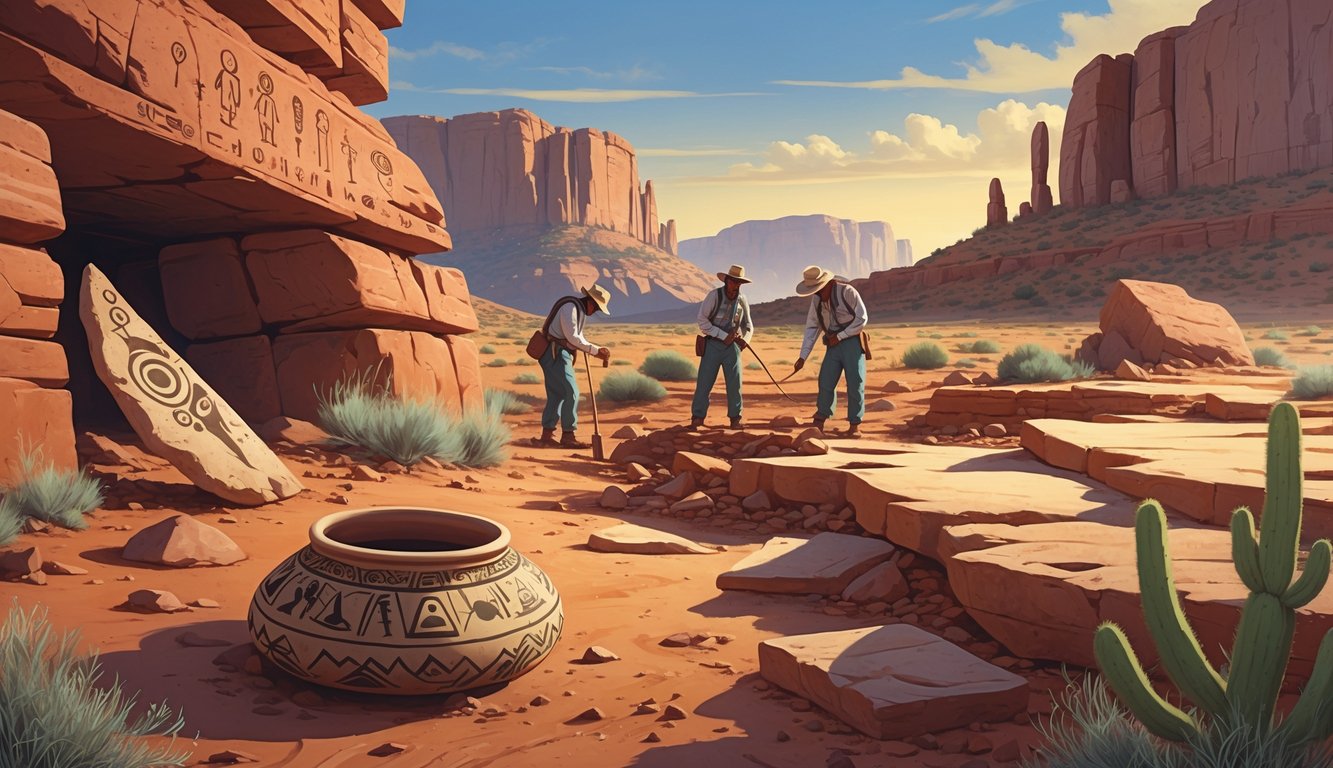
New Mexico’s deserts and mountains have revealed ancient artifacts, rare gold coins, and clues about early cultures in the American Southwest. These discoveries shape our knowledge of the state’s history and continue to spark new questions.
Unearthed Gold Coins and Relics
Many stories in New Mexico talk about hidden treasures and unearthed riches. Some explorers and hobbyists have actually found real gold coins left behind by Spanish explorers or outlaws from the 1800s.
These coins were often buried or lost near old trails and settlements. In addition to coins, archaeologists have uncovered pottery, tools, jewelry, and even ancient footprints.
At sites like Blue J, researchers found the remains of a Puebloan village that is over 1,000 years old. These finds include ceramic bowls, tools made from stone, and decorative items.
Most artifacts are now preserved in museums or studied by experts. Lists of treasures, like those in New Mexico’s canyons and deserts, show that lost fortunes and mysterious relics are still being hunted today.
Impact on New Mexico History
Each new artifact tells a small part of New Mexico’s long history.
Gold coins, for example, show that Spanish colonists and explorers traveled through these lands. Sometimes, they left their wealth behind.
Finding coins or jewelry shows that trade and migration happened before written records.
Archaeological discoveries can change what people believed about early life in New Mexico.
Evidence from ancient settlements, such as tools or pottery, shows that people lived here for over 12,000 years.
These findings help historians understand how ancient cultures survived the desert.
Major discoveries, like the 1,000-year-old Blue J village, show how Puebloan people built homes and gathered in communities.
Artifacts found here give more insight into daily life than old history books.
With every dig, historians uncover more of New Mexico’s hidden past.