
Laos is a country full of ancient sites and fascinating secrets. Travelers and historians find its stone monuments and hidden landscapes intriguing.
Among its biggest mysteries are relics whose true purposes remain unknown. From giant stone jars scattered across valleys to tales shrouded in myth, Laos offers puzzles that remain unsolved even today.

The most famous of these is the Plain of Jars. Thousands of massive stone jars rest across the Xieng Khouang Plateau.
These jars, carved from solid rock and some weighing up to 30 tons, have left experts guessing why they were created and who placed them there. Despite years of research, archaeologists still debate their original use.
Many travelers visit Laos not just for its natural beauty but also to explore these captivating mysteries. The country holds more questions than answers.
The Enigma of the Plain of Jars
The Plain of Jars in northern Laos is famous for its thousands of ancient stone jars. Their origin, purpose, and age still fascinate travelers and archaeologists.
Discovery of the Megalithic Stone Jars
French researchers first studied the Plain of Jars in the 1930s. They found massive, hollow jars made of stone, spread across the fields near Phonsovan.
Most jars are between 1 and 3 meters tall and can weigh several tons. Local legends connect these jars to ancient giants who used them to brew rice wine.
Early explorers found remains such as beads, tools, and bones close to many jars. These finds suggest the jars may have been part of old burial sites.
Today, researchers estimate the site is over 2,000 years old. Research into its history continues.
The jars are made mainly from sandstone, but some were carved out of granite and limestone. Their size and number make the Plain of Jars one of Southeast Asia’s most noticeable archaeological sites.
Visitors can see jar fields stretching across the Xieng Khouang plateau.
Archaeologists’ Theories
Archaeologists have proposed various ideas to explain the purpose of the stone jars. The leading theory is that people used them for funerary practices.
Remains like teeth, bones, and burned ash have been found in and around the jars. This evidence points to their use in burial rituals.
Some researchers believe that bodies were placed inside the jars before being moved to a final resting place. Others think the jars stored ancient food or water, but little evidence supports these ideas.
One theory suggests the jars marked travel routes or acted as symbols for nearby villages. However, the jars’ size and scattered placement make this less likely.
Recent finds support the idea that the jars were tied to burial and religious practices.
Extent and Diversity of Jar Sites
The Plain of Jars includes more than 3,000 massive stone jars spread over nearly 100 separate sites. Some of the largest fields, like Site 1, are easily accessible from Phonsovan.
Others are hidden in remote areas. The jars can be found alone, in small groups, or placed in large clusters.
Most jars are round or oval, but their shapes, sizes, and materials vary. Some jars are covered with statues or stone lids, but many have lost these features over time.
The largest jars can weigh up to 30 tons and reach over 3 meters tall. These archaeological sites span hundreds of square kilometers.
Only a few of the sites are cleared of unexploded bombs from past wars, so exploration is limited. Yet the fields still attract visitors and researchers.
Theories on the Ritual Significance of the Stone Jars

Researchers have long debated the meaning behind the massive stone jars in Laos. Theories focus on burial customs, cremation practices, and their possible use as containers for human remains.
Funerary Practices and Cremation
Many archaeologists believe the jars played a major role in ancient funerary rites. Evidence found at several jar sites includes human remains, burial goods, and ash, which suggests cremation was part of the ritual.
Some jars are found near burial pits or tombs. This has led experts to think the jars could have been used in the first stage of a process, where bodies decomposed in jars before being moved to another burial spot.
Excavations at the Plain of Jars revealed tools, beads, and burnt materials. This supports the view that ancient people performed funerary rituals in the area.
For more findings, see Plain of Jars’ funerary practices and cremation theories.
Potential Use as Funerary Urns
A key theory suggests that the jars served as funerary urns. These large vessels might have held the ashes or bones of the deceased after cremation.
The jars’ size—many are over two meters high—means they could easily serve as containers for remains. Some jars even have stone lids, though most are now missing.
The presence of lids fits the idea that the jars were sealed to protect the remains inside. The sheer number of jars and their spread across many sites imply that the urn theory might have been important in social or ritual activities.
Details can be found in discoveries on the Plain of Jars’ ritual urn usage.
Iron Age Burial Customs
The Iron Age is thought to be the period when the jars were carved. Researchers link the jars to iron tools, pottery, and beads found at the sites, all dating back to the Iron Age.
Burial customs during this era involved both cremation and secondary burials, where bones were moved after the body decomposed. The jars fit well within these practices.
Similar customs have been observed in other Iron Age cultures in Asia. Archaeologists believe this connection highlights the importance of ritual significance in the community.
The jars likely played a role in honoring the dead and maintaining traditions. To learn more about how the jars relate to Iron Age burial customs in Laos, visit this article.
Human Remains and Burial Mysteries
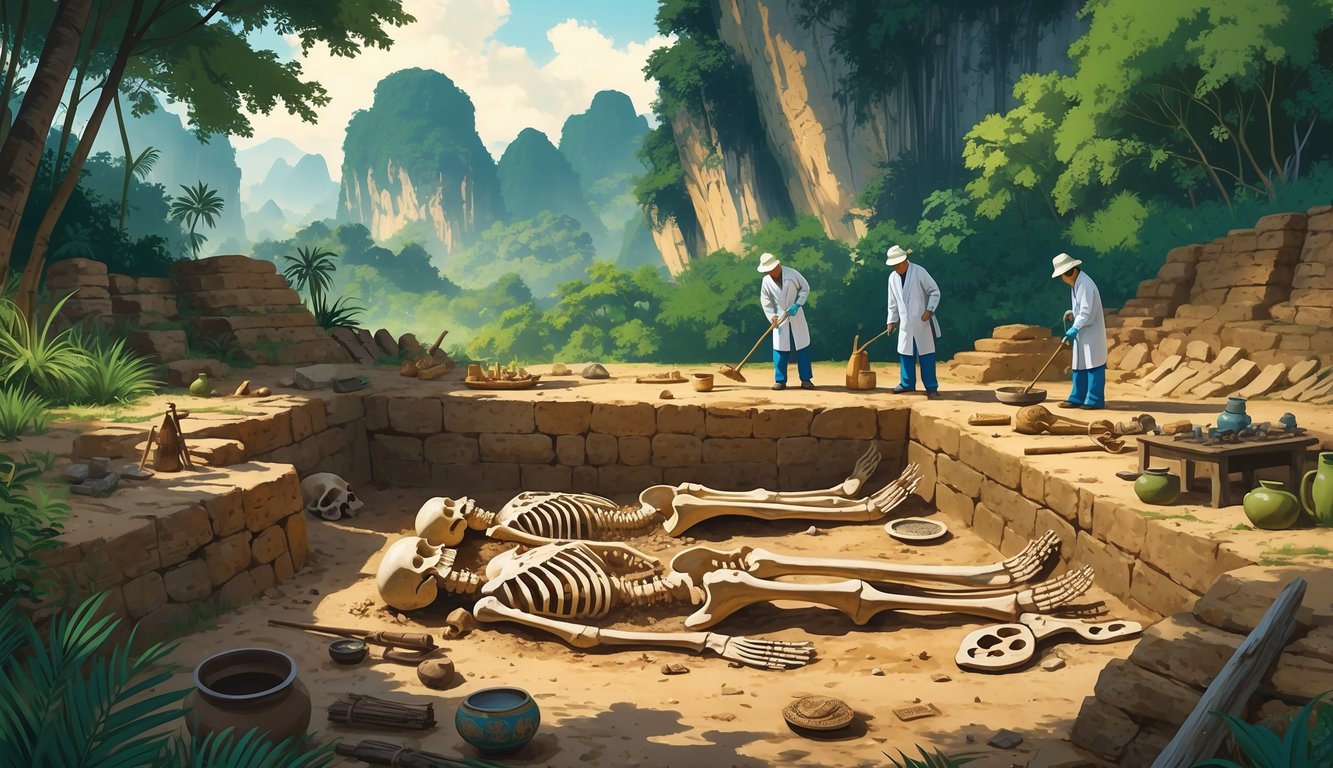
Archaeologists working at the Plain of Jars in Laos have uncovered a wide range of human remains and artifacts. The ways these remains were buried give important clues about the lives and beliefs of ancient Laotians.
Findings of Human Remains
Excavations at the Plain of Jars revealed human bones, teeth, and ashes both inside the stone jars and in the ground nearby. Many jars held burnt bones, suggesting cremation rituals were practiced.
Some burial sites around the jars also had iron tools, ceramic beads, and bronze objects. Researchers discovered terracotta urns and stone discs marking these graves.
These items likely played a role in ancient ceremonies, but experts still debate their full meaning and use. Clusters of jars and graves are spread across different sites.
Items left with the remains help indicate social and cultural differences among the ancient people of the Xiangkhoang Plateau. More details about these discoveries can be found in the article on ancient mortuary vessels and cemeteries in Laos.
Analysis Using Optically Stimulated Luminescence (OSL)
Optically stimulated luminescence (OSL) is a scientific dating method. It lets archaeologists estimate when the sediment around a jar or burial site was last exposed to sunlight.
This process helps experts figure out how old the stone jars and burial sites are. OSL studies show that the jars at the Plain of Jars were placed between 2,000 and 2,500 years ago.
Some burials near the jars could be much more recent. This suggests the area was used for ceremonies over a long period.
The use of OSL is especially important in Laos because written records are rare. This technology provides reliable dates and helps researchers establish timelines for jar placement, burials, and changes in local culture.
More on OSL and dating of the jars is discussed in this report on the true age of the objects in the Plain of Jars.
Insights into Ancient Laotian Societies
Findings at the Plain of Jars give a rare view into how ancient Laotians treated death. The mix of cremation, jar burials, and grave goods suggests that rituals were complex and possibly changed over time.
Researchers believe these practices may show strong social ties and spiritual beliefs. The placement of valuable objects with the dead hints at beliefs in an afterlife or a wish to respect ancestors.
Although the exact group who built the Plain of Jars is still unknown, these discoveries help reveal that Laos was home to an advanced society with unique burial customs. Ongoing research by archaeologists continues to shed light on how these mysteries fit into the larger history of Southeast Asia.
Other Mysterious Megalithic Sites in Laos
Laos is home to several unique megalithic sites that puzzle archaeologists and history lovers. These ancient places offer a glimpse into how early Southeast Asian societies might have lived and honored the dead.
Little-Known Archaeological Sites
Beyond the famous Plain of Jars, Laos has other hidden megalithic sites scattered across the countryside. Some of these locations feature clusters of stone jars or large rocks arranged in mysterious patterns.
The number and size of these rocks differ from site to site, but many are found in remote mountainous areas. Archaeologists have not fully explored or documented many of these places.
Locals sometimes know of these sites, but tourists rarely visit them. Many of the jars and stones weigh several tons and are carved from single pieces of rock, showing impressive skill for ancient times.
Most experts agree that these sites are linked to ancient burial and ceremonial practices. Many objects have been dated back as far as 1240 BCE.
Some jars even have traces of human remains or belongings inside, providing clues about how early Laotians honored life and death. For more, see this overview of the Plain of Giant Jars.
Comparison to Other Southeast Asian Megaliths
Laos is not the only country in Southeast Asia with mysterious megalithic sites. In Indonesia and Vietnam, people have discovered similar stone structures, though they often take different forms, such as stone tombs or carved pillars.
The Laos jars stand out because of their size and hollow shapes. Indonesian sites like Gunung Padang feature stepped pyramids and rounded stones.
Vietnamese megaliths are often used as grave markers or stone coffins instead of large jars. The purpose of these structures sometimes overlaps, with many built for burials or spiritual rituals.
Experts note that carving and moving these stones required significant effort and teamwork. These similarities show that ancient peoples across Southeast Asia shared some stone-working knowledge, but each culture made unique choices in their designs and traditions.
Unexploded Bombs and Their Impact on Archaeology
Unexploded bombs scattered across Laos create serious problems for archaeology and daily life. These hidden dangers affect where archaeologists can work and impact people living in these regions.
Legacy of Past Conflicts
During the Vietnam War, the Plain of Jars and other areas in Laos were heavily bombed. The United States dropped millions of bombs here from 1964 to 1973.
More bombs fell on this region than in the whole of World War II. A large number did not explode on impact.
Experts estimate about 80 million unexploded bombs remain buried in places like Xiangkhouang province. These explosives continue to harm the countryside decades after the war ended.
Vast stretches of land remain unused or unsafe because of the uncertain threat. Bomb craters are still visible and serve as reminders of the conflict.
Laotians live with this dangerous heritage. The plain is now one of the most heavily bombed places on Earth, which puts both people and land at risk.
Farming, building, and exploring the area are all limited due to explosive hazards.
Danger to Researchers and Locals
Unexploded bombs pose a risk to farmers, children, and archaeologists studying historical sites. The Plain of Jars is famous for its ancient stone jars, but many parts remain unstudied because they are too dangerous to access.
Since the war, hundreds of Laotians die or get injured every year from hidden bombs. Land mines and other military ordnance remain scattered over the landscape, making fieldwork risky and slow.
Clearing the land takes time and money, slowing down both archaeology and normal activities. Archaeological surveys require special teams to clear unexploded bombs before research starts.
This extra step makes studying ancient mysteries more expensive and dangerous. Bomb disposal teams must regularly check fields, roads, and villages to protect both locals and visitors.
This ongoing threat means that many secrets in places like the Plain of Jars are still waiting to be discovered.
Chronological Puzzles and the Role of OSL Dating

Archaeologists use different methods to learn when ancient sites in Laos were created. One important tool is optically stimulated luminescence (OSL) dating, which helps estimate the last time sand or minerals were exposed to sunlight or heat.
Dating the Jars and Sites
The Plain of Jars in Laos is famous for its thousands of stone jars. Figuring out their true age is difficult.
Researchers try to date these jar sites to understand when people used them. OSL dating is often used because traditional carbon dating does not work well on stone.
With OSL, scientists measure the light released from minerals found around or under the jars. This method gives clues about when the jars were last moved or when the soil was last exposed to light.
It helps build a timeline for the archaeological sites, especially where other methods fall short.
Challenges of Accurate Chronology
OSL dating is helpful, but it has challenges. The results depend on the minerals having a clear record of sunlight exposure, which is not always guaranteed outdoors.
If the soil is disturbed, the dates may not reflect the original time when people used the jars. Some studies have found that OSL dates from certain sites are unreliable or inconsistent with evidence from other dating methods.
Archaeologists sometimes use multiple techniques to confirm the age of these important locations. Creating an exact timeline is a puzzle that experts work hard to solve.
Theories on the Builders of the Stone Jars
Archaeologists have debated who created the massive stone jars scattered across Laos. Many believe the jars hold clues about Iron Age communities and broader cultural exchanges in Southeast Asia.
Identifying the Ancient Communities
Most experts agree that people living in the Xieng Khouang plateau during the Iron Age crafted the jars. These communities thrived between 500 BCE and 500 CE.
The jars, some weighing over 30 tons, show advanced skills in quarrying and moving stone. Evidence like tools, pottery, and burial items found near the jars suggest they belonged to local Laotian ancestors.
Some researchers believe these people used the jars for funerary practices, marking this site as a key piece of Laos’s early history. Remains found by the jars hint that the builders honored their dead with special rituals.
Cultural Connections Across Southeast Asia
Similar megalithic jar sites have been found in Northeast India and other parts of Southeast Asia. These similarities point to shared knowledge or possible contact between early regional cultures.
Artifacts from the jar sites sometimes match designs and techniques seen across the region. This suggests trading networks or migrations connected ancient societies.
The movement of ideas and technologies during the Iron Age might explain why the jars appear in different countries.
The Mystery of the Abandonment of Jar Sites
The jar sites in Laos are scattered across mountain plains and valleys. Their sudden abandonment has puzzled archaeologists for decades.
Possible Reasons for Desertion
There are several ideas about why the ancient jar sites were abandoned. One theory is that war or invasions forced the local people to leave quickly.
Evidence shows that the area has faced conflict over the ages, including raids and shifts in power. Another idea is that environmental changes, like droughts or shifting rivers, made it hard to live nearby.
Archaeologists also suggest that changes in trade or religious customs led to the jar sites being left behind. Some researchers believe the huge stone jars may have once marked burial sites or were used in ancient ceremonies.
When religious beliefs changed, people might have stopped visiting these places. The true reason remains debated, with many clues still hidden at these archaeological sites.
Impact on Local History
The stop in activity at these jar sites influenced the region. Local villages lost important cultural links to their past, with legends and stories starting to fade.
After their desertion, dense forests sometimes grew over the jars, making the sites hard to find. This helped keep them mysterious, but it also meant valuable artifacts and clues were left untouched for centuries.
Today, these abandoned sites attract researchers and visitors. They help show what life might have been like for ancient people in Laos.
Current Preservation Efforts and Future Discoveries
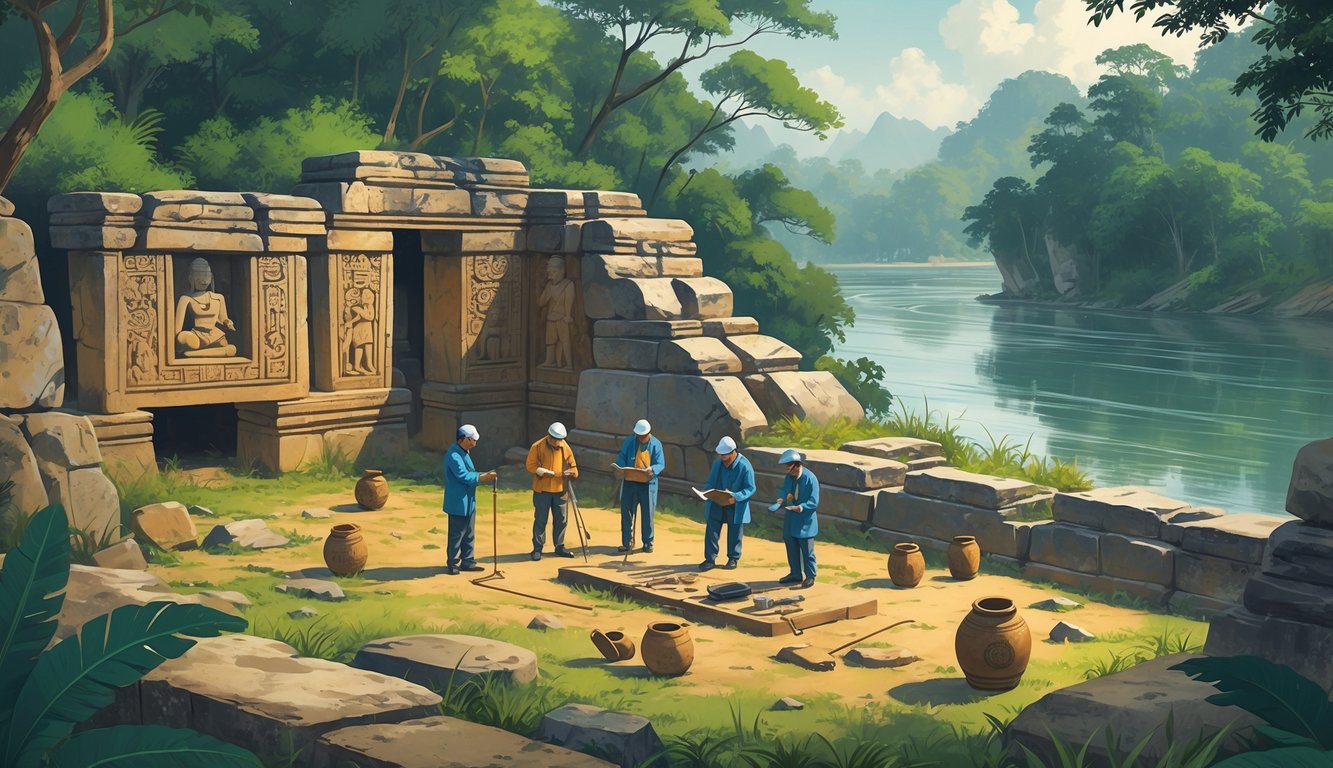
Ongoing work at the Plain of Jars combines hands-on conservation with careful research. Efforts are shaped by the area’s history and the challenges it still faces.
Conservation Initiatives
The Plain of Jars, near Phonsovan, faces threats from weather, tourism, and past wars. Unexploded bombs still lie scattered across the landscape, making some sites hard to access and dangerous.
To protect the ancient jars, teams from Laos and other countries are mapping, documenting, and clearing dangerous areas. Organizations work with locals to raise awareness about not moving or damaging the jars.
Paths, fences, and signs guide people along safe routes. Restoration experts try to keep the jars from breaking down due to wind, rain, and plants.
School programs and guided tours help teach respect for the site’s history and cultural value. These careful preservation strategies are needed to keep the area safe for people to visit and study.
Potential For New Archaeological Breakthroughs
Continued excavation at the Plain of Jars uncovers new sites, artifacts, and even human remains. Archaeologists hope these finds will explain why the jars were made, who used them, and how people lived there thousands of years ago.
Advanced tools like ground-penetrating radar and drone mapping help teams find hidden features without disturbing the land. Every new discovery adds to the region’s story.
In recent years, new sites have been mapped and older ones reassessed. These findings hint at ancient trading routes and social customs.
Work is ongoing, and teams believe many mysteries remain buried. As dangers from unexploded bombs decrease, researchers expect more breakthroughs.
With careful planning, future projects may reveal secrets that have been hidden for thousands of years.
Cultural Legacy and Living Traditions
The mysteries of the Plain of Jars and other ancient sites are deeply linked with how modern Laotians see their past. Many of these unanswered questions still shape community life, beliefs, and cultural expression in Laos today.
Modern Laotian Perspectives
Laotians living near Phonsovan and the Plain of Jars show strong interest in their history. Many are proud of these sites and view them as important symbols of their national identity.
Young people learn about the jars in school and often visit them with their families. Some communities take part in efforts to protect and study the sites, hoping to keep them safe for future generations.
Local guides in Phonsovan share stories and facts with visitors. These guides help both locals and tourists appreciate the meaning behind the ancient jars.
Discussions about their origins and purpose still spark curiosity in daily life. This promotes a sense of shared history.
Integration Into Local Folklore
Stories about the Plain of Jars blend with Lao myths and legends. Some people believe giants made the jars, while others say ancient kings used them to brew rice wine.
Elders pass down these tales at festivals, village gatherings, and family events. The stories connect the historical sites to daily traditions.
Many local festivals in Phonsovan include songs, dances, and re-enactments inspired by the ancient jars. This living folklore lets people celebrate their past and make history part of cultural events.
For more details, visit this exploration of the historical and religious sites of Laos.