Kyrgyzstan is a country filled with ancient secrets, mysterious ruins, and untold legends. Some of the biggest historical mysteries in Kyrgyzstan include unexplained ancient cities, mysterious stone carvings, and lost artifacts that continue to puzzle researchers and visitors.
These mysteries are not just about the past—they are stories that spark curiosity and invite people to discover more.
From remote mountains to old Silk Road stops, the country’s landscapes guard many clues from the past. Travelers and history lovers can explore ancient cities and archaeological sites, like UNESCO World Heritage locations, to try to solve these mysteries for themselves.
Every lost temple, crumbling fortress, and hidden relic has a story waiting to be told. Many of these historical sites may seem forgotten, but each holds hints about the people and cultures that lived in the region long ago.
The Origins of the Kyrgyz People
The Kyrgyz have a long and complex past shaped by movement across Central Asia. Historians and scientists look at ancient records, family stories, and genetic studies to learn where the Kyrgyz came from and how their unique culture formed.
Ancient Tribes and Migrations
Early Kyrgyz history goes back more than 2,000 years. Ancient Chinese sources from as early as 201 BC mention the Kyrgyz as a separate group living in the upper Yenisei River valley in what is now Siberia.
These early Kyrgyz were known for their horse riding and nomadic lifestyle. They moved with the seasons to find fresh pastures.
The Kyrgyz belonged to a larger network of nomadic tribes that traveled across the Eurasian steppe. The first Kyrgyz state, called the Kyrgyz Khanate, existed from the sixth to the thirteenth century.
At its largest, the Kyrgyz Khanate stretched from south-central Siberia to areas of present-day Kazakhstan and Kyrgyzstan. This shows the wide influence of the tribe in Central Asian history.
During their migrations, the Kyrgyz interacted and mixed with other Turkic and Mongolic peoples. Their journeys brought changes in language, customs, and appearance.
Some records describe early Kyrgyz as having fair skin, red or blond hair, and blue or green eyes, setting them apart from neighboring groups. For more details on these migrations, visit this background on the early history of the Kyrgyz and Kyrgyzstan.
Genetic and Linguistic Roots
The Kyrgyz are part of the Turkic ethnic group, which connects them to other peoples across Central Asia. Their native language, Kyrgyz, belongs to the Turkic language family.
This language group is spoken by millions and unites several nomadic tribes in the region. Genetic studies show that the Kyrgyz have roots in several ancient populations.
Many have genetic markers from Siberian, Mongolic, and other Turkic ancestors. This reflects their long history of movement and mixing with other Eurasian steppe peoples.
Culturally, the Kyrgyz kept many traditions from their nomadic past. They valued horsemanship, lived in portable homes called yurts, and passed down stories and epics like “Manas.”
Their unique mix of genes, languages, and customs makes them an important part of the history of Kyrgyzstan and Central Asia.
Enigma of Burana Tower
Burana Tower is one of Kyrgyzstan’s oldest and most mysterious monuments. Its origins, design, and ties to ancient trade still raise questions today.
Unsolved Purpose and Construction
Burana Tower stands about 25 meters tall, but experts believe it was once much higher. Builders constructed it between the 11th and 12th centuries, and it is all that remains of the ancient city of Balasagun.
The original purpose of the tower is still debated. Some say it was a minaret used to call people to prayer, while others think it may have been a watchtower or even a lighthouse for travelers across Central Asia.
The tower’s design features intricate brickwork, which is still visible despite centuries of earthquakes and weather. Historians are unsure who exactly oversaw its construction.
Many attribute the craftsmanship and style to the Karakhanid dynasty, a Muslim empire that left its mark on the region’s architecture. Fragments of ancient materials and foundations of lost buildings nearby continue to puzzle archaeologists and attract visitors interested in one of Kyrgyzstan’s most important historical sites.
Connections to the Silk Road
Burana Tower is not just a single structure. It once stood at the heart of Balasagun, a bustling city on the ancient Silk Road trade route.
Caravans moving goods between East and West often stopped at Balasagun, making the city important for commerce and culture. The location of the tower and its ruins point to Balasagun’s strategic role in connecting empires and civilizations.
Remnants found around the site include petroglyphs, ancient gravestones known as balbals, and the foundations of vanished homes and mosques. Though the Burana Tower is not yet a UNESCO World Heritage Site, many believe it deserves this status.
Its blend of Islamic architecture, Central Asian artistry, and connection to global trade make the Burana Tower a rare link to the ancient world.
Tash Rabat Caravanserai’s Hidden Secrets
Tash Rabat is a stunning stone building set deep in the mountains of Naryn, Kyrgyzstan. It is famous for its mysterious history, unique architecture, and possible ties to the ancient Silk Road.
Origins and Function
The exact origins of Tash Rabat remain a puzzle. Experts often date it to the 15th century, but some think it may be much older and connected to even earlier cultures in the region.
Many believe Tash Rabat served as a caravanserai, an inn for travelers, traders, and their animals along the Silk Road. Merchants moving silk, spices, and other goods between China and the West might have used it for shelter and safety.
The structure stands out because of its thick stone walls, small rooms, and a dome at the center. Historians still debate if Tash Rabat served only as a rest stop or if it was built for another reason, like a fortress or religious building.
Few ancient artifacts have been found onsite. This makes its original purpose harder to confirm.
Mysterious Underground Chambers
One of the strangest features of Tash Rabat is its underground rooms. Visitors have counted more than 30 chambers, some of which are partly below ground level.
Many of these chambers are connected by narrow hallways and arches. Their design is unlike most other caravanserais on the Silk Road.
Local legends claim that the underground rooms were used to hide treasure or protect people from danger, but there is no clear proof. Some researchers believe the underground area may have helped store goods or provided warmth in Kyrgyzstan’s cold winters.
The real purpose of these chambers remains unsolved, adding to the building’s mysterious reputation among travelers and historians. Learn more about Tash Rabat and its hidden wonders at this detailed guide.
The Lost Cities of Central Asia
Kyrgyzstan is home to fascinating places that reveal secrets of ancient times and lost civilizations. The country’s cities and monuments shed light on its role in Central Asian history.
Rediscovering Uzgen
Uzgen once stood as a major center along the Silk Road. It played a key part in connecting traders and travelers across Central Asia.
The city’s importance is clear in the impressive Uzgen architectural complex. This complex includes three large mausoleums from the 11th and 12th centuries.
Their brickwork and ornamentation are striking examples of medieval craftsmanship. Uzgen was part of the Fergana Valley, a region known for its fertile soil and busy markets.
Archaeologists have found the remains of old mosques, towers, and baths. These discoveries show Uzgen’s role as both a trade hub and a religious center.
Its history reflects the shifts of empires and peoples over thousands of years. To learn more about Uzbekistan’s lost sites, visit this article on the lost civilizations of Central Asia.
Key Highlights of Uzgen:
- Major stop along the Silk Road
- Home to the Uzgen architectural complex
- Rich Islamic heritage
Fabled City of Osh
The city of Osh is sometimes called “the capital of the south.” It is one of the oldest settlements in Central Asia, with more than 3,000 years of history.
Osh lies at the heart of the fertile Fergana Valley, surrounded by mountains. Sulayman Mountain stands above the city.
This UNESCO World Heritage site holds ancient shrines and petroglyphs carved into the rock. Pilgrims still visit for its spiritual value.
Throughout history, Osh has been a meeting point for cultures, languages, and faiths. Its bustling bazaar has operated since the days of the Silk Road.
The city remains known for its diverse population and historic sites. You can read about other forgotten cities of the Silk Road for more context on its significance.
The Petroglyphs and Stone Monuments
Petroglyphs and stone monuments in Kyrgyzstan give a rare window into life thousands of years ago. These ancient sites reveal drawings, symbols, and carvings that tell stories about early cultures in the region.
Saimaluu-Tash’s Rock Art
Saimaluu-Tash is a remote site high in the Tian Shan mountains. It is famous for having the largest number of petroglyphs in Central Asia.
There are nearly 90,000 rock carvings spread over basalt boulders, with many images dating back to the Bronze Age. People from different eras, including the Scythians and later nomads, created these carvings.
The images show animals like deer, goats, and wolves, as well as hunting scenes and ancient symbols. Some stones even show chariots and sun wheels.
Key details:
| Feature | Description |
|---|---|
| Location | Jalal-Abad region, 3,000 meters above sea level |
| Estimated Age | 2000 BCE and later |
| Number of Carvings | Around 90,000 |
Saimaluu-Tash is only open for a short time in summer because of snow and harsh weather. Many believe these petroglyphs are tied to rituals or beliefs about nature and ancestors.
Read more about the Saimaluu-Tash petroglyphs.
Prehistoric Monuments near Issyk-Kul
The area around Issyk-Kul Lake holds several important prehistoric monuments. Stone circles, burial mounds (called kurgans), and rocks engraved with petroglyphs dot the landscape.
Near the lake, ancient people carved pictures of animals, hunting scenes, and mysterious symbols into the rock. These carvings likely date from the Bronze Age to the early Middle Ages.
Some stones marked ceremonial or funeral sites. Many of these monuments are found at the Cholpon-Ata petroglyph site, a large open-air gallery.
Visitors at Cholpon-Ata can walk among stones decorated by local artists over thousands of years. These artifacts show how early people in Kyrgyzstan used art to tell stories and connect with their world.
Sulaiman-Too and the Mysteries of Sacred Mountains
Sulaiman-Too stands over the city of Osh and is Kyrgyzstan’s only UNESCO World Heritage Site. Its caves, trails, and carvings connect to ancient legends and daily life from past cultures.
Spiritual Significance and Legends
Sulaiman-Too has long been linked to spiritual beliefs in Central Asia. For more than a thousand years, people from across the Silk Road considered the mountain sacred.
Many came to pray, hoping for health, fertility, or good fortune. The mountain’s name comes from the biblical prophet Solomon (known locally as Sulayman), who, according to legend, visited or rested on the mountain.
This connection inspired stories blending Islamic and pre-Islamic traditions. Locals believe that touching or climbing the rock brings healing.
Today, pilgrims visit Sulaiman-Too’s shrines and caves, leaving offerings and prayers. The mountaintop mosque honors Prophet Sulayman and attracts visitors from around the region.
The blend of stories and rituals makes Sulaiman-Too a living example of spiritual history in Osh.
Archaeological Discoveries
Sulaiman-Too is important for archaeology due to its ancient rock carvings, petroglyphs, and burial sites. Some carvings are over 1,500 years old and show animals, rituals, and daily life.
These carvings help researchers learn about the people who once lived there. Inside the mountain, the Sulayman-Too Museum is carved directly into caves.
It protects thousands of artifacts, from tools and pottery to jewelry and religious objects. Each item gives clues to Kyrgyzstan’s cultural heritage.
UNESCO recognized the site for its blend of history, religion, and art. The mountain’s archaeological finds continue to reveal new secrets about past civilizations.
Kyrgyzstan’s Role in the Silk Road
Kyrgyzstan was a vital part of the ancient Silk Road. It served as a crossroads for people, goods, and ideas between Asia and Europe.
Its location shaped the development of trade, culture, and daily life, blending traditions from East and West.
Trade Routes and Cultural Exchange
Kyrgyzstan connected China to Central Asia, Persia, and beyond. Caravans moved silk, spices, and precious metals across its mountains and valleys.
Major stops in Kyrgyzstan included Osh and the Chuy Valley, known for lively markets and safe resting spots for traders. The movement of people helped spread knowledge, religions, and customs.
Kyrgyz nomads, skilled in livestock herding, traded wool, felt, and horses. This exchange encouraged new farming practices and technologies.
As traders passed between China and what is now Kazakhstan, they brought goods, art, music, and new styles of dress. Over time, Kyrgyzstan became a true meeting point for different cultures.
Influences from China and Russia
Chinese influence in Kyrgyzstan grew through trade and cultural contact. The Kyrgyz learned techniques for making paper, weaving silk, and practicing Buddhism from China.
Chinese coins, pottery, and language styles appeared in Kyrgyz lands, showing these close connections. Russian influence arrived later, especially in the 19th century.
After Kyrgyzstan became part of the Russian Empire, Russian settlers introduced new crops and built roads across key trade routes. Farming methods changed as Russians taught new ways to grow wheat and potatoes.
The Russian language and schools became part of daily life.
Today, traces of both Chinese and Russian impact can be seen in Kyrgyz culture, food, and customs.
The Impact of Empires: Mongols, Russians, and Soviets
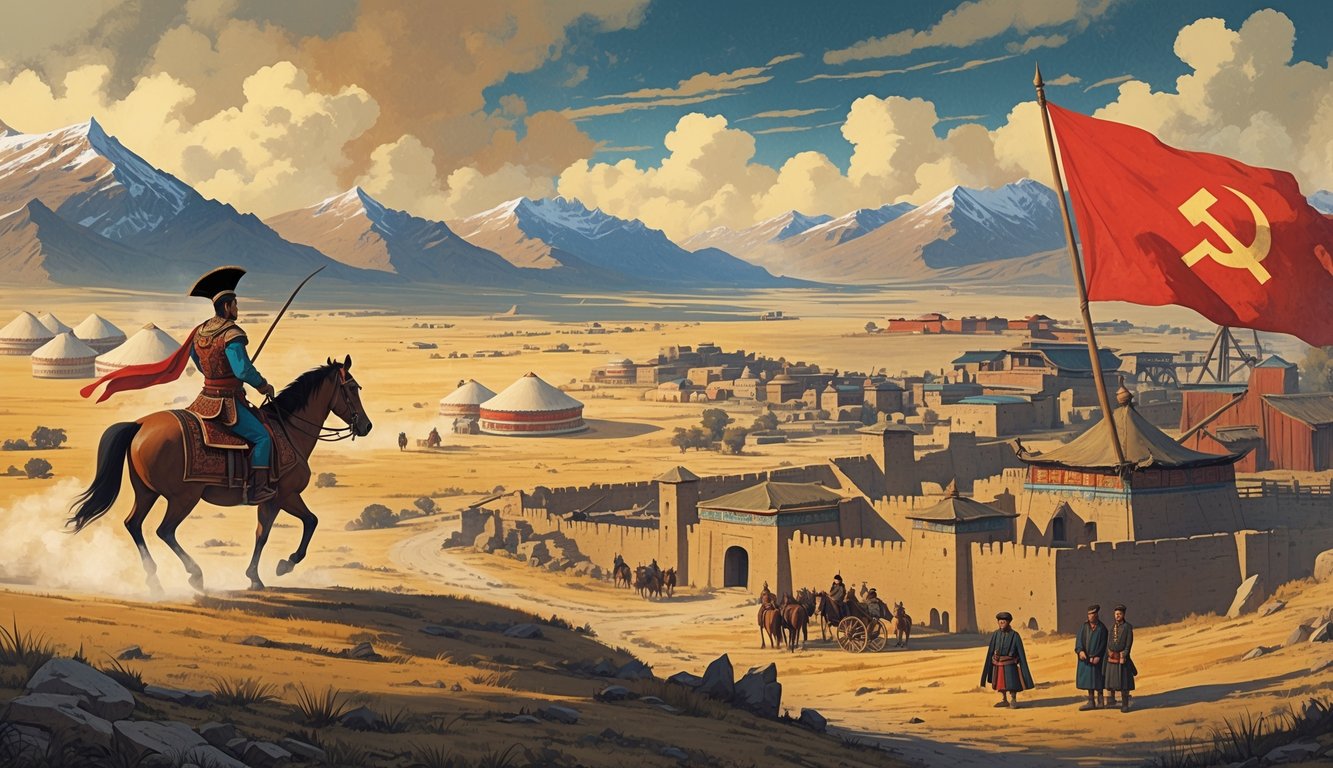
Kyrgyzstan has been shaped by powerful forces from abroad. The Mongol Empire, the Russian Empire, and the Soviet Union all left lasting marks through conquest, migration, and change.
The Mongol Empire and Genghis Khan
In the early 1200s, Genghis Khan and his Mongol armies swept across Central Asia. Local tribes, including ancestors of today’s Kyrgyz people, fell under Mongol rule.
The Mongols changed local life by imposing new leaders, taxes, and systems for communication and travel. One innovation was the yam, a network of postal stations across the region.
This network connected distant lands and made moving messages and goods much easier, as noted by GeoHistory. The Mongol control pushed many Kyrgyz tribes into the mountains, changing migration patterns for centuries.
Trade increased, and goods flowed along the Silk Road due to Mongol order. While the Mongol era ended, memories of Genghis Khan’s rule remain important in Kyrgyz history.
Russian Empire’s Expansion
By the 1800s, the Russian Empire pushed south into Kyrgyzstan. Russian generals built forts and established control over local khanates and tribal leaders.
New laws and administration reduced the power of traditional chiefs. Russian settlers built towns and farmed land, taking many grazing areas from the Kyrgyz.
This caused hardship for nomadic families. Rebellions flared up, especially in the early 1900s.
The Russian presence brought new roads, schools, and Orthodox Christian churches. Some people found new economic opportunities, while others faced discrimination and loss of land and tradition.
Soviet Power and Transformation
In 1917, the October Revolution turned the Russian Empire into the Soviet Union. Kyrgyzstan became part of the USSR soon after.
Soviet leaders forced industrialization and collectivization. Farmers had to join state-run farms, and officials often seized private livestock.
This caused food shortages and hardship for many families. The Soviets built factories, schools, and hospitals.
They promoted literacy but also tried to weaken local languages and customs. Political instability was common, as leaders were often removed or punished.
Some people saw benefits like jobs and education, but others remember losing freedom, property, and traditional ways of life.
The Puzzle of Kyrgyzstan’s National Identity
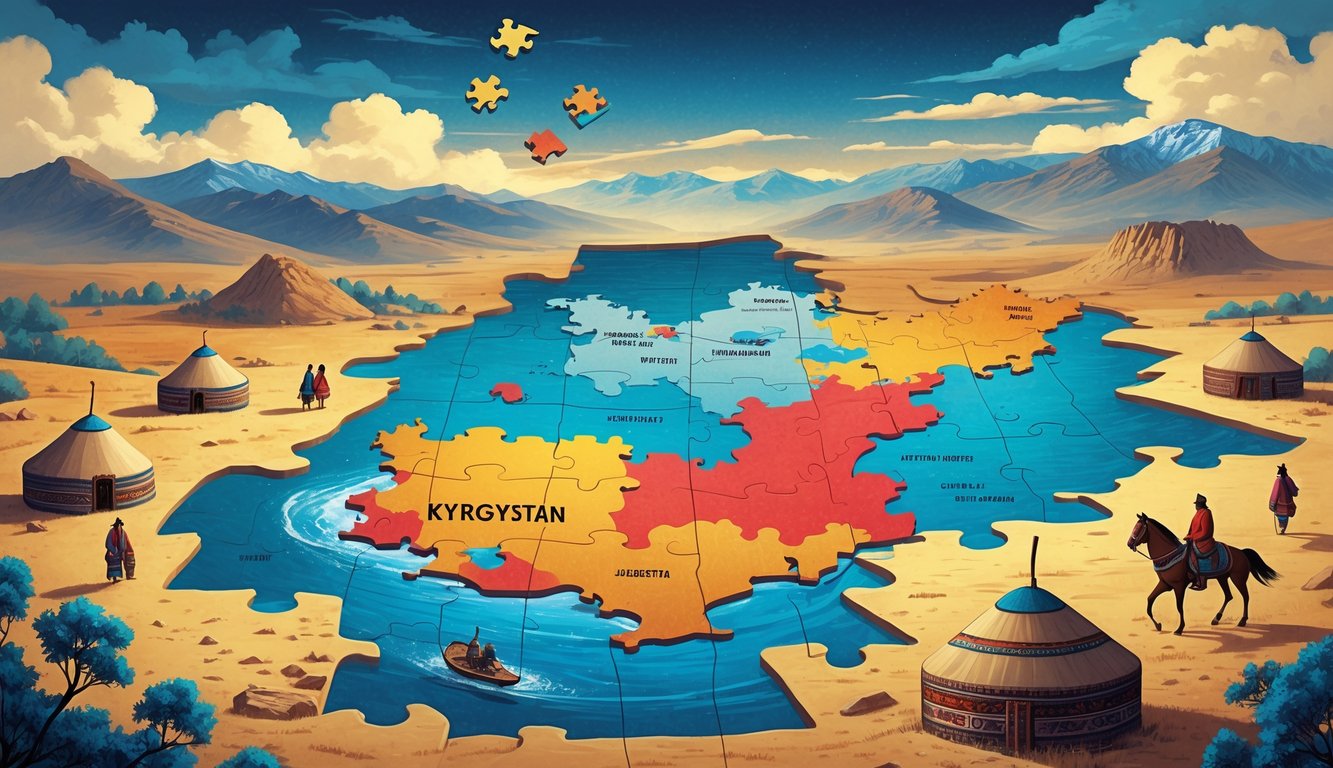
National identity in Kyrgyzstan developed in a complex way. Stories, outside influences, and changing political systems all shaped it.
Oral Tradition and Storytelling
The oral tradition is at the heart of Kyrgyz cultural identity. For centuries, epic tales like the Manas have been passed down from generation to generation.
These stories tell of ancient heroes and battles, helping people remember shared values and define what it means to be Kyrgyz. Reciting and listening to these stories is a big part of everyday life.
Even under the Soviet Union, when some traditions were discouraged, people still gathered to share the Manas and other tales. The Manas epic became a symbol of pride and unity.
Young people learn important lessons about bravery, wisdom, and respect through these stories. This keeps old traditions alive and links the past with the present.
The oral tradition remains a key part of strengthening national identity. More on these traditions is available in discussions about the Kyrgyz national narrative.
Cultural Influences and Adaptations
Kyrgyzstan’s national identity has also been shaped by a mix of cultural influences. As nomads, the Kyrgyz borrowed ideas and customs from neighboring cultures in Central Asia.
Over the years, they interacted with Persians, Turks, Russians, and Chinese, blending these elements with local traditions. The Soviet era brought more changes, introducing new language, education, and holidays.
Instead of losing their customs, many Kyrgyz adapted these influences, mixing old and new. This is seen in language, religion, and daily habits.
Religion, especially Islam, has become more important in recent years, yet it often mixes with older beliefs and ways of life. The result is a national identity that honors cultural heritage while staying open to new ideas and democratic institutions.
These ongoing changes show how Kyrgyzstan’s identity is both rooted and adaptable. Studies on the evolution of its national identity explore this further.
Religion and Spiritual Change in Kyrgyzstan
Kyrgyzstan’s religious landscape has shifted a great deal over time. The region saw major changes as new faiths arrived and mixed with long-standing beliefs shaped by its nomadic roots and past civilizations.
Arrival and Spread of Islam
Islam is now the most practiced religion in Kyrgyzstan, but it arrived many centuries ago. Traders and invaders, including Arabs and Turks, brought Islam to the area during the 8th to 12th centuries.
The religion blended with local customs, creating a unique style of Muslim practice. Even today, Islamic practices in Kyrgyzstan often mix with traditions from nomadic life.
Local holidays, family celebrations, and food reflect both Muslim and older local elements. For many Kyrgyz people, being Muslim is both a matter of belief and a part of cultural heritage.
More details are in the article on the diverse religions of Kyrgyzstan.
Survival of Ancient Beliefs and Christianity
Before Islam, the Kyrgyz people followed beliefs linked to their ancestors and the natural world, such as shamanism and animism. These older traditions did not disappear with the arrival of Islam.
Many ancient customs, like honoring spirits and nature, remain part of local culture. Christianity also has a long presence in Kyrgyzstan.
Archaeological evidence shows Christian churches existed as early as the 7th century. Although Christianity is now a minority faith, Eastern Orthodox churches and other branches play a role in community life, especially among ethnic Russians and other groups.
This mix of Islam, Christianity, and ancient traditions is a key part of Kyrgyzstan’s cultural heritage. Learn more about religious beliefs in Kyrgyzstan and how they shape daily life.
Modern Mysteries: Independence, Change, and Continuity
Kyrgyzstan changed a lot after the Soviet Union collapsed. The country built new institutions and chose a currency.
Leaders in Bishkek declared independence from the Soviet Union on August 31, 1991. This marked a turning point in the country’s history.
People filled the streets with hope and questions about the future. After independence, Kyrgyzstan introduced its own currency, the som.
They created new laws and set up local governments. Many families still depended on agriculture.
Different groups had their own ideas about independence. Some wanted to keep close ties with Russia, while others hoped Kyrgyzstan would move in a new direction.
Challenges of Nation-Building
Once independent, Kyrgyzstan faced many challenges. Building democratic institutions from the ground up was not easy.
People often debated the fairness of elections in the early years. The capital city Bishkek became the center for political change.
Officials tried to improve schools, roads, and hospitals. Infrastructure projects took time and money.
Corruption caused problems for both leaders and regular people. Kyrgyzstan’s economy grew slowly.
Agriculture stayed important. Many young people moved to cities or went abroad for work.
The government tried to balance modernizing with keeping old traditions alive. This balancing act led to ongoing debates.