Hungary is a country full of fascinating stories and unanswered questions. Its history stretches back over a thousand years, blending legends, wars, royalty, and mysterious events.
Some of the biggest historical mysteries in Hungary include the Tomb of Attila the Hun, the identity of Anonymus the royal chronicler, and the strange death of Miklós Zrínyi.
People are still curious about unexplained disappearances and baffling secrets like the mysterious fate of Brigitta Árvai. The real story behind Saint Emeric’s early death also captures attention.
These mysteries have puzzled historians and locals. They continue to spark discussions and rumors today.
The Disappearance of Sándor Petőfi
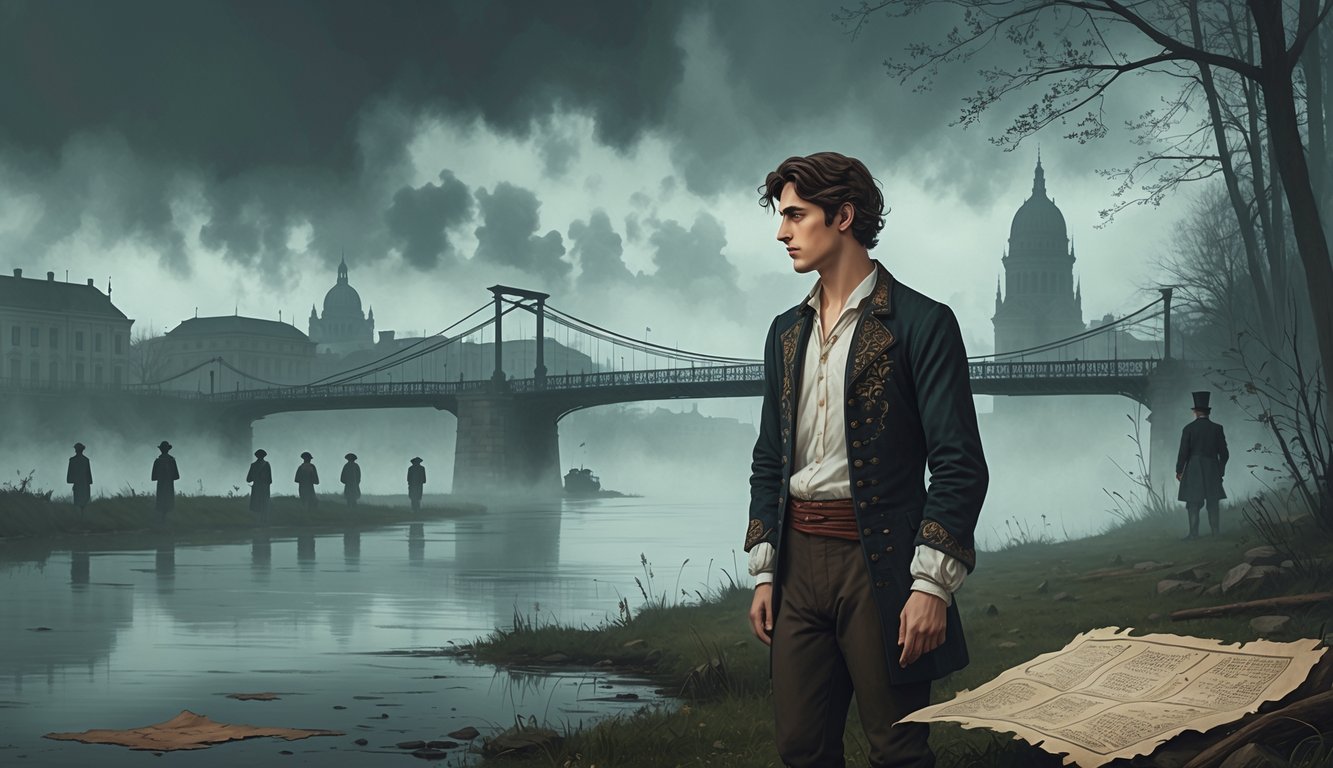
Sándor Petőfi is one of Hungary’s most loved poets. He played a leading role in the Hungarian Revolution of 1848-1849.
His mysterious vanishing during a crucial battle has sparked debate and legends for over a century.
The Battle of Segesvár
People last saw Petőfi on July 31, 1849, at the Battle of Segesvár in present-day Transylvania. The Hungarian revolutionary forces, led by Polish general Józef Bem, faced much larger Russian troops sent to crush the revolution.
Petőfi fought alongside his fellow revolutionaries during the chaotic confrontation. Reports say he refused to leave the battlefield, even when retreat became the only option.
Eyewitnesses described the panic as the Hungarian line broke and soldiers scattered. Amid the confusion, Petőfi disappeared and never returned to his comrades.
His horse was later found without a rider, fueling rumors about his fate. More details about Petőfi’s last moments can be found here.
Petőfi’s Alleged Fate
Many believed that Petőfi died during the battle, possibly at the hands of Russian soldiers. The absence of a body and conflicting reports led to countless theories and legends.
Some rumors claimed he was captured and taken to Siberia as a prisoner. Others thought he might have escaped and lived under another name.
Several supposed witnesses later claimed to have seen him alive after the battle.
Modern Search Efforts
In recent decades, historians and archaeologists have searched for evidence about Petőfi’s fate. Some teams excavated the battlefield in Transylvania, looking for remains or clues.
Others traveled to Russia and Siberia to explore rumors of Hungarian prisoners sent east. Scientific efforts, such as DNA testing on discovered remains, have not led to confirmation.
Despite advances in research, Petőfi’s disappearance continues to fascinate the public. New theories still appear, but the real story remains unknown.
For more on the legends and ongoing search, visit this article.
Attila the Hun’s Final Resting Place
Attila the Hun, known for his fearsome leadership and vast empire, left behind one of Hungary’s greatest unsolved mysteries. No one has found his grave, and legends about its location are a big part of the country’s history.
Attila in the Carpathian Basin
Attila led the Huns in the 5th century. He claimed a large part of Europe, including the Carpathian Basin.
Many believe he set up his main headquarters in what is now Hungary. The area’s open plains suited the Huns’ horseback lifestyle.
Historical accounts, such as those by the Roman diplomat Priscus, mention Attila’s palace near rivers like the Tisza and Danube. These rivers flow through Hungary.
Attila’s deep connection to this land grew over time. Many places in modern Hungary still carry his name.
Burial Legends
There are several legends about Attila’s burial. Old stories say Attila died suddenly, and his men buried him in secret to keep his body safe from enemies.
One famous tale says Attila was buried in a triple coffin: one of gold, one of silver, and one of iron. His soldiers supposedly diverted a river, built his tomb under the riverbed, and let the water flow back over it to hide the spot.
Afterward, the workers were killed so the location could never be revealed. These dramatic stories remain popular today, but people have never proven them.
Modern Archaeological Theories
Modern archaeologists and historians have searched many places across Hungary for Attila’s tomb. So far, no one has found solid evidence of its location.
Some believe it could be between the Tisza and Danube rivers in eastern Hungary, where Attila’s palace may have once stood according to archaeological theories.
Archaeologists use ancient texts, river maps, and local legends to guide their searches. Despite using ground-penetrating radar and satellite images, the real burial site remains undiscovered.
The Lost Relics of King Stephen I
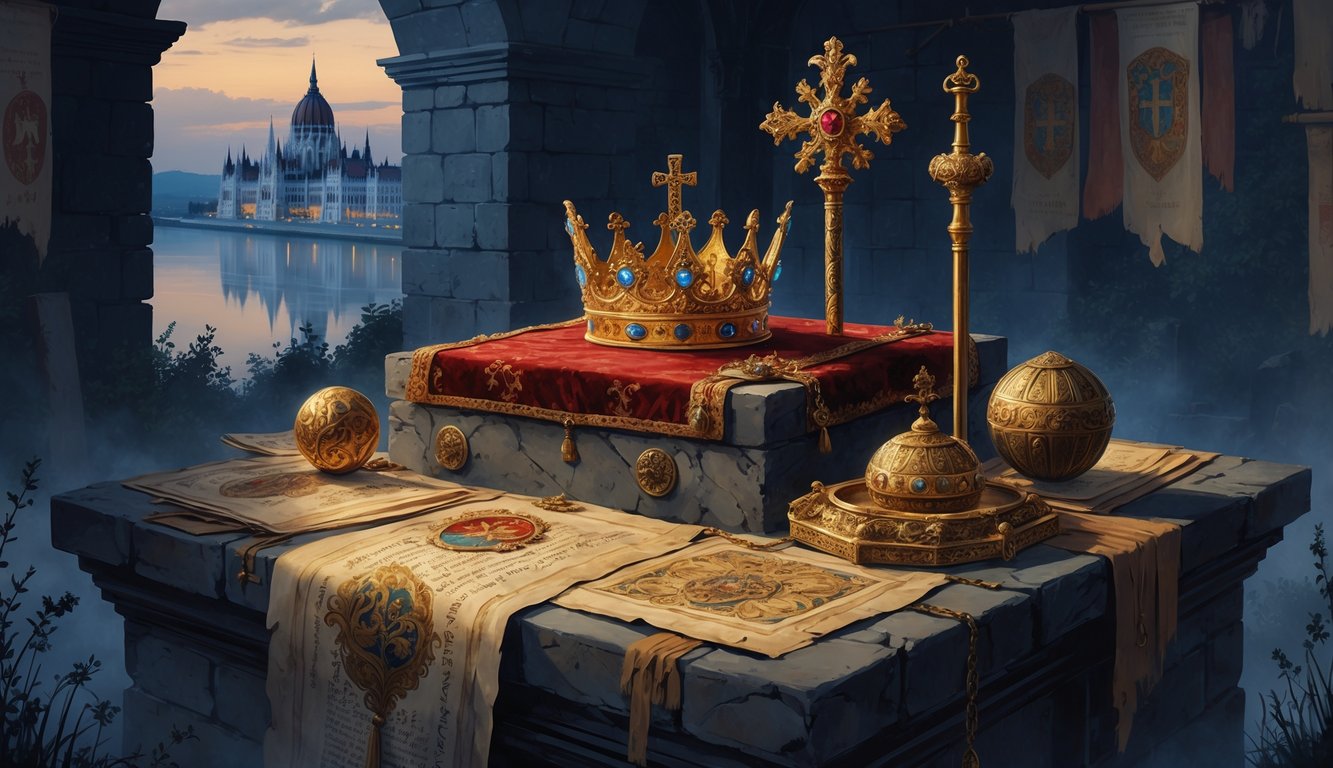
The story of King Stephen I’s lost relics is full of tradition, secrets, and national pride. Many Hungarians honor King Stephen I as the founder of the Kingdom of Hungary.
The fate of his sacred relics fascinates historians and everyday people alike.
The Right Hand Mystery
One of the most famous relics is the mummified right hand of King Stephen I. People call it the “Holy Right,” and it symbolizes the king’s power and leadership.
During his canonization in 1083, they opened his tomb and found the hand well-preserved. Over time, the Holy Right became a cherished object in Hungarian history.
Its journey has been anything but simple. The hand was hidden, stolen, and moved across different regions as political and religious changes swept through Hungary.
Those who guarded it believed the relic carried blessings and the fate of the kingdom. During times of war and upheaval, the Holy Right vanished several times.
Each disappearance led to rumors and legends about its true whereabouts. Today, the relic is protected in a special chapel in Budapest, but the details about its travels and survival still puzzle experts.
Learn more about the troubled history of the Holy Right.
Sanctity and Symbolism
For many Catholics and Hungarians, the relic of King Stephen I has unique meaning. It represents faith, nationhood, and a direct link to Hungary’s first king.
Each year, people display it during major celebrations, especially on August 20th, which marks the founding of the Kingdom of Hungary. The “Holy Right” is Hungary’s most sacred relic.
It has its own gilded reliquary and is displayed with great ceremony. This shows how King Stephen’s legacy is tied closely to the Christian identity of the nation.
Legends describe miraculous qualities, such as its “incorruptible” state. These ideas strengthened King Stephen’s reputation as a saint and protector of Hungary.
More details can be found about King Saint Stephen’s cherished relic.
Relic Disappearances
Throughout history, religious relics in the Kingdom of Hungary often disappeared or were relocated in times of conflict. King Stephen I’s right hand is not the only relic with a mysterious past.
Lists from historical archives show frequent moves and losses:
- The hand was reportedly hidden to protect it from Ottoman invasion.
- During the 18th century, it changed locations between churches and castles.
- At times, relics were even smuggled abroad for safekeeping.
Not every disappearance is fully explained. In modern times, careful records keep track of the relic’s location, but centuries ago, confusion and chaos during wars made it hard to follow.
That’s why details about where the hand went or how it was returned are still seen as one of the biggest mysteries in Hungarian history.
Enigmatic Archaeological Sites

Hungary is full of mysterious finds, puzzling symbols, and ancient ruins that spark curiosity. Many artifacts, carvings, and old monuments continue to raise questions that researchers still try to answer.
The Jászberény Treasure
The town of Jászberény is known for one of the most important Iron Age treasures in Hungary. This collection includes decorated gold and silver items, weapons, and jewelry.
Many of the objects show unique patterns not found elsewhere. Archaeologists study the Jászberény Treasure to learn about the culture, wealth, and daily life of the people who once lived on the Great Hungarian Plain.
However, no one knows the exact reason the treasure was buried. Some say the items were hidden to protect them during wars, while others believe they were meant as offerings.
What makes the Jászberény Treasure even more fascinating is how carefully the items were arranged in the hiding spot. The people who placed them there might have followed rituals or traditions that have since been lost.
Key Features of the Jászberény Treasure:
| Item Type | Material | Estimated Age |
|---|---|---|
| Jewelry | Gold/Silver | Iron Age |
| Weapons | Bronze/Iron | Iron Age |
| Tools | Bronze | Iron Age |
Undeciphered Inscriptions
Several sites in Hungary contain ancient writings or symbols that experts have not been able to read. These undeciphered inscriptions often appear on stone monuments, pottery, or even cave walls.
One notable example is the mysterious set of runic-like markings found near Jászberény and elsewhere on the Great Hungarian Plain. The designs show patterns, but their meaning is still unknown.
The style of the carvings suggests a link to early nomadic tribes. Some believe these marks could have marked tribal areas, family ownership, or even religious beliefs.
Without a translation, the full story behind the symbols remains hidden. This puzzle draws the attention of linguists and historians, all eager to crack the ancient code.
Prehistoric Structures
Hungary’s landscape features many prehistoric monuments. Some date as far back as the Bronze Age.
Somló Hill is a striking example. Archaeologists found hundreds of ancient metal objects there, including tools, weapons, and jewelry up to 3,400 years old.
Some structures, like earth mounds and burial sites, still puzzle scientists. They may have served as ceremonial sites, burial grounds, or early settlements.
The shape, size, and careful planning show the skill of prehistoric people. Their social organization also stands out.
Many questions remain about these sites. Who built them, and what was their purpose?
The answers lie buried in layers of soil, waiting to be discovered.
Unsolved Crimes and Mysterious Deaths
Hungary’s most famous mysteries often involve violent crimes, secret poisonings, and suspicious deaths tied to politics. These cases show how the truth can stay hidden for decades, even when investigators and historians search for answers.
Historic Murders
Hungary’s history includes several violent deaths that remain unexplained. One notable case is the unsolved 1920 murder of Béla Somogyi, a journalist who criticized the government.
His body appeared floating in the Danube, but authorities never convicted anyone.
Another unsolved killing is the 1981 murder of actress Zsuzsa Csala. The investigation did not find a clear suspect, and the case drew public attention because of her fame.
These murders remain topics of discussion in Hungary. The identities and motives of the killers are still debated.
For more details, see the list of unsolved deaths.
Cases of Poisoning
Hungary experienced a shocking wave of poisonings in the 20th century. Many women faced accusations of killing husbands or relatives.
The “Angel Makers of Nagyrév” became infamous for poisoning at least 40 people between 1914 and 1929. They used arsenic, often mixing it into food and drink.
Police had difficulty proving who committed each act because poisoning leaves few clues. Many trials ended with light sentences or acquittals due to a lack of evidence.
These poisonings created fear and mistrust in small communities. Stories of mysterious illnesses and sudden deaths lingered long after the last trials.
Political Intrigues
Political struggles in Hungary led to many mysterious deaths, especially during the communist era. Politicians and dissidents sometimes died under suspicious circumstances, often labeled as accidents or suicides.
Péter Boros became involved in several political trials. Several people linked to him died suddenly, which led to rumors of foul play.
Some suspect secret police or rival politicians played a role. Power struggles often led to cover-ups, making it hard to get clear answers.
Many of these cases remain part of debates about Hungary’s history of unsolved murders.
Ghostly Mysteries of Budapest
Budapest is famous for its Gothic architecture and cobblestone streets. Its long history has led to many ghost stories.
Local tales and strange events blend true accounts and legends. These stories capture the imagination.
Haunted Landmarks
Budapest has several landmarks with haunted reputations. Buda Castle stands over the city and is known for ghostly sightings and eerie sounds.
Many visitors report cold spots and the feeling of being watched.
The old Svábhegy neighborhood is also unsettling. Once full of grand residences, stories mention tragic events and spirits from centuries ago.
The gloomy atmosphere, especially in autumn, adds to its mysterious charm. Cemeteries like Kerepesi Cemetery attract those interested in haunted places.
Locals claim to see shadowy figures among the monuments at dusk. This makes it a favorite spot for ghost hunters.
To learn more, visit this list of haunted places in Budapest.
Urban Legends
Urban legends add another layer to Budapest’s ghost stories. Many old tales have been passed down through families.
These stories often involve lost treasures, secret tunnels, or mysterious figures wandering at night.
One popular legend is about the phantom of the Opera in Budapest. Some believe a ghost haunts the old opera house, moving stage props or creating chills among late-night staff.
Another tale speaks of a “crying woman” seen along cobblestone lanes. Her story remains unsolved.
Locals share these legends during tours or autumn festivals, keeping the tradition alive. Some stories have roots in real events, but many have changed over time.
Budapest’s Unexplained Events
Not all of Budapest’s mysteries come from ancient times. Some strange events have happened recently.
For example, there have been sudden and unexplained disappearances in the city. These cases remain open for police and locals.
In 1997, the city faced the shocking murder of Attila Moczó. The case was never fully explained and is still discussed today.
People whisper about secret motives and hidden evidence. These stories fuel Budapest’s sense of mystery.
Across the city, people sometimes report sudden blackouts, odd lights in the sky, or strange noises, especially near old Gothic buildings. These events add to the city’s secrets.
Ancient Peoples and Lost Cultures
Hungary’s early history saw many different groups settle, merge, and sometimes disappear. Traces of the Huns, Bulgars, and other cultures still puzzle archaeologists and historians.
The Origins of Hungarians
The origins of the Hungarians, or Magyars, remain a debated topic. Their language belongs to the Ugric branch, but many details about their early past are unclear.
Evidence suggests they became distinct around 800 BC. Scholars agree the Hungarians entered the Carpathian Basin near the end of the 9th century.
The path they took and the cultures they met remain mysterious. Written records from the Kingdom of Hungary appeared much later and often do not match archaeological findings.
Artifacts from places like Somló Hill show that earlier people in the region had different customs and technology. These finds create a puzzle for anyone trying to connect ancient and modern Hungarian prehistory.
The Bulgars’ Influence
The Bulgars, a Turkic people, moved through the Carpathian Basin before the Hungarians. They were active during the early Middle Ages and mixed with other groups, such as the Huns and local Slavs.
Archaeological sites sometimes reveal Bulgar burials, weapons, and homes. Their exact impact on Hungarian language and culture is hard to measure.
Some researchers believe the Bulgars influenced how people in the region organized their society. This may include parts of the future Kingdom of Hungary.
The Bulgars did not create a lasting state in the region. They blended into local populations or moved further south.
Migration Myths
Hungary’s history is full of legends about migrations and great journeys. Stories of the Huns led by Attila became part of national identity, but most historians now see them as myths.
These migration tales often mix fact and fiction. Ancient chronicles, oral legends, and new finds such as hoards on volcanic hills in Hungary shed light on ancient settlers, but gaps remain.
Key themes include epic journeys across the Eurasian steppes, lost tribes, and encounters with other groups like the Bulgars. These stories and discoveries keep curiosity about Hungary’s real past alive.
Historical Mysteries of War and Power

Wars and dynasties shaped Hungary in the 20th century and earlier. Shifting alliances, missing artifacts, secret deals, and old royal ties still raise questions for historians.
World War II Secrets
Hungary was caught between powerful nations during World War II. Under Regent Miklós Horthy, the country first sided with Germany.
By 1944, Horthy tried to negotiate with the Allies. Unanswered questions remain about Hungary’s gold reserves and lost treasure from this period.
Rumors say gold and valuable art were hidden or transported out of Hungary during chaotic retreats. Historians still search for missing archives about war crimes and secret negotiations.
Many Jewish Hungarians were deported during the war. Some survivors believe that lists of valuables taken from families are still hidden by the authorities of the era.
These mysteries keep researchers searching for documents lost during the Soviet advance. For more, see this detailed exploration of unsolved Hungarian mysteries.
The Habsburg Legacy
The Habsburgs ruled Hungary for centuries. Their dynasty’s impact goes beyond politics.
Old secrets from the royal family’s archives remain sealed. Some believe these archives hold letters, treaties, or plans that could reveal new details about Hungary’s history.
Debates continue over lost royal jewels and artwork. Some items vanished during the fall of the Austro-Hungarian Empire, while others were allegedly hidden by royal loyalists before World War I.
Personal diaries of Habsburg rulers and nobles may contain hints about their political struggles with Hungarian leaders. These writings could offer details on uprisings and power shifts.
Many documents remain out of reach for historians. The Habsburg era still presents a puzzle.
Literature and Lost Works

Hungarian history is full of literary secrets, lost writings, and authors whose stories faded over time. Some of the most intriguing mysteries involve vanished manuscripts and forgotten creators.
Missing Manuscripts
Many old Hungarian texts have vanished because of war, misplacement, or neglect. One well-known example is the Gesta Hungarorum, a medieval chronicle describing Hungary’s early days.
Only one mysterious version survived, but historians believe earlier or longer drafts once existed. Their fate is unknown.
Another lost treasure is the Chronicon Pictum, a richly illustrated record of Hungarian history. While one version survives, other copies and notes disappeared during the Ottoman invasions.
Key points:
- Gesta Hungarorum: Only one copy has been found
- Wars and fire destroyed many medieval texts
- Some ancient libraries recorded in royal archives no longer exist
Forgotten Authors
Hungarian literature includes writers whose works vanished or were dismissed over time. During the Austro-Hungarian period, some poets wrote in local dialects.
Their works disappeared as the country changed rulers and languages. In some cases, censorship or political unrest prevented manuscripts from being published.
Examples of forgotten authors:
| Name | Period | Reason for Obscurity |
|---|---|---|
| László Mednyánszky | Late 1800s | Only found after death |
| Anonymous court poets | Medieval | Works lost or unsigned |
| Writers during Ottoman rule | 1500s-1600s | Manuscripts destroyed |
Libraries and historians search for these lost works. Sometimes, only references to names or titles survive in old letters and notes.
Mysteries from Hungarian Legends
Many mysteries in Hungarian literature come from legends passed down for centuries. Stories like the Csodaszarvas (the Wonder Stag) mix fact with myth.
Some believe written tales once explained these legends, but no complete versions remain. Folk tales were mostly shared aloud and rarely written down.
As a result, key details changed or disappeared over time. Researchers still debate the original sources of some famous Hungarian legends.
For more classic stories, many turn to important Hungarian novels and legends that reflect Hungary’s history and imagination.
Hungarian Mysteries and Global Enigmas
Hungary’s unsolved cases often appear in discussions about famous mysteries worldwide. Important similarities and unique differences appear when comparing Hungarian enigmas to global wonders.
Comparisons with Nazca Lines
The Nazca Lines in Peru are giant drawings in the desert, visible only from the air. Some Hungarian researchers have searched for similar ancient symbols or patterns in the Magyar landscape.
Aerial surveys over the Great Hungarian Plain have sparked discussions about possible land markings. None match the scale or clarity of the Nazca Lines.
Hungary has a rich tradition of folk art and motifs, mostly in textiles and carvings. The countryside has ancient earth mounds and fortifications, thought to be burial sites or defensive structures from the Roman Empire and earlier.
Unlike the Nazca, who used their lines for rituals or calendars, Hungarian earthworks served practical or ceremonial purposes. No evidence points to giant pictograms in Hungary.
Piri Reis Map Connections
The Piri Reis map is a famous 16th-century world map drawn by an Ottoman admiral. Some believe it shows lands unknown at the time.
A few theories try to link Hungarian mysteries to the Piri Reis map, since the Ottoman Empire controlled parts of Hungary during Piri Reis’s life. Researchers in Hungary have examined the map, checking if any unexplained features might represent Hungarian or nearby Central European lands.
No solid proof ties the map to Hungarian mysteries. The period does connect Hungary and the wider Ottoman world.
The study of old maps in Hungary focuses on routes taken by explorers and armies. The Piri Reis map remains mysterious for its own reasons, but no strong link to any specific Hungarian mystery exists.
The Antikythera Mechanism Debate
The Antikythera Mechanism is a complex, ancient device found off the Greek coast. It is often called the world’s first analog computer.
Some historians have searched for similar technological surprises in Hungary, especially from the Roman Empire era. The Romans controlled the region for centuries.
No device like the Antikythera Mechanism has been found in Hungary. Roman artifacts discovered in places like Aquincum (modern Budapest) show skillful metalwork but remain typical of Roman technology.
The Antikythera stands out as unique. Debates continue about whether the skills needed to build such a device traveled north with Roman soldiers or craft workers.
Hungary’s archaeological finds have not revealed anything close to the complexity of the Greek machine.
Other European Mysteries
Europe has many puzzling sites. Stonehenge in England was built with massive stones and surrounded by legends.
In Hungary, ancient sites like the burial mounds in the Great Plain spark local curiosity. However, these sites do not match Stonehenge’s fame or scale.
The European Union has started joint projects to study and protect old sites across Europe. These projects include sites in Hungary.
This cooperation brings more attention to Hungary’s lesser-known ancient sites. Most Hungarian mysteries, while interesting, remain local in impact compared to big names like Stonehenge.