Queen Boudica’s name still fascinates people nearly two thousand years after she led the Iceni tribe in a fierce revolt against Roman rule. Her story blends courage, tragedy, and mystery.
One of the most enduring mysteries is the fate of her rumored treasure. Historians and archaeologists think that Boudica may have hidden a hoard of gold and silver, possibly to fund her rebellion, somewhere in the British countryside.
Over the years, people have made chance finds that fuel the legend. For example, a birdwatcher in eastern England discovered a hoard of Celtic coins from the time of Boudica’s uprising.
These discoveries suggest that people hid valuable caches in haste, possibly as Roman forces approached. Each new find leads to fresh theories about where the rest of her riches might be.
Queen Boudica: The Warrior Queen
Boudica was a Celtic queen who ruled the Iceni tribe in what is now eastern England. She became known for her leadership and defiance against Roman control during the first century AD.
Her story began long before her rebellion, rooted in her heritage, marriage, and role as a tribal leader.
Origins and Early Life
Later Latin records called Boudica Boadicea. She was born into a noble Celtic family.
She likely grew up in East Anglia, an area that included parts of modern Norfolk, Suffolk, and Cambridgeshire.
The Iceni tribe valued courage, independence, and loyalty. They had a strong warrior tradition.
Roman writers described Boudica as tall, with long reddish-brown hair and a commanding presence. She would have spoken a Brythonic language, related to modern Welsh.
Her upbringing probably included training in horsemanship and tribal customs. These skills prepared her for the responsibilities of leadership.
Marriage to King Prasutagus
Boudica married King Prasutagus, ruler of the Iceni, before the Roman conquest of Britain was complete. Prasutagus formed an alliance with Rome to maintain semi-independent rule.
This arrangement let the Iceni keep their lands and leaders, but they still paid tribute to Rome.
Prasutagus became wealthy under this agreement. When he died around AD 60, he left his kingdom to his two daughters and the Roman emperor.
He hoped this would protect his family and tribe. Instead, Roman authorities ignored his will.
They annexed Iceni lands, seized property, and mistreated Boudica and her daughters. These events led to her uprising.
Role as a Celtic Queen
As queen, Boudica had political and ceremonial duties. She united the Iceni and their allies.
Celtic queens could hold significant power, especially in times of war. Boudica advised tribal councils, led negotiations, and sometimes commanded warriors in battle.
She represented the honor and independence of her people. Her authority allowed her to rally other tribes when Rome became oppressive.
Boudica earned respect by defending her people’s way of life against one of the most powerful empires in history.
For more on her life and historical context, see this account of Boudica’s leadership and rebellion.
The Iceni Tribe and Celtic Britain
The Iceni lived in what is now Norfolk, Suffolk, and parts of Cambridgeshire. They were one of several Celtic tribes in the region.
They became known for their skilled warriors, distinctive art, and independence during the early years of Roman Britain.
Society and Culture
The Iceni practiced mixed farming, raising cattle, sheep, and crops. They worked with metals to make weapons, tools, and decorative items.
Gold and silver torcs, coins, and brooches showed their wealth and craftsmanship.
Women had more influence than in many other ancient societies. Queens like Boudica could lead armies and govern.
Leadership often passed through families, but alliances between tribes helped maintain stability.
Religion played a central role. The Iceni followed Celtic polytheism and worshipped nature-linked gods and goddesses.
They used sacred groves and rivers for worship. People placed valuable offerings in these sites during rituals.
Relations with Rome
After the Roman conquest of Britain in AD 43, the Iceni cooperated with Rome. They became a client kingdom and kept some independence in exchange for loyalty and tribute.
This changed after King Prasutagus died. Rome ignored his will and annexed Iceni lands.
Roman officials seized property and mistreated the royal family. These actions caused resentment and led to the Boudican Revolt in AD 60–61.
The Iceni allied with other tribes and attacked Roman settlements. The revolt failed, but it left a lasting mark on Roman Britain’s history.
Other Celtic Tribes
The Iceni did not stand alone against Rome. The Trinovantes, based in what is now Essex, became close allies during the uprising.
They had also suffered under Roman rule and shared cultural ties with the Iceni.
Other tribes in Britain, such as the Catuvellauni and the Brigantes, responded differently to Rome. Some fought openly, while others formed alliances for trade and security.
Celtic tribes shared language, art styles, and religious beliefs, but each tribe had its own leaders and customs.
Roman Rule and Rising Tensions
When the Roman Empire arrived in Britain, it brought new laws, taxes, and military control. These changes disrupted local traditions and shifted political power.
Friction grew between native tribes and the occupying forces.
Roman Conquest of Britain
The Romans invaded Britain in 43 AD under Emperor Claudius. They wanted to expand the empire, secure resources, and strengthen trade routes.
Roman soldiers used advanced tactics and well-trained legions to defeat many Celtic tribes. They built forts, roads, and towns to secure control and move troops quickly.
Roman Britain became a province with governors appointed by Rome. Some areas accepted Roman rule, while others resisted.
Client Kingdoms and Political Alliances
Some tribes became client kingdoms instead of being conquered outright. They kept their rulers but pledged loyalty to Rome.
The Iceni, ruled by King Prasutagus, were one such kingdom. They kept some independence in exchange for peace and cooperation.
These alliances helped Rome collect tribute, influence local politics, and place troops without constant warfare.
However, these political ties were fragile. Changes in leadership or policy could turn allies into enemies.
Abuses and Injustices
When King Prasutagus died, Roman officials ignored his will. They annexed Iceni lands instead.
Romans seized property and mistreated nobles. They reportedly assaulted members of Boudica’s family.
Heavy taxation and land confiscations increased anger. Many Celtic tribes saw these abuses as proof that Roman promises were unreliable.
This mix of betrayal and humiliation fueled resentment across the region. It gave leaders like Boudica a reason to rally their people against Roman rule.
The Outbreak of Rebellion
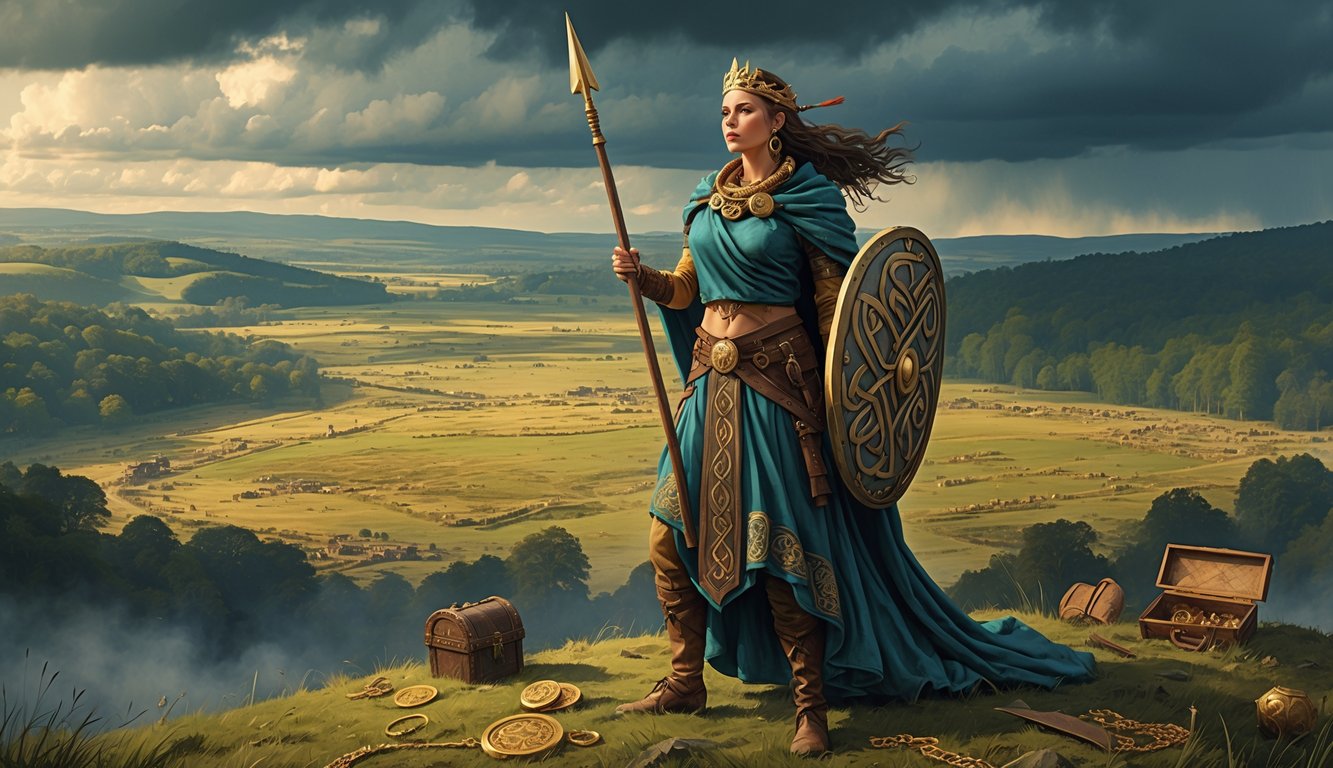
In AD 60 or 61, tensions between Rome and the Celtic peoples in Britain reached a breaking point. The Iceni, once semi-independent under their king, suffered harsh treatment after his death.
Anger spread quickly across tribal lines.
Catalysts for Uprising
Boudica was queen of the Iceni, a tribe in what is now East Anglia. Her husband, Prasutagus, ruled as a client king under Rome.
In his will, he left his kingdom to his daughters and the Roman emperor. Rome ignored the will.
Officials seized Iceni lands, confiscated property, and mistreated nobles. They publicly flogged Boudica and assaulted her daughters.
These acts were not isolated. Other Celtic tribes also suffered under Roman taxation, land seizures, and cultural suppression.
The Iceni’s grievances became a rallying point for resistance. Resentment toward Roman rule had been building for years.
Boudica’s Call to Arms
After the abuses, Boudica became the central figure leading resistance. She spoke to her people about defending their lands and way of life.
Her leadership came from her position as queen and her personal experience of injustice. She presented the fight as a struggle for survival and autonomy.
According to accounts, she inspired warriors by pointing out Rome’s vulnerability. The governor, Gaius Suetonius Paulinus, was far away in the west.
This moment gave the Iceni a rare chance to strike before Roman forces could regroup.
Alliances with Neighboring Tribes
Boudica knew the Iceni could not defeat Rome alone. She formed an alliance with the Trinovantes, a tribe with its own history of conflict against the Romans.
The Trinovantes brought warriors and local knowledge. They had access to important Roman settlements like Camulodunum (modern Colchester).
Other Celtic tribes joined in, uniting groups that were often rivals. This coalition created a large, coordinated force.
It combined the Iceni’s numbers, the Trinovantes’ strategic position, and the shared determination to resist Roman domination. These alliances laid the foundation for the large-scale revolt that followed, as described in the Boudiccan Revolt.
The March of Destruction: Key Battles
Boudica’s forces moved quickly through Roman Britain. They attacked key settlements that symbolized Roman control.
Each attack left behind burned buildings and heavy loss of life. The Roman army had to regroup and respond.
Attack on Camulodunum
Camulodunum, now called Colchester, was the first major target. Roman authorities used it as a colony for retired soldiers and built a large temple dedicated to Emperor Claudius.
Many locals viewed the temple as a symbol of oppression. When Boudica’s army arrived, the settlement had little defense—only a small garrison and no protective walls.
The rebels overran the town. They set fire to buildings and destroyed the temple.
Archaeologists found layers of ash in Colchester that confirm the scale of the destruction. Roman reinforcements arrived too late to help the colony.
The Sacking of Londinium
Londinium, now London, was a growing trade hub along the Thames. In AD 60–61, it did not have strong fortifications.
When Boudica approached, Roman governor Gaius Suetonius Paulinus decided not to defend the city. He ordered an evacuation and left behind those unable to flee.
Boudica’s forces entered and burned Londinium to the ground. Evidence of the attack remains in the city’s “Boudican destruction layer,” a thick band of burnt debris beneath modern streets.
Destruction of Verulamium
Verulamium, near today’s St Albans, was another prosperous Romanized town. It sat along Watling Street, a key Roman road, making it a strategic target.
The rebels destroyed public buildings, markets, and homes in the attack. The town was left undefended as the Roman army focused on gathering for a decisive battle.
Archaeologists in St Albans have found burnt remains and collapsed structures that match historical accounts of the assault.
For more on the historical background of Boudica’s campaign, see this detailed account of the Boudican Revolt.
The Final Stand: Battle of Watling Street
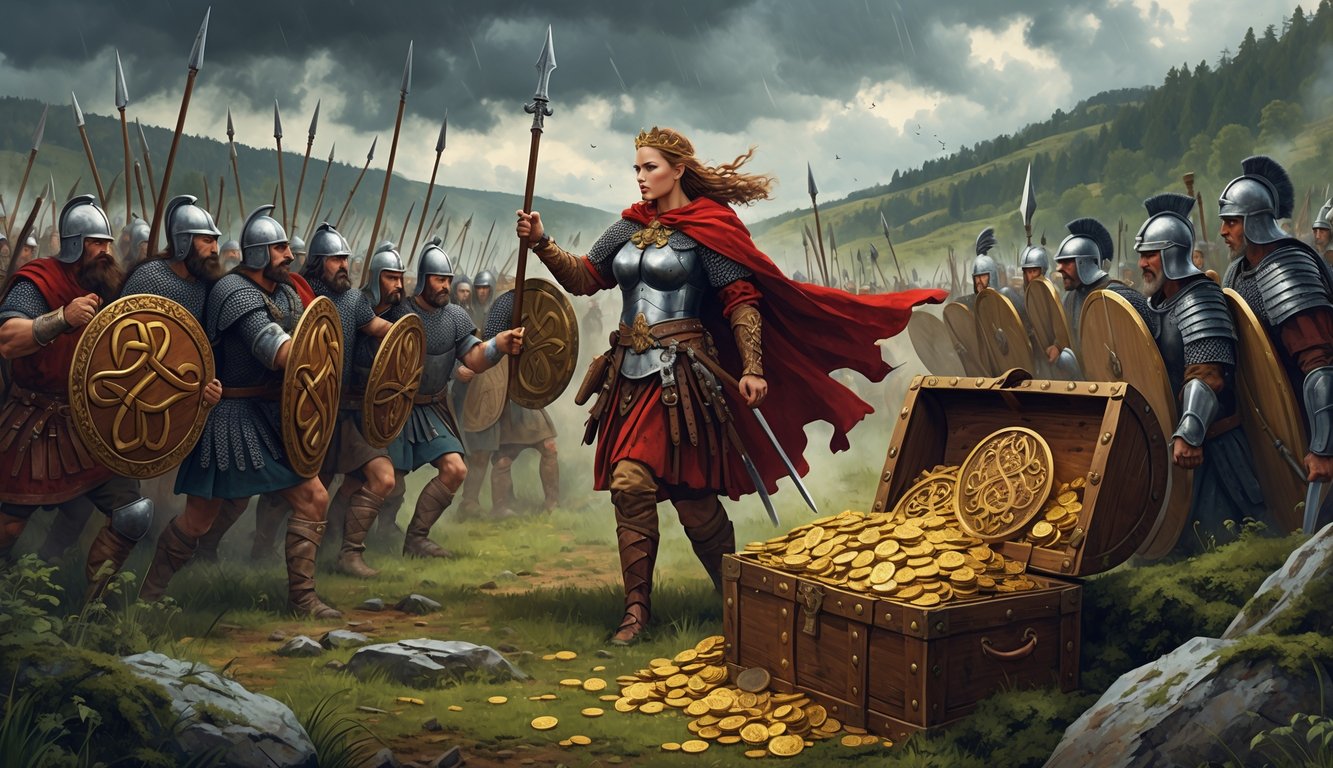
In 60 AD, Roman governor Gaius Suetonius Paulinus faced Queen Boudica’s massive rebel army along the Roman road called Watling Street. The outcome of this battle determined whether Roman rule would continue in Britain after months of destruction.
Roman Strategy and Tactics
Suetonius chose a narrow location along Watling Street with woods at his back and open ground in front. This choice stopped Boudica’s larger army from surrounding his forces.
The Roman army had about 10,000 men. They included legionaries, auxiliary troops, and cavalry, all fighting in tight formations with shields and short swords.
Suetonius arranged his men in a wedge formation. This let them push forward into the enemy line while staying protected on the flanks.
Heavy javelin volleys weakened the Britons before close combat started.
Key advantages for the Romans:
- Strong defensive position
- Superior training and discipline
- Coordinated use of infantry and cavalry
Boudica’s Forces and Leadership
Boudica led a coalition of tribes, including the Iceni and Trinovantes. Ancient accounts suggest her army may have reached over 100,000 warriors, though the exact number is unknown.
Her forces included lightly armed infantry, chariots, and warriors with spears and swords. Many brought their families in wagons to watch the expected victory, but these wagons later blocked their escape.
Boudica inspired her troops with speeches that called for freedom from Roman rule. She was tall, with long red hair, and often wore a colorful tunic and cloak.
Her army lacked the training, armor, and coordinated tactics of the Romans. The large, loosely organized force struggled to adapt when the battle turned against them.
Aftermath and Defeat
The Romans advanced in disciplined lines and broke through the Britons’ front. Cavalry attacked the flanks, causing panic, and the retreating warriors became trapped between the Romans and their own wagons.
Ancient writers claim tens of thousands of Britons died, while Roman losses were low. The defeat ended large-scale resistance to Roman rule in Britain for centuries.
Boudica’s fate is uncertain. Some accounts say she took poison to avoid capture, while others suggest she fell ill and died soon after the battle.
The Legend of Queen Boudica’s Lost Treasure
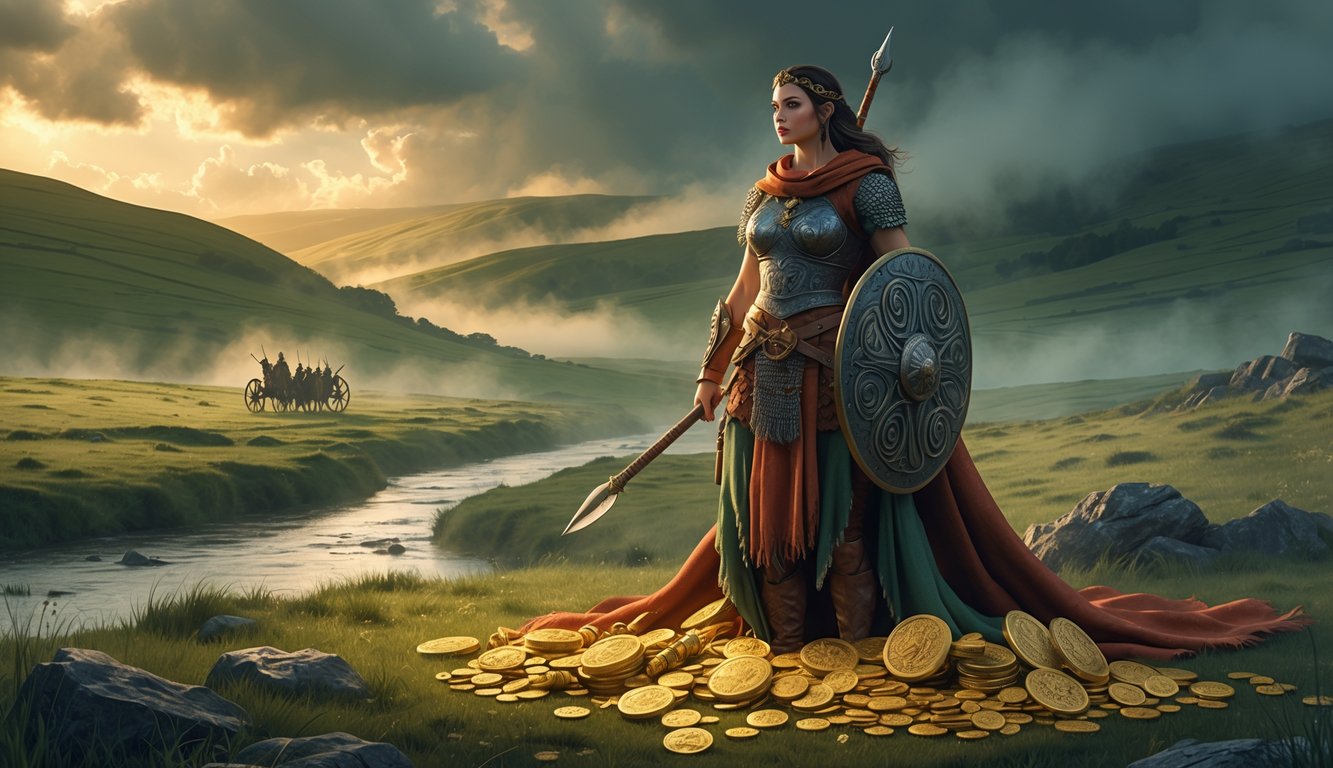
Stories of Queen Boudica’s lost treasure are linked to the final days of her revolt against Rome. Archaeologists and historians connect the legend to valuable gold and silver items that once belonged to the Iceni tribe, such as coins, torcs, and ceremonial objects.
Many believe the Iceni hid these riches to keep them from the Romans.
Historical Accounts of Hidden Riches
Roman historians like Tacitus and Cassius Dio wrote about Boudica’s rebellion but did not describe her treasure in detail. Later folklore suggests the Iceni queen ordered her wealth buried before her defeat in AD 60 or 61.
The Iceni were skilled metalworkers. Gold torcs, decorated brooches, and coin hoards have been found in East Anglia, some dating to the same era. In 2008, a discovery of 824 gold coins minted by the Iceni between 40 BC and 15 AD was made in Suffolk, possibly linked to her people’s wealth.
These finds suggest more treasure could remain hidden. Some historians think the hoard might have included war spoils, tribute, and royal regalia.
Theories on the Treasure’s Location
Several theories suggest possible hiding places. Some think the treasure lies somewhere in ancient Iceni territory in Norfolk, Suffolk, or Cambridgeshire. Others believe it could be buried near the site of her final battle, though the exact location is still debated.
Archaeological evidence shows that the Iceni often hid hoards in remote or marshy areas. This made them harder for Roman soldiers to find.
Modern metal detectorists have found Iceni coins and artifacts in fields, but no confirmed “Boudica hoard” has been discovered. Sites near the River Thet and along old Roman roads are popular search areas.
Cultural Significance of the Hoard
If found, the treasure would offer more than monetary value. It would give insight into the Iceni tribe’s craftsmanship, economy, and power.
Gold torcs were symbols of high status and tribal identity, not just ornaments. Coins could reveal trade links and the reach of Iceni influence.
For modern Britain, such a find would connect today’s communities to a key moment in early history, much like the Celtic coin hoard from Boudica’s reign that has already provided clues about Iron Age society.
Archaeological Evidence and Recent Discoveries
Archaeologists have uncovered traces of Queen Boudica’s time through buried valuables, burned layers in ancient towns, and careful digs. These finds help date her uprising and show how the conflict with Rome changed daily life and trade in Britain.
Coin Hoards and Jewelry
People have found several large hoards of coins from Boudica’s era across eastern England. In one case, a metal detectorist found over 1,300 Iron Age gold coins that may date to her revolt. These coins often show Celtic designs and tribal symbols.
Roman coins from the same period also appear in these hoards. This suggests active trade or looting from Roman settlements. Some hoards were likely buried to hide wealth during the unrest.
Jewelry finds are important too. Items like the torc, a rigid neck ring made of gold or bronze, show high-status craftsmanship. Such objects often appear in graves or as single finds, hinting at the Iceni elite’s personal wealth.
The Boudican Destruction Horizon
Archaeologists use the term “Boudican Destruction Horizon” for a distinct layer of charred debris found in several Roman towns. This layer is most visible in places like Colchester (Camulodunum), which Boudica’s forces burned in 60 or 61 CE.
The layer includes blackened timbers, collapsed walls, and scattered Roman artifacts. Burned grain stores and smashed pottery point to a sudden and violent attack.
In some sites, this destruction sits directly above layers from peaceful Roman occupation. This sharp change in the archaeological record helps confirm the timing and scale of her campaign.
Modern Excavations
Recent digs continue to reveal traces of Boudica’s time. Urban excavations often uncover coins, tools, and building remains sealed beneath later construction. These finds add detail to the known map of her revolt.
Television-led expeditions, such as those on Expedition Unknown, have highlighted new discoveries, including caches of ancient treasure.
Some modern fieldwork focuses on rural sites where hoards were buried. For example, a hoard of Roman coins found in farmland may have been hidden during the revolt. Each discovery adds to the archaeological evidence and helps researchers understand the reach of her conflict.
Ancient Sources and Historical Debates
The story of Boudica’s revolt comes from a small number of ancient writings and limited archaeological finds. These accounts differ in important ways, and modern historians continue to examine how much of each version reflects fact, interpretation, or bias.
Tacitus and Cassius Dio
Two Roman historians, Publius Cornelius Tacitus and Cassius Dio, wrote the main surviving accounts of Boudica. Tacitus wrote in the late first and early second century AD, using reports from his father-in-law, who served in Britain.
Tacitus described how the Iceni queen rose against Roman rule after her family suffered mistreatment. He focused on political causes and the brutality of Roman officials.
Cassius Dio wrote over a century later. He included dramatic speeches and vivid battle descriptions, and gave more detail about Boudica’s appearance and leadership.
Both accounts agree on the scale of the revolt, but they differ in dates, numbers, and motivations. Readers can explore more about these ancient accounts at the University of Warwick’s overview of Boudica’s sources.
Challenges in Interpreting the Evidence
Historians face major gaps in the record. No confirmed grave or physical remains of Boudica have been found. This means her life is known only through Roman writings, which may reflect the authors’ political agendas.
Tacitus may have aimed to criticize Roman governors, while Cassius Dio may have shaped events to fit literary traditions. These motives make it hard to separate fact from embellishment.
Archaeological evidence, such as layers of burnt debris in cities like Colchester and London, supports reports of large-scale destruction. However, it cannot confirm every detail of the written accounts.
Coins, weapons, and other finds give clues about the period but rarely link directly to Boudica herself.
Ongoing Scholarly Research
Researchers keep combining archaeology with close study of ancient texts. New finds, such as hoards of Roman coins possibly buried during the revolt, offer fresh clues about the timing and scope of the conflict.
Specialists also re-examine translations of Tacitus and Cassius Dio to spot differences in meaning. Small changes in wording can shift how events are understood.
Some scholars investigate possible burial sites, like the debated Birdlip grave in Gloucestershire, though none have been proven to belong to Boudica.
By comparing material evidence with written accounts, historians hope to build a clearer picture of what happened in 61 AD and how it was remembered.
Boudica’s Enduring Legacy

People continue to look to Boudica’s story when they think about resistance, leadership, and the role of women in history. Her life inspires public art, political speeches, and cultural works that keep her memory alive long after her revolt against Rome.
National Heroine and Symbol of Freedom
People in Britain remember Boudica as a national heroine. She led the Iceni tribe and allied Celtic groups in a revolt against the Roman Empire in 60–61 AD.
Her defiance turned her into a lasting symbol of freedom and self-determination. Writers and historians during the reign of Elizabeth I compared the queen to Boudica, linking both as women who defended their land from foreign powers.
This comparison strengthened Boudica’s image as a patriotic figure. Modern historians highlight her as one of the earliest documented women warriors in British history.
Her leadership challenges the idea that only men fought in ancient wars. Political leaders have used her name in speeches to inspire unity and resilience during national challenges.
Statues and Memorials
A famous memorial to Boudica stands near Westminster Bridge in London. The bronze statue shows her in a war chariot with her daughters, holding a spear and facing the Houses of Parliament.
Thomas Thornycroft created this statue in the late 19th century. The statue reflects Victorian admiration for her courage and leadership.
Many visitors and photographers come to see the statue. Other tributes to Boudica appear in museums, historical sites, and public art across Britain.
Artists often show her in battle dress to highlight her role as a warrior queen. The central location of these memorials in London shows her deep connection to the nation’s identity.
Influence on Modern Culture
Boudica’s life has inspired books, plays, films, and television dramas. Many works show her as a determined leader who fought against great odds.
Writers include her story in educational materials and children’s books. This helps new generations learn about her.
Websites such as The Warrior Queen: Boudica’s Celtic Legacy explain her historical impact.
In popular culture, people often group her with other famous women warriors from around the world. This has broadened discussions about women’s roles in history and leadership.
Artists use her image in art, music, and brand names. This keeps her presence alive in everyday life.