Ukraine is a country filled with hidden secrets, old legends, and puzzling stories that still leave people guessing today. From ancient underground tunnels to lost treasures and strange places, its landscape is packed with mysteries waiting to be uncovered.
People are drawn to sites like the Odessa Catacombs, legendary castles, and churches that carry tales of unexplained events and secrets. Across the country, places covered in mysticism and riddles invite visitors to explore their past and piece together the truths behind the stories.
These mysteries reflect Ukraine’s rich culture, history, and the curious spirit of its people. Those who love a good mystery or want to discover something new will find Ukraine an exciting place to explore.
Kyiv’s Mysterious Ancient Origins
Kyiv’s early history is filled with unanswered questions and fascinating tales. Historians and archaeologists have discovered both legendary stories and real artifacts, some dating back thousands of years.
Legend of the Founding of Kyiv
One of the most famous legends tells how Kyiv was founded by three brothers named Kyi, Shchek, and Khoryv, along with their sister Lybid. They settled on the high hills above the Dnipro River and named the city after Kyi, the eldest brother.
These tales have been passed down through generations and often appear in chronicles and folk stories. Many people still debate how much of this legend is fact or myth.
Excavations in Kyiv have uncovered early settlement layers, but connecting these directly to the legendary founders remains difficult. For many, the story represents more than history and serves as a symbol of cultural identity and pride in Ukraine’s ancient roots.
Unsolved Archaeological Discoveries
People have lived in the area around Kyiv since the Late Paleolithic Period. Archaeologists have found stone and bone tools, mammoth bones, and traces of early wooden shelters during excavations around the city.
Some discoveries, such as the unique “hieroglyph” carvings recently uncovered in caves beneath Kyiv, puzzle modern researchers because their purpose is still unknown. Excavations at Starokyivska Hill point to a city center dating back to the Kyivan Rus era, while areas like Podil reveal remnants of old streets and trade routes.
Each new excavation raises more questions about where and when Kyiv truly began. Learn more about these finds at Britannica’s page on the history of Kyiv.
Epic Myths and Local Lore
Local legends in Kyiv go far beyond the city’s founders. Stories of hidden treasure, lost cave systems, and mysterious underground tunnels fill the city’s folklore.
An explorer once followed family stories and found a secret cave system right in the city, adding a new layer to Kyiv’s ancient mysteries. Many Kyiv landmarks have their own tales, like the Monastery of the Caves, believed by some to hide ancient secrets still not uncovered.
Art, songs, and oral stories keep these myths alive, making Kyiv’s streets feel almost magical. For a closer look, read about Kyiv’s lost cave system and other discoveries.
Lost Civilizations of Trypillia
The Trypillian culture thrived over 6,000 years ago in what is now Ukraine. They left behind massive settlements, unique rituals, and many mysteries that scientists still try to explain.
Enigmatic Trypillian Megasites
Archaeologists have found huge prehistoric monuments and settlements, some covering up to 400 hectares. These sites, called megasites, often had thousands of buildings and could house tens of thousands of people.
The largest known settlement is near the village of Legedzino. Excavators revealed that these ancient cities were carefully planned, with buildings sometimes arranged in circles and having uniform shapes.
Some sites, such as those studied across Ukraine, Moldova, and Romania, show that residents used advanced construction techniques for their time. You can read more about these discoveries at Cucuteni-Trypillia: Eastern Europe’s lost civilisation.
People have also discovered evidence of pottery workshops and places for crafts. These finds suggest that trade and community life were important to the Trypillians.
Purpose of Large Structures
One of the biggest puzzles of the Trypillian civilization is why they built such large structures. Some buildings were much bigger than typical homes, raising questions about their function.
Researchers believe that the largest buildings may have been used for community gatherings, leadership meetings, or important rituals. Since written records do not exist, the exact purpose is difficult to know.
Artifacts like painted pottery and symbolic figures are often found in these bigger buildings. This evidence supports the idea that these places hosted spiritual or ritual activities.
Disappearance of the Trypillian Culture
The Trypillians vanished after nearly three thousand years, and the reason is still debated. Some experts think environmental changes or drought affected farming, making it hard for large cities to survive.
Others suggest that outside threats, like invasions, wars, or changing trade routes, could have forced people to leave their cities. Archaeological evidence, such as traces from burnt buildings found during excavation, supports the idea of sudden abandonment in some areas.
You can learn more at Trypillia – Enigmatic Proto-Ukrainian Civilization. Ongoing digs continue to uncover new objects, adding to our understanding of the mysterious end of the Trypillian culture.
The Zaporizhian Cossacks’ Hidden Treasures
Tales of the Zaporizhian Cossacks’ hidden treasures have fascinated Ukrainians for generations. These stories speak of missing gold and secret graves connected to one of Ukraine’s most legendary warrior groups.
Mysterious Disappearance of Gold
The Zaporizhian Cossacks are often linked with hidden gold said to be buried across the steppes, riverbanks, and caves of Ukraine. Many legends claim that the Cossacks, before facing invasions or defeat, stashed their vast amounts of treasure in secret spots that have never been found.
Stories describe places like the deep waters of the Dnieper River or the wild fields surrounding the former Cossack stronghold known as Zaporizhzhian Sich. For centuries, treasure hunters have searched these locations, hoping to find coins, jewelry, and even ceremonial items.
Local lore often combines fact and fiction. Some people think the treasures could remain hidden due to complicated hiding methods or simply because no one has discovered the right clues yet.
Ukrainian steppe legends give colorful descriptions of Cossack riches, but so far, they remain part of the mysteries of Cossack history.
Key facts:
- Gold and artifacts are tied to Cossack legends.
- Descriptions of hiding places include rivers, forests, and caves.
- Treasure seekers have not confirmed any major finds.
Elusive Burial Sites
The final resting places of many Cossack leaders and warriors are another historical mystery. Stories describe secret burial sites filled with not just bodies, but important items and war trophies.
Researchers have looked for these graves in the Zaporizhzhia region, where the Cossacks had their main base. Some graves might hold personal weapons, clothing, or old banners.
According to legend, burying treasures with the dead was a way to keep them safe from enemy hands. Locals have passed down tales about hidden burial mounds and lost cemeteries.
Explorers and archaeologists sometimes find clues, like pieces of armor or coins, but very few whole tombs have been documented. The search for these graves is still ongoing.
For many, the idea that such sites remain hidden helps keep the legend and magic of the Zaporizhian Cossacks alive today.
Puzzling Petroglyphs and Geoglyphs of Ukraine
Ukraine is home to ancient rock carvings and large land drawings that continue to puzzle archaeologists. These prehistoric sites give a glimpse into early cultures, offering clues through symbols, shapes, and inscriptions still not fully understood.
Kamyana Mohyla Symbols
Kamyana Mohyla, located in the Ukrainian steppe, is a prehistoric monument with many mysterious petroglyphs carved into sandstone blocks. Archaeologists have found carvings of animals, people, and abstract shapes covering several rock panels.
Mesh-analysis and 3D-modeling have helped experts study these images, revealing hidden details missed before. Some panels show possible scenes from daily life or ancient rituals.
Others have symbols that may be linked to mythological stories, although the true meaning remains unclear. Kamyana Mohyla stands out because carvings from different ages overlap or mix on the same rock, showing that people visited and reused the site for thousands of years.
The variety of symbol styles and the use of the site over long periods have challenged researchers. No single explanation can fit all the markings, making it a key example of Ukraine’s complex ancient rock art.
The Dniester Geoglyphs
Along the Dniester River, researchers have identified geoglyphs—large designs made by arranging stones, digging trenches, or shaping the earth. Unlike petroglyphs, these geoglyphs are meant to be seen from above or at a distance.
Most date back to the Neolithic or Bronze Age. Excavations near these shapes sometimes uncover hearths, pottery fragments, or tools.
These finds suggest the geoglyphs had a ritual or communal use, but their exact purpose still isn’t proven. Some patterns look like spirals, animals, or geometric shapes, raising more questions about the beliefs and skills of the people who made them.
Ukrainian geoglyphs remain rare compared to those in other parts of the world. Each new discovery excites archaeologists working to unlock their secrets.
Untranslatable Inscriptions
In different parts of Ukraine, some petroglyphs and carved inscriptions show strange signs that no one can read or match to any known language. These markings appear next to pictures or symbols on ancient stones or cave walls.
Researchers have tried to compare these scripts to runes, pictographs, and early alphabets, but they have not succeeded. Some experts think they could be messages, names, or symbols linked to lost rituals.
No “Rosetta Stone” has turned up to help solve their code. The mystery grows when similar signs show up at separate sites far apart, hinting at a shared system or idea now lost to time.
Excavations often find these markings in ritual or burial sites. This suggests they were important in ancient life.
The Mystery of the Black Sea Flood
Many scientists believe a huge flood once changed the shape of the Black Sea and its lands. This event, described in geology and old stories, has inspired many theories and links to famous legends.
Flood Theories and Ancient Legends
The Black Sea deluge hypothesis says the Black Sea flooded about 7,600 years ago when water from the Mediterranean rushed in. Geologists say that glaciers melted, sea levels rose, and water broke through a natural dam, flooding the area quickly.
This flood turned fertile land into sea and forced people to move. Historians and archaeologists have found underwater settlements, showing people lived there before the flood.
Many cultures near the Black Sea, including those in Ukraine, have old stories about a great flood. Stories like the biblical tale of Noah may come from this real disaster.
You can read more about these ideas in the Black Sea deluge hypothesis.
Connections to Plato’s Atlantis
Some researchers link the Black Sea flood to the legend of Plato’s Atlantis. Plato described Atlantis as a powerful island that sank into the sea.
He placed Atlantis beyond the “Pillars of Hercules,” but some think he meant a disaster like the Black Sea flood. As settlements sank underwater, memories of the flood may have turned into myths.
These stories may have traveled far from Ukraine and mixed with legends from Greece and the Middle East. There is no proof that the Black Sea flood was Atlantis, but the idea stays popular because it helps explain how ancient people described such a big event.
Secrets of the Scythian Gold
The Scythian Gold is famous for its beauty and mystery. These treasures give clues about the lives and rituals of the Scythian people who lived in Ukraine long ago.
Origins and Missing Artifacts
The Scythians made gold helmets, jewelry, and ceremonial items between the 7th and 3rd centuries BC. Excavators found many pieces in old burial mounds across southern Ukraine.
These artifacts show the skill of Scythian goldsmiths and tell stories about power and religion. Not all artifacts stayed in place.
Some went missing during wars and political changes. In a recent case, hundreds of pieces sent abroad for a museum display were returned to Ukraine from the Netherlands after a dispute with Russia.
This event brought attention to the mystery of missing Scythian gold.
A table of important Scythian gold artifacts:
| Artifact Type | Discovered Location | Current Status |
|---|---|---|
| Gold Helmet | Crimea burial mound | Returned to Ukraine |
| Necklace | Melitopol kurgan | In Ukrainian museum |
| Ceremonial Bowl | Kerch region | Traveled internationally |
Sacred Burial Mounds
The Scythians buried their kings and warriors in large earth mounds called kurgans. These burial sites are scattered across Ukraine, filled with treasures and everyday items.
Excavators found golden armor, decorated daggers, and animal-shaped ornaments in these mounds. Many items relate to sacred rituals.
Gold cups or vases likely had spiritual meaning and were used during funerals or ceremonies. Some burial chambers held horses and weapons, showing the Scythians believed in an afterlife for their leaders.
Historians and archaeologists study these burial mounds to learn more about Scythian beliefs and traditions. Each new find adds to Ukraine’s history.
For more on these findings, see details about ancient Scythian gold treasures.
Unexplained Megalithic Sites

Ukraine has several ancient stone monuments that raise questions about the past. Some sites are linked to rituals or burials, while others remain mysterious.
The Stone Tombs of Melitopol
Near Melitopol, the Stone Tombs, or Kamyana Mohyla, form a cluster of sandstone blocks and caves on a low hill. Archaeologists have found carvings and symbols on the rocks that are thousands of years old.
These carvings may be early writing, but their meaning is unclear. Historians debate whether the site was a monument for worship, an ancient library, or a meeting place.
Excavators have uncovered stone altars and fire pits. Some artifacts suggest many cultures visited the area over time.
Visitors can see petroglyphs of animals, human figures, and geometric shapes carved into the stone. No one knows who built the site or why it was so important.
Ukraine’s Stonehenge: Mysterious Altars
Near Novooleksandrivka, a burial mound called the Ukrainian Stonehenge stands over 5,000 years old. This makes it older than the pyramids of Egypt.
Researchers found large stone slabs arranged in a circle, like Stonehenge in England. These stones may have served as altars or a ceremonial center for early people.
Excavators found burial remains, pottery, and tools at this site. The true purpose of the stone circle is still unknown.
Many scientists think the monument was used for astronomical or religious gatherings. Learn more about this ancient Stonehenge-like site in Ukraine.
Modern Ukrainian Mysteries and Unsolved Cases
Ukraine has faced strange disappearances and the rise of mysterious figures in recent times. These cases puzzle both the public and experts, as many questions remain unanswered.
Unexplained Disappearances
Some people have vanished in Ukraine without a clear reason. Families and police search, but leads often run out.
Lists of missing persons in Ukraine have grown, especially since conflict began in the eastern regions. Several activists and journalists have disappeared, leaving behind few clues.
In many cases, the last known locations are cities affected by war or unrest. International watchdogs track these disappearances, noting that some are linked to political activity or sensitive reporting.
Authorities sometimes reopen old cases, but progress is slow. Key concerns include:
- Missing activists in conflict zones
- Journalists vanishing after reporting on corruption
- Unexplained absences that may be tied to organized crime or foreign agents
These cases remind citizens to stay alert and highlight ongoing risks in Ukraine’s public life.
Shadowy Figures in Recent History
After 2014, several unknown figures gained sudden influence. Some of these people are tied to secret deals, armed groups, or controversial events.
Sometimes, groups connected to ISIS or other extremists are rumored to have operated in Ukraine’s border regions. These individuals often appear in reports of high-profile crimes or sudden political changes.
The public sometimes learns about them only after state actions or media leaks. Some have military backgrounds, while others act as power brokers behind the scenes.
Authorities try to trace the activities of these shadowy players. They track financial links, technology movements, and communication with groups outside Ukraine.
Efforts continue to make these networks more transparent, but many details remain unclear. For more real cases of unknown figures and secrets in Ukraine, go to this detailed podcast episode.
Enigmatic Manuscripts and Lost Texts

Ukraine has a long history of mysterious texts and puzzling manuscripts. Some works remain undeciphered or are linked to famous mysteries from other places.
The Kyiv Codex
The Kyiv Codex is an ancient collection of religious and philosophical writings. Over time, parts of the codex disappeared, especially during the 13th century Mongol invasion, when many relics and manuscripts were lost or destroyed.
Researchers think the codex could offer clues about early Slavic beliefs, languages, and culture. Some versions describe the book as full of strange symbols, hidden messages, and illustrations that historians cannot fully understand.
The remaining fragments are stored in Ukraine, but many scholars believe large sections may never be recovered.
A table below summarizes what is known:
| Aspect | Details |
|---|---|
| Time Period | Middle Ages |
| Content | Religious texts, unknown symbols |
| Current Location | Monasteries and archives in Ukraine |
| Deciphered? | Partially, much is still a mystery |
Connection to Voynich Manuscript
Some historians see similarities between Ukrainian manuscripts and the famous Voynich Manuscript. Both feature unusual writing, unknown languages, and strange illustrations.
Researchers note that trade and contact between Eastern and Western Europe allowed ideas and texts to travel. The makers of the Kyiv Codex may have known about similar encoded works or exchanged techniques with creators of the Voynich Manuscript.
The Voynich Manuscript is famous for its undeciphered text, much like Ukrainian mystery writings. Experts compare symbols, illustration styles, and even the ink used in both manuscripts.
No direct link has ever been proven, but the similarities continue to puzzle scholars.
Folklore, Rituals, and Supernatural Legends
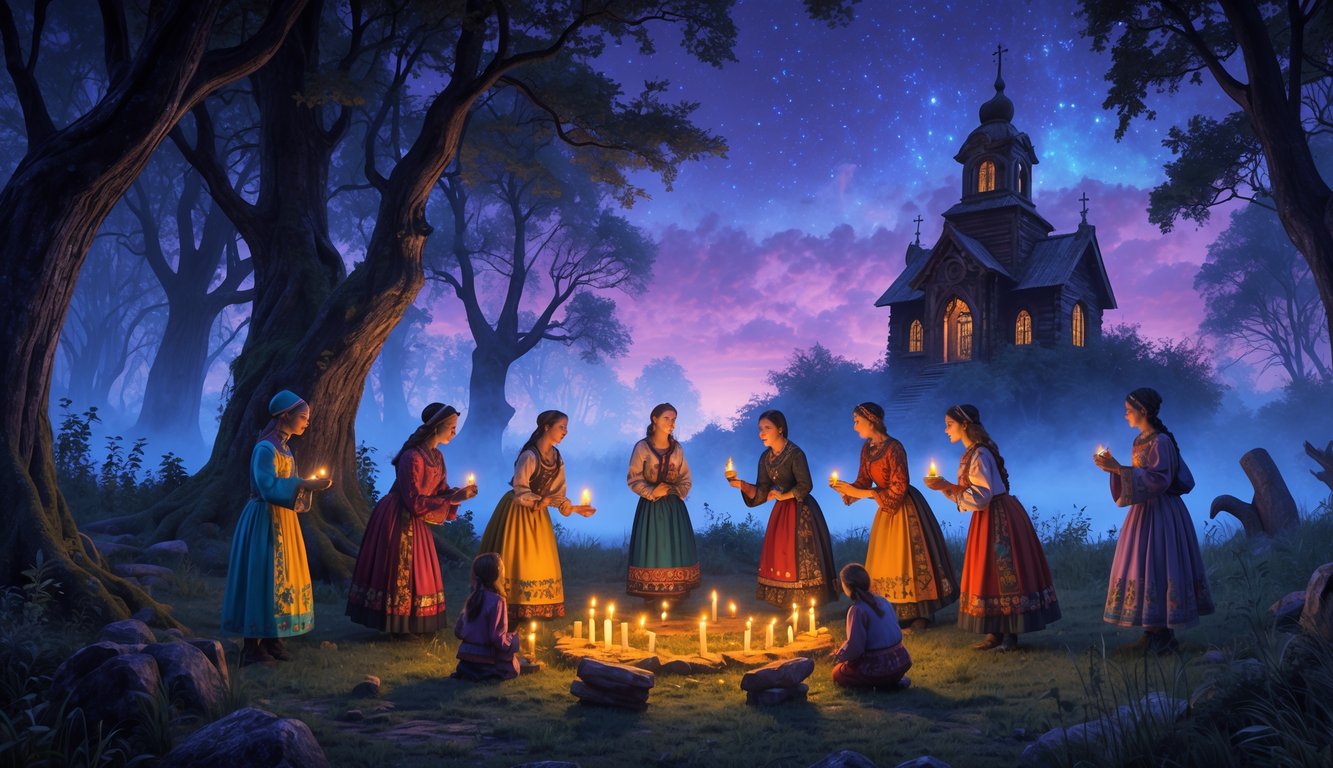
Ukrainian history is full of ancient traditions and unexplained events that still puzzle people today. Many communities in Ukraine keep old rituals and legends alive, mixing beliefs, customs, and mysterious folklore.
Unsolved Supernatural Phenomena
Ukraine is famous for its haunted landscapes and legends of ghosts, witches, and mythical beings. The story of the Chort, a demon from old Slavic stories, is still told in rural areas.
People believe the Chort caused mischief and disaster. He remains an important figure in village tales.
Another common legend is about the Mavka, a spirit said to appear in forests. Locals describe Mavkas as beautiful young women with long hair who lure people into the woods.
Some say they are the spirits of girls who died tragically. Ukrainian folklore often mixes real events with supernatural claims.
Some people still report sightings of strange lights or sudden cold gusts near old battlefields. These mysterious happenings are often explained as signs from restless spirits.
Stories about the supernatural run deep in Ukrainian culture. Learn more about Ukrainian folklore at Ukrainian folklore – Wikipedia.
Ritual Sites
Many villages in Ukraine have special places where people believe supernatural events happened. These sites often become the center for rituals and festivals.
One example is the celebration of Ivan Kupala Night, which marks the summer solstice. During Ivan Kupala Night, people jump over bonfires and search for the magical fern flower, hoping to gain luck and wisdom.
Locals also weave flower wreaths and let them float on rivers. This tradition is tied to wishing for love and telling fortunes.
Some sites date back to pre-Christian times and feature large stones arranged in circles or patterns. Researchers think people used these places for rituals and gatherings.
Visitors often come to connect with the country’s ancient past and mysterious legends. These rituals keep old stories and beliefs alive.
The Dyatlov Pass Incident: Ukrainian Connections
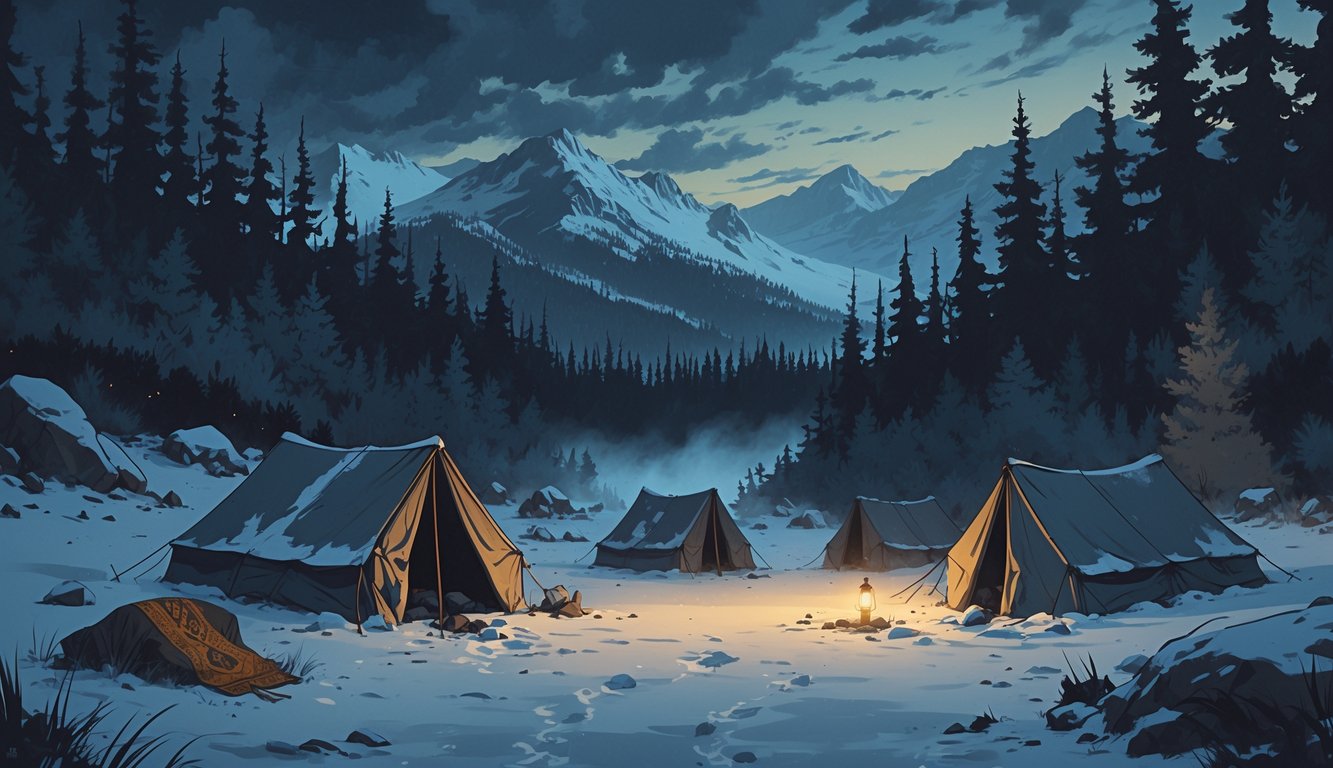
The Dyatlov Pass incident from 1959 has sparked decades of debate and mystery. While the tragedy happened in Russia, several hikers involved had Ukrainian backgrounds.
This connection has drawn interest from historians in Ukraine. Some members of the group in the Dyatlov Pass incident were students at the Ural Polytechnical Institute.
A few of these students had Ukrainian roots, linking the story back to Ukraine. Families in Ukraine were deeply affected by the news.
They waited months to find out what happened to their loved ones. The loss connected communities across borders as the hikers’ backgrounds and stories came to light.
Key details:
- The Dyatlov Pass group was made up of experienced hikers.
- Ukrainian media and historians have discussed the personal histories of the victims with Ukrainian connections.
- The event still appears in Ukrainian discussions about unsolved historical events.
For more background on the incident itself, visit this overview on the Dyatlov Pass incident.
Comparisons to Dyatlov Pass
Over the years, people have compared the Dyatlov Pass incident to other disappearances of hikers from Ukraine and nearby countries. These cases often share sudden bad weather and rare avalanche conditions.
Comparison points:
- Dyatlov Pass and some Ukrainian cases involve experienced groups who face mysterious accidents.
- Investigators remain puzzled by unexplained injuries and odd circumstances.
- Media in Russia and Ukraine report on these cases and warn hikers.
No Ukrainian incident has received the same level of global attention. Some Ukrainian hikers’ stories, especially from the Carpathian Mountains, echo the eerie details of Dyatlov Pass.