Saudi Arabia is home to some of the world’s oldest and most intriguing historical mysteries. Scattered across its vast deserts and rocky landscapes are ancient ruins, lost tombs, and strange monuments that still puzzle archaeologists today.
From the secrets of vanished civilizations to mysterious stone carvings, Saudi Arabia’s history holds unsolved questions that continue to spark curiosity.
Sites like Hegra, also known as Mada’in Saleh, reveal a powerful empire that once thrived in the region. The empire left behind impressive tombs and monuments.
Researchers continue to uncover new discoveries in places such as Al Ula. Ancient tombs and relics in these areas have kept their secrets hidden for thousands of years.
Find out more about these hidden archaeological treasures as experts work to piece together Saudi Arabia’s fascinating past.
The country’s unique blend of ancient cultures, desert mysteries, and ongoing archaeological finds makes its history especially captivating. Whether it’s animal sacrifices, astral tombs, or unexplained stone structures, the biggest historical mysteries in Saudi Arabia invite everyone to explore and wonder about what these ancient people left behind.
The Standing Stones and Mustatil Enigma
Mustatil and other stone structures are scattered across the northwest Arabian Peninsula. Their size, age, and purpose remain a mystery that continues to puzzle archaeologists.
Origins of the Mustatils
Mustatils are large, rectangular stone monuments built in the ancient landscapes of Saudi Arabia. Some are over 600 feet long, with thick walls and central courtyards.
Archaeologists have dated these structures to about 7,000 years ago, making them older than Egypt’s pyramids. Most mustatils are found in northwest Saudi Arabia, especially around the city of AlUla.
The name mustatil comes from the Arabic word for “rectangle,” describing their shape. Tools and remains discovered nearby help date the structures to the Neolithic period.
This places them among the earliest examples of large-scale monument-making in the region. To learn more about their origins, visit this article about the mysteries of the mustatils.
Purpose of the Stone Structures
Experts still debate the use of mustatils, but many believe they served a special purpose. Some think people used them for rituals or religious gatherings.
Findings at some sites include animal bones, especially cattle, placed intentionally inside the structures. This suggests that people performed animal sacrifices or ceremonies here for spiritual reasons.
Over 1,000 mustatils exist across the region, showing their importance to early communities. Their placement often seems planned, possibly linked to seasonal events or travel routes.
Read about how these stone structures are older than Egypt’s pyramids and what they may mean.
Revelations from Recent Excavations
In recent years, archaeological teams have made important discoveries by excavating mustatil sites. They have found tools, animal remains, and engraved stones, giving new insight into the people who built them.
Surveys using drones and satellite images have helped map hundreds of new mustatils. These surveys reveal patterns in their size and location.
Teams now believe these structures were part of a shared tradition across the Arabian Peninsula thousands of years ago. Building mustatils was a big task and likely brought groups together for a common goal.
For details on the most recent findings, see research on mapping Saudi Arabia’s 7,000-year-old monuments.
Lost Ancient Cities of Saudi Arabia
Saudi Arabia holds secrets of lost civilizations. Its desert landscapes hide ancient cities that once thrived but are now shrouded in mystery and ruin.
The Vanished City of AlUla
AlUla is an ancient city surrounded by dramatic sandstone cliffs and sweeping desert. It is most famous for the site of Hegra (also called Madain Salih), which features over 100 grand tombs carved into the rock.
These tombs date back nearly 2,000 years to the Nabatean Kingdom. The city was a center for international trade, linking southern Arabia with Egypt, Greece, and Rome.
With its strategic location, AlUla grew as traders passed through, bringing spices, silk, and incense. The area contains ancient inscriptions and mysterious stone monuments, such as the “mustatils”—rectangular stone structures whose purpose remains unclear.
After the Roman Empire annexed the territory in 106 AD, AlUla and Hegra slowly declined. Sand covered much of the city, protecting some parts but leaving others open to erosion.
Today, teams excavate and study AlUla, revealing many secrets. Large parts of this lost city are still waiting to be discovered.
Learn more about the rediscovery of Hegra and AlUla.
Forgotten Kingdoms of the Arabian Desert
The Arabian Desert once hosted other thriving civilizations, some dating back as far as 5,000 years. Archaeologists have found ancient tombs, petroglyphs, and remains of cities that hint at a complex culture long before modern times.
The Prehistoric AlUla and Khaybar Excavation Project has unearthed tombs and stone circles, offering clues to the area’s past rulers. One mystery surrounds the “lost city” sought by British explorer Harry St. John Philby in the Empty Quarter.
Stories describe a place called Iram or Ubar, thought to have vanished beneath the sands after a dramatic event, possibly a meteorite strike. While its true nature remains uncertain, the search for Ubar shows how much remains hidden in Saudi Arabia’s vast desert.
Finds from these ancient kingdoms continue to reshape what historians know about early life on the Arabian Peninsula. Read more about the search for lost Arabian cities and the discovery of ancient tombs.
Unsolved Mysteries of Arabian Tombs

Ancient tombs across Saudi Arabia have puzzled archaeologists for decades. These burial sites offer glimpses into old rituals and hint at the daily lives of people from thousands of years ago.
Unique Burial Practices
Researchers have found rows of tombs along ancient routes called “funerary avenues.” These roads are lined with ring-shaped and pendant-shaped graves.
People used these avenues to connect oases and pasture lands, linking different communities. This network of graves may show how closely people worked together more than 4,000 years ago.
Some tombs were used for animal sacrifices, while others align with astral symbols. These shapes suggest possible connections to religious beliefs or star-worship.
The sheer number of tombs, sometimes in the thousands, shows how important burial customs were to ancient Arabian societies. These findings raise new questions about why people chose specific shapes or arrangements for these tombs.
To learn more about these practices and the communities, read about the funeral roads of Saudi Arabia.
Tomb Construction in the Bronze Age
Many of the oldest tombs date back to the Bronze Age, about 4,500 to 5,000 years ago. Builders used sandstone and other local materials to construct these tombs.
Some tombs are large and complex, while others are simple stone circles. The builders had advanced knowledge of construction for their time.
Building these tombs required organized labor and shared effort. The arrangement of tombs along routes suggests a network of societies working together over long distances.
Unexplained features, like odd tomb shapes or unexpected locations, sometimes surprise researchers. For example, a 5,000-year-old tomb excavated recently did not match what experts expected about Bronze Age burial patterns.
The mystery of how these stone tombs were built, and why, continues to challenge both local and international archaeologists.
Mysterious Animal Traps and Ancient Hunting Grounds
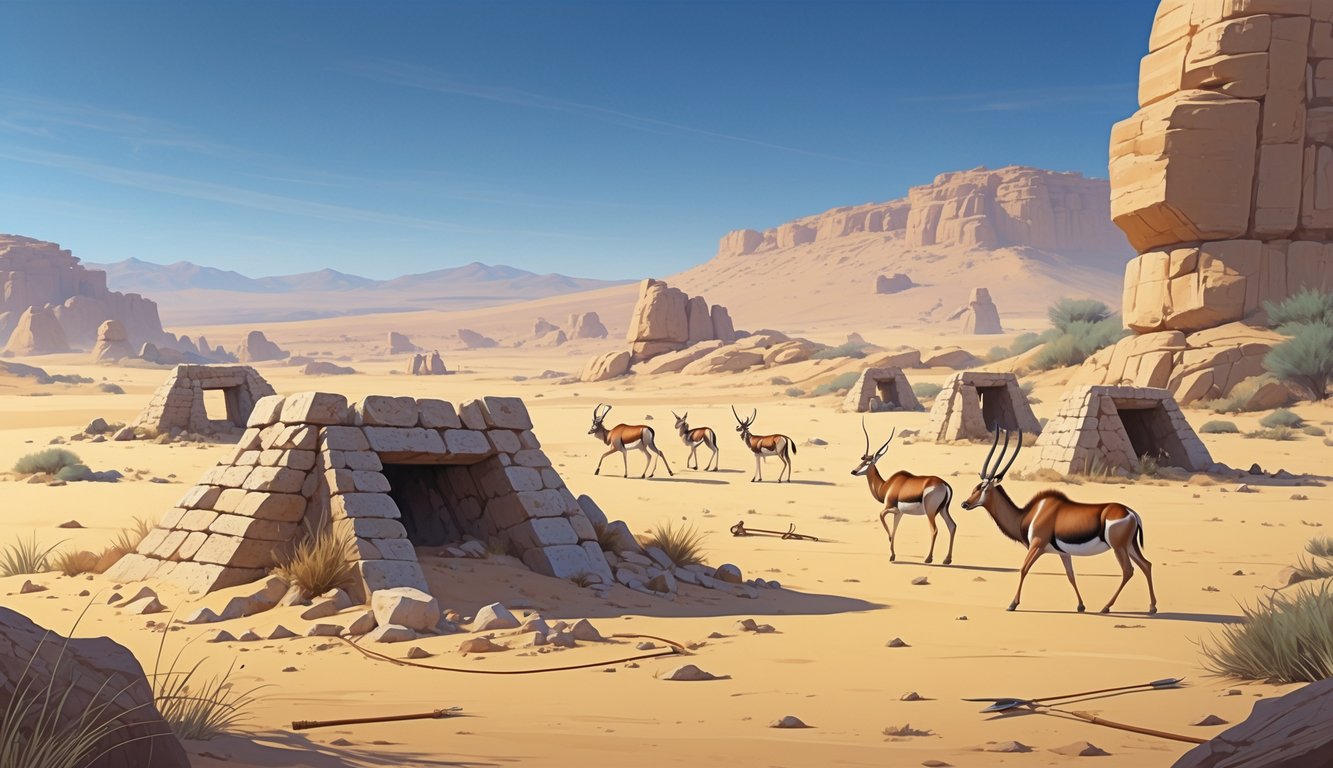
Across the Arabian Peninsula, massive stone structures mark old hunting sites. These animal traps give clues about how ancient people survived in a harsh environment.
Function and Design of Ancient Traps
Ancient animal traps known as “desert kites” are made from lines of stones that stretch for hundreds of meters. These lines fan out in a V-shape, leading to a small enclosure or pit at the narrow end.
Hunters used these traps to funnel wild animals, like gazelle, into the enclosed area where they could be caught with less effort. The design showed careful planning and teamwork.
Sometimes, traps would stretch across wide desert areas.
Key features of desert kites:
- Long, low stone walls
- Wide openings narrowing to a point
- Deep pits or enclosures at the end
People worked together in groups to build these massive hunting grounds. They understood the movement of wildlife.
Desert kites have been found across Saudi Arabia and nearby regions, with some dating back more than 7,000 years. Research suggests the main goal was to catch large numbers of animals efficiently.
These traps show a complex side to prehistoric life in Arabia. More details can be found about these Late Neolithic animal traps.
Recent Discoveries Using Satellite Imagery
In recent years, archaeologists have used satellite imagery and Google Earth to find and map these traps. Aerial surveys and high-resolution images have helped locate hundreds of desert kites.
Some traps are almost invisible from the ground. Satellite imagery revealed that desert kites are more common and widespread than first believed.
Many are located in remote places where few people have visited. This technology lets researchers study the shapes and sizes of traps without needing to be on-site.
Google Earth has helped spot new sites quickly. Scientists have identified different patterns and layouts between regions.
These digital methods have led to a better understanding of how ancient people changed the landscape for hunting. For more about these discoveries, see how satellite imagery revealed the scale of desert kites.
The Petra Connection: Saudi Arabia’s Northern Secrets
The ancient city of Hegra in northern Saudi Arabia connects to Petra, the famous city in Jordan. These sites reveal much about trade, architecture, and the people who once lived in the Middle East.
Trade Routes and Lost Civilizations
Hegra, also called Mada’in Saleh, stood as an important stop along ancient trade routes. Caravans traveled through these desert lands carrying spices, incense, and goods between the south of Arabia, Petra, and beyond.
The Nabataean civilization built both Petra and Hegra. Their control over trade made them rich and powerful.
They created a network of cities through the Middle East. This allowed them to collect taxes and protect merchants.
Hegra is the largest archaeological site left by the Nabataeans south of Petra. The site helps researchers learn how these people lived and traded with other ancient cultures in the region.
Explorers study tombs and carvings to discover details about daily life and local customs from thousands of years ago. Today, travelers can visit this UNESCO World Heritage site and see how the Nabataeans shaped history in Saudi Arabia’s northern deserts.
The city remained hidden for centuries before opening to the public. To find out more about Hegra’s location and importance, visit this guide to Hegra, the ancient city.
Architectural Influences in the Arabian Peninsula
Hegra and Petra share a striking look from their stone-cut tombs and detailed designs. The Nabataeans carved large burial chambers into the cliffs and decorated them with columns and carved doorways.
Many tombs in Hegra, like those in Petra, show blended styles. They mix Egyptian, Greek, and Roman designs.
This blend shows how the Nabataeans adopted ideas from travelers and merchants who passed through the region. Some tombs display symbols and images that tell stories about the people buried there.
The buildings show that the Nabataeans were skilled builders who respected other cultures. Hegra is the first site in Saudi Arabia listed as a UNESCO World Heritage site.
For a closer look at its details and connection to Petra, read about Hegra, Saudi Arabia’s famous archaeological site.
Hidden Archaeological Sites in the Saudi Desert
Saudi Arabia’s desert holds many archaeological sites that remain mysterious or unexcavated. These hidden places offer clues about ancient kingdoms, lost cities, and desert life thousands of years ago.
Archaeologists want to uncover more, but several challenges make research slow and complex.
Major Unexcavated Locations
A remarkable discovery in the Arabian desert is a 5,000-year-old walled oasis found beneath the sand. This fortified settlement suggests forgotten civilizations once thrived in these now-barren lands.
Many ancient sites near AlUla or the northwest region remain barely explored. Hegra, also called Mada’in Salih, is one of the few that has received major attention.
Other locations, marked by crumbling walls or faint ruins, wait for researchers to reveal their secrets. Archaeologists believe the desert landscape hides entire networks of settlements and trade routes.
Satellite images sometimes show lines and shapes lost to human eyes, possibly signaling hidden tombs or temples. With so much land unexplored, Saudi Arabia’s desert may hide some of the largest ancient towns yet unknown to history.
Barriers to Archaeological Research
Excavation in the Saudi desert faces several hurdles. The harsh climate, with extreme heat and sandstorms, makes long fieldwork challenging.
Access to remote sites is difficult. Rugged land, shifting sand, and the vast size of the desert slow travel and add risk.
Not all sites are mapped or well-known, making planning harder. Political factors and funding can also slow research.
In some regions, permits and local cooperation are needed. Archaeological work often depends on budgets that can change from year to year.
Protecting ancient sites from damage is another concern. Once excavated, ruins can suffer from erosion, exposure, or looting.
Researchers balance the excitement of new finds with the responsibility to keep history safe for future generations.
Unexplained Stone Arrangements and Markings
Thousands of mysterious stone structures and markings, shaped as circles, lines, or gates, scatter Saudi Arabia’s desert. These ancient features have become an important part of research and inspire new ideas about early civilizations.
Theories on Standing Stones
Recent studies show Saudi Arabia has more than 400 ancient stone structures, often called “gates” and circles. Some appear as long lines or large clusters built across old lava fields.
Their sizes differ, with some over 500 meters in length. Experts remain unsure of their purpose, but common theories include use as animal traps, burial sites, or places for ritual gatherings.
Other stone formations are circular or star-shaped. Archaeologists believe some may have been gathering spots or markers for early travel routes.
In the Harrat ‘Uwayrid area, over 300 circular stone dwellings provide hints of ancient communities that may date back thousands of years. These structures remain one of the biggest mysteries in Arabian archaeology.
Learn more about the circular stones in Saudi Arabia’s lava fields.
Impact on Cultural Heritage
These standing stones and mysterious gates highlight Saudi Arabia’s rich history. They give researchers and visitors a glimpse into prehistoric life and activity in the region.
Many stones are protected and studied by archaeologists, who work to preserve their meaning for future generations. The stone arrangements encourage local pride and interest in cultural roots.
Communities include these sites in school lessons, heritage tours, and festivals. These ancient stones play a vital role in building national identity and boosting tourism.
Saudi Arabia has made efforts to protect these unique sites so they remain part of its living history. The stone gates in the desert are now seen as key symbols of Saudi heritage.
Modern Technology and Rediscovery of Saudi Arabia’s Past
New tools have changed how experts study Saudi Arabia’s history. Digital mapping and government projects help uncover ancient sites that were once unknown.
Role of Satellite and Google Earth Explorations
Researchers in Saudi Arabia use satellite imagery and platforms like Google Earth to identify old structures and lost landmarks. These tools let scientists see patterns in the desert that are not visible from the ground.
Large stone circles and mysterious shapes, called “kites,” have been spotted with these technologies. Some believe these sites served as hunting grounds or early community meeting places.
Satellites allow new discoveries without anyone physically visiting difficult or remote areas. Scientists at King Abdullah University of Science and Technology use artificial intelligence and high-quality images to study ancient locations.
This advanced technology speeds up the process of finding archaeological sites and helps protect them for future study. For more details on these discoveries, check out this article on the future tech helping to uncover Saudi Arabia’s past.
Influence of Vision 2030 on Archaeological Development
Saudi Arabia’s government started the Vision 2030 program to modernize and grow the country. One part of this vision is to increase research into the nation’s history and make ancient sites accessible to the public.
Under Vision 2030, new museums are being built. Old sites are being carefully restored.
These efforts attract visitors and support cultural tourism, which is important for the country’s economy. Local and international teams receive more funding and support to use the latest technology to preserve and share their discoveries.
Projects from Vision 2030 are bringing attention to places like Al Ula, where teams use modern equipment to uncover buried secrets. This development creates a new future for Saudi history and research.
Preserving Historical Mysteries for Future Generations
Protecting the rich cultural heritage of Saudi Arabia takes focused action and teamwork. Efforts include on-the-ground site conservation and steady collaboration with local communities and experts from around the world.
Conservation Efforts in the Arabian Peninsula
Saudi Arabia has many historic sites, such as rock art in Hail, the ruins of Al-`Ula, and ancient tombs in Madain Saleh. These sites face risks from erosion, modern development, and environmental changes.
It is important to carefully document and protect these locations before damage happens. Government agencies, like the Saudi Commission for Tourism and National Heritage, invest in site management and surveying.
They use new technology, such as drones and enhanced imaging, to map fragile areas and document artifacts. Better tools help researchers make decisions to safeguard important finds.
Laws stop illegal digging and trade of artifacts. Conservation teams work with archaeologists to restore damaged structures using materials that match the original.
These methods help keep the past alive so discoveries can support future research. For more on conservation and preservation challenges, visit this article about historical preservation in the Middle East.
Community Engagement and International Collaboration
Local communities play a major role in protecting Saudi Arabia’s archaeological sites. People learn the value of cultural heritage early and often join projects that care for local monuments and ruins.
Events, workshops, and guided tours help people discover their history. When local leaders support preservation, sites are less likely to be damaged or ignored.
International cooperation brings expertise and funding for large projects. Allies like UNESCO, universities, and museums help study rare artifacts and create plans to keep them safe.
This teamwork also introduces new technology and fresh ideas. Preservation efforts grow stronger through these collaborations.
To read more about international partnerships and historical mysteries, check these historical mysteries in the Middle East.