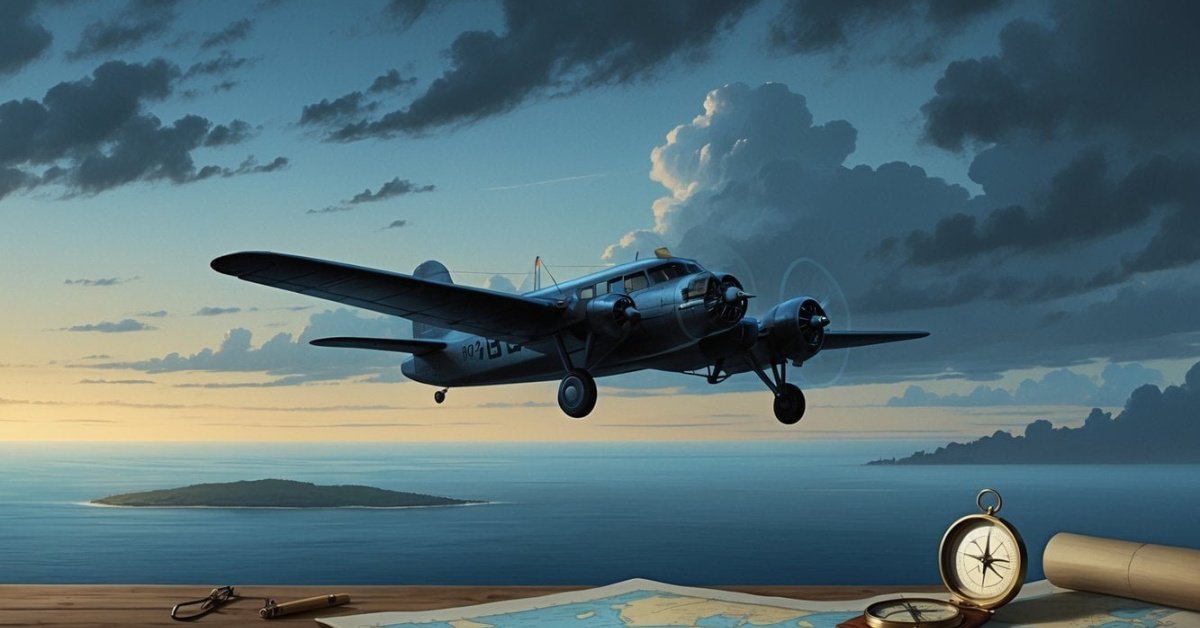
Amelia Earhart’s disappearance is one of history’s most famous mysteries. In July 1937, she vanished during an ambitious flight around the world, and searches to find her lasted for weeks with no success. To this day, nobody knows exactly what happened to Amelia Earhart after her plane went missing over the Pacific Ocean.

Many people have tried to solve the puzzle. Over the years, new evidence and theories have kept the story alive and captured the imagination of people around the world. The story of Earhart’s last flight still fascinates because of the search for answers and the idea that the truth might still be out there.
Multiple ideas compete to explain her fate, from her running out of fuel and crashing into the ocean to other more unusual possibilities. Reports and investigations, like the one by the U.S. government, point to her likely crashing at sea, but the real answer remains hidden, making the mystery of Amelia Earhart’s disappearance an enduring topic for exploration and debate. For a summary of key theories and search efforts, see this Britannica article on her disappearance.
Amelia Earhart: Early Life and Aviation Journey

Amelia Earhart grew up with big dreams and a strong curiosity about the world. She faced many challenges but became known for her brave flights and for changing history in aviation.
Childhood and Inspiration
Amelia Earhart was born on July 24, 1897, in Atchison, Kansas. Her childhood was shaped by her love for adventure and learning. She was close to her younger sister, Muriel, and together, they would climb trees and explore the outdoors.
Amelia’s family moved several times because of her father’s job issues. She did not always have an easy home life. Even with struggles, she stayed curious and read many books.
Her first real interest in flying began in her early twenties. In 1920, she took a ten-minute ride in a plane, which changed everything for her. After landing, Amelia knew she wanted to fly. This moment set her on the path to becoming a pilot. More about her early life can be found at Britannica’s Amelia Earhart page.
Breaking Barriers in Aviation
Amelia worked many jobs to pay for flying lessons, including as a truck driver and photographer. She saved enough to buy her first plane, a second-hand yellow Kinner Airster that she named “The Canary.”
By 1923, she earned her pilot’s license, becoming one of the first women in the United States to do so. At the time, very few women flew airplanes. She often faced criticism and doubt just because she was a woman.
Amelia did not let this stop her. She joined groups that supported women pilots, like the Ninety-Nines. She also spoke out for women’s rights and showed by example that women could achieve what they set their minds to. She became a symbol for women in aviation, which is detailed on Wikipedia’s Amelia Earhart page.
Famous Solo Flights
One of Amelia’s most important flights happened in 1932. She became the first woman to fly solo across the Atlantic Ocean. She flew from Newfoundland, Canada, all the way to Ireland. This dangerous trip made headlines around the world.
After that, she broke more records:
- First person to fly solo from Hawaii to California
- Set speed and distance records in various races
- Became the first woman to receive the Distinguished Flying Cross
People everywhere began to admire her bravery and achievements. Her famous flights are discussed in further detail on History.com’s article about Amelia Earhart.
Planning the Final Flight

Amelia Earhart’s last journey took months of careful planning and preparation. She set out with a clear goal, detailed logistics, and a trusted team, hoping to make history on the world stage.
The Round-the-World Ambition
Earhart’s main goal was to fly around the world near the equator, which would be the longest possible route. She wanted to prove not just her own skills, but also the reliability of modern airplanes. The planned path would span about 29,000 miles and cross four continents and multiple oceans.
The trip was ambitious and broke down into many legs, each with carefully chosen stopping points. One of the most difficult stretches was the flight from Lae, Papua New Guinea, across the Pacific to a tiny point called Howland Island. This leg alone was nearly 2,500 miles over open ocean, making navigation and fuel management critical to success. Earhart announced her plan widely to raise support and excitement for the trip. Her adventure was followed closely by newspapers and radio around the world.
Technical Preparation and Aircraft
Earhart selected a Lockheed Electra 10E for her journey. This airplane was chosen for its long range, strong build, and advanced equipment for its time. The plane was modified to carry extra fuel tanks, with a capacity of about 1,100 gallons, to help it handle the longer ocean crossings.
Navigation equipment included a radio direction finder and various communication tools. However, setup and testing of this equipment proved to be tricky. Reports show that the radio sometimes failed to work properly, which caused problems during the flight. Earhart and her team worked to make repairs at every stop, but not all technical issues could be fixed before the next leg.
Key technical upgrades for the flight:
| Upgrade | Purpose |
|---|---|
| Extra fuel tanks | Extended flight range |
| New navigation instruments | Improve route accuracy |
| Reinforced landing gear | Handle rough takeoffs and landings |
Crew Members and Roles
The main crew on the final flight consisted of Amelia Earhart, the pilot and leader, and Fred Noonan, who served as navigator. Fred Noonan brought years of experience in navigation, especially over unknown and open ocean areas. His skills were crucial for hitting small targets like Howland Island.
While some earlier flights included additional crew, Earhart and Noonan were the only ones aboard the Electra during the last leg. Earhart took charge of piloting, communications, and making quick decisions. Noonan focused on maps, charts, and setting courses, often using the stars and sun for guidance.
Their success depended on strong teamwork and trust. As they approached the Pacific, this partnership became even more important because navigation mistakes could mean getting lost over endless ocean. Each brought their own set of strengths, but the mission was challenging for both of them. For more details about their roles and journey, see accounts from air and space historians.
The Last Flight: Timeline and Key Events

Amelia Earhart’s attempt to fly around the world pushed human limits and navigational skills. Each step of her trip was carefully planned, but the journey ended in mystery before her last stop. Below are the critical stages of her final adventure.
Departures and Stopovers
Amelia Earhart and her navigator, Fred Noonan, began their trip on June 1, 1937, starting from Oakland, California. Their plane, a Lockheed Electra 10E, was packed with fuel and supplies. They headed east, following a flight plan that spanned four continents and crossed both the Atlantic and Indian Oceans.
The team made many stops for fuel and needed repairs, visiting cities such as Miami, Darwin, and Calcutta. Over 28 days, they traveled about 22,000 miles, meeting reporters and welcoming crowds along the way. Each stop was important for checking the plane and giving Earhart and Noonan time to rest.
By late June, their flight was nearing the hardest stretch. They faced long flights over open water and fewer places to land if something went wrong. Still, spirits were high as they reached the last legs of their journey. For a complete timeline of the stops, visit this timeline of Amelia Earhart’s final flight path.
Arrival at Lae, New Guinea
On June 29, 1937, Earhart and Noonan landed in Lae, New Guinea. Lae was an important stop because it marked the start of the most difficult part of their trip—crossing the Pacific Ocean to reach tiny Howland Island. The crew spent time checking the aircraft, especially making sure radios and navigation tools were working.
The distance from Lae to Howland Island was about 2,556 miles. This was one of the longest and most dangerous parts of their journey, mostly over empty ocean. Bad weather and possible radio problems made things even riskier.
Lae was their last safe place to prepare. They loaded extra fuel and supplies to improve their chances of reaching Howland Island. Local weather reports were mixed, and there was concern about cloud cover and rain along their planned path.
Departure Toward Howland Island
On July 2, 1937, at 10 a.m. local time, Earhart and Noonan took off from Lae, aiming for Howland Island. Their route would take about 18 hours, and their navigation depended on precise radio signals. The U.S. Coast Guard ship Itasca was stationed near Howland to help guide them by radio.
The last leg was dangerous because Howland Island is very small and hard to spot. Earhart’s radio messages showed rising stress as she reported weak signals and trouble locating the island. Her final message said they were running north and south to try to find it.
After this, all contact was lost. Despite long searches, no trace of the plane or crew was ever found. The mystery continues, drawing interest from historians and aviation fans around the world.
Disappearance Over the Pacific
Amelia Earhart and her navigator Fred Noonan vanished during their attempt to fly around the world. The last part of their journey was full of radio confusion, tough weather, and strange reports of distress signals.
Final Radio Transmissions
On July 2, 1937, Earhart and Noonan flew from Lae, New Guinea, toward tiny Howland Island. The distance was about 2,500 miles over open ocean. Earhart kept in contact with the U.S. Coast Guard ship, Itasca, which waited near Howland to help them land safely.
Their last clear radio message reached the Itasca around 8:43 a.m. Earhart said they were flying “on line 157 337,” meaning they were searching for the island along a specific path. Before this, radio signals from Earhart sounded worried, and she said they couldn’t see the island or the ship. After this final report, no more clear transmissions were received from her plane. For more details, visit the search for Amelia Earhart.
Weather and Navigational Challenges
Heavy clouds and low visibility caused serious problems during this flight. Noonan, the navigator, relied on sun sightings and radio signals to locate Howland Island, but overcast skies made navigation much harder.
The Pacific Ocean’s open space left little room for error. The plane’s fuel was running low, which added pressure. Without clear radio signals or visual signs, even small mistakes in direction could mean missing the island by miles. Many experts believe fuel exhaustion caused the crash, as explained in Britannica’s report on the disappearance of Earhart.
Distress Calls and Signals
After the last known radio contact, people reported hearing strange radio signals that might have come from Earhart. Some amateur operators and even a few listening posts picked up faint messages that could have been distress calls.
Many of these reports described short, unclear messages asking for help and giving possible locations. However, most of these signals could not be traced, and the Coast Guard was unable to confirm if any were really from Earhart’s plane. These mysterious signals helped add to the confusion of her disappearance. A summary of these events is given in these five main theories about Amelia Earhart’s mystery.
Search Efforts and Immediate Response

Amelia Earhart’s disappearance in July 1937 led to one of the largest search operations of its time. Both private citizens and the United States government reacted quickly in an effort to find Earhart and her navigator, Fred Noonan.
Early Search Operations
As soon as radio contact with Earhart was lost, search efforts began. The first actions involved sending out distress calls, hoping Earhart would respond. Ground stations and nearby ships tried to listen for her signal.
Earhart’s husband, George Putnam, played a key role. He organized private search efforts, hiring planes and boats to look for any sign of her plane. The private search focused on the islands and waters along her planned flight path. It continued even after the official government operation slowed down.
People offered tips and theories, which Putnam often followed up on. Eventually, the search even included psychic advice, but nothing concrete turned up. The challenge was the vast area—covering thousands of square miles of open ocean and small islands—making a thorough search extremely difficult. More details on Putnam’s search can be found on this History Facts article about Earhart’s search.
Involvement of the U.S. Navy
The United States Navy began its official search right after Earhart was declared missing. The main resources used were the aircraft carrier USS Lexington and several destroyers, along with aircraft and search boats.
Navy crews scanned the ocean and small islands in the area where Earhart’s plane was last heard from. They used both visual searches and radio equipment, trying to pick up any trace of her aircraft or radio signals. The area searched was extremely wide and challenging due to rough seas and remote locations.
After about two weeks, the Navy ended its official mission on July 18, 1937. They found no confirmed wreckage or evidence of the missing plane. The scope of the operation was remarkable for the time, but the exact circumstances of the disappearance remain unexplained.
Popular Theories on Amelia Earhart’s Fate
Researchers and historians have studied Amelia Earhart’s last flight for decades. Several well-known ideas try to explain why she never reached her destination. Each theory is based on clues, reports, and eyewitness stories.
Crash and Sink Theory
The Crash and Sink Theory says that Amelia Earhart and her navigator, Fred Noonan, crashed into the Pacific Ocean after running out of fuel. Supporters point out that their last radio transmission said they were low on gas and couldn’t find Howland Island. The search at the time focused mostly on the ocean near the island.
No sign of the plane was ever discovered, but experts believe it may be deep underwater. Ocean searches using sonar and submersibles have not found wreckage, but the Pacific is vast and reaches great depths. Many major organizations still say this theory is most likely. You can read more on the main theories behind her disappearance.
Gardner Island (Nikumaroro) Hypothesis
The Gardner Island Hypothesis suggests that Earhart and Noonan landed on a remote island called Nikumaroro, then known as Gardner Island. Evidence includes pieces of airplane wreckage, a woman’s shoe, and reports of radio distress calls from the island just days after Amelia disappeared.
Researchers from the International Group for Historic Aircraft Recovery (TIGHAR) have led multiple trips to Nikumaroro. They found bones that some believe could be from a woman of Earhart’s height and build, though DNA tests have not proven anything for sure. This idea remains popular because the island is close to where Earhart’s plane was last heard. National Geographic covers more on the top Nikumaroro theory.
Japanese Capture Theory
The Japanese Capture Theory claims that Earhart and Noonan were captured by Japanese forces after landing or crashing in the Marshall Islands or Saipan. Some people living on these islands say they saw a woman pilot and heard reports about the pair being held by the Japanese military.
This theory gained attention from a 1970 book and stories passed down from islanders. Some believe that Earhart may have survived for some time in Japanese custody. To this day, no solid evidence has been found to prove the story. Learn more about the Japanese capture claims here.
Key Evidence and Investigations

Amelia Earhart’s disappearance in 1937 has led to decades of searching and debate. Important clues have included unusual artifacts, personal stories from people at the time, and organized efforts to find proof of what happened.
Recovered Artifacts
Several items have been found over the years that may be linked to Earhart’s last flight. Shoes, pieces of metal, and possible airplane parts were recovered on Nikumaroro Island in the Pacific. These artifacts have sparked interest because some items matched the time period and could have belonged to a female pilot.
In one notable case, human bones found on Nikumaroro in 1940 were studied. Recent research suggests the bones may have belonged to a woman of Earhart’s height and build. Other items, like a makeup compact and a pocket knife, have also raised hopes that the site could explain what happened to Earhart and her navigator.
Groups such as The International Group for Historic Aircraft Recovery (TIGHAR) have led searches and detailed studies of these items. Many believe Nikumaroro holds the key to the enduring mystery.
Eyewitness Accounts
A handful of people from islands in the Pacific have claimed to hear or see signs of Earhart after her plane disappeared. Some said they heard strange radio messages, including distress calls, coming from her aircraft. Others reported seeing a plane crash or even spotting strangers matching Earhart’s and Noonan’s descriptions on remote islands.
These accounts, while intriguing, often lack physical proof. Determining the reliability of these memories has been difficult, since many were collected years later. Some stories even came from people who had heard rumors rather than seen events themselves. While interesting, these eyewitness stories have not led to a confirmed discovery.
Modern Search Efforts
Searches for Amelia Earhart have used new technology and large teams. After she vanished, the U.S. Navy made a wide effort, sending ships and planes to look for signs of her plane but finding nothing. Since then, groups have used sonar, underwater robots, and aircraft to look for wreckage along her flight path.
One of the most active groups continues to be TIGHAR, which has led several expeditions to Nikumaroro. New analyses and evidence, like DNA tests and bone studies, are being used to find answers. Recent studies of old bones found on the island have hinted they may belong to Earhart, but doubts remain. Many of these modern searches and scientific tests are discussed in detail by the Smithsonian National Air and Space Museum and other organizations.
Legacy and Lasting Impact

Amelia Earhart’s story continues to shape both the world of aviation and how people see women in exploration. Her achievements and courage have left permanent marks in these areas.
Influence on Aviation History
Amelia Earhart is credited as a true aviation pioneer. She was the first woman to fly solo nonstop across the Atlantic Ocean and was known for setting several other records. She also played a key part in making air travel more popular during a time when flying was still new and dangerous.
Airlines and organizations use her example to inspire future pilots. Many museums feature exhibits about her flights, including both her accomplishments and the mystery of her disappearance. Her influence reaches pilots and fans worldwide, as highlighted on Historic Mysteries.
Table: Major Accomplishments
| Achievement | Year |
|---|---|
| First woman to fly solo across Atlantic | 1932 |
| First person to fly solo Hawaii to U.S. mainland | 1935 |
| Set women’s speed and altitude records | 1930s |
Women in Exploration
Earhart worked hard to show that women were just as capable as men at exploring and achieving great things. She encouraged women to fly planes and take on leadership roles. As a founder of The Ninety-Nines, a group for women pilots, she helped open doors for countless women in aviation.
Her life became an inspiration for books, movies, and classroom projects around the world, as shown by the lasting interest in her story on Popular Timelines and Sick History. Organizations still hold discussions and events in her honor. Many young girls and women see her as proof that anyone can chase bold dreams in science, travel, and beyond.
Further Unanswered Questions
Many questions about Amelia Earhart’s disappearance still do not have clear answers. Even experts disagree about what really happened on that day in July 1937.
Was the Lockheed Electra ever found?
Despite many searches, her exact plane has never been recovered. Every new lead raises hopes, but no solid proof of the aircraft’s location exists.
Did Earhart and Noonan survive for a time after landing?
Some believe they may have landed on a remote island and survived as castaways. Others think the plane crashed straight into the ocean.
What happened to the bones found decades ago?
There were claims that bones found on a Pacific island in the 1940s could belong to Earhart. Later research said the bones matched her size, but this is still debated among scientists. Read more about the ideas surrounding these findings at NPR’s article on bones possibly linked to Earhart.
Key questions that remain:
| Question | Still Unanswered? |
|---|---|
| Where is the plane? | Yes |
| How did Earhart’s last hours unfold? | Yes |
| Was there any distress signal sent? | Yes |
| Who discovered the last credible clues? | Yes |
These mysteries keep people interested and searching for answers year after year.
Contemporary Perspectives and Ongoing Interest
People still care deeply about what happened to Amelia Earhart. Her story is shared in classrooms, documentaries, and online forums. New generations keep discovering her mystery and are encouraged to ask their own questions.
Many researchers use advanced technology like DNA analysis and sonar mapping to search for answers. These tools help people look for clues in places that were hard to explore before. For example, teams have scanned Pacific islands and the ocean floor, hoping to find evidence of her plane.
Some recent findings and ongoing research have led to renewed public interest. Stories about potential remains or new discoveries often make headlines. This helps keep Amelia Earhart’s legacy alive and keeps the mystery in the news. You can read more about current theories and developments in articles like this one from USA Today.
The topic also comes up in popular culture. Books, movies, and even podcasts continue to share her journey and explore what might have happened.
Here’s a simple table showing main reasons people remain interested:
| Reason | Description |
|---|---|
| Unsolved Mystery | People enjoy solving puzzles and finding new clues. |
| Technological Advances | New tools offer hope for future discoveries. |
| Inspiring Life Story | Earhart’s achievements motivate both students and adults. |
| Community Involvement | Many work together from different countries and backgrounds. |