Josh Gates takes audiences on a holiday adventure in ‘Twas the Search for St. Nick. He explores the real-life story behind one of the world’s most famous figures.
St. Nicholas, a 4th-century bishop from Myra in modern-day Turkey, started the legend of Santa Claus. He became known for his generosity and compassion.
This journey shows how a humble man of faith turned into the global symbol of Christmas. The adventure traces his story across centuries and continents.
The expedition crosses continents, starting from ancient churches in Turkey and moving to relics in Italy. Josh Gates even makes surprising stops like Chicago.
Along the way, he gathers clues, examines historical records, and uses DNA analysis. These steps help reveal the truth about the man behind centuries of holiday tradition.
By following St. Nicholas’s footsteps, the story shows how culture, history, and science shape the Santa Claus we know today.
The Search for St. Nick: An Epic Holiday Quest
Josh Gates travels across several countries to investigate the real-life figure behind Santa Claus. He follows historical clues, scientific evidence, and cultural traditions to piece together the story of St. Nicholas.
Uncovering the Mystery of Santa Claus
St. Nicholas, a 4th-century bishop from Myra in present-day Turkey, inspired the modern Santa Claus. Historical accounts describe him as generous, giving to the poor and protecting children.
Over time, his story spread across Europe and blended with local customs. In Italy, people believe his bones rest in Bari, while some traditions link his remains to Venice.
Researchers use archaeology, church records, and DNA analysis to study these relics. This scientific approach helps separate fact from legend.
Gates visits these sites to examine their authenticity.
The Role of Expedition Unknown
The holiday special of Expedition Unknown traces St. Nicholas’ path across continents. The show combines travel, history, and science to tell his story.
Filming took place in Turkey, Italy, and the United States. Gates explores Myra’s ancient ruins and churches in Turkey.
In Chicago, he visits a scientific lab to examine bone fragments linked to the saint. The episode shows both field exploration and lab testing to give viewers a clear look at historical investigations.
Josh Gates and His Adventure
Josh Gates leads the search with curiosity and humor. He interviews historians, archaeologists, and religious experts during his journey.
His travels take him from the Mediterranean coast to busy city streets, always following clues. In Bari, he observes the shrine where pilgrims honor St. Nicholas.
In the lab, Gates watches experts analyze DNA from relics to check if they match Nicholas’ time and place. This mix of travel and science makes the Search for St. Nick educational and engaging for viewers on Discovery.
Tracing the True History of St. Nicholas
St. Nicholas was a real person who inspired centuries of traditions. His story mixes recorded history with folklore, creating a figure remembered for generosity and acts of kindness.
St. Nicholas: The Historical Figure
St. Nicholas was born in the late 3rd century in Patara, now part of Turkey. He became bishop of Myra while Christianity was still spreading through the Roman Empire.
Historical records show he was deeply committed to helping the poor. He often gave aid in secret, inspiring the tradition of anonymous gift-giving.
Archaeological and historical studies indicate he was buried in Myra. Over time, people moved his remains, with some relics taken to Bari, Italy.
Legends and Legacy
Many famous stories about St. Nicholas come from oral traditions. One account tells how he secretly gave dowries to three sisters to save them from slavery.
Another story describes him calming a storm at sea to save sailors. These legends spread across Europe during the Middle Ages.
They helped establish him as the patron saint of children, sailors, and travelers. His feast day, December 6, became a time for giving small gifts in many regions.
Over time, these customs blended with other winter traditions and shaped the modern Santa Claus.
Separating Fact from Fiction
It is challenging to separate the true history of St. Nicholas from legend. Written records from his lifetime are scarce, and many stories were recorded much later.
Historians use church documents, archaeological evidence, and relic studies to piece together his life. Modern investigations, such as those in Expedition Unknown: ‘Twas the Search for St. Nick, even use DNA testing to examine remains.
While not all stories can be proven, his generosity is well supported by evidence.
From Turkey to Italy: Following the Footsteps of St. Nicholas
St. Nicholas lived on the southern coast of Turkey and was later buried in Italy. His story connects both places through religious tradition and archaeological discoveries.
The Saint’s Early Life in Turkey
St. Nicholas was born in Patara, in what is now southwestern Turkey. He later became the bishop of Myra, now called Demre.
As bishop, he gave gifts to the poor in secret and defended his faith during Roman persecution.
Myra’s St. Nicholas Church became a major pilgrimage site after his death. Excavations there have uncovered Byzantine-era structures and possible burial chambers that may hold clues to the saint’s remains.
Journey to Italy
Centuries after his death, sailors from Bari, Italy, took what they believed were St. Nicholas’s bones from Myra in 1087. They brought them to Bari’s Basilica di San Nicola, where they remain today.
They moved the relics to protect them during political unrest. This also made Bari a major pilgrimage destination.
Researchers now compare bone fragments in Bari to relics in other locations. Some expeditions, including those in Expedition Unknown: ‘Twas the Search for St. Nick, investigate whether more remains are still in Turkey.
Cultural Significance Across Continents
Both Turkey and Italy honor St. Nicholas. In Turkey, he is remembered as a bishop and local figure.
In Italy, he is revered as a patron saint, especially by sailors and merchants. Religious festivals in Bari each May celebrate his arrival from Myra, while Demre holds events for his feast day in December.
This shared heritage shows how one person’s life can shape traditions in different countries.
The Science Behind the Search
Researchers use biological testing and advanced imaging to learn more about Saint Nicholas. These methods help confirm the age, origin, and appearance of the man who inspired Santa Claus.
DNA Analysis and Saint’s Remains
Historians believe Saint Nicholas was buried in Myra, in present-day Turkey. Over time, his bones were moved, and some are now in Italy.
In Expedition Unknown: ‘Twas the Search for St. Nick, Josh Gates and his team follow clues from Turkey to Italy to investigate the saint’s missing remains. They work with local experts to examine relics.
DNA testing helps determine if bones from different places belong to the same person. Experts extract genetic material from the remains and compare it to known samples.
Analysis can also confirm the approximate age and geographic origin of the bones. These results help historians verify the authenticity of relics.
Modern Technology in Historical Investigations
Scientists use 3D forensic reconstruction to recreate the face of Saint Nicholas from his skull. This process combines CT scans, digital modeling, and anatomical knowledge.
This technology gives people a visual connection to historical figures. It also supports research by showing physical traits that match written descriptions.
Other tools, like radiocarbon dating and isotope analysis, help determine when and where the saint lived. These methods do not damage the remains but still provide valuable information.
Together, these techniques help turn centuries-old mysteries into real discoveries.
Transforming St. Nicholas into Santa Claus
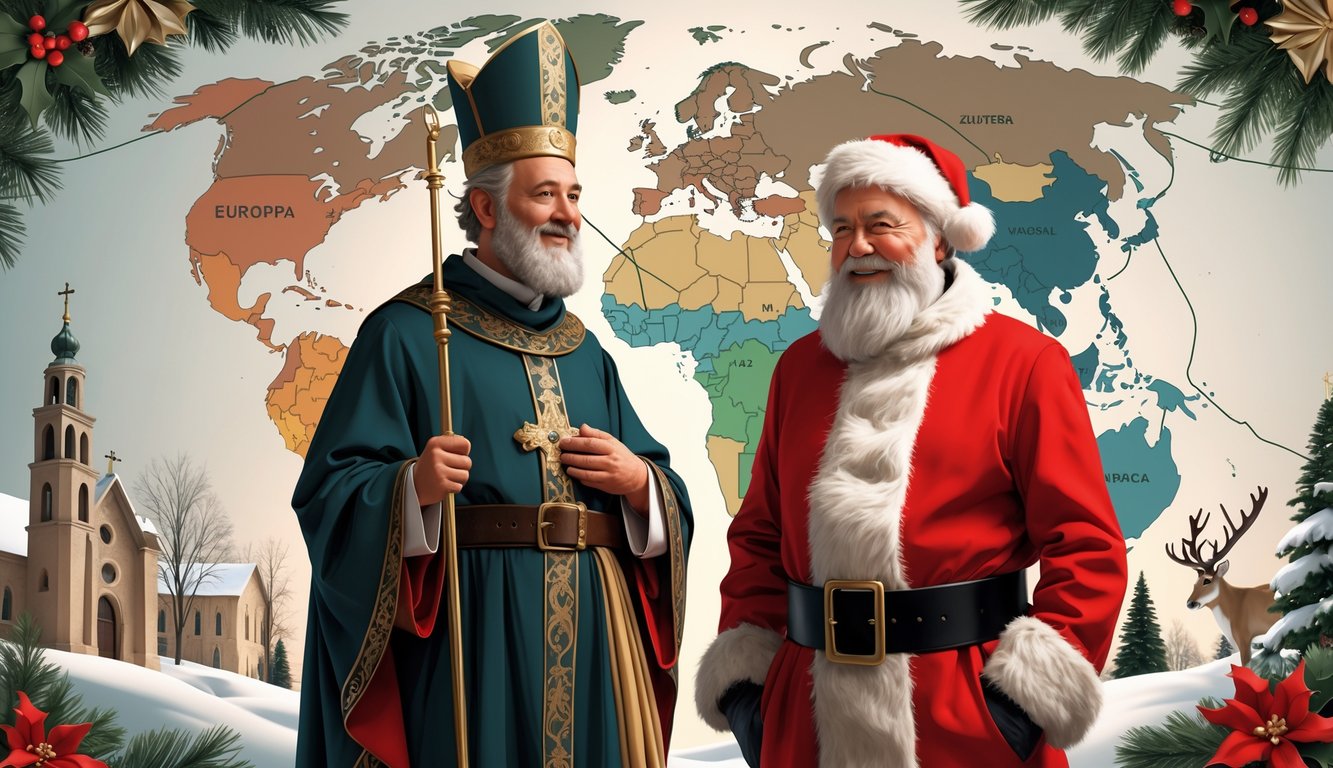
St. Nicholas began as a 4th-century bishop in Myra, known for his generosity and charity. Over centuries, his image and traditions changed through art, literature, and cultural exchange.
These changes eventually created the modern figure recognized during Christmas.
Evolution of the Santa Image
Early images of St. Nicholas showed him in bishop’s robes, holding a staff, and wearing a mitre. These depictions highlighted his religious role.
By the 19th century, artists reimagined him. The 1823 poem A Visit from St. Nicholas described a jolly, plump man delivering gifts in a sleigh pulled by reindeer.
Illustrator Thomas Nast later added key features like the red suit, fur trim, and cheerful demeanor.
In the 20th century, advertising made this look famous. Coca-Cola’s holiday campaigns in the 1930s popularized a warm, friendly Santa with a round face and twinkling eyes.
This image became the standard worldwide and replaced many regional variations.
Key changes in Santa’s appearance:
| Period | Main Features |
|---|---|
| Early Christian | Bishop’s robes, mitre, staff |
| 1800s Literature | Plump, merry gift-giver, sleigh |
| 1900s Advertising | Red suit, fur trim, friendly face |
Influence of European Traditions
In the Netherlands, children celebrate Sinterklaas, a gift-bringer who arrives by boat from Spain. Dutch settlers brought this tradition to the New World and called him “Sinter Klaas.” The name later became Santa Claus.
In Germany, St. Nicholas blended with Father Christmas and other winter figures. These traditions combine religious and folk elements, such as rewarding good children or punishing the naughty.
France knows him as Père Noël, while parts of Eastern Europe call him Father Frost. Each culture keeps St. Nicholas’s generosity but adapts his appearance and customs to local beliefs.
Arrival in America
Dutch immigrants brought Sinter Klaas to New Amsterdam (now New York City) in the 1600s. English-speaking communities later adapted the name to “Santa Claus” and changed his traditions.
Writers like Washington Irving helped spread the legend. In his 1809 book A History of New York, he described St. Nicholas flying over rooftops and delivering gifts.
This playful portrayal made the figure more appealing to a broader audience. By the mid-1800s, Santa Claus became a central character in American Christmas celebrations.
Illustrations, poems, and holiday cards reinforced the image of a joyful gift-bringer.
Santa Claus Around the World
Santa Claus appears in many forms across different countries. Local history and culture shape each tradition.
Some customs focus on gift-giving, while others highlight religious roots or community celebrations.
Global Traditions and Celebrations
In North America, Santa Claus wears a red suit and delivers gifts on Christmas Eve. This image became popular in the 19th century and still appears in movies, ads, and parades.
In the Netherlands and Belgium, children celebrate Sinterklaas on December 5 or 6. Dressed as a bishop, he arrives by boat from Spain and gives treats to well-behaved children.
In Italy, La Befana, a kind witch, brings gifts on January 6 during Epiphany. This tradition blends Christian beliefs with Italian folklore.
In Germany and Austria, Christkind—an angelic gift-bringer—visits on Christmas Eve. In some areas, St. Nicholas still comes earlier in December.
Table: Key Gift-Giver Dates
| Country | Gift-Giver | Date of Visit |
|---|---|---|
| USA/Canada | Santa Claus | Dec 24–25 |
| Netherlands | Sinterklaas | Dec 5–6 |
| Italy | La Befana | Jan 6 |
| Germany | Christkind | Dec 24 |
Unique Customs in Different Cultures
In Iceland, children place shoes in windows for 13 nights before Christmas. Each night, one of the Yule Lads leaves small gifts or potatoes, depending on behavior.
In Japan, Christmas is not a public holiday, but many people celebrate with festive lights and a special meal of fried chicken. Santa Claus is called “Santa-san” and is seen as a bringer of joy.
In Mexico, families join Las Posadas, a nine-night procession reenacting Mary and Joseph’s search for shelter. Gifts are given on Christmas or during Día de los Reyes on January 6.
In Finland, many believe Santa lives in Lapland. Children visit “Santa’s Village” in Rovaniemi, a popular winter destination.
For more examples of Santa’s forms around the world, see this list of different versions of Santa Claus from around the world.
The Impact of Media and Popular Culture
Stories, illustrations, and advertising have shaped how people picture Santa Claus today. Literature and visual media have fixed his red suit, white beard, and cheerful personality in the public mind.
‘Twas the Night Before Christmas and Beyond
In 1823, the poem A Visit from St. Nicholas, or ‘Twas the Night Before Christmas, described Santa as a plump, jolly figure in a sleigh pulled by eight reindeer.
This poem set his appearance and behaviors, like entering homes through chimneys and delivering gifts on Christmas Eve.
Its popularity grew through newspapers and books. Artists later illustrated the verses, giving Santa a consistent look.
By the late 19th century, this image had spread across the United States. The poem’s detail created a lasting template for Santa Claus that still influences modern portrayals.
Santa Claus in Art and Advertising
Artists in the 19th and 20th centuries refined Santa’s image. Illustrator Thomas Nast drew him in a red suit with fur trim and added details like the North Pole workshop and the “naughty or nice” list.
By the early 1900s, advertisers used Santa to promote products during Christmas. Companies like Coca-Cola made him more popular through colorful holiday ads.
These campaigns highlighted warmth, generosity, and joy. Visual media—from magazine covers to store displays—reinforced this version of Santa across generations.
Today, this commercialized image appears in films, television, and holiday marketing worldwide. Santa Claus has become one of the most recognized symbols of Christmas. Learn more about his transformation in this history of Santa Claus.
Notable Figures in the Modern Search
Historians, television hosts, and authors have uncovered the real story of St. Nicholas. Their work combines historical research, travel, and modern technology to connect ancient traditions with today’s Santa Claus.
Josh Gates’ Contributions
Josh Gates, host of the Discovery series Expedition Unknown, has explored the life and legacy of St. Nicholas. In the holiday special ‘Twas the Search for St. Nick, he traveled across three continents to investigate historical clues.
He visited ancient Myra in modern-day Turkey and Bari, Italy, where relics of St. Nicholas are kept. He met with historians, archaeologists, and church officials to verify accounts of the saint’s life.
He examined human remains believed to belong to St. Nicholas. With the help of experts, Gates explored the use of DNA analysis to confirm their origin.
Through his investigations, Gates brought academic research to a wide audience. His storytelling made the history of St. Nicholas accessible to viewers.
Other Key Researchers
Travel writer Jeremy Seal studied how St. Nicholas became the modern Santa Claus. His book Nicholas: The Epic Journey from Saint to Santa documents travels from Turkey to other countries linked to the saint’s story.
Historians have traced the transformation from Sinterklaas to Santa Claus. They examine the influence of the 1823 poem A Visit from St. Nicholas and 19th-century illustrations.
Religious scholars highlight St. Nicholas’s role as the patron saint of sailors, children, and the poor. Their research focuses on his charitable acts, which inspired his link to gift-giving.
By using archaeological evidence, literature, and oral traditions, these researchers explain how a 3rd-century bishop became a global Christmas icon.
The Enduring Spirit of Christmas
Acts of giving and care shape Christmas celebrations in many cultures. From St. Nicholas to the modern Santa Claus, traditions focus on helping others and sharing joy.
Kindness and Generosity Through the Ages
St. Nicholas of Myra, a 4th-century bishop, became known for his quiet acts of charity. He gave gifts in secret, such as leaving coins for families in need.
His actions built a reputation for compassion that spread across Europe. Over time, different regions adapted his story.
In the Netherlands, he became Sinterklaas. In France, he was Père Noël. These figures often visited children in early December, bringing small presents or sweets.
Gift-giving traditions linked to St. Nicholas inspired the modern Santa Claus. Many cultures still celebrate St. Nicholas Day on December 6 with community events and charitable acts.
| Region | Name for St. Nicholas | Common Tradition |
|---|---|---|
| Netherlands | Sinterklaas | Gifts on Dec 5 |
| France | Père Noël | Sweets for kids |
| Germany | Nikolaus | Shoes filled with treats |
Santa’s Message Today
The modern Santa Claus blends the history of St. Nicholas with cultural influences from literature and advertising. The 1823 poem and Coca-Cola campaigns shaped his red-suited image.
Today, Santa Claus stands for kindness, family gatherings, and seasonal giving. His story encourages people to help others without expecting anything in return.
Communities support this message through toy drives, food donations, and volunteer work during Christmas. The focus on generosity continues the values of the original St. Nicholas.
Continuing the Legacy: What the Future Holds

Historians and scientists keep uncovering new details about the life and remains of St. Nicholas. Modern tools, like DNA analysis and archaeological surveys, help researchers confirm facts and challenge old assumptions.
Ongoing Research and Discoveries
Recent investigations, such as those in Expedition Unknown: ’Twas the Search for St. Nick, have traced artifacts and relics from Turkey to Italy. These studies aim to verify the true history of St. Nicholas through physical evidence.
Archaeologists examine churches in Demre, Turkey, where St. Nicholas served as bishop. Ground-penetrating radar has found hidden chambers that may hold remains or personal items.
DNA testing on relics stored in Bari, Italy, helps confirm if they match bones found in other locations. This work requires cooperation between museums, religious institutions, and universities.
Researchers compare ancient records with modern findings to create a more accurate timeline of his life. This process often leads to small but important corrections in historical accounts.
Preserving St. Nicholas’ Story
People work to preserve St. Nicholas’ legacy by focusing on both physical relics and cultural traditions. Churches in Turkey and Italy keep shrines that attract visitors throughout the year.
These sites offer historical exhibitions and hold religious services. Staff members manage both activities.
Teachers and museum educators explain the saint’s charitable acts in education programs. They help young people separate fact from legend and understand the difference between St. Nicholas and Santa Claus.
Archivists upload high-resolution images of manuscripts, relics, and archaeological sites to digital archives. This gives people around the world access without risking the original items.
Communities organize St. Nicholas Day celebrations to keep his story alive. These events blend history with local customs and may include storytelling, charity drives, or reenactments from his life.