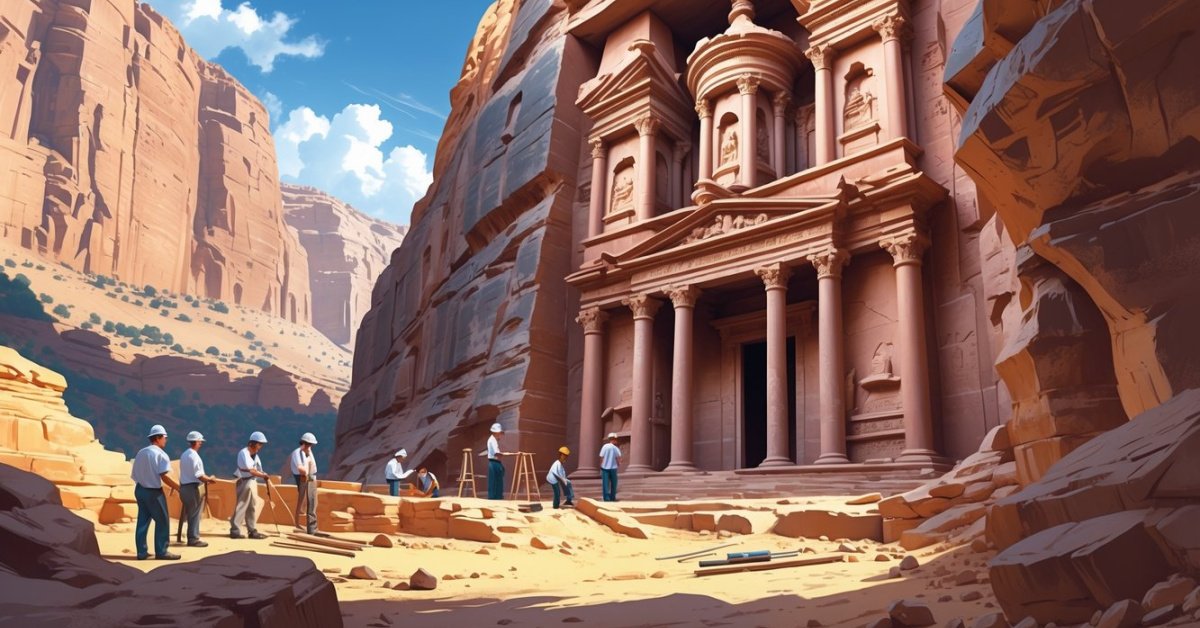
Beneath Petra’s famous rose-colored Treasury, archaeologists uncovered a hidden tomb sealed for nearly two millennia.
They found 12 human skeletons and artifacts dating back about 2,000 years, giving a rare glimpse into the Nabataean people’s lives and deaths.
This discovery adds a new chapter to the story of one of the world’s most visited ancient cities.
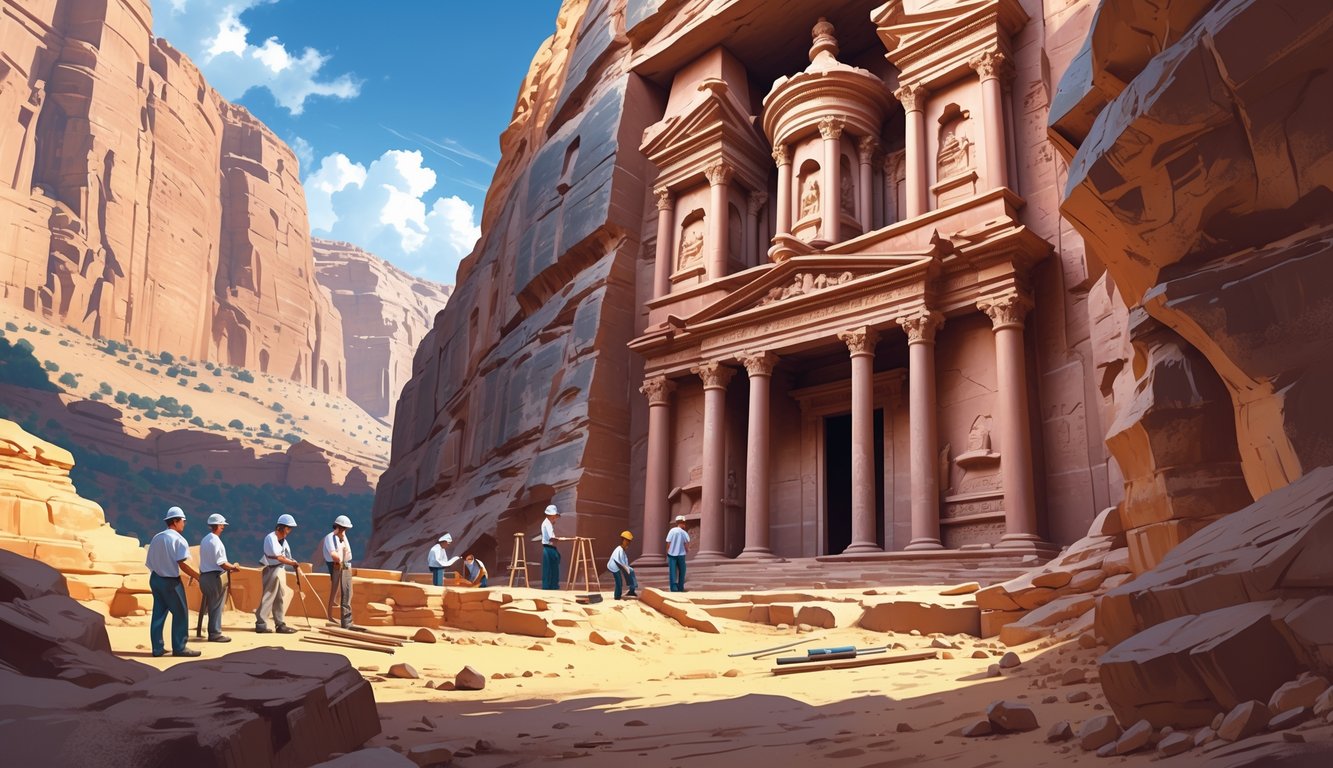
Archaeologists made this discovery directly under the structure known as Al-Khazneh.
The find challenges old ideas about the site’s purpose.
While the Treasury has long captivated visitors with its carvings and size, its underground secrets stayed hidden until now.
The tomb’s contents, including pottery and personal items, offer clues about Petra’s role as a cultural and ceremonial center.
Archaeologists and historians now work to piece together what these remains reveal about Nabataean burial practices and social life.
As excavation continues, each artifact and bone fragment adds detail to a picture that has been incomplete for centuries.
The Discovery Beneath the Treasury
Archaeologists in Petra, Jordan, revealed a 2,000-year-old tomb hidden under the Treasury, or Al-Khazneh.
They found human remains, artifacts, and rare architectural features that had been sealed for centuries.
Researchers used careful excavation and advanced technology to document the site without damaging its fragile contents.
Uncovering the Hidden Tomb
A research team with the American Center of Research began exploring beneath the Treasury after they noticed unusual ground features.
They suspected an underground chamber because of the building’s elevated platform and carved base.
Excavators revealed a staircase leading down to a sealed doorway.
Inside, they found 12 human skeletons along with pottery, jewelry, and carved stone fragments.
These items dated back to the 1st century AD and offer insight into Nabataean burial customs.
The tomb’s location directly under one of Petra’s most visited monuments made the discovery rare.
The chamber stayed untouched, preserving its layout and contents in remarkable condition.
The Role of Ground-Penetrating Radar
Before digging, the team used ground-penetrating radar (GPR) to map the area beneath Al-Khazneh.
This non-invasive method sent radio waves into the ground and measured reflections to detect buried structures.
The GPR scans showed a rectangular void about 15 feet below the surface.
This allowed archaeologists to plan their excavation precisely and avoid damaging important features.
By combining GPR data with surface measurements, the team confirmed the chamber’s size and orientation.
This technology reduced the risk of collapse and helped preserve delicate artifacts during removal.
It also provided a clear record of the site’s original state before any soil was disturbed.
Collaboration and Permissions
The project needed formal approval from the Jordanian Department of Antiquities.
Officials reviewed the excavation plan to make sure it met national heritage protection standards.
Researchers worked with local experts, including Petra-based conservators, to handle fragile materials.
The American Center of Research coordinated logistics and provided technical support throughout the dig.
This cooperation ensured that all work followed Jordan’s cultural heritage laws.
The findings remain in Jordan for further study and display, strengthening ties between international archaeologists and local heritage authorities.
Inside the Newly Discovered Tomb
Archaeologists uncovered a 2,000-year-old burial site beneath Petra’s Treasury, also known as Al-Khazneh.
They found human remains, valuable objects, and well-preserved structures that shed light on Nabataean burial customs.
The 12 Skeletons
The tomb contained 12 complete human skeletons, an unusual find in Petra where many graves have been looted or damaged.
The remains lay in separate niches within the rock-cut chamber.
Researchers believe the individuals belonged to the Nabataean elite, possibly linked to a nearby mausoleum.
Their placement suggests planned burials rather than a mass grave.
A mix of male, female, and juvenile skeletons was present.
This diversity may show family ties or a small community buried together.
Grave Goods and Artifacts
Archaeologists found a variety of grave goods with the skeletons.
These included bronze tools, ceramic vessels, and iron implements.
Some items appeared to be personal belongings, while others were likely offerings for the afterlife.
One notable find was an ancient ceramic cup that looks like the legendary Holy Grail, though experts confirm it is not the biblical relic.
The artifacts date to the Nabataean period and reflect both local craftsmanship and imported goods.
The arrangement of objects—near the head, feet, or chest—suggests symbolic meaning.
This careful placement offers clues to the beliefs and social status of those buried here.
Preservation and Condition of Remains
The skeletons stayed largely intact, which is rare in Petra’s tombs.
The sealed chamber beneath the Treasury protected them from weather and disturbance.
Bone surfaces show minimal erosion, which allows for possible DNA and isotope analysis.
These studies could reveal diet, health, and origins of the individuals.
Many of the ceramic and metal artifacts were also well preserved, with some showing surface decoration.
The stable microclimate inside the tomb likely slowed decay, making this find one of the most informative in recent Petra excavations.
For more details, see the hidden tomb beneath Petra’s Treasury.
Significance for Nabataean History
The discovery of an ancient tomb in Petra gives researchers direct evidence about how the Nabataeans treated their dead and organized their society.
Items found with the remains, along with the tomb’s location and design, help place these practices in the broader timeline of the Nabataean Kingdom under rulers like Aretas IV.
Funerary Practices Revealed
Archaeologists uncovered 12 skeletons near Petra’s Al-Khazneh façade, a site often linked to royal or elite burials.
The skeletal arrangement and presence of burial goods suggest a structured approach to honoring the dead.
The tomb’s architecture shows a blend of Nabataean styles with influences from Alexandria.
This style adaptation is visible in the façade-type tombs carved into Petra’s sandstone cliffs.
Finds such as pottery fragments, jewelry, and carved stone markers point to a belief in preparing the deceased for an afterlife.
The location near a major ceremonial space also shows the importance of public display in funerary customs.
Researchers believe these details match earlier evidence from the Negev Desert and Dead Sea region, where Nabataean cultural traits continued even after Roman annexation.
This continuity suggests that burial traditions were a key part of maintaining their identity.
Insights into Nabataean Society
The tomb’s size and its placement in a prominent area imply that those buried held high status.
In the Nabataean Kingdom, such positioning often reflected wealth, political influence, or family lineage.
Trade goods found in the tomb, including imported ceramics, reveal the Nabataeans’ far-reaching connections.
Their network extended to places like Italy, bringing luxury items such as gold, ivory, and perfumes into Petra.
The craftsmanship of the tomb highlights the skills of Nabataean artisans, who adapted foreign styles to local geology.
This ability to blend cultures while keeping their own identity marked their society.
By studying these remains and artifacts, historians gain a clearer picture of how social hierarchy, trade, and cultural exchange shaped life in Petra during and after the reign of Aretas IV.
For more details, see the discovery of 12 skeletons at Petra.
The Treasury: Petra’s Iconic Monument
Carved into rose-colored sandstone cliffs, the Treasury stands as one of Petra’s most recognized landmarks.
Its detailed façade, towering columns, and blend of artistic styles reflect the skill and cultural connections of the Nabataean civilization.
Visitors often stop here first when exploring the ancient city.
Architectural Marvel
The Treasury, also called Al Khazneh, measures about 39 meters tall and 25 meters wide.
Builders carved it directly into the cliff, showing precision stonework without mortar.
The façade combines Hellenistic and Near Eastern design elements.
Corinthian capitals crown the columns, while statues and reliefs show mythological figures.
A two-level design gives the structure balance.
The lower level features a portico with six columns, while the upper level holds a central tholos framed by smaller columns.
Its pink sandstone changes color with the sunlight, giving it a striking appearance at different times of day.
This visual effect made it a favorite subject for photography and film, including its appearance in Indiana Jones and the Last Crusade.
Debates on Its Purpose
Historians still debate the original function of the Treasury.
Some believe it served as a royal tomb for Nabataean kings, supported by the discovery of burial chambers nearby.
Others suggest it may have been a temple or ceremonial hall because of its elaborate design and prominent location at the city entrance.
Local legends add another layer of mystery.
Bedouin stories claimed the urn atop the façade held hidden treasure, inspiring the name Al Khazneh, meaning “The Treasury.”
Modern archaeological surveys, including ground-penetrating radar, have helped researchers better understand the site’s layout.
The recent tomb discovery beneath the Treasury adds new evidence that supports its role in Petra’s funerary practices.
Petra: The Ancient City
Petra in southern Jordan is carved into rose-colored cliffs and is known for its detailed stone architecture.
The Nabataean people built advanced water systems and monumental tombs that still stand today.
Its location in a narrow valley made it both defensible and a hub for trade routes linking Arabia, Egypt, and the Mediterranean.
Origins and Growth
Archaeological evidence shows that people settled in the Petra area as early as 7000 BC.
The city flourished under the Nabataeans around the 4th century BC.
They carved temples, tombs, and homes directly into the sandstone cliffs.
The most famous structure, the Treasury (Al-Khazneh), is a prime example of their craftsmanship.
Petra’s growth depended on its control of water in a desert climate.
The Nabataeans built cisterns, dams, and channels to store and distribute water year-round.
By the 1st century AD, Petra had become the Nabataean capital.
Roman annexation in 106 AD brought new architecture, including colonnaded streets and public buildings.
Today, sites like the Treasury still draw millions of visitors for their historical and cultural value.
Role in Trade and Culture
Petra’s location on the Incense Route allowed the Nabataeans to control valuable goods like frankincense, myrrh, and spices. Traders from Arabia, India, and the Mediterranean passed through its gates.
The city attracted many cultures. Visitors saw Greek, Roman, and Egyptian design mixed with Nabataean styles.
Markets in Petra sold imported luxury items and local crafts. This trade helped the Nabataeans grow wealthy and influential in the region.
Petra’s art, inscriptions, and architecture still show its cultural diversity. The city remains a key example of ancient urban life in the Middle East.
Archaeological Methods and Technology
Archaeologists used non-invasive scanning tools and careful digging to study the Petra tomb. These tools helped them map underground features before starting excavation.
This approach reduced the risk of damaging fragile remains.
Remote Sensing Techniques
The team used ground-penetrating radar (GPR) to find the tomb beneath the Treasury. GPR sends radar pulses into the ground and records reflections from buried structures.
Archaeologists saw the tomb’s outline and depth without disturbing the site. Petra’s sandstone erodes easily, so this step helped prevent collapse.
They also created a 3D digital model of the area. This model identified safe entry points for excavation and helped track progress.
By using these tools together, the team minimized damage to archaeological layers. They preserved the tomb and nearby features for future study.
Excavation Challenges
When excavation began, the team faced obstacles. The tomb lay beneath a busy tourist spot, so they worked in tight spaces and kept noise low.
Fragile sandstone walls needed supports to prevent cave-ins. The team removed soil and debris slowly, often by hand, to protect 2,000-year-old artifacts and human remains.
They followed strict permissions from the Jordanian government, which delayed digging. This process ensured that preservation standards were met.
Fluctuating desert temperatures made the work tough. Archaeologists scheduled shifts to protect workers and delicate finds from heat damage.
Media Coverage and Public Fascination
Television features and popular films have introduced the recent Petra tomb discovery to a wide audience. Viewers learned about the find through factual programming and adventure stories.
Expedition Unknown and Discovery Channel
The Discovery Channel series Expedition Unknown, hosted by Josh Gates, filmed parts of the excavation under Petra’s Treasury. The program captured the moment archaeologists uncovered the hidden chamber with 12 skeletons and ancient artifacts.
Footage showed pottery, tools, and stonework up close. Viewers also saw 3D scans and GPR images used to locate the tomb.
Expert interviews and on-site exploration helped audiences understand the excavation process. The show explained how archaeologists confirm the age and importance of finds.
The format mixed history and discovery, making Petra accessible to people worldwide. It also showed the careful conservation steps taken before removing artifacts.
Impact of Indiana Jones and the Last Crusade
Petra’s Treasury became famous after appearing in Indiana Jones and the Last Crusade. In the film, it served as the temple’s exterior.
Tourists often expect to see the movie’s interior, though the real building is solid stone. The recent tomb discovery renewed interest by connecting the site to both film and archaeology.
Film exposure boosted Petra’s recognition beyond academic circles. Many visitors first learn about Petra through the movie, then become interested in its real history.
This mix of Hollywood and real excavation has sparked public fascination, linking entertainment with heritage conservation.
Key Figures and Institutions
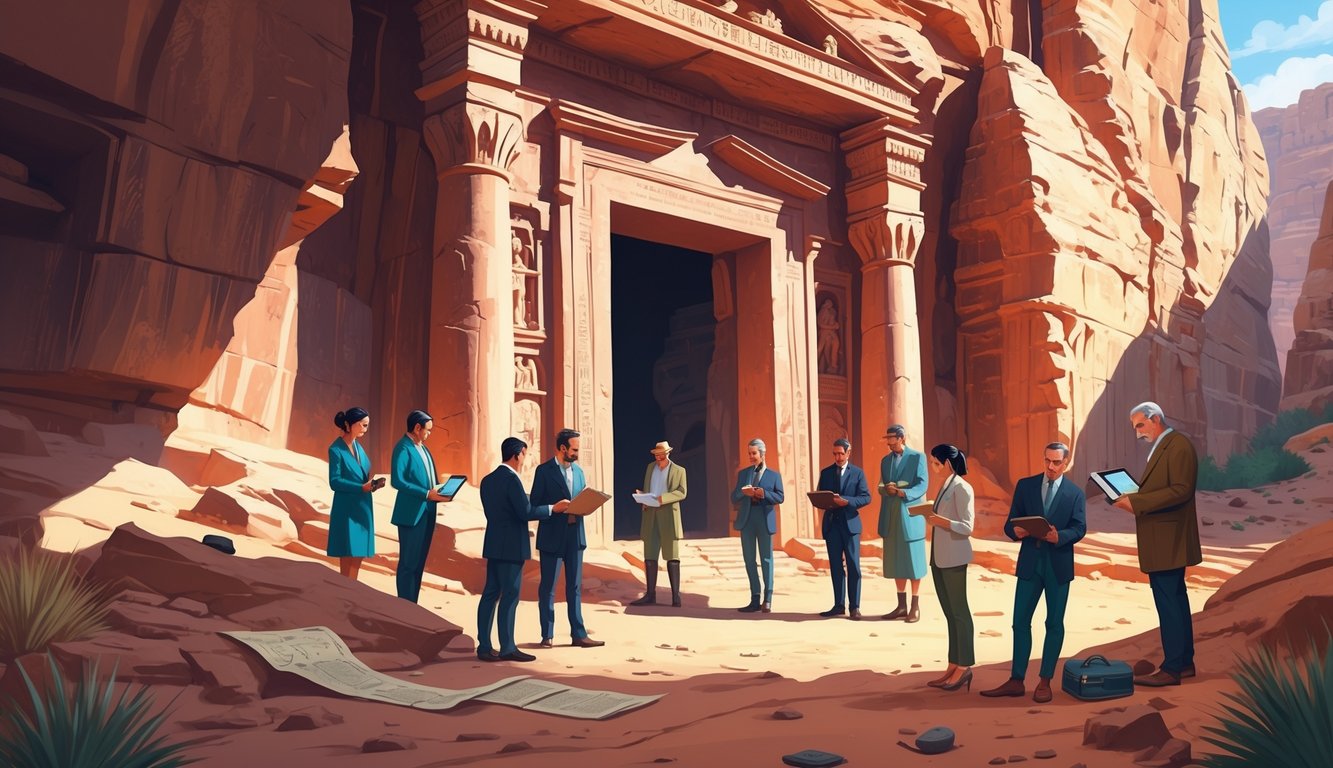
The excavation of the hidden tomb beneath Petra’s Treasury brought together skilled researchers and respected organizations. Their teamwork ensured careful recovery of remains and artifacts while documenting the site.
Archaeologist Pearce Paul Creasman
Pearce Paul Creasman is an archaeologist with years of field experience in the Middle East. He specializes in ancient architecture, burial practices, and cultural heritage preservation.
He led the team that uncovered the 2,000-year-old tomb with 12 skeletons and artifacts. He directed field operations, coordinated with specialists, and made sure all finds were recorded accurately.
Creasman balances scientific rigor with public engagement. He shares updates through interviews and academic publications, helping people understand discoveries.
His leadership in Petra shows his focus on combining research with conservation to protect historical sites.
The Role of the American Center of Research
The American Center of Research (ACOR), based in Amman, Jordan, supports archaeological projects, cultural documentation, and academic training. It has worked in Jordan since the 1960s.
For the Petra tomb excavation, ACOR provided logistical support, research resources, and connections with local authorities. This support helped the project meet scientific and legal requirements.
ACOR also helped Jordanian officials and international researchers collaborate. This cooperation streamlined permits, site access, and artifact handling.
Beyond Petra, ACOR runs fellowships, publishes research, and maintains archives for future studies. Its role in the tomb discovery shows how institutions can enable fieldwork and protect cultural heritage.
Petra’s Global Importance
Petra attracts millions of visitors each year for its archaeology, rock-cut architecture, and cultural heritage. The site holds international recognition for its preservation and status as a world landmark.
UNESCO World Heritage Status
UNESCO named Petra a World Heritage Site in 1985. The site earned this status for its cultural value and the skill of the Nabataean civilization.
Petra covers about 264 square kilometers, with temples, tombs, and water systems carved into sandstone cliffs. These features show advanced engineering in a desert environment.
UNESCO’s listing brings global efforts to protect Petra from erosion, tourism, and illegal excavation. Preservation projects often involve both Jordanian and international experts.
Petra’s place on the World Heritage List helps secure funding and technical support for conservation. It also raises public awareness to maintain its fragile structures for the future.
New Seven Wonders of the World
In 2007, Petra was named one of the New Seven Wonders of the World after a global poll by the New7Wonders Foundation. This title increased its visibility and boosted tourism.
The recognition highlights Petra’s famous landmarks, like the Al Khazneh (The Treasury) and the Monastery, both carved into rose-red cliffs. These monuments are among the world’s most photographed ancient sites.
Being on the New Seven Wonders list puts Petra alongside sites like the Great Wall of China and Machu Picchu. This global status makes it a must-visit for travelers interested in history and archaeology.
Many visitors now plan trips to see Petra because of this recognition, making it a key part of Jordan’s tourism economy.
Future Research and Unanswered Questions
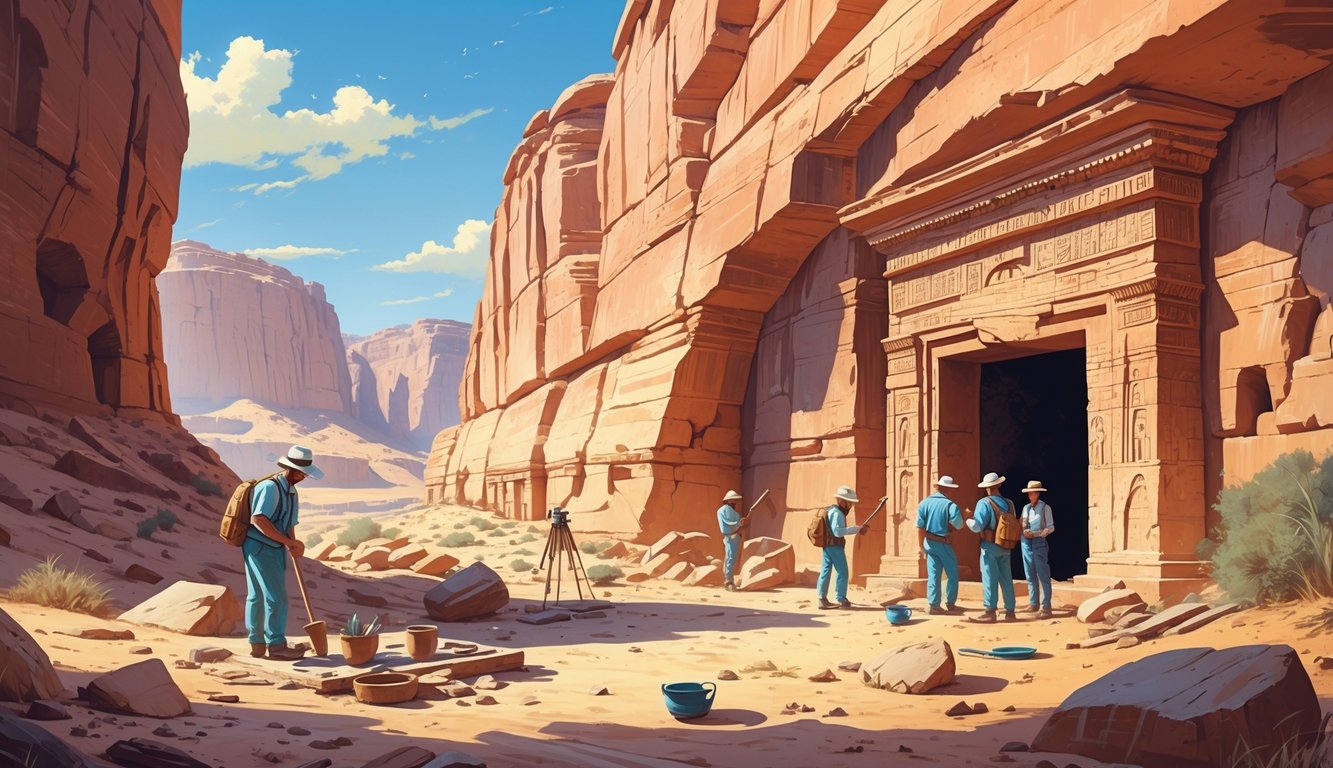
Archaeologists continue to examine the newly uncovered tomb beneath Petra’s Treasury. The find has raised questions about who was buried there, the cultural practices of the time, and whether more hidden structures exist nearby.
Potential for Further Discoveries
The Jordanian Department of Antiquities confirmed that ground-penetrating surveys show possible voids and chambers in the area. These could hold more burials or storage rooms.
Archaeologists plan to extend excavations beyond the main chamber. They will use 3D scanning to map the underground layout and protect fragile structures.
A key question is whether the tomb belonged to a larger burial complex. If so, it could reveal how Petra’s elite organized funerary spaces.
Future work may also compare artifacts with other Nabataean sites. This could help identify trade links or shared burial customs.
Ongoing Analysis and Debates
Specialists are studying the 12 skeletons found in the tomb. They want to determine age, sex, and cause of death.
Researchers may use DNA testing to find out if the individuals were related. They also want to know if the skeletons belonged to different social groups.
Some historians question whether the tomb’s design is unique. Others think it might follow known Nabataean styles.
This debate could affect how experts date the site.
Researchers are also discussing the purpose of certain artifacts. Decorated pottery fragments may show ritual use.
Metal tools might suggest people maintained the burial site.
The Jordanian Department of Antiquities is reviewing conservation plans. They must balance public access with protecting delicate remains from environmental damage.
For details on the discovery itself, see the report on the hidden tomb beneath Petra’s Treasury.