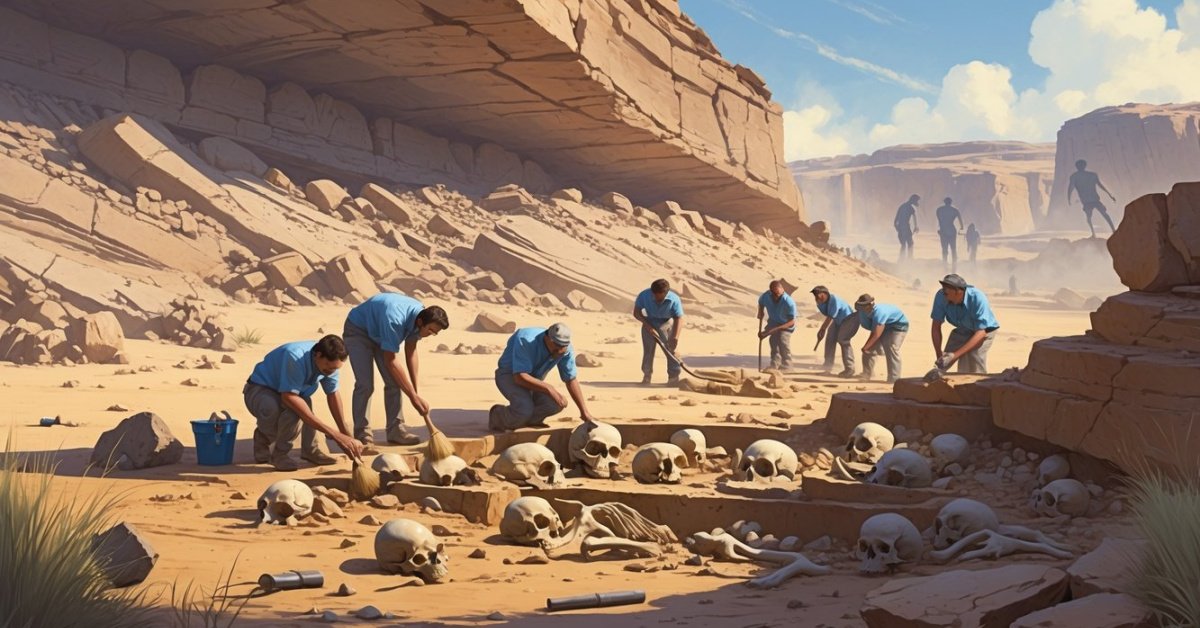
Many people imagine the “missing link” as a single fossil that connects ancient apes to modern humans.
In reality, there is no single missing link—human evolution is a complex chain of many transitional species, each adding pieces to the puzzle of our origins.
Scientists study these fossils to trace how early humans developed new traits and adapted to changing environments.
These studies help explain how our ancestors eventually became Homo sapiens.
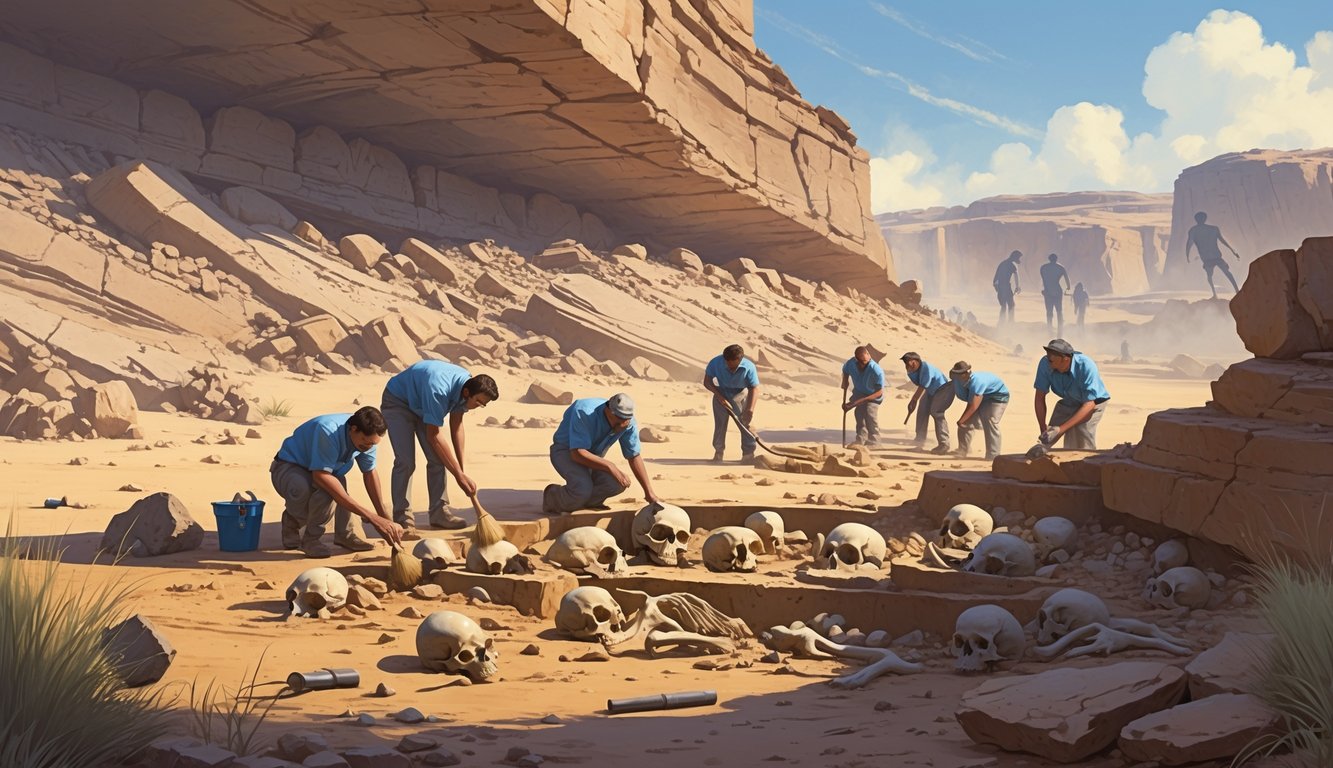
Over the past century, discoveries like Australopithecus sediba and Homo habilis have shown that evolution is more of a branching tree than a straight line.
Each fossil provides clues about anatomy, behavior, and migration.
These discoveries help researchers understand when and how abilities like tool use or long-distance walking emerged.
From early ancestors to close relatives like Neanderthals, the story of human evolution continues to grow with every new discovery.
Understanding the Concept of Missing Links
Scientists use fossil and genetic evidence to trace how humans evolved over millions of years.
The idea of a “missing link” comes from an older view of evolution that pictured a straight line of progress from ancient apes to modern humans.
Modern research shows a more complex picture with many branching species.
Definition and Origins of the Term
The term missing link originally described a hypothetical extinct species halfway between humans and their ape-like ancestors.
In the late 19th century, some people misread Charles Darwin’s work and thought evolution was a simple chain.
This led people to believe that one fossil could connect humans directly to modern apes.
Early fossil discoveries, like Java Man in 1891, often received this label.
Over time, scientists recognized that this idea was too simplistic.
Human evolution involves many species, each with unique traits.
Now, the “missing link” is seen as a cultural term rather than a precise scientific one, as explained by Britannica.
Transitional Fossils Versus Missing Links
Transitional fossils show traits from both older and newer species.
They help document gradual changes over time.
Unlike the outdated “missing link” idea, transitional fossils are not about finding one perfect specimen.
Examples include Australopithecus afarensis (like the famous “Lucy”) and Homo habilis.
These fossils reveal how features such as brain size, walking posture, and tool use evolved step by step.
Scientists often stress that many transitional forms exist.
The fossil record is incomplete, but evidence from multiple finds builds a clearer picture, as noted by Science News Today.
The Evolutionary Tree Model
Modern biology uses an evolutionary tree to describe relationships between species.
Instead of a straight line, this model shows branches where species split from common ancestors.
In this view, humans share a branch with chimpanzees and other primates.
Each followed its own path.
Many hominin species lived at the same time, not in a single sequence.
This branching model explains why there is no single missing link.
Fossils fit into different parts of the tree, showing a network of connections rather than a chain, as described in Evolvopedia.
The Role of Fossil Evidence in Human Evolution
Fossils give scientists direct physical evidence of ancient life.
They help trace how species changed over time.
Fossils reveal anatomical details that connect extinct species to modern humans and show when certain traits first appeared.
Importance of the Fossil Record
The fossil record is the timeline of preserved remains and impressions of past organisms.
In human evolution, it includes skulls, teeth, and bones that show gradual changes in brain size, posture, and tool use.
Transitional fossils, such as Australopithecus afarensis, help bridge gaps between earlier primates and modern humans.
These finds show that evolution was not a straight line but a branching process with multiple species existing at the same time.
Paleoanthropologists study these remains to understand how climate shifts and environmental changes influenced survival.
Fossils from East Africa suggest that open grasslands encouraged upright walking.
By comparing fossil anatomy with modern humans and other primates, researchers can identify shared traits and unique adaptations.
This makes the fossil record essential for testing evolutionary theories.
Discovery and Preservation Challenges
Fossils form under rare conditions.
Soft tissues decay quickly, so most remains never fossilize.
Bones need to be buried rapidly in sediment to avoid destruction by weather, scavengers, or erosion.
Researchers have found important sites, such as the Olduvai Gorge, through careful surveying and sometimes by chance.
Erosion and human activity can damage or destroy undiscovered fossils.
Preservation quality varies.
Some fossils are complete skeletons, while others are only fragments.
Even a single tooth can provide valuable clues about diet and age.
Access to excavation sites can be difficult due to political, environmental, or funding challenges.
This limits how much of the fossil record researchers can study.
Dating Techniques and Technological Advances
Dating fossils helps scientists place them in the correct sequence of human evolution.
Methods like radiometric dating measure the decay of isotopes in volcanic layers surrounding fossils.
Other techniques, such as optically stimulated luminescence, estimate when sediment was last exposed to light.
These methods give age ranges that help connect fossils to environmental events.
Advances in imaging, including CT scanning, allow researchers to study internal structures without damaging specimens.
Digital models can be shared worldwide, letting scientists compare finds without moving fragile fossils.
In paleoanthropology, combining dating methods with genetic analysis has improved accuracy.
This has helped confirm the age of key transitional fossils and refine the human evolutionary timeline.
Key Transitional Fossils and Their Significance
Some fossil discoveries provide clear evidence of physical traits that link ancient human ancestors to both earlier primates and later members of the genus Homo.
These finds help scientists trace how walking upright, brain size, and facial structure changed over millions of years.
Australopithecus afarensis and Lucy
Australopithecus afarensis lived between about 3.9 and 2.9 million years ago in East Africa.
The most famous specimen, nicknamed Lucy, was discovered in 1974 in the Afar region of Ethiopia.
Lucy’s skeleton is about 40% complete.
This makes it one of the most complete hominin fossils ever found from this time period.
She stood roughly 1.1 meters tall and had a small brain size of about 400 cubic centimeters.
Her pelvis and leg bones show clear adaptations for bipedal walking.
Her long arms and curved fingers suggest she still climbed trees.
This mix of traits shows a stage of evolution between fully tree-dwelling primates and later humans.
Researchers use Lucy and other A. afarensis fossils to study how early hominins balanced life on the ground with time in the trees.
This was a key step in human evolution.
You can read more about how such finds are classified as transitional fossils.
Australopithecus africanus Discoveries
Australopithecus africanus lived later, about 3 to 2 million years ago.
Fossils have been found mainly in South Africa.
The first discovery was the Taung Child in 1924, a partial skull of a young individual.
This species had a slightly larger brain than A. afarensis, averaging around 450–500 cubic centimeters.
Its teeth and jaw suggest a diet that included both tough plant material and softer foods.
The shape of the pelvis, spine, and leg bones confirms upright walking.
However, the arm and shoulder structure still allowed for climbing.
Fossils of A. africanus help bridge the gap between earlier australopithecines and the first members of the genus Homo.
These fossils offer insight into how physical traits shifted toward a more human-like body plan.
More on the role of such fossils can be found in this overview of transition fossils.
Homo habilis: The Handy Ancestor
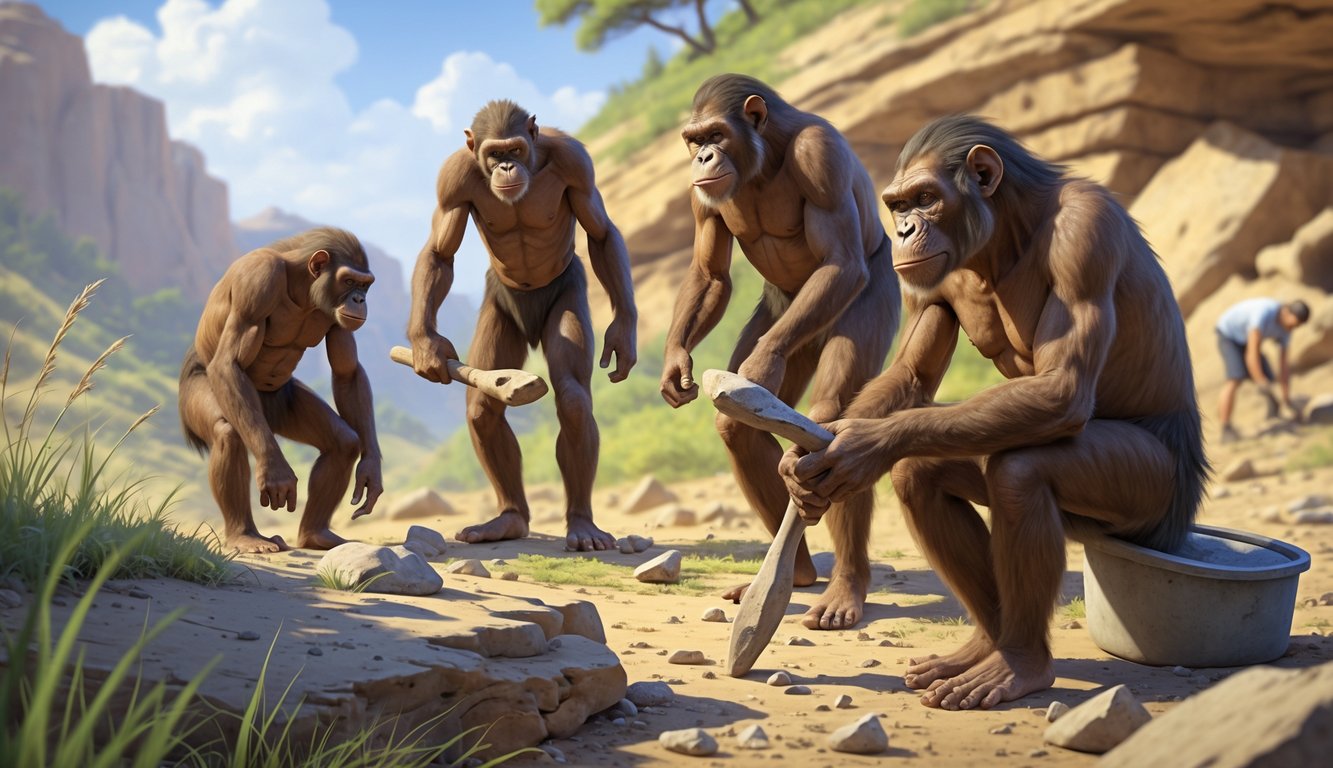
Homo habilis lived in Africa between about 2.4 and 1.4 million years ago.
Fossils show it had a larger brain than earlier australopithecines and made some of the earliest known stone tools.
These traits suggest it was a key transitional fossil between ape-like ancestors and later members of the genus Homo.
Tool Use and Cognitive Development
Archaeologists link Homo habilis to the Oldowan tool tradition.
These simple tools included sharp flakes for cutting and hammerstones for breaking bones.
Many were made from hard stones like quartz or basalt.
Tool-making required planning and skill.
Knapping a stone to create a sharp edge shows an understanding of cause and effect.
This suggests Homo habilis had more advanced problem-solving abilities than earlier hominins.
Evidence from cut-marked animal bones shows they used tools to process meat and marrow.
Access to these foods may have supported brain growth over time.
Key points about tool use:
- Tools were likely used for both hunting and scavenging.
- Sharp flakes could cut meat from carcasses.
- Hammerstones cracked open bones for nutrient-rich marrow.
Fossil Evidence of Homo habilis
Researchers have found Homo habilis fossils mostly in East and South Africa.
Sites like Olduvai Gorge in Tanzania and Koobi Fora in Kenya have yielded skulls, jawbones, and hand bones.
The species had a brain size of about 510–600 cubic centimeters—larger than australopithecines but smaller than later Homo species.
Its face was still relatively flat, and teeth were smaller than those of earlier ancestors.
Some researchers debate if Homo habilis belongs in the genus Homo or is closer to australopithecines.
This is because its body proportions were still somewhat primitive.
Others see it as an important early member of our genus that bridges the gap between ape-like species and later humans.
Fossil finds help scientists study how brain size, tool use, and anatomy changed during early human evolution.
Homo erectus and the Global Expansion
Homo erectus lived for nearly two million years and spread farther than any earlier human species.
Fossils show they adapted to different climates and landscapes while keeping similar physical traits, such as a long, low skull and strong brow ridges.
Their remains are found across Africa, Asia, and parts of Europe.
Peking Man and Java Man
Peking Man refers to a group of Homo erectus fossils found near Zhoukoudian, about 50 km southwest of Beijing. These remains date to roughly 700,000–300,000 years ago.
Researchers believe Peking Man used stone tools and may have controlled fire for cooking and warmth.
Java Man fossils were discovered on the island of Java, Indonesia, in the 1890s. These fossils are about 1 million years old and have skull and bone structures similar to Peking Man.
Homo erectus populations, like Peking Man and Java Man, lived in different environments but shared core physical features. Archaeological finds, such as hearths and stone tools, show their problem-solving skills and social cooperation.
| Fossil Group | Location | Estimated Age | Key Traits |
|---|---|---|---|
| Peking Man | Zhoukoudian, China | 700k–300k years ago | Stone tools, possible fire use |
| Java Man | Java, Indonesia | ~1 million years ago | Similar skull to Peking Man |
Migration Patterns and Adaptations
Homo erectus is the first known human species to leave Africa. Fossils and tools show they expanded into Asia soon after appearing in the African fossil record.
They adapted to new regions by using local materials for tools. They also adjusted hunting and gathering strategies.
In colder climates, they used fire and shelters to survive. Their long legs and narrow hips helped them walk long distances.
This ability allowed them to follow migrating animals and explore new territories. Finds such as Peking Man and Java Man show that Homo erectus could live in both tropical and temperate zones.
They became one of the most adaptable early human species.
Neanderthals, Denisovans, and Other Close Relatives
Ancient DNA and fossil finds reveal that modern humans once shared the planet with other human species. These groups sometimes interbred, leaving small traces of their DNA in people today.
Fossils, tools, and genetic studies help scientists learn about their appearance, behavior, and relationships.
Neanderthal Discoveries
Neanderthals lived across Europe and parts of western Asia from about 400,000 to 40,000 years ago. They hunted skillfully and made stone tools.
Fossils show they had strong builds, large noses, and heavy brow ridges. Genetic studies show that people outside Africa carry up to 2% Neanderthal DNA.
This DNA comes from interbreeding between Neanderthals and early modern humans. Some of these genes affect skin, hair, and immune responses.
Important finds include the La Chapelle-aux-Saints skeleton in France and the Shanidar Cave burials in Iraq. These sites provide evidence of care for the sick and possible burial practices.
Researchers have sequenced the Neanderthal genome, revealing details of their genetic relationship with modern humans.
Denisovan Fossil Evidence
Scientists know Denisovans mainly from a few fossils, including a finger bone and teeth found in Denisova Cave in Siberia. DNA from these remains shows they were a distinct human group, more closely related to Neanderthals than to modern humans.
They lived in parts of Asia and likely adapted to different environments. For example, a gene variant from Denisovans helps modern Tibetans live at high altitudes.
No one has found a complete Denisovan skeleton, so their exact appearance remains uncertain. Sequencing their Y chromosome alongside Neanderthal DNA has revealed a missing link in human history.
Fossil evidence outside Siberia, such as a jawbone from Tibet, suggests Denisovans had a wider range than once thought.
Homo floresiensis: The Hobbit
Homo floresiensis lived on the Indonesian island of Flores until about 50,000 years ago. They stood about 1 meter tall and had small brains.
Despite their size, they made stone tools and hunted small animals. Their short stature may be due to island dwarfism, where large species become smaller over generations when isolated.
Researchers found fossils, including a nearly complete skeleton called LB1, in Liang Bua cave in 2003. Homo floresiensis lived at the same time as modern humans and other relatives like Neanderthals and Denisovans.
The Emergence of Modern Humans
Modern humans first appeared in Africa during the late Middle Pleistocene. Fossil and genetic evidence show they shared the planet with other hominin species before becoming the only surviving branch of the human family.
Their spread across continents was shaped by biological changes and cultural innovations.
Origins of Homo sapiens
The earliest known fossils of Homo sapiens date to about 300,000 years ago in Africa. Remains from Jebel Irhoud in Morocco show a mix of modern and archaic traits.
Researchers think early populations lived in small, mobile groups that hunted, gathered, and made tools. Over time, stone tools became more refined, and symbolic objects like beads and carvings appeared.
By about 60,000–70,000 years ago, modern humans started migrating out of Africa. They moved into regions already occupied by other hominins such as Neanderthals and Denisovans.
Fossil finds and genetic evidence from places like the Altai Mountains show that these groups sometimes interbred.
Genetic Diversity and Adaptation
Modern humans carry DNA from both ancient African ancestors and other hominins they met during migration. Studies show that about 1–2% of the genome of non-African populations comes from Neanderthals, while some groups in Oceania have Denisovan DNA.
This inherited DNA influences traits such as immune system responses and adaptation to high altitudes. For example, certain Denisovan genes help Tibetans live in low-oxygen environments.
Genetic diversity also comes from mutations and natural selection within Homo sapiens populations. Traits like skin pigmentation, lactose tolerance, and disease resistance were shaped by environmental pressures.
Today, scientists use ancient DNA and fossils to learn how modern humans adapted to different climates, diets, and diseases.
Genetics and Ancient DNA in Human Evolution
Genetic research provides direct evidence of how humans changed over time. DNA from ancient remains shows population movements, adaptation to environments, and traces of extinct human groups in modern people.
These findings help explain evolutionary changes that fossils alone cannot show.
Role of Ancient DNA
Ancient DNA is genetic material recovered from the remains of early humans and their ancestors. Scientists extract it from bones, teeth, and sometimes preserved tissue.
This lets them compare ancient genomes to those of living people. Researchers use these comparisons to study migration patterns, identify genetic adaptations, and trace how populations responded to environmental pressures.
For example, studies in the journal Genes explore how ancient DNA reveals adaptation to shifting environments and co-evolution with microorganisms.
Ancient DNA helps confirm or challenge fossil-based timelines. It can show when different human groups split from each other and whether they later mixed.
By combining genetics with archaeology, scientists better understand natural selection’s role in shaping traits like skin color, immunity, and metabolism.
Interbreeding and Genetic Legacy
Genetic evidence shows that early modern humans interbred with Neanderthals and Denisovans. The first complete Neanderthal genome showed they were 99.7% genetically identical to living humans.
Some modern people still carry small amounts of their DNA. These inherited genes influence certain traits today.
For example, some Neanderthal DNA affects immune system function, while Denisovan DNA helps Tibetan populations adapt to high altitudes. Recent studies suggest some humans carry DNA from an unknown ancient ancestor.
This points to more complex interbreeding events than once thought.
Major Discoveries and Controversies in Paleoanthropology
Researchers have found fossils that reshaped the timeline of human evolution and clarified relationships between ancient species. Some finds sparked debates that lasted decades, while others exposed mistakes or even deliberate fraud.
Famous Fossil Finds
One of the most well-known fossils is Australopithecus afarensis, best represented by the 3.2-million-year-old skeleton nicknamed Lucy. Scientists discovered her in 1974, giving strong evidence that early human ancestors walked upright long before they developed larger brains.
Other notable finds include Homo habilis, often called the “handy man” for its association with stone tools, and Homo erectus, which shows evidence of migration out of Africa. Each fossil adds new detail to the evolutionary “mosaic” described in modern paleoanthropology.
Recent discoveries, such as Australopithecus sediba, have been described as possible “missing links” between earlier australopithecines and the genus Homo. Some scientists support this idea, while others caution against the term because evolution is not a straight line.
John Reader’s historical accounts show how each find fits into a broader picture and how evidence builds over time.
The Piltdown Hoax and Other Debates
In 1912, a fossil skull found in England was presented as the long-sought “missing link.” The Piltdown Man combined a human-like skull with an ape-like jaw.
For decades, many accepted it as proof that human evolution began in Europe. In 1953, testing revealed it was a forgery made from a medieval human skull and an orangutan jaw.
This event remains one of the most famous scientific hoaxes and damaged trust in the field for years. Other debates focus on interpretation.
Researchers often disagree over whether a fossil represents a new species or a variation of an existing one. Darwin’s ideas about gradual change still guide these discussions, but new fossil and genetic evidence sometimes challenges older assumptions.
Ongoing Challenges and Future Directions
Researchers studying human evolution face ongoing problems that limit what they can learn from the past. Fossil evidence is rare, new tools are changing what scientists can discover, and the meaning of a “missing link” continues to shift as science advances.
Gaps in the Fossil Record
The fossil record for human evolution is incomplete because fossilization rarely occurs. Most organisms decay before rock can preserve them.
Many key periods, especially during major evolutionary transitions, have few well-preserved remains. This makes tracing clear steps between species difficult.
Paleoanthropologists often find only a few transitional fossils to study evolutionary changes. Preservation issues and dating uncertainties make interpretation more challenging, according to The Mystery of the Missing Link.
Scientists compare fossils from different sites and time periods to work around these gaps. They also use genetic evidence from living humans and other primates to fill in missing details.
New Technologies and Exploration
New technology helps researchers find and study fossils that they once overlooked.
Key tools include:
- 3D scanning to create digital models of fossils
- CT imaging to view inside bones without causing damage
- Improved dating methods to make timelines more accurate
Researchers are now exploring regions beyond the well-studied areas. New digs in Asia and Africa have revealed previously unknown hominin species, as noted in The latest steps of human evolution.
Remote sensing and drone surveys help scientists find promising sites more quickly. This increases the chances of discovering rare transitional fossils that connect evolutionary branches.
The Evolving Definition of Missing Links
The term “missing link” once meant a single fossil directly connecting humans to their ancestors.
Modern paleoanthropologists view human evolution as a mosaic of traits that appear at different times. The Mosaic of Human Evolution explains this idea.
Now, scientists focus on patterns in the fossil record instead of searching for one perfect specimen.
Each discovery adds a piece to the puzzle, even if it does not fit neatly between two known species.