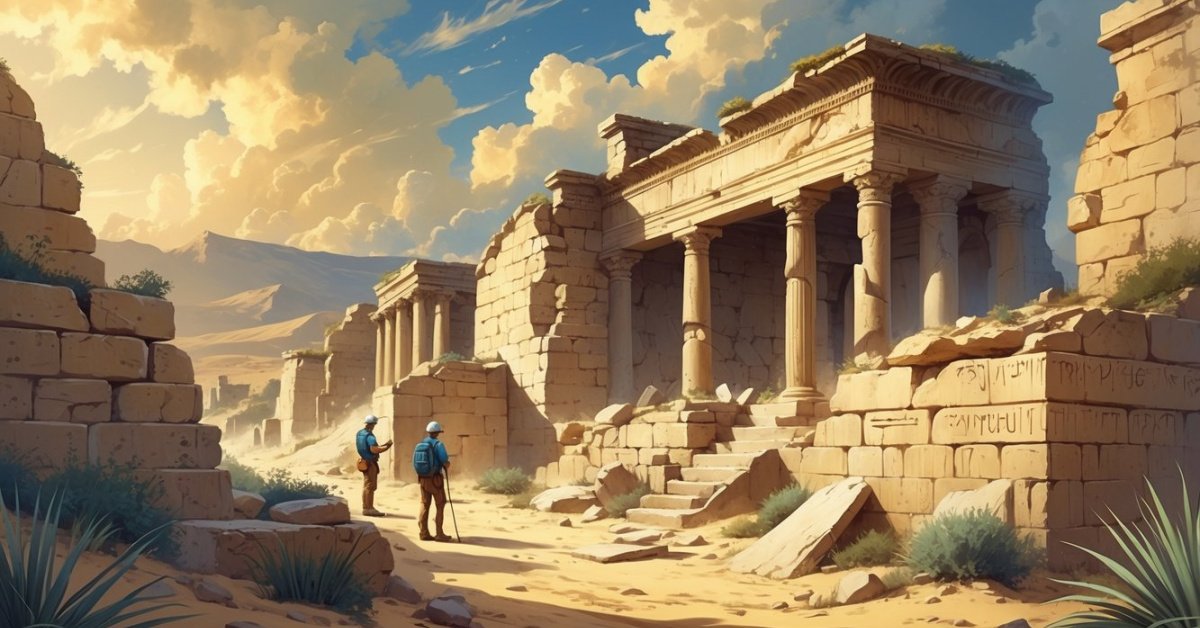
For centuries, people have wondered what happened to the great cities mentioned in the Bible. Some served as centers of trade and culture, while others played key roles in well-known events.
Many of these cities disappeared from the map, leaving only ruins and clues buried beneath soil, sand, or sea.
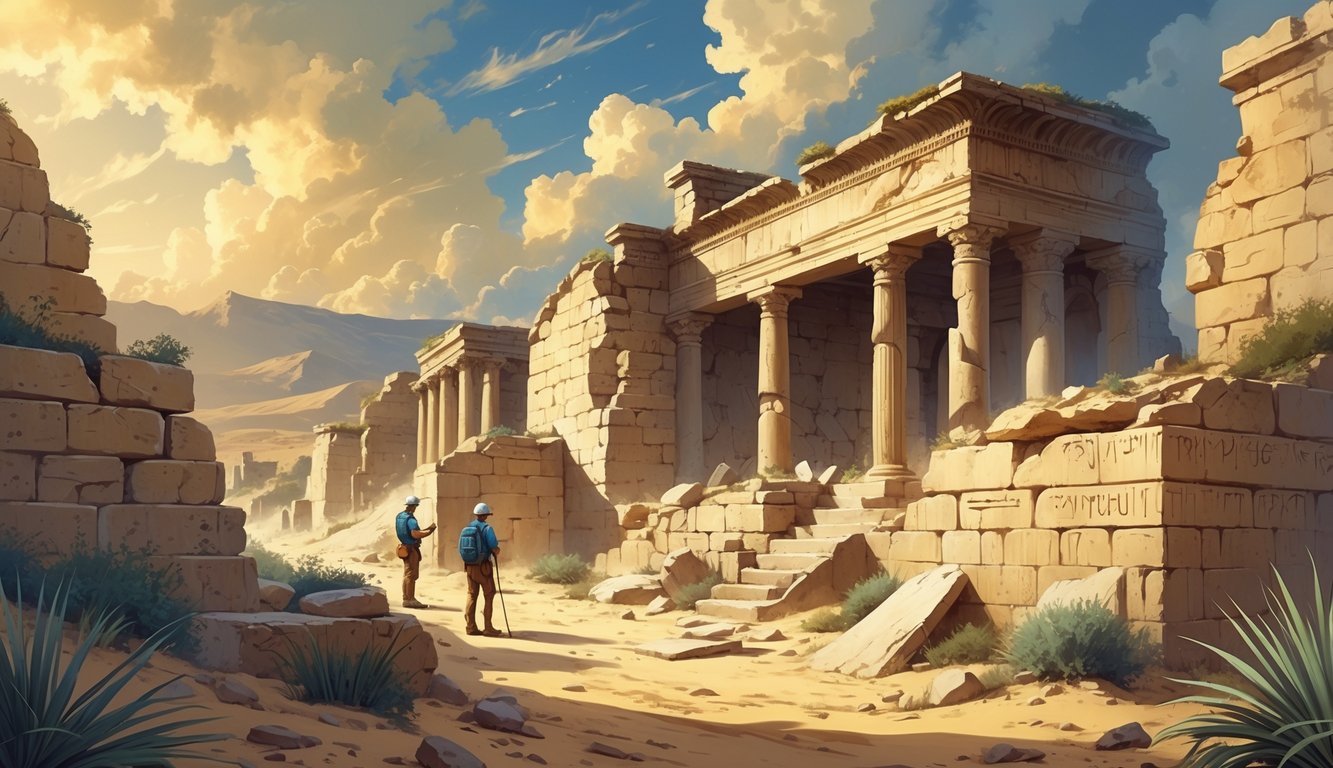
Archaeologists have uncovered places like Petra and Jericho. They use modern tools to match ancient texts with real locations.
Each discovery adds to our knowledge about the history, culture, and daily life of the people who lived there. These finds also challenge or confirm ideas about the biblical world.
Teams continue to explore deserts, river valleys, and coastal sites, hoping to find more lost cities. Every excavation gives a chance to connect ancient stories to real places.
The Mystery of Lost Biblical Cities
Archaeologists and historians keep finding ruins that match descriptions from ancient texts. These discoveries reveal details about cities once thought to be only stories.
They show information about the people, culture, and role in the biblical world.
Defining Lost Biblical Cities
Lost biblical cities are settlements mentioned in the Bible whose exact locations people forgot over time. Some fell to war or natural disasters.
Others were abandoned and buried under layers of earth.
Examples include Babylon, Nineveh, and Ur. Each is tied to well-known biblical events.
Archaeologists use historical records, satellite imagery, and excavation to find these sites. Sometimes, ruins match biblical descriptions closely, giving researchers confidence.
“Lost” does not always mean a city vanished completely. Many sites continued in some form but lost their original identity.
This makes them hard to trace without modern research tools.
Significance in Ancient History
These cities often acted as political, economic, and religious centers in the ancient Near East. For example, Babylon was a hub of trade and governance.
Ur was a major center for early urban life.
They also played key roles in regional conflicts. Control over these cities meant control over trade routes, fertile land, and cultural influence.
Some cities, like Nineveh, served as capitals of powerful empires that shaped the history of surrounding nations. Their rise and fall often matched events described in biblical accounts.
Studying these cities helps historians connect scripture with material evidence found in the ground.
Impact on Modern Faith
For many people, finding these cities strengthens their connection to the Bible. Discovering ruins that align with biblical descriptions makes the text feel more real and grounded in history.
Documentaries such as Lost Cities of the Bible show how archaeologists work in places like ancient Iraq to uncover these sites.
Faith communities often see these findings as affirmations of their traditions. Some view them as historical proof, while others see them as cultural and spiritual heritage.
These discoveries can spark new interest in biblical study and encourage people to explore the history behind their beliefs.
Famous Lost Cities Mentioned in the Bible
Some ancient cities mentioned in the Bible have been identified through archaeological digs. Others are still debated by researchers.
Excavations have revealed city walls, burned layers, and artifacts that match historical accounts. These finds give insight into their age, culture, and destruction.
Sodom and Gomorrah
Genesis describes Sodom and Gomorrah as cities destroyed due to corruption. Archaeologists have searched for their location near the southern end of the Dead Sea.
Sites such as Bab edh-Dhra and Numeira show evidence of sudden destruction by intense heat. Layers of ash and burned stone suggest a catastrophic event.
Some researchers believe these ruins fit the biblical account, while others think the cities remain undiscovered.
Jericho
Jericho is one of the oldest known cities in the world. The Bible says its walls collapsed after the Israelites marched around them for seven days.
Excavations at Tell es-Sultan uncovered massive stone walls and a destruction layer from the Late Bronze Age. Archaeologist John Garstang thought this matched the biblical conquest.
Later studies by Kathleen Kenyon suggested the city was destroyed earlier. Artifacts such as grain storage jars show the city ended suddenly, possibly during harvest season.
The date of this destruction is still debated among scholars.
Ai
The Book of Joshua mentions Ai as a fortified city conquered by the Israelites. Its exact location is still disputed.
Many link Ai with the site of et-Tell, which shows a large city destroyed around 2200 BCE—before the biblical conquest. This has led some to question the match.
Other scholars suggest Ai may have been at Khirbet el-Maqatir, where excavations revealed fortifications, pottery, and weapons from the right time period.
Hazor
Hazor was a major Canaanite city in northern Israel and is mentioned several times in the Bible. It was called “the head of all those kingdoms” and later destroyed by Joshua.
Excavations at Tel Hazor uncovered a large city with upper and lower sections, massive gates, palaces, and temples. Burned layers show the city was destroyed by fire in the Late Bronze Age.
Archaeologists found statues, cuneiform tablets, and imported goods, showing Hazor’s importance in trade and politics. Some link the destruction to the Israelites, while others suggest other invading forces caused it.
Archaeological Discoveries and Excavations
Archaeologists have found city walls, pottery, and inscriptions that match ancient texts. These discoveries help identify locations and shed light on daily life.
They also confirm events recorded in the Bible.
Major Excavation Sites
One important site is Jericho. Layers of collapsed walls suggest destruction events similar to those described in the Old Testament.
Excavations revealed grain storage jars, fortifications, and housing foundations.
In the Jordan Valley, the ruins near Tell el-Hammam have drawn attention for their size and complexity. This site includes a fortified wall system, public buildings, and a large city gate.
Researchers believe it may be linked to a lost biblical settlement based on its age and layout.
The site of Khirbet el-Maqatir is another focus. Many scholars argue it best fits the biblical description of Ai.
Findings include pottery from the Late Bronze Age, defensive structures, and evidence of sudden destruction. You can read more about Ai’s identification at Bible Archaeology Report.
Recent Breakthroughs
On July 20, 2025, a University of Jerusalem team announced they had discovered a buried city in the Jordan Valley. The team found defensive walls, domestic structures, and a variety of pottery styles near modern Tell el-Hammam.
This matches descriptions of fortified cities in biblical accounts. Learn more about this find at Free Bible Study Hub.
Excavations at Ashkelon have also produced valuable results. As one of the five Philistine cities, it has yielded artifacts showing trade connections, religious practices, and urban planning.
Items include carved ivory, imported ceramics, and a Philistine temple foundation.
Advances in ground-penetrating radar and drone mapping have sped up surveys. These tools help teams locate buried walls and streets before digging.
Notable Archaeologists
Dr. Steven Collins has led work at Tell el-Hammam for over a decade. His team links the site’s destruction layer to a possible natural disaster, such as a meteor airburst.
Bryant G. Wood is known for his work at Khirbet el-Maqatir. He has published research on the site’s alignment with the biblical Ai.
Lawrence E. Stager directed excavations at Ashkelon for many years. He documented the city’s Philistine heritage and its role in regional politics.
These archaeologists combine fieldwork and careful analysis. Their efforts help match physical evidence with historical records.
Investigating the Ruins: Methods and Technologies
Researchers now use advanced tools to locate and study ancient biblical cities without damaging the sites. These methods help them find buried structures, analyze artifacts, and confirm timelines with greater accuracy.
Ground-Penetrating Radar
Ground-penetrating radar (GPR) sends radio waves into the ground and measures the echoes that bounce back. This lets archaeologists see underground features like walls, roads, and building foundations without digging.
Teams can map large areas quickly, saving time compared to traditional excavation. GPR is especially useful in fragile sites where digging could destroy important remains.
For example, remote sensing and GPR have revealed lost biblical towns hidden beneath soil. The data creates 3D maps that guide targeted excavations.
Archaeological AI Innovations
Artificial intelligence now plays a growing role in biblical archaeology. AI systems scan satellite imagery, aerial photos, and excavation records to identify patterns humans might miss.
Researchers have used AI to locate possible sites of lost biblical cities by comparing terrain data with old texts. This method speeds up the search and helps narrow down where to dig.
AI can also sort and classify artifacts found at a site. By analyzing shapes, materials, and wear patterns, it suggests the likely use or origin of an object.
This reduces manual sorting time and increases accuracy in cataloging finds.
Dating and Preservation Techniques
Once teams find ruins, dating methods help place them in the right historical period. Radiocarbon dating measures the age of organic materials.
Pottery analysis compares styles and manufacturing methods to known timeframes.
Preservation is just as important as discovery. Archaeologists stabilize walls with temporary supports or use chemical treatments to prevent stone decay.
Careful storage of artifacts in climate-controlled environments protects them from moisture and temperature changes. These steps ensure both structures and items remain intact for research and display.
Interpreting Ancient Artifacts
Archaeologists often learn the most from the smallest objects. Everyday items, sacred symbols, and building materials show how people lived and what they valued.
Careful study of these finds reveals how communities were organized and can confirm historical records. These artifacts also uncover details not written down.
Pottery and Inscriptions
Archaeologists often find pottery fragments in ancient city ruins. The shape, clay composition, and decoration of these pieces help date a site and link it to a specific culture.
People carved inscriptions into stone or etched them on pottery shards to record names, trade transactions, or official decrees. These inscriptions sometimes mention known historical figures or places, such as at Khirbet el-Maqatir, which matches biblical descriptions of Ai.
Researchers study letter styles and language to identify the time period. Even a single inscribed fragment can confirm a city’s identity or its political role.
Religious Relics
Communities created religious artifacts like altars, carved idols, incense stands, or ceremonial vessels. These objects reveal ancient belief systems.
The design and material of these relics often reflect the community’s resources and artistic skills. Some relics match descriptions in historical texts, confirming a site’s existence and its spiritual practices.
Altars with horned corners, for example, link to worship customs described in the Hebrew Bible. Archaeologists examine wear patterns and residue on these items.
Traces of incense, oil, or animal sacrifice show how often people used these objects.
Architectural Remains
Builders constructed stone walls, gates, and foundations to plan and defend ancient cities. The size and quality of these structures often show a city’s wealth and importance.
Thick walls or watchtowers indicate concerns about invasion. Public buildings, such as meeting halls or storage facilities, reveal the community’s organization.
Burn layers or collapsed walls sometimes match accounts of destruction in ancient writings. Archaeologists have found such evidence in several biblical cities, linking ruins to historical events.
Theories Behind the Disappearance of Cities
Environmental, political, and social pressures often caused ancient cities to vanish. Archaeological evidence shows that climate shifts, armed conflict, and changes in trade or culture could each lead to a city’s decline.
Natural Disasters
Earthquakes, floods, droughts, or volcanic eruptions sometimes forced people to abandon cities. For example, settlements in the Jordan Valley display signs of sudden destruction that may result from seismic activity.
Long droughts destroyed agriculture and forced migrations. Without food and water, people could not maintain urban life.
Flooding and river changes also affected cities. In Mesopotamia, shifting rivers sometimes cut cities off from trade and irrigation, making survival difficult.
Common disaster impacts:
- Loss of farmland
- Destruction of infrastructure
- Reduced access to resources
Warfare and Conquest
Invading armies often destroyed cities, burning homes and taking resources. Survivors sometimes found little left after such attacks.
In the Levant, empires conquered many fortified cities mentioned in the Bible. Archaeologists find burn marks, collapsed buildings, and weapons in these ruins.
After a conquest, conquerors sometimes left cities abandoned if they lost strategic or economic value. Over time, wind and soil buried the ruins.
Signs of warfare in ruins:
- Arrowheads and weapons in collapsed structures
- Burnt layers in excavation sites
- Sudden breaks in pottery or architectural styles
Cultural Shifts
Trade route changes, new religions, or political shifts could cause cities to decline. When a city depended on one trade path, losing it could cut off supplies and income.
Religious or political reforms sometimes led people to move to new centers. When capitals shifted, old hubs lost population and importance.
Buildings fell into disrepair without maintenance. Nature reclaimed the land as structures collapsed. Sometimes, the memory of a city faded until modern archaeologists rediscovered it, as with biblical cities lost to time.
Lost Cities in the Old Testament
Archaeologists have found ruins that match descriptions from ancient Hebrew texts. These sites reveal city layouts, fortifications, and artifacts that align with Old Testament events.
Bethel
Bethel served as a significant religious center in ancient Israel. The Old Testament mentions it as the place where Jacob dreamed of a ladder reaching to heaven.
People often identify Bethel with the modern village of Beitin in the West Bank. Excavations have uncovered stone structures, storage jars, and city walls.
These finds show Bethel was both a fortified settlement and a center of worship. Its location along trade routes made it strategically important.
Control of Bethel shifted between kingdoms, reflecting its political value. Researchers have noted layers of destruction that match conflicts mentioned in biblical accounts.
Lachish
Lachish ranked as the second most important city in Judah after Jerusalem. It served as a military stronghold and administrative center.
Today, people identify the site as Tel Lachish in southern Israel. Archaeologists have found city gates, siege ramps, and wall remains.
These match descriptions of the Assyrian siege in the Bible and on Assyrian reliefs. The Lachish Letters, written on pottery fragments, provide insight into the city’s final days before its fall to Babylon.
Visitors can still see the reconstructed gate area and remains of defensive walls.
Shechem
Shechem stood in a mountain pass between Mount Ebal and Mount Gerizim. It was an early political and religious center for the Israelites.
The ruins are now at Tel Balata in the West Bank. Excavations have uncovered a large fortress-temple, city gates, and residential areas.
These finds confirm Shechem’s role in worship and governance. The city connects to key biblical events, such as the covenant renewal under Joshua.
Its location made it a meeting point for trade caravans. Archaeological evidence shows repeated rebuilding, reflecting a long and contested history.
Lost Cities in the New Testament
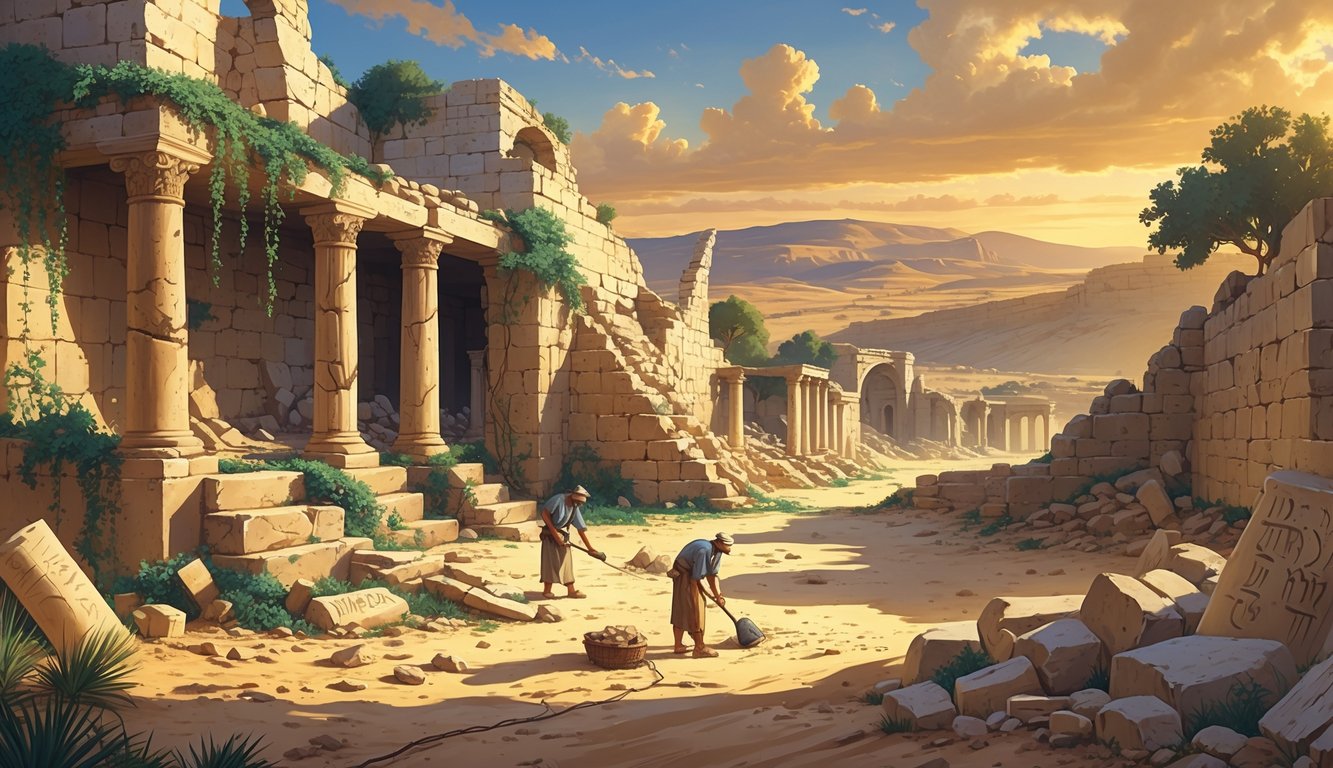
Towns mentioned in the New Testament played important roles in the life and ministry of Jesus. Archaeological work has uncovered remains that reveal their culture, economy, and daily life.
Bethsaida
Bethsaida was a fishing village near the northern shore of the Sea of Galilee. The Gospels mention it as the hometown of Peter, Andrew, and Philip.
Archaeologists have identified et-Tell as a possible location for Bethsaida. Excavations there revealed city gates, fishing tools, and pottery from the first century.
The town is linked to miracles like the healing of a blind man and the feeding of the 5,000. According to the Bible, Jesus criticized Bethsaida for not repenting after witnessing these events.
Today, the area is inland because the shoreline has changed. This explains why fishing gear is found far from the current water’s edge and offers clues about ancient environmental changes.
Capernaum
Capernaum served as a central base for Jesus during his ministry in Galilee. It was a small fishing and farming community on the Sea of Galilee’s northwestern shore.
Excavations uncovered a synagogue built over an earlier structure that may date to Jesus’ time. Nearby, stone houses with courtyards and storage areas show daily life.
One site is a house believed to have hosted early Christian gatherings. Pilgrims later built a church over it, showing lasting significance.
Capernaum was also a trade hub, with roads connecting it to other towns. This made it strategic for teaching and travel.
Visitors today can walk through the basalt ruins and see the ancient street layout.
Magdala
Magdala, also called Migdal, was a prosperous fishing town on the western shore of the Sea of Galilee. It is known as Mary Magdalene’s hometown.
Archaeologists have uncovered a well-preserved first-century synagogue. Inside, they found a carved stone with a menorah image, one of the earliest known depictions.
Excavations also revealed fish processing pools, showing that Magdala exported salted fish. The town’s wealth appears in its paved streets and stone buildings.
Magdala’s location along major trade routes made it an important economic center. Its remains provide a rare glimpse into a Jewish town from Jesus’ time, with both religious and commercial life preserved.
Challenges in Identifying Biblical Locations
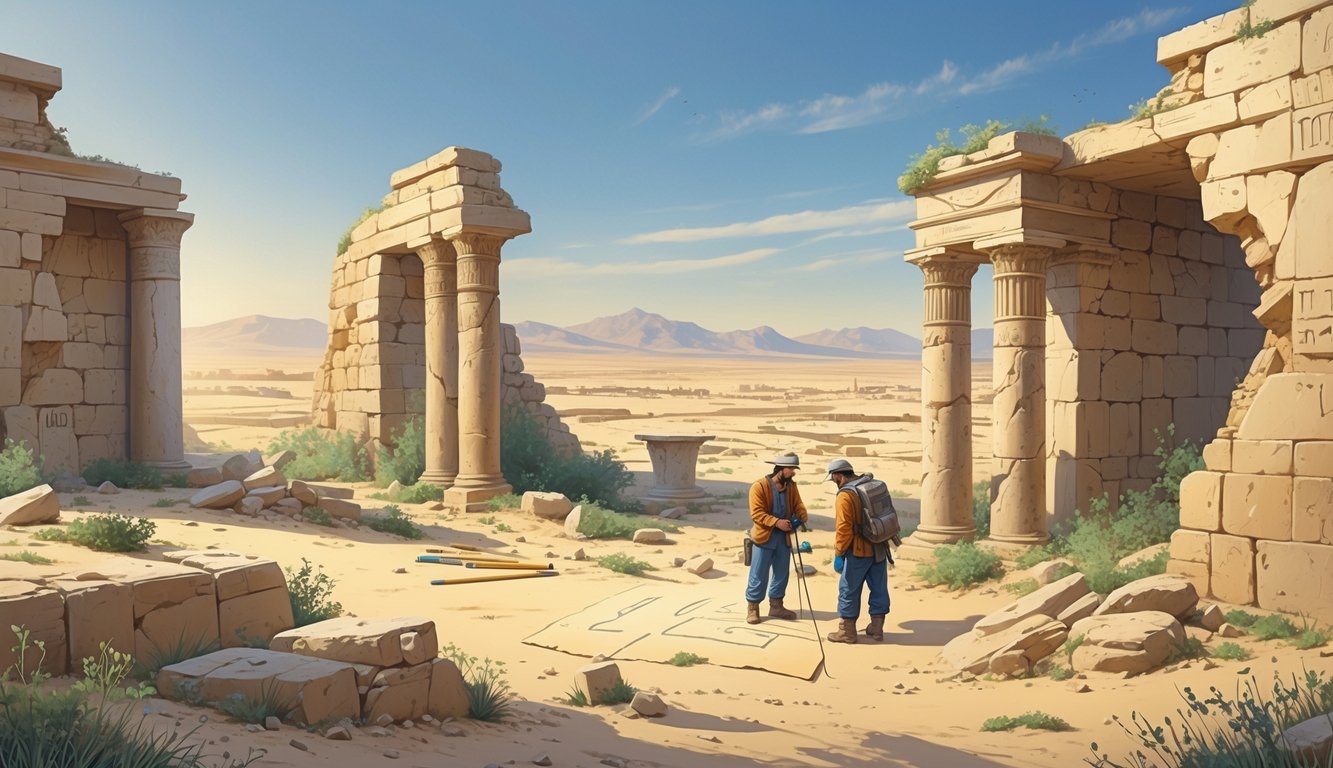
Archaeologists often face incomplete evidence, shifting landscapes, and ancient accounts that do not always match physical findings. Even when they uncover ruins, linking them to a specific biblical city can be difficult without clear, matching details.
Conflicting Historical Records
Ancient texts sometimes use different names for the same place or describe locations vaguely. This causes confusion when matching sites to biblical cities.
For example, the city of Ai has sparked debate because some historians rely on the Bible, while others compare archaeological data. Sites like Khirbet el-Maqatir fit some descriptions but not all, leading to disagreement.
Records from different cultures may contradict each other. An Egyptian text might mention a city that Hebrew writings do not, or describe it differently.
Researchers must weigh which accounts are most reliable and match them with physical evidence.
Geographical Changes
Over thousands of years, rivers shift, coastlines erode, and cities are buried under soil. These changes make it harder to pinpoint where ancient cities once stood.
Natural disasters like earthquakes or floods can alter terrain so much that landmarks from ancient texts disappear. Some believe the biblical city of Ziklag was hidden under settlement debris until recent excavations uncovered possible remains.
Urban development also covers ancient ruins. Modern towns sometimes sit directly above old sites, making excavation difficult.
Archaeologists often use satellite imagery, soil analysis, and old maps to narrow down possible locations.
Myth Versus Reality
Some biblical cities may be real, while others might be symbolic or legendary. Distinguishing between them is a major challenge.
The story of Sodom, for example, led researchers to investigate sites like Tall el-Hammam, which shows evidence of sudden destruction. Still, no universal agreement identifies it as Sodom from scripture.
Archaeologists must avoid letting expectations shape their interpretations. A site may fit part of a biblical description but not match dating or cultural evidence.
Often, the line between history and tradition remains blurred, so researchers must study carefully before identifying a site.
The Ongoing Search and Future Prospects
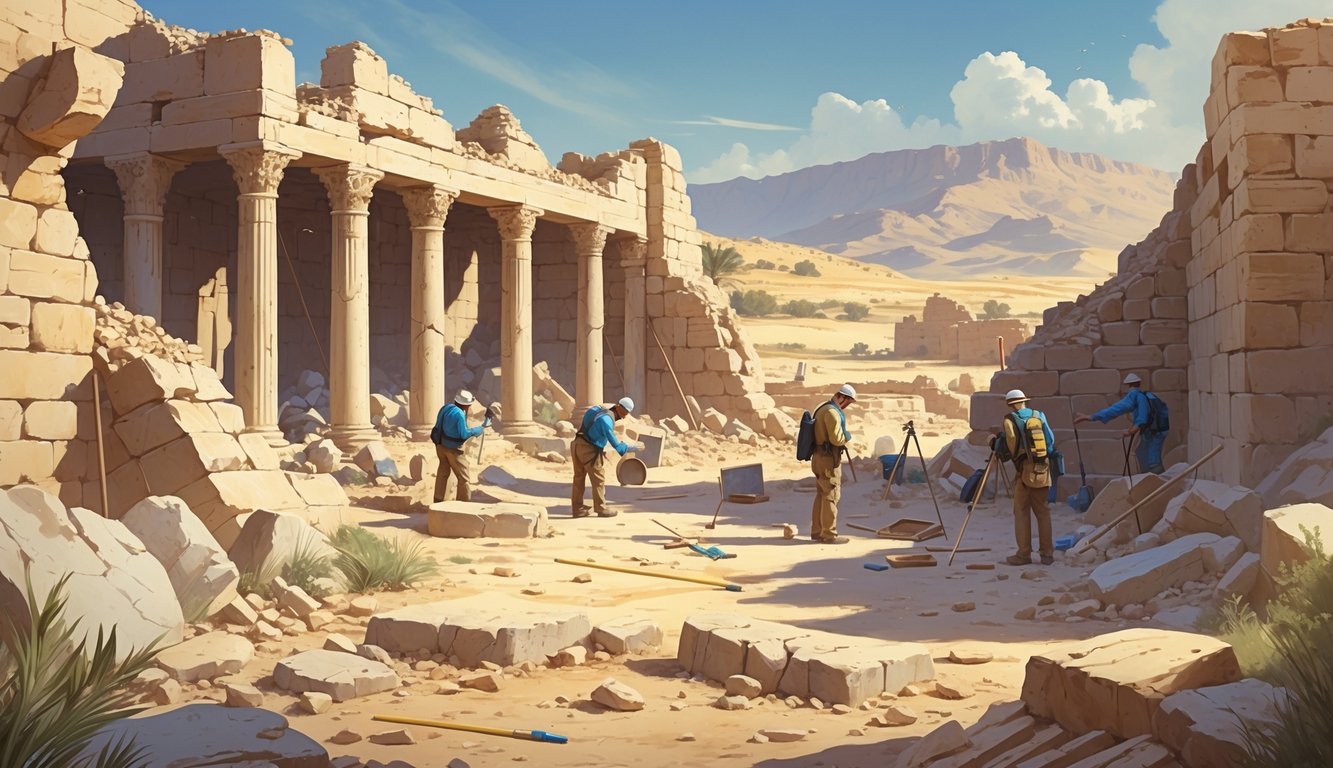
Archaeologists continue to uncover ruins that match ancient texts, revealing details about daily life, trade, and faith in the biblical world. They rely on advanced tools, global teamwork, and careful study of sites hidden beneath soil, sand, or water.
Emerging Technologies
New tools have changed how researchers locate and study ancient cities. Ground-penetrating radar (GPR) lets them detect buried walls and streets without digging.
LiDAR scanning uses drones or aircraft to map landscapes. This method reveals hidden structures under vegetation.
Digital modeling recreates ancient layouts using limited remains. Scholars use this visual data to test theories about city boundaries and building purposes.
Satellite imagery offers another important method. It detects soil changes, crop marks, or surface features that suggest buried ruins.
In some cases, AI analyzes large sets of images to spot possible biblical sites. Projects like these use technology to identify locations that might otherwise go unnoticed.
International Collaboration
Experts from different countries often work together to excavate ancient cities. Archaeologists, historians, linguists, and conservationists combine their skills to interpret findings.
Joint projects allow teams to access sites in politically sensitive areas. Digs in Israel and Jordan have benefited from agreements between local authorities and foreign researchers.
Universities, museums, and cultural heritage groups often provide funding. This shared support helps preserve and study artifacts.
International teams train local archaeologists for long-term site management and protection. These partnerships improve research quality and support cultural preservation.
Potential Sites Yet to Be Explored
Ancient texts mention several locations that researchers have not yet confirmed. Archaeologists believe the biblical city of Bethsaida may match ruins at Et-Tell or nearby areas. Recent excavations support this idea.
Modern towns sometimes cover possible sites, which makes excavation hard. Rivers have buried other sites under layers of sediment. Some ancient coastlines now lie underwater and hide more locations.
Researchers study trade routes and old road systems to focus their searches. They trace the movement of goods and travelers to find likely city sites.
Unexplored deserts and remote valleys may still hide major discoveries. Natural erosion sometimes reveals building stones or pottery fragments in these areas.