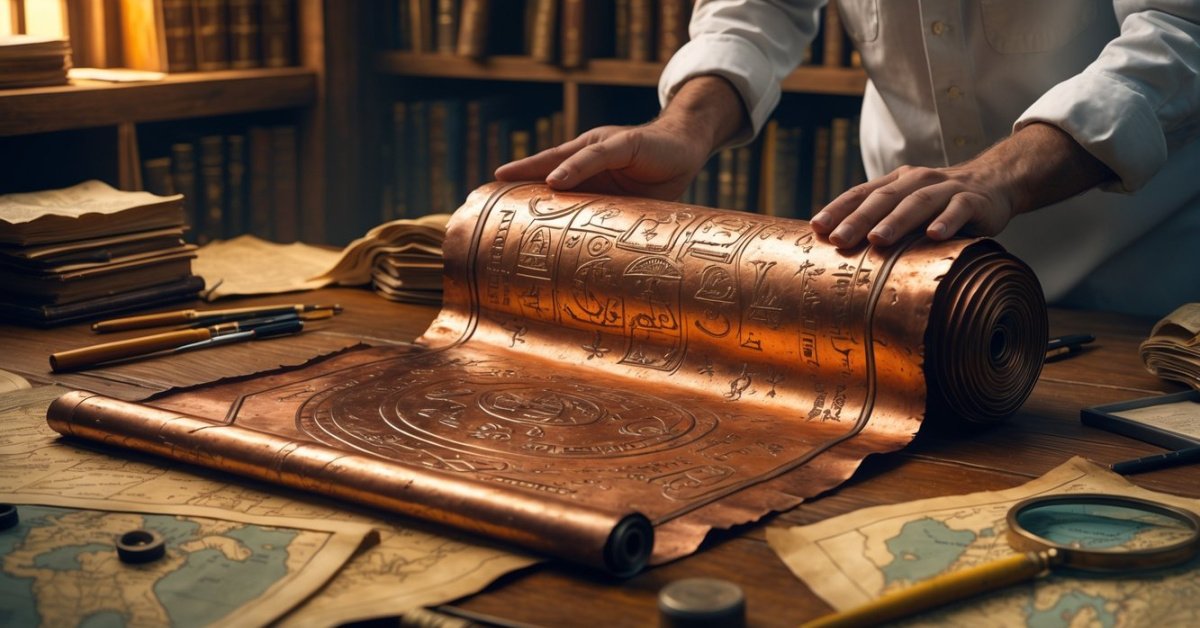
The Copper Scroll stands apart from other Dead Sea Scrolls because it is made of metal and lists what appears to be hidden treasure.
Researchers found it in 1952 in a cave near Qumran.
It describes 64 locations that may contain gold, silver, and other valuables connected to the Second Temple period.
This ancient inventory could point to real, physical wealth buried across the Judean wilderness.
Historians and archaeologists have studied the scroll for decades.
They try to decode its unusual Hebrew text and cryptic measurements.
Some believe it is a genuine record of temple treasures, while others think it may be symbolic or ceremonial.
The details are so specific that it reads more like a set of instructions than a myth.
The mystery grows when we consider why someone engraved such a list on copper instead of parchment.
From its discovery in the Qumran caves to modern translation efforts, the scroll continues to spark debate and inspire treasure hunts.
Exploring its history reveals not just clues to possible riches, but also a glimpse into a turbulent chapter of ancient Jerusalem.
What Is the Copper Scroll?
The Copper Scroll is an ancient Hebrew text engraved on thin sheets of copper.
Researchers discovered it in 1952 in a cave near Qumran.
It is unusual among the Dead Sea Scrolls because it lists detailed locations of hidden gold, silver, and other valuables buried in the Judean wilderness.
Unique Features of the Copper Scroll
Unlike other scrolls made of parchment or papyrus, the Copper Scroll uses a copper and tin alloy.
This material makes it durable but also hard to unroll without damage.
Archaeologists cut it into strips to read the engraved text.
The writing is in Hebrew, but the style and vocabulary differ from many other Qumran finds.
The scroll lists 64 specific locations where treasures were supposedly hidden.
These entries use precise measurements, landmarks, and quantities, such as “forty talents of silver” stored in certain spots.
Its material and content suggest the author wanted it to last and be read long after it was written.
This durability may have been intentional, given the value of the items described in the text.
Comparison With Other Dead Sea Scrolls
The Dead Sea Scrolls include religious texts, biblical manuscripts, and community rules.
Most were written on parchment or papyrus and focus on spiritual or legal matters.
The Copper Scroll stands apart because it reads like an inventory list rather than a theological or literary work.
It does not contain prayers, laws, or prophecy.
Other scrolls were likely intended for a specific religious community.
The Copper Scroll’s purpose appears more practical.
Its detailed records of treasure locations make it unique among finds at Qumran.
Scholars debate whether the treasure belonged to the Jerusalem Temple, a wealthy sect, or another group.
Its tone is factual, with little symbolic or allegorical language, which is rare for ancient texts in this collection.
Purpose and Function as a Treasure Map
Many researchers view the Copper Scroll as a literal treasure map.
It describes caches of gold, silver, and other valuables, possibly linked to the Second Temple before its destruction in 70 CE.
The scroll’s 64 entries often mention landmarks, such as cisterns, courtyards, and specific distances from known places.
These clues have fueled numerous expeditions.
Despite decades of searching, no one has confirmed finding treasure from the list.
Some believe the items were recovered long ago, while others think they remain hidden.
Its practical tone and specific directions suggest the author created it as a secure record for trusted individuals.
This ensured the wealth could be recovered if needed.
You can read more about its possible treasure locations in this detailed overview of the Copper Scroll.
Discovery and Location
Archaeologists uncovered the Copper Scroll in the arid region near the Dead Sea, where ancient settlements and hidden caves preserved many historical artifacts.
Its discovery shed light on both the local geography and the people who once lived there.
Finding the Copper Scroll in Qumran
In 1952, researchers exploring the Qumran area found the Copper Scroll in Cave 3.
Unlike the other Dead Sea Scrolls, which use parchment or papyrus, this one uses thin copper sheets.
The scroll had corroded over centuries, making it impossible to unroll without damaging it.
Specialists cut it into sections to read the engraved Hebrew text.
It listed 64 locations that described hidden gold, silver, and other valuables.
These details led many to believe it was a literal treasure record rather than a symbolic or religious text.
For more on its unique material and inscriptions, see this overview of the Copper Scroll’s contents.
Khirbet Qumran and the Qumran Caves
Khirbet Qumran is an archaeological site on the northwest shore of the Dead Sea.
It contains ruins of a settlement believed to have been occupied by a Jewish sect during the Second Temple period.
Nearby, the Qumran Caves served as storage for hundreds of ancient manuscripts.
The dry desert climate preserved the scrolls in these limestone caves.
Cave 3, where the Copper Scroll was found, is one of several numbered caves in the area.
Each cave has yielded different types of texts, but the Copper Scroll remains unique because of its metal medium and treasure-related content.
Maps and excavation records of the Qumran caves help researchers understand how and why the scrolls were hidden there.
Role of Archaeologists in the Discovery
Archaeologists identified, preserved, and interpreted the Copper Scroll.
They documented the exact location in Cave 3 and safely transported the fragile copper sheets for study.
Specialists in ancient languages worked with conservation experts to decipher the corroded text.
This required both technical skill and historical knowledge.
Their work connected the scroll’s inscriptions to the geography of Judea and the history of the Second Temple period.
Collaboration between field archaeologists and scholars keeps the study of the Copper Scroll active.
An account of the scroll’s decipherment process provides insight into the challenges faced during its recovery and translation.
Deciphering the Ancient Text
The Copper Scroll contains detailed instructions about hidden treasures.
Its wording is unusually direct compared to other Dead Sea Scrolls.
Scholars have studied its unique writing style, material, and historical context to understand its meaning and origins.
Language and Script of the Copper Scroll
The Copper Scroll uses a form of Hebrew that differs from the biblical style found in most other scrolls.
Its language is closer to the everyday Hebrew of the late Second Temple period.
Instead of ink on parchment, the author engraved the text onto thin sheets of copper.
This made the letters more durable but harder to inscribe.
The script uses square Hebrew characters, with some unusual spellings and terms.
These features suggest the writer intended the text for a practical purpose rather than for religious teaching.
Some scholars note that the Hebrew contains hints of Aramaic influence.
This reflects the multilingual environment of Judea at the time.
Challenges in Translation
Translators struggle with the Copper Scroll because many of its words are rare or unclear.
The text also includes abbreviations and place names that no longer exist.
The scroll lists over sixty locations, but describes them in vague terms like “in the cistern in the courtyard” without naming a city or landmark.
This makes it hard to match them to real-world sites.
Damage to the copper sheets adds to the challenge.
Parts of the text are missing or corroded, leaving gaps that require educated guesses.
Some researchers compare the descriptions to known archaeological sites.
Others believe the locations may have been intentionally cryptic.
This uncertainty has led to many competing interpretations.
John Marco Allegro’s Contributions
John Marco Allegro, a British scholar and one of the original team members studying the Dead Sea Scrolls, was among the first to publish a translation of the Copper Scroll.
He believed the scroll described real treasures hidden during the Roman siege of Jerusalem.
Allegro’s work brought public attention to the artifact, though his theories were controversial.
His translation tried to match the scroll’s directions with modern geography.
While many disagreed with his conclusions, his early efforts helped make the Copper Scroll a subject of wider historical and archaeological debate.
You can read more about the scroll’s discovery and details at Copper Scroll – Wikipedia.
The Treasure Described in the Scroll
The Copper Scroll lists detailed locations and contents of buried treasure, including gold, silver, and other valuable objects.
It also records the weight of these items in ancient units, giving clues to the scale of the hidden wealth.
Types of Hidden Treasures
Archaeologists note that the scroll describes 64 separate deposits of hidden treasure spread across Judea.
These sites range from Hebron to Mount Gerizim and Qumran.
The treasures include:
- Gold and silver ingots
- Silver chests
- Jars and bowls made of precious metals
- Perfume and spices stored in containers
- Priestly vestments and other ceremonial items
Some locations appear linked to religious sites, possibly connected to the Jerusalem Temple.
The detailed descriptions, such as the number of items or the type of container, make it read like an inventory.
This level of specificity is unusual for ancient texts and suggests the list was meant for practical use.
Talents of Gold and Silver
The Copper Scroll often measures treasure in talents and karsh, both ancient units of weight.
A single talent could weigh about 75 pounds (34 kilograms), though exact values varied in the ancient world.
In some entries, the scroll mentions dozens of talents of gold or silver stored in one location.
For example, a site might list forty talents of silver in jars or seventeen talents of gold in ingots.
This method of record-keeping shows the treasure was not just symbolic wealth but measurable, physical assets.
The use of consistent units also hints that someone with administrative or temple-related responsibilities compiled the list, possibly during a time of conflict or threat.
Estimated Value of the Treasure
Experts have tried to calculate the modern value of the treasure described in the scroll.
Estimates vary, but some researchers believe it could include as much as 160 tons of gold and silver, depending on how the ancient weights are interpreted.
If accurate, this would place the value in the billions of dollars today.
However, the treasure remains undiscovered despite decades of searching.
The detailed clues in the scroll, such as distances from landmarks and descriptions of hiding places, have inspired both archaeologists and treasure hunters.
Yet no one has confirmed a recovery, leaving the ancient treasure a mystery.
The 64 Treasure Locations
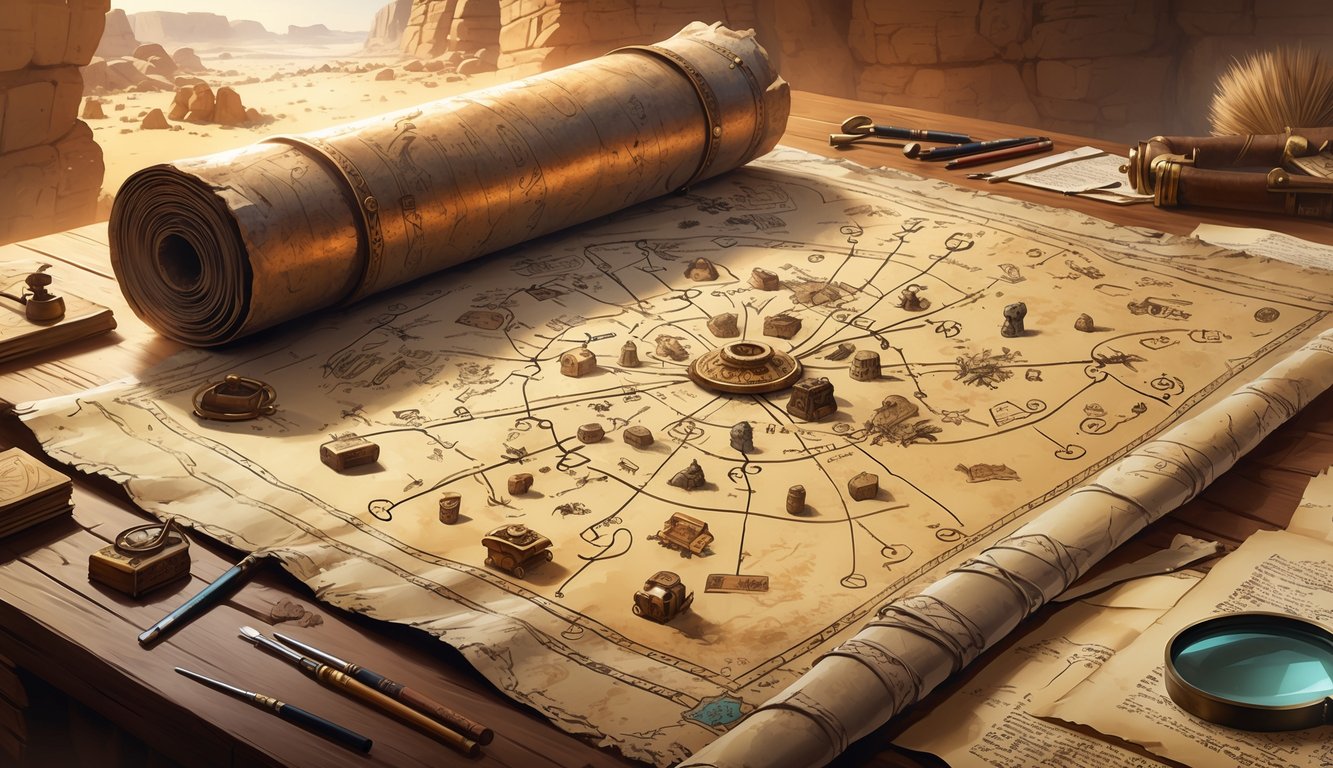
The Copper Scroll, also known as 3Q15, lists detailed instructions for finding caches of gold, silver, and sacred objects.
Many of these sites span a wide area, from Hebron to Mount Gerizim to Qumran, and include exact weights of the stored metals along with their hiding places.
Notable Sites Listed
Archaeologists believe the scroll records 64 separate deposits. Most entries describe gold and silver measured in talents, an ancient unit of weight.
One example describes a site that holds 900 talents of silver—about 30 tons—buried near a water source. Another entry details a silver chest with gold ingots hidden inside a building’s corner.
The locations range from urban structures to rural landmarks. Some are near valleys or springs, while others are in caves.
Researchers say the treasures include jars, bowls, and even priestly garments.
Below is a quick breakdown of treasure types mentioned:
| Treasure Type | Example Quantity |
|---|---|
| Silver | 900 talents (≈30 tons) |
| Gold | Multiple ingots |
| Sacred items | Vestments, incense jars |
| Containers | Chests, jars, bowls |
Clues and Directions in the Scroll
The scroll reads like a literal treasure map. It gives not just the site but also directions to reach the exact spot.
Many entries measure depth in cubits and specify distances from known landmarks. For example, one instruction says to dig a set number of cubits “under the steps” or “by the cistern’s corner.”
Some clues mention ancient place names that are hard to match with modern maps. This makes identifying the exact locations difficult.
Researchers note that the Copper Scroll’s format is unusual compared to other Dead Sea Scrolls. Instead of religious text, it provides a straightforward inventory with precise measurements.
Theories About the Treasure’s Origins
Archaeologists and historians have proposed several ideas about where the treasure listed in the Copper Scroll may have come from. Some focus on events in ancient Jerusalem, while others look to the Qumran community and related groups for answers.
Connection to the Second Temple
One major theory says the treasure came from the Second Temple in Jerusalem. This temple was the center of Jewish worship until the Romans destroyed it in 70 CE.
Supporters of this idea think priests hid temple treasure—gold, silver, and sacred vessels—to protect them from seizure. The 64 locations listed on the scroll could have served as secret storage sites spread across the region.
Some researchers point to the large amounts of metal described, possibly over 160 tons of gold and silver, as evidence of a state or temple origin. This scale would have been difficult for small communities to amass.
The theory also fits with historical accounts that valuables were removed from Jerusalem during times of conflict.
Possible Link to the Essenes
Another theory ties the treasure to the Essenes, a Jewish sect that lived in the area of Qumran. They are often linked to the Dead Sea Scrolls, which were found in nearby caves.
The Essenes lived simply and avoided personal wealth. This makes it unlikely they owned such riches.
Some scholars suggest they may have acted as guardians for valuables belonging to the temple or other groups. The Qumran community might have stored these items in remote hiding places, using the copper scroll as a durable inventory.
Copper was chosen instead of parchment because it could survive centuries underground. Critics of this theory argue that the Essenes’ ascetic lifestyle conflicts with the idea of them safeguarding massive treasure.
Still, the geographic link between Qumran and the scroll’s discovery site keeps this idea in discussion.
Alternative Theories
Some researchers propose that the treasure was not connected to the temple or Essenes at all. It could have belonged to wealthy individuals or political factions during the late Second Temple period.
Others think rebels during the First Jewish–Roman War owned the treasure and hid it to fund future resistance efforts.
A few suggest the scroll could be symbolic or ceremonial, representing spiritual wealth rather than actual gold and silver. The detailed measurements and location descriptions make this less likely.
Some believe the treasure was spread across different owners and eras, with the scroll serving as a compiled record rather than a single deposit. This would explain the wide geographic spread of the listed sites.
Attempts to Find the Treasure
Over the years, archaeologists and independent treasure hunters have tried to locate the hoard described in the Copper Scroll. Many expeditions have focused on matching the scroll’s detailed locations with real-world sites across ancient Judea.
The search has combined historical research, field surveys, and even modern technology.
Early Treasure Hunts
Explorers discovered the Copper Scroll in 1952 in a cave at Qumran. Soon after, small groups began searching the desert and hills for its 64 listed deposits.
Some believed the treasure came from the Jerusalem Temple before its destruction in 70 CE. This theory led hunters to explore areas near Hebron, Mount Gerizim, and the Jordan Valley.
In the 1960s, archaeologists tried to follow the scroll’s clues literally, measuring distances in ancient cubits. Many sites were inaccessible or had been disturbed over centuries.
Early searches often lacked funding and proper excavation tools. Most efforts were limited to surface-level exploration, leaving deeper deposits untouched.
Modern Expeditions and Searches
Recent decades have seen better-organized expeditions. Teams now use satellite mapping, ground-penetrating radar, and GPS to match the scroll’s descriptions to specific coordinates.
Some projects have focused on the Qumran area, while others explored sites across the Judean Desert. A few have examined caves along the Dead Sea’s western shore.
Modern archaeologists follow strict excavation rules. This ensures that any artifacts found are documented and preserved.
Despite these advances, no confirmed treasure from the scroll has been recovered.
Challenges Faced by Treasure Hunters
One major obstacle is the ambiguity of the scroll’s measurements. Ancient units like the talent or karsh vary in weight, making estimates of the treasure’s size uncertain.
Environmental conditions also pose risks. Harsh desert heat, unstable caves, and shifting terrain make exploration dangerous and slow.
Political restrictions add another layer of difficulty. Many potential sites lie in sensitive or disputed areas, requiring special permits for excavation.
Centuries of erosion, construction, and looting may have destroyed or moved the original deposits. This leaves little for modern searchers to find despite the Copper Scroll’s detailed inventory of hidden wealth.
Debates and Controversies
The Copper Scroll has sparked ongoing discussion among historians, archaeologists, and linguists. Questions about its origin, purpose, and accuracy continue to shape how people interpret this unique part of the Dead Sea Scrolls.
Authenticity of the Copper Scroll
Some researchers accept the Copper Scroll as a genuine ancient document created during the Second Temple period. They point to its discovery in 1952 at Qumran alongside other Dead Sea Scrolls as strong evidence of its authenticity.
Others remain cautious. The unusual choice of copper instead of parchment or papyrus raises questions. Copper is durable, but engraving it was labor-intensive, suggesting the contents were considered highly important.
Tests on the metal show it is ancient, but exact dating remains difficult. Critics argue that without clear archaeological context for the treasure sites it describes, its historical accuracy cannot be fully confirmed.
Key authenticity points:
- Found in Cave 3 at Qumran
- Engraved on 23 copper sheets
- Mentions 64 treasure locations
Scholarly Disagreements
Experts disagree on how to interpret the Copper Scroll’s text. Some believe it is a literal inventory of hidden gold and silver, possibly from the Jerusalem Temple before its destruction in 70 CE.
Others suggest it may be symbolic or ceremonial, not meant to guide actual treasure hunters. The Hebrew used in the scroll contains unusual terms, making translation difficult and open to multiple readings.
The debate also extends to measurement units like talent and karsh. These ancient weight measures could dramatically change the estimated size of the treasure, with some estimates suggesting as much as 160 tons of gold and silver.
Unresolved Mysteries
The biggest mystery is whether the treasure still exists—or ever did. The scroll lists precise hiding spots, but none have been verified.
Many locations are described in ways that are hard to match with modern geography. Treasure hunters and archaeologists have searched for decades without success.
Some believe the sites were looted long ago, while others think they remain undiscovered.
The possibility that the Copper Scroll is a coded document adds another layer of complexity. If the directions are encrypted or symbolic, then finding the treasure may be impossible without the original key.
Preservation and Display
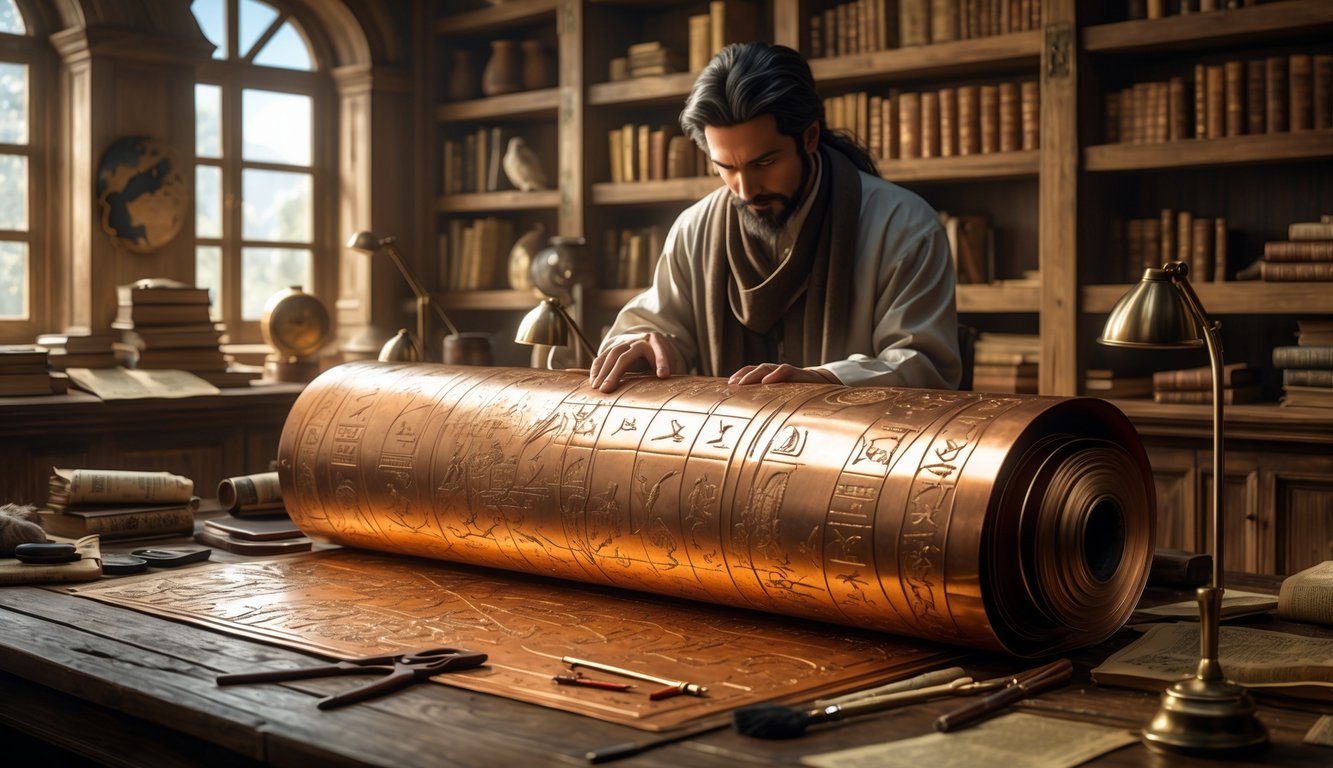
The Copper Scroll is fragile due to its age, material, and the way it was originally stored. Careful conservation and controlled exhibition conditions protect it from further deterioration while allowing the public to view this rare artifact.
Conservation Efforts
The scroll is made of thin copper sheets, which corrode easily when exposed to air and moisture. Specialists have worked to stabilize the metal and slow the corrosion process.
When explorers first discovered the scroll, it was brittle and difficult to handle. Conservators cut it into 23 strips to prevent cracking and to make it possible to read the text.
Today, preservation involves climate-controlled storage with stable temperature and humidity. Light exposure is kept low to reduce chemical reactions in the metal.
Regular inspections check for signs of new corrosion. If needed, experts apply safe cleaning methods to remove harmful deposits without damaging the engraved letters.
These measures help researchers continue to study the scroll while keeping it intact for future generations.
The Copper Scroll at the Jordan Museum
The Copper Scroll is housed at the Jordan Museum in Amman as part of the Dead Sea Scrolls collection. The museum uses secure, sealed display cases with controlled environmental conditions to protect it.
Visitors can see the scroll alongside detailed explanations of its discovery and translation. High-resolution images and replicas allow people to view the inscriptions closely without risking damage to the original.
The exhibit also includes background on the Qumran site and the techniques used to decipher the text. This helps visitors understand both the artifact’s historical context and the challenges of working with such a delicate object.
By combining careful preservation with public access, the Jordan Museum helps people appreciate the Copper Scroll’s significance while ensuring its long-term safety.
Legacy and Cultural Impact
The Copper Scroll has shaped both academic research and public imagination through its unusual material, detailed descriptions, and connection to the Dead Sea. Its influence reaches beyond archaeology into literature, media, and modern treasure hunting communities.
Influence on Popular Culture
Writers, filmmakers, and documentary producers have often drawn on the Copper Scroll’s mystery for inspiration. Its listing of 64 hidden hoards of gold and silver has provided ready-made storylines for adventure novels and historical thrillers.
Some television programs have featured the scroll as part of broader explorations of the Dead Sea Scrolls. These portrayals usually focus on the idea of an ancient treasure map, even though no confirmed discoveries have been made from its directions.
Collectors and amateur explorers have also been influenced. The scroll’s reputation has encouraged private expeditions, often blending historical research with speculative searching.
While these efforts have not yielded the treasure, they have kept the scroll in the public eye.
In popular culture, the Copper Scroll often serves as a symbol of hidden history—something tangible yet still out of reach. This blend of fact and uncertainty keeps it a recurring reference in creative works.
Ongoing Fascination With Ancient Treasures
The scroll draws continued interest because it lists gold, silver, and sacred objects in detail. Some scholars believe these items came from the Jerusalem Temple.
Others connect the scroll to the Essene community near Qumran.
Unlike other Dead Sea Scrolls written on parchment, this scroll uses copper. The creators likely chose copper to make the information last longer.
Modern researchers remain interested because verifying the scroll’s contents is difficult. Political and safety challenges in the region prevent full-scale excavation.
Historians study the scroll for its rare glimpse into ancient record-keeping. The public sees it as a link to the age-old search for hidden treasures.