The Comoros islands sit in the Indian Ocean and have a long, fascinating past shaped by many peoples and cultures. From early settlers with debated origins to the arrival of Arab merchants and later European colonizers, many details about this history remain hidden.
Some of the biggest historical mysteries in Comoros are unsolved questions about the island’s first inhabitants, old trade networks, and the reasons behind lost traditions.
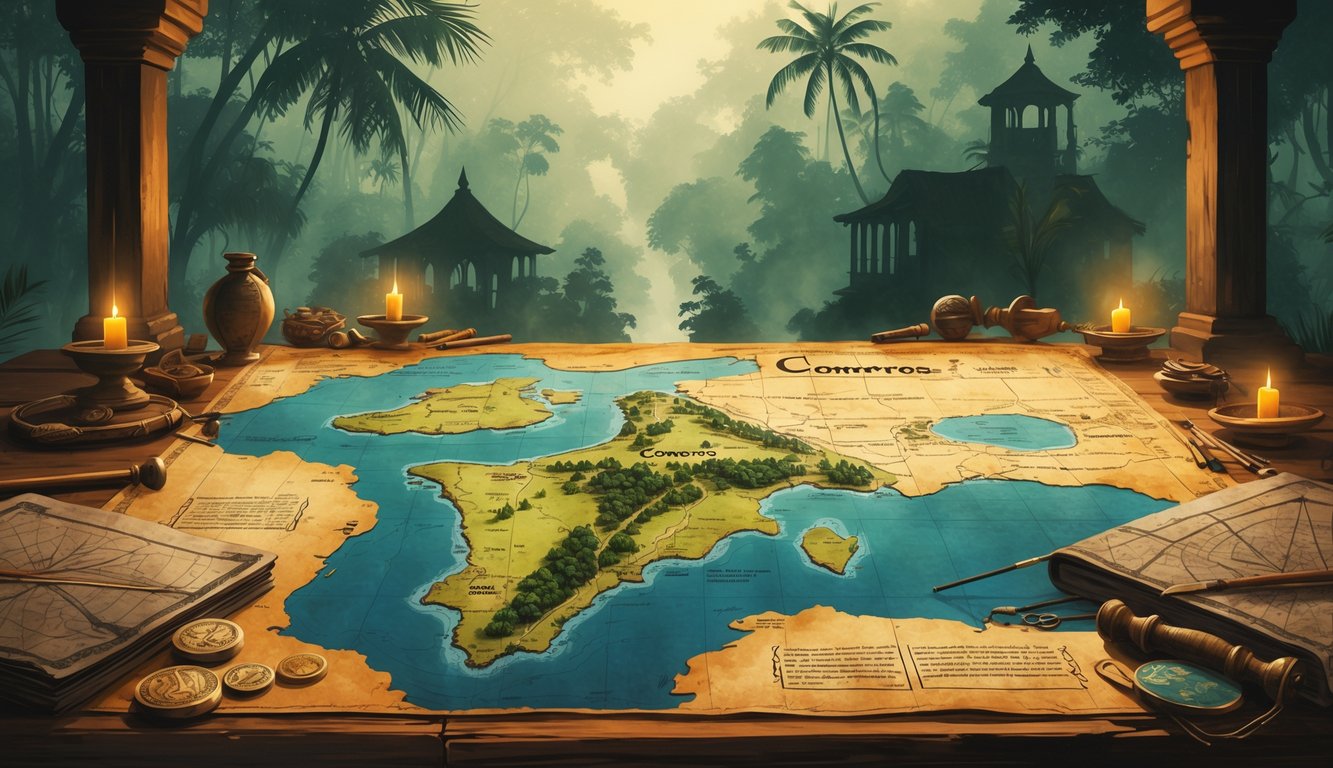
People who enjoy ancient stories may wonder how early settlers reached the islands. They may also ask what brought together the many cultures of Comoros or why certain ancient structures and artifacts were created.
These mysteries are woven into the daily life, beliefs, and legends of the Comorian people. This adds to the archipelago’s unique character.
Tracing the past of Comoros gives a glimpse into a world where much still waits to be discovered. Its complex history and cultural heritage offer many secrets.
The Enigmatic Origins of Comoros
Comoros sits at a crossroads in the Indian Ocean, where cultures from Africa, Asia, and the Middle East have mingled for centuries. The islands’ early history remains unclear, shaped by mysterious migrations and the arrival of traders and explorers.
Malayo-Polynesian Descent and Early Settlers
Many believe the first settlers of the Comoros came from Southeast Asia, especially from Malayo-Polynesian communities. Austronesian-speaking groups likely reached the Comoros between the 8th and 10th centuries.
They may have traveled by outrigger canoe, a technology also used in Madagascar. Archaeological findings show that these early settlers practiced tropical agriculture, growing bananas and taro.
They fished in the Indian Ocean and built small communities along the coast. Later, Bantu-speaking people from East Africa joined them and brought new skills and traditions.
The blend of Malayo-Polynesian and Bantu ancestry is still seen in Comorian language and culture today. This unique heritage sets the Comoros apart from other African islands.
More details about their early origins can be found in the History of Comoros.
Arab Traders and the Influence on Culture
By the 11th century, Arab traders began stopping at the Comoros as part of the Indian Ocean trade network. These traders brought Islam, which soon became the dominant religion on the islands.
They introduced new crops like cloves and coconut palms and shared navigation technologies. The Arab world’s influence appears in Comorian architecture, dress, and language.
Comorian Swahili includes many Arabic words, reflecting this connection. Mosques, such as the old Friday Mosque on Grande Comore, remain central to island life.
The islands grew as a trading post, linking Africa, the Middle East, and Asia. Over time, Arab settlers intermarried with local people, further shaping the culture and traditions of the Comoros.
More about this period is described in the Chronology of Events – The History of Comoros.
Portuguese Explorers and First European Contact
The Portuguese were the first Europeans to reach the Comoros Islands in the early 16th century. Their arrival marked the start of increased European interest in the Indian Ocean region.
They did not settle on the islands, but the Portuguese made maps and recorded their visits in logbooks. During their stops, they traded with locals, exchanging goods like cloth and metal tools for food and water.
The Portuguese reported seeing a diverse population with African, Arab, and Asian roots. Their brief presence opened the Comoros to new global trade routes.
More detailed accounts of this period can be read at History of Comoros.
Ancient Settlements and Archaeological Mysteries
Comoros has a long history that is still not fully understood. The islands feature ruins, old towns, and unexplored places that hold clues about early life and trade.
Unexplored Sites on Grande Comore
Grande Comore is the largest island in the Comoros archipelago. The island contains ruined villages, ancient mosques, and stone structures.
Many of these sites remain unexcavated due to limited resources. Archaeologists believe some settlements date back to when traders from Africa, Arabia, and Madagascar visited these shores.
Pottery fragments and old coins sometimes wash up on the beaches, suggesting trade routes passed through here. The dense forests and volcanic landscape hide more secrets.
Areas near the Karthala volcano may reveal lost communities if studied in detail. Much of what is known comes from small digs or accidental finds.
| Location | Key Features |
|---|---|
| North Grande Comore | Stone tombs, tools |
| Coastal villages | Pottery, Arabic scripts |
Exploring these sites could uncover more about how Grande Comore became a crossroads in the Indian Ocean.
Historic Iconi and Its Forgotten Past
The town of Iconi stands out for its mix of old buildings and legends. Once a thriving port, Iconi served as a center for trade and local power.
Forts and city walls built from volcanic rock still line the cliffs. Some believe Iconi might hold unknown royal graves or ceremonial grounds.
The old Friday Mosque, with its unique architecture, is considered a hidden gem in the region. Researchers have found fragments of ceramics, glass beads, and coral stone walls that hint at Iconi’s importance.
Few written records remain, so most history comes from oral stories and what can be learned from the ruins. Preserving what is left of Iconi’s historic sites is important.
The town’s past may soon be listed as a potential UNESCO World Heritage Site.
Hidden Treasures of Mohéli
Mohéli, also known as Mwali, is famous for its biodiversity and scenic beauty. Ancient settlements are scattered across the island, often overgrown by dense forests and native plants.
Archaeological finds include shell mounds, ancient wells, and upright stones believed to be markers for local communities. Some areas have yielded tools made from coral and hints of early farming techniques.
Much of Mohéli’s past is undocumented. Local stories describe sunken villages and lost treasures hidden along the coast.
Researchers call Mohéli a “hidden gem” for archaeology. Plans to survey and protect key sites are ongoing, especially in areas that could qualify for UNESCO status.
The island’s archaeology may eventually reveal more about the movement and daily life of early island settlers.
Mayotte: The Ever-Contested Island
Mayotte stands out in the Comoros for its unusual political journey. The island’s population has faced several decisions about its legal and national status, creating ongoing debates about identity and governance.
Referendums and the Question of Independence
Mayotte has held multiple referendums to decide if it should remain with France or join the Union of the Comoros. In each vote, most people in Mayotte chose to stay linked to France instead of joining their neighboring islands.
The 1974 and 1976 referendums both resulted in Mayotte choosing not to be part of the newly independent Comoros. This rejection of independence was based mainly on economic concerns and trust in French governance.
Many residents saw French connections as a path to better public services and stability. These votes have fueled disagreement between France, the Union of the Comoros, and international observers.
Comoros claims Mayotte should be part of its country, arguing that the island’s refusal to join undermined regional unity. The United Nations has recognized the Comorian claim, but Mayotte’s referendums continue to define its path.
Detailed numbers and political context can be found on Mayotte’s political choices.
The Status of Mayotte as an Overseas Territory of France
Mayotte officially became a French overseas department in 2011. This status means its residents are French citizens and enjoy certain legal and economic benefits.
The change to a department was a significant moment, giving Mayotte more local governance but not full independence. Today, Mayotte sends representatives to the French Parliament and operates under French law.
As a special collectivity, the island receives investments and public services from France that are often better than those in the rest of the Comoros. This status has led to higher living standards but has also increased migration from nearby islands.
The Union of the Comoros still disputes Mayotte’s French status, stating that colonialism has prevented full self-governance for Comorians as a whole. Many in Mayotte value their current relationship with France.
More about its present legal status and history can be read through Mayotte’s relationship with France.
Shadowy Figures and Mysterious Leaders
Comoros has seen dramatic changes in its political history. Key individuals have shaped its path.
Power struggles, shifting alliances, and foreign involvement have all influenced the nation’s direction.
Ahmed Abdallah and His Legacy
Ahmed Abdallah served as Comoros’s first president after independence from France in 1975. His rule was marked by repeated political unrest and several changes in leadership.
He was overthrown and then returned to power multiple times, often with foreign support. Many people see Ahmed Abdallah as a figure who worked closely with French interests, especially during a time when the country faced coups and instability.
He relied on French backing and the help of mercenaries to stay in power. Abdallah’s assassination in 1989 remains unexplained, and theories about who was behind his death continue to circulate.
A timeline of Ahmed Abdallah’s leadership would include:
- 1975: Comoros’s first president
- 1978: Returns to power with foreign help
- 1989: Assassinated under mysterious circumstances
His legacy is still debated in Comoros today.
Ali Soilih: Reformist or Revolutionary?
Ali Soilih took control after a coup in 1975. He was known for his bold reforms, aiming to modernize Comoros and break away from old colonial influences.
His government tried to introduce secularism, land reforms, and youth-focused policies. However, his approach worried many, both inside the country and abroad.
Traditional leaders and those loyal to France opposed his changes. Some saw Soilih as a visionary, while others believed his actions were too radical and disruptive.
His brief rule ended violently in 1978 when he was overthrown and later killed. The debate over Ali Soilih centers on whether he was a much-needed reformer or an unstable revolutionary.
Bob Denard: The French Mercenary in Comoros
Bob Denard was a French mercenary who left a major mark on Comoros’s history. He led or supported several coups in the country, starting from the late 1970s.
Denard and his men acted as power brokers, often working for leaders who supported French interests. He became infamous for his shadowy operations and his ability to change the political landscape behind the scenes.
At times, Denard controlled security forces and was a key figure in the country’s ongoing instability. Bob Denard’s presence highlighted the strong French influence and ongoing political instability in post-colonial Comoros.
Many view his actions as part of a larger pattern of foreign involvement in the country’s politics.
The Puzzle of Frequent Coups and Political Turmoil
Comoros has struggled with political instability since gaining independence in 1975. Military coups, leadership changes, and secessionist movements have shaped the country’s government and local politics.
Key Events in the Political History of Comoros
Comoros has seen more than 20 coups or coup attempts since independence. It is often listed as one of the countries with the most frequent power grabs in modern history.
These turbulent changes often start with military leaders or foreign mercenaries taking control.
Chronology of notable coups:
| Year | Event | Consequence |
|---|---|---|
| 1975 | Independence, first coup | Ahmed Abdallah overthrown |
| 1978 | Coup led by Bob Denard (mercenary) | Abdallah returns to power |
| 1989 | Abdallah assassinated, chaos follows | Transitional governments set up |
| 1999 | Colonel Azali Assoumani takes power | Suspension of constitution |
| 2021 | Recent unrest after disputed elections | Ongoing protests and crackdowns |
Azali Assoumani is a central figure in these events. He has ruled Comoros at different times, either by force or election.
Political turmoil often leads to new constitutions or changes in government structure. These shifts have made it hard for the Union of the Comoros to have stable and continuous leadership.
Secessionist Movements Across the Islands
Comoros is made up of several islands, including Grande Comore, Mohéli, and Anjouan. Tensions among these islands have led to attempts to break away from the central government.
In 1997, Anjouan and Mohéli both declared independence from the Union of the Comoros. This created a crisis where the central government lost control and needed international help to restore unity.
Forces from the African Union intervened to end the standoffs. Anjouan has remained especially active in attempting to separate.
In 2007, Anjouan’s leader refused to step down, causing another military intervention. These secessionist efforts continue to be a serious issue for political stability in the country.
The French Colonial Rule and Quest for Self-Government
French colonial rule shaped the Comoros islands in many ways. It affected economic development, education, daily life, and the nation’s long-term quest for independence from foreign rule.
Colonization and the Shaping of Modern Comoros
The French formally declared the Comoros a colony in the early 1900s. Their government introduced new laws, schools, and ways of organizing land and work.
French leaders made decisions about resources and jobs, often ignoring the needs of local people. Economic development was uneven.
Some new roads and buildings were built, but most public services and investments went to Madagascar, leaving Comoros with limited healthcare and education. Many Comorians migrated to seek better opportunities elsewhere, which caused social changes and tensions with nearby countries like Madagascar.
Key Impacts of French Colonial Rule:
- Limited local involvement in government
- Focused resources on the needs of France, not Comoros
- Slow growth in infrastructure
- Increased migration patterns
The Long Path Toward Self-Governance
Calls for more local control grew stronger after decades under French rule. Comorian leaders and citizens wanted the right to manage their own schools, land, and laws.
However, the road to self-governance was not simple. When three islands voted for independence, France held onto Mayotte, sparking ongoing disputes.
Control over local decisions returned only after long political struggles, protests, and negotiations. Colonial policies left gaps in training, skills, and institutions that slowed progress once independence was achieved.
Comoros finally gained most of its self-rule, but the legacy of colonialism still limits its economic and political future. Today, the country continues to work toward stronger systems for education, healthcare, and government.
Comoros’ Natural Wonders and Unsolved Environmental Mysteries
Comoros is home to stunning landscapes and rare wildlife. Its volcanic origins and vibrant coral reefs shape these features.
Ongoing environmental changes and limited scientific research mean that many questions still surround its most impressive natural wonders.
The Unpredictable Karthala Volcano
Mount Karthala dominates the main island, rising over 2,300 meters above sea level. This active volcano erupts frequently, with the most recent large eruption in 2005.
Locals often witness ash clouds and lava flows that can change the shape of the summit. Scientists still do not fully understand the patterns or causes behind Karthala’s eruptions.
These unpredictable events can threaten villages and forests nearby. Tourists are drawn to the volcano for hiking, but the risk of sudden eruptions keeps the area under close observation.
Researchers study the volcano’s crater, trying to predict future activity and uncover the history behind its unique geology. The connections between volcanic activity, climate patterns, and the safety of the islands remain a mystery.
Lush Volcanic and Coral Landscapes
Comoros features dramatic volcanic landscapes alongside rich reefs and coastal waters. Black volcanic rocks share space with white sand beaches and vibrant coral reefs.
These reefs are home to an amazing variety of fish, turtles, and other marine life. Rising sea temperatures and pollution are damaging the coral and changing the coastlines.
Parts of the island have lost up to 30 meters of shoreline due to erosion and extreme weather. Scientists and local communities worry about the future.
The link between volcanic activity and the changing coral reefs is still being studied. Ongoing questions remain about how to best protect these natural wonders as tourism grows and the climate continues to shift.
Unique Biodiversity and Endangered Wildlife
Comoros holds a mix of animals and plants not found anywhere else, including rare lemurs, fruit bats, and unusual bird species. Its forests and waters have some of the highest levels of biodiversity in the Indian Ocean.
In just 20 years, 28% of the islands’ forest cover has been lost. Endangered species struggle to survive as habitats shrink due to logging, farming, and expanding villages.
Local and international groups work together to find solutions. Their efforts focus on creating wildlife reserves, teaching communities about conservation, and encouraging sustainable tourism that protects fragile ecosystems.
Many mysteries remain about how best to save these unique ecosystems for future generations.
The Economic Enigma: Prosperity and Persistent Challenges
Comoros is full of natural riches, but its economy is puzzling. Locals work hard, yet many families face hardships even though the islands export unique crops and attract support from Comorians living abroad.
Agriculture and the Mystery of Perfume Exports
Agriculture has always been central in Comoros. The islands grow ylang-ylang, which is used in making perfume, along with cloves and vanilla.
These three crops give Comoros an important place in the world market for fragrant oils and spices. Ylang-ylang is sometimes called “liquid gold” because it is key to luxury perfumes.
Still, even though Comoros is a top perfume exporter, many farmers remain poor. Low crop prices, tough weather, and old farming methods make profits hard to find.
Exporting famous scents like ylang-ylang has not led to true prosperity for most people. Global markets and the fact that most processing happens outside the country mean Comoros does not get the full value from its own natural resources.
Remittances and the Role of the Comorian Diaspora
Many Comorians live abroad, especially in France. These families send back money, called remittances, which supports relatives at home.
The funds help pay for daily needs, school, and even community projects. Remittances are one of the biggest sources of income for the whole country.
They often bring in more money than farming or tourism. Most Comorian households rely on these transfers to cover basic costs.
Too much dependence on remittances means the local economy can suffer if families abroad have financial problems. It also makes it tricky for the government to plan for steady growth.
Tourism’s Untapped Potential
Comoros is sometimes described as a hidden gem in the Indian Ocean. The islands have beautiful beaches, coral reefs, and rare wildlife.
Some adventurous travelers come for the unique culture and nature that cannot be found elsewhere. Tourism could play a big part in the country’s future.
But the sector faces roadblocks like limited flights, poor infrastructure, and few hotels. Visas and travel information can also be hard to get.
If Comoros invested more in tourism, it could create jobs and bring in foreign money. For now, most visitors are only a small group of curious explorers, and the country’s full tourism potential remains mostly untouched.
Comorian Culture and Heritage: Lost Pages of History
The Comoros Islands are known for their rich blend of African, Arab, and French influences. Many of their old customs, beliefs, and stories are at risk of fading as time passes and new influences take hold.
Diversity and Cultural Fusion
Comoros is a country made up of four main islands in the Indian Ocean. For centuries, its location brought people from Africa, the Middle East, Southeast Asia, and Europe to its shores.
These groups mixed their languages, religions, and food, creating a unique culture. Islam became the main religion as early as the 11th century, while French became common during colonial rule.
You can still see African dances, Arab-style architecture, and French cuisine on the islands today. The country keeps several holidays and festivals that reflect this blend, like weddings and religious celebrations filled with music and dance.
The cultural heritage of Comoros is not just in its buildings and festivals. It can be heard in the way people speak, seen in local crafts, and tasted in their spicy dishes.
Disappearing Traditions and Intangible Heritage
Some traditions once practiced by Comorians are becoming rare. Old legends, storytelling, and song are less commonly passed down through families.
Special crafts like weaving, wood carving, and perfume making risk being lost as younger generations move to cities or seek different careers. Fewer young people learn about the history of Comoros, including the island’s unique marriage customs and sultanate stories.
Language is also changing, and with each shift, some words and meanings disappear. Intangible heritage, like community rituals and oral history, is hard to keep alive.
Groups such as the Djoumbe Foundation work to record and share these endangered parts of Comoros’ heritage. Their efforts help make sure stories, knowledge, and traditions are remembered before they are lost forever.
Unraveling Modern Mysteries: Comoros in a Changing World
Comoros faces unique challenges as it adapts to shifting political, economic, and cultural conditions. Decisions made today will shape the islands’ place in Africa and the world.
African Union and Regional Relations
Comoros is a member of the African Union and cooperates closely with neighboring countries. Its location in the Indian Ocean makes it important for trade and security.
The nation takes part in regional discussions about fighting piracy and illegal fishing. Both issues threaten its coastal waters.
The African Union has supported Comoros through political changes and helped resolve past crises. Keeping peace among the islands remains delicate, especially after earlier independence movements.
Sharp divisions sometimes surface during elections or leadership transitions. Participation in the African Union opens doors for financial aid and technical support.
Working with larger neighbors like Madagascar and Mozambique can be difficult. Comoros has to balance its own needs with those of bigger countries in the region.
Infrastructure Projects and National Development
In recent years, Comoros has focused on building new roads and upgrading ports. Improving electricity is also a priority.
These projects are vital for the nation’s economic development and public safety. Progress is slow because of limited funding and the country’s small size.
Fishing is a key industry that depends on strong infrastructure. Poor roads and old equipment make it hard for fishermen to transport their catch quickly.
Better roads and facilities could help fishermen reach new markets and keep more products fresh. There are new efforts to tap into renewable energy, especially solar power.
The country wants to reduce fuel costs and protect the environment. International donors and banks often lead or support these projects.
Success depends on training local workers and using new technology.
Society, Identity, and Globalization
Comoros blends African, Arab, and French cultural influences. As technology spreads, young people encounter new ideas and customs from outside.
This exposure brings opportunities but can also cause identity struggles. Education and social media make people more aware of the wider world.
Many youth dream about jobs or living abroad. Some families worry about losing traditional values as more people travel or connect online.
The country is also seeing changes in language, fashion, and family life. Balancing local culture with the impact of tourism and foreign business remains a challenge.
Some leaders believe that joining global trends could help Comoros solve its economic problems. Others urge caution and focus on preserving the islands’ unique heritage.