The Central African Republic holds deep history and many unsolved questions. From ancient settlements to later kingdoms, much of what happened in central Africa remains mysterious.
Some of the biggest mysteries here include the origins of its early people, lost kingdoms, and the reasons behind dramatic events in its past.
Archaeologists and historians have found signs that people began settling, farming, and fishing in this region thousands of years ago. Many details about these first communities remain unknown.
As outside influences arrived, especially during the era of the trans-Saharan slave trade and French colonialism, stories were lost. This loss makes it even harder to trace the country’s true beginnings and cultural changes.
You can find more about the region’s complicated past at this Central African Republic history overview.
The Ancient Megaliths And Prehistoric Puzzles
Central African Republic’s ancient landscape is full of mysteries. Evidence of early people and their stone monuments reveals secrets from prehistory.
Mysterious Stone Structures
Large stone formations called megaliths appear in several areas of the Central African Republic. These standing stones are often arranged in circles or lines.
Some of these formations date back thousands of years and are some of the oldest human-made sites in the region. Historians believe that local people set up these stones for reasons that are still unknown.
Some think they marked burial grounds or were used in ancient ceremonies. Others suggest they pointed to key places in the landscape, like water sources or safe camps.
Very little writing or art has been found nearby, which adds to their mystery. Many of these megaliths are made from hard stone or quartz, showing skill in shaping large rocks with simple tools.
For more information about these ancient stone sites, visit an article about the hidden meanings of African megaliths.
Early Human Settlement Sites
Archaeologists have discovered old camps and settlements where early hunter-gatherers lived. These sites often contain stone tools made from polished flint and quartz.
Some of these tools include arrowheads, scrapers, and hand axes. People used these tools to hunt and gather food.
These ancient people likely chose spots near rivers and lakes. Along with tools, pieces of pottery and animal bones have been found.
This gives clues about daily life long before written history began. Scientists use these camps to study how people survived and built early communities.
Lost Kingdoms And Vanished Civilizations
Traces of ancient cultures remain hidden in the Central African Republic. Few ruins or artifacts have been found, but stories and studies suggest the region was home to complex societies.
Unknown Empires Of The Ubangi River
The Ubangi River is one of the main landmarks in the Central African Republic. Archaeologists have found tool fragments and pottery near the river that hint at ancient settlements.
The Banda and Bobangi people lived and traded along these waters, possibly as far back as 2,000 years ago. Oral history describes kingdoms led by powerful chiefs who controlled trade in items like iron, salt, and cloth.
Artifacts show contact between different groups, including the Baya, Zande, and Mandjia. Unlike some well-known African empires, these kingdoms did not leave temples or walls.
Still, the river area may have supported large populations and complex societies. For more on forgotten kingdoms, see this list of forgotten kingdoms from across the world.
Absence Of Written Records
Most ancient peoples in the Central African Republic did not develop writing. As a result, there are few historical documents about the beliefs, leaders, or daily life of kingdoms like those of the Banda and Bobangi.
What remains are oral traditions and archaeological finds, such as decorated pottery and tools. These clues tell fragments of stories but leave many questions unanswered.
Historians compare these clues with those from nearby regions, where trade or migration may have brought new technologies. This lack of records is similar to other lost civilizations that disappeared without a trace around the world.
Enigmatic Trade Routes And The Unexplained
The Central African Republic’s ancient trade history is still full of gaps. While traces of old commercial paths remain, many routes and their roles have not been fully explained.
Uncharted Commercial Networks
Long before written history, Central Africa had busy trade networks. Traders moved goods like ivory, salt, iron, and beads through forests and savannas using paths that have faded over time.
Connections between distant communities led to the sharing of technology, beliefs, and farming methods. Archaeologists sometimes find artifacts from faraway places, such as glass beads and bronze items, in Central African sites.
These finds suggest the area was linked to bigger trade systems reaching North Africa, East Africa, and even Asia. There is little written record of who controlled these routes or how trade was managed.
Some believe that nomadic groups played a large part, but the full structure of these trade networks is still a mystery. Trade may have shifted as kingdoms rose and fell.
The Role Of The Nile And Congo River
The Nile and Congo rivers were vital to trade and travel in ancient Central Africa. The Congo River, with its wide basin, let traders carry goods over long stretches of land and water.
Canoes and rafts provided a way to cross rivers, making trade possible between forest villages and larger towns. These rivers acted as natural highways, connecting people and cultures.
Along the banks, trading posts and settlements appeared, where people exchanged spices, fish, and wild resources. The Nile, though more known to Egypt and Sudan, also played a role by linking Central African regions northward.
Because of these big rivers, ideas and goods flowed both ways. The exact patterns of river trade remain unknown.
Some evidence comes from ancient structures or oral legends. Many questions about how goods traveled or who profited remain unanswered.
Atlantic Connections
Contact with the Atlantic Coast brought new opportunities and new threats. By the late first millennium, traders sought the riches of Central Africa, especially ivory, gold, and enslaved people.
Although the Central African Republic is inland, ancient trading networks often stretched hundreds of miles from the coast deep into the continent. European, Arab, and African merchants used complex routes to transport goods to and from Atlantic ports.
This movement reshaped local cultures and economies. Some trade routes today still mirror these older paths, showing their long-lasting influence.
The lack of ancient written records makes it hard to trace every link or trader. Hints in oral stories and archaeological finds point to a lively system moving goods from the heart of Africa to the Atlantic world.
For a broader look at ancient trade routes and unsolved questions, see the mysteries of ancient trade routes.
Silent Stones: The Bouar Megalithic Sites
Near the town of Bouar in the Central African Republic, dozens of ancient stone structures called megaliths stand on the landscape. These stones have sparked curiosity because of their unknown origins and the secrets they might hold.
Purpose Of The Megaliths
The megaliths of Bouar are found in about 70 clusters scattered over a wide area. Each cluster contains large upright stones, some reaching several meters tall.
Researchers do not know for sure why these stones were arranged this way. Many suspect they marked graves or served for ceremonial purposes.
Some believe they could have been places where people gathered, while others point to their possible use in ancient rituals. Similar to sites like Stonehenge, these Central African megaliths may have been important for social or religious reasons.
Their exact purpose is still debated by experts. For more on the layout and spread of these stones, see megaliths in Bouar.
Archaeological Mysteries Of Bouar
Archaeologists have dated some of the Bouar megaliths back to the Neolithic period, which means they may be thousands of years old. There is little written history or evidence to explain who built them.
Key mysteries include:
- How were the stones moved and set upright?
- What tools or methods did early people use?
- Why do the stones appear in specific clusters?
No carvings or inscriptions have been found on the stones. This lack of written records makes it hard to attach them to a particular culture or historical event.
The area’s remote location has meant that little excavation has happened. There is still much to learn.
The Bouar megalithic sites continue to raise questions about the people who once called this region home.
The Mystery Of Ethnic Origins And Social Units
Central African Republic is home to many ethnic groups, all with their own unique stories and ways of life. The Banda and Baya people are two of the largest groups in the area.
Researchers still puzzle over how their ancestors arrived and how their society is organized.
Origins Of The Banda And Baya
The Banda and Baya have lived in Central African Republic for centuries. Details about their earliest origins remain uncertain.
Linguists and historians believe the Banda likely migrated from the northeast. The Baya may have moved from areas closer to present-day Cameroon.
Both groups settled in the central and western regions, often living alongside river systems. Archaeological evidence about their early settlements is limited.
Many questions remain about their movements and earliest roots. Oral traditions fill some gaps, sharing stories of travels through forests and plains.
Researchers still seek more definite proof about exactly where these groups started and when they arrived.
Key facts about their origins:
- Banda are known for farming and iron working.
- Baya traditionally lived in small villages and relied on hunting, gathering, and farming.
- Both groups speak Niger-Congo languages, yet their dialects differ.
Formation Of Social Structures
Traditional social units in Banda and Baya societies are usually based on family ties and local leadership. Extended families form the core of each village. Elders play a leading role in settling disputes and making major decisions.
Among the Banda, clans are important. Each clan has distinct names, traditions, and roles.
Leadership often stays within families, but the community also values respect when choosing chiefs or elders.
The Baya organize their villages into small, closely-knit groups. Decision-making is collective, with discussions and consensus guiding daily matters.
Village life centers around a central meeting space. People gather there for celebrations and council meetings.
Main features of their social structures:
| Group | Social Unit | Leadership |
|---|---|---|
| Banda | Extended family, clan | Hereditary chief, elders |
| Baya | Village, kin group | Consensus, elders |
Unsolved Questions From The Slave Trade Era

Many details about the history of slavery in the Central African Republic remain unclear. Key facts about how the slave trade took shape and who drove it are still debated.
The Scope Of Slavery
Most enslaved people in Central Africa came from large and powerful states in the region. Records show that over five million Africans left Central African ports during the trans-Atlantic slave trade.
Historians still do not fully understand where these enslaved people ended up or exactly how they were transported. Local African states and European traders both took part, exchanging goods like metals, guns, and cloth for captives.
Some people walked hundreds of miles from the interior to the coast. They passed through unknown trading networks before being shipped across the ocean.
One central question is what happened to the people and cultures that vanished or changed because of this trade. Families were separated, and whole communities were destroyed.
The loss of so many people changed the development of Central African Republic’s society. Researchers are still trying to measure the full impact.
For more on this, see how Central Africa differed from other slave trade regions.
Legacy Of Arabic-Speaking Slave Traders
Arabic-speaking slave traders played a major role, especially in northern and eastern Central Africa. They came from North Africa, Egypt, and nearby regions, and established routes deep into the interior.
Dar al-Kuti was a state in northern Central African Republic that sometimes worked with and sometimes fought against these traders. Control of Dar al-Kuti shifted as it tried to resist the capture and sale of its people.
Details about these interactions with Arabic-speaking slave traders remain unclear. Records are scattered and sometimes conflict with each other.
Local leaders sometimes sold captives to these traders. At other times, they fought to protect their people from being taken.
The long-term effects of these networks can still be seen in northern communities today. Much of this history remains a mystery.
For more on this trade system in Central Africa, read about the broader system of trade involving Africa and Europe.
Colonial Conundrums And Unexplained Transitions
The colonial period in what is now the Central African Republic brought sudden changes to local communities, trade, and borders. Many questions remain about decisions made by colonial rulers and the reasons behind shifts in political power.
Impact Of French Equatorial Africa
In the late 1800s, the “Scramble for Africa” caused European powers to compete fiercely for territory. French Equatorial Africa included Ubangi-Shari, which is present-day Central African Republic.
French authorities set up strict borders and changed how people moved and traded. Missionaries arrived, spreading new religions and schools.
Many wonder why certain policies, like forced labor and harsh taxes, were enforced when they hurt local economies and families. Decisions made from Paris often ignored the needs and traditions of the people.
The map below shows how borders ignored tribal lands:
| Period | Territory Name | Controlling Power | Major Change |
|---|---|---|---|
| 1880s – 1910 | Ubangi-Shari | France | Borders established |
| 1910 – 1960 | French Equatorial Africa | France | Region grouped with Gabon, Chad, Congo-Brazzaville |
Even today, the reasons behind many colonial laws remain unexplained.
Mysteries Of Political Movements
After World War II, new political parties quickly formed in Central Africa. The speed of these changes raises questions about who controlled the process.
Sometimes, it is unclear whether local leaders or French officials guided political movements. Early independence efforts were sometimes slowed or redirected.
For example, leaders who spoke up against colonial rule were sometimes arrested or replaced without explanation. There are also stories of sudden policy shifts that seemed to benefit only a small group.
Historians still debate what motivated certain political parties and why some leaders were supported over others. For a deeper look at this era, see this overview of colonial history.
The Puzzles Of Independence And Political Turmoil
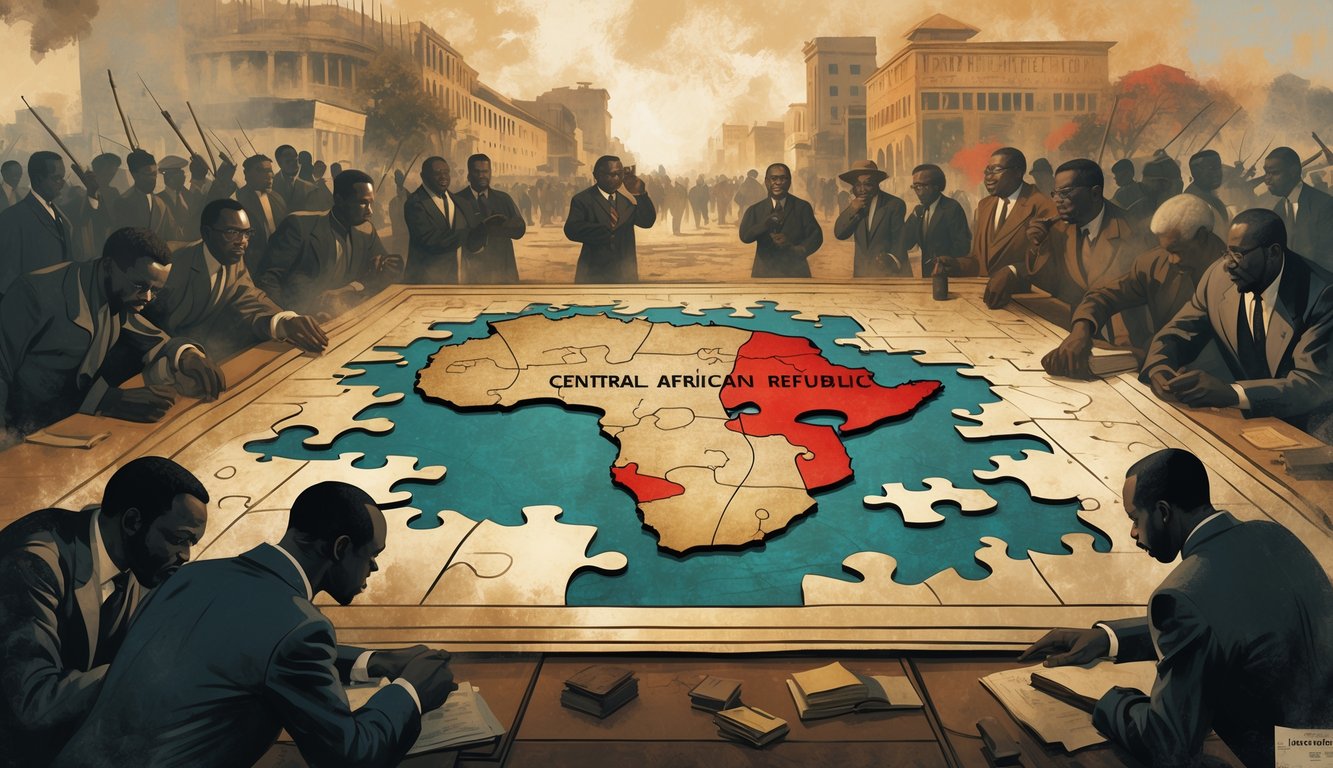
Central African Republic’s journey since independence has been full of important events and unanswered questions. Early leaders, shifting political parties, and unstable governments have shaped a complicated history.
The Fate Of Barthélemy Boganda
Barthélemy Boganda was a key figure in the fight for independence from France. He founded the MESAN (Movement for the Social Evolution of Black Africa) party to unite people under a vision of progress and democracy.
In 1959, Boganda died in a plane crash. The cause of his death remains one of the country’s most debated mysteries.
Some say it was an accident, but others believe sabotage or assassination played a role. There are still no clear answers.
Boganda’s loss affected the country’s first steps toward self-rule. His death left a deep mark on the political climate that followed.
The Evolution Of Political Parties
After independence in 1960, loyalty to leaders and powerful parties shaped the political scene. David Dacko, Boganda’s cousin and first president, took control and declared MESAN the only legal political party.
This move undermined efforts to build a true multi-party democracy. Political competition faded, and the country soon entered a long period of dictatorship and instability.
Over the decades, new parties appeared but often faced conflict and power struggles. According to Human Rights Watch, the Central African Republic’s story is marked by repeated coups and weak governments.
The country’s political evolution still raises questions about what true democracy will look like and when it will arrive.
Mysterious Rise And Fall Of The Central African Empire
The Central African Empire shocked Africa and the world when it appeared in the late 1970s. Its lavish monarchy, short reign, and sudden end left many questions about its true purpose and legacy.
Enigma Of Emperor Bokassa I
Colonel Jean-Bédel Bokassa, later known as Emperor Bokassa I, ruled the Central African Republic before declaring it an empire in December 1976. He crowned himself emperor in a ceremony modeled after Napoleon’s, spending vast sums on the event while many citizens lived in poverty.
Bokassa’s personality and leadership style confused many observers. He ruled strictly, made unpredictable decisions, and wanted recognition both inside Africa and abroad.
The reasons behind his move from president to self-declared emperor remain debated. Some say he wanted a lasting legacy, while others believe he wanted to centralize power for personal gain.
His rule as emperor lasted only three years. In 1979, French and local forces overthrew Bokassa, ending the empire as quickly as it had begun.
Details about why he rose so quickly, and then fell just as fast, still puzzle historians. To learn more about the timeline and dramatic events, read about the Central African Empire.
Hidden Agendas Of The Bokassa Regime
Bokassa’s government operated behind a veil of secrecy and fear. He chose key figures based on loyalty, making it hard for anyone to question his decisions or oppose his rule.
Foreign relations during his reign were complicated. Bokassa tried to strengthen ties with France, his country’s former colonial ruler, but also clashed with critics from other nations.
Reports of harsh punishments and lavish spending angered both locals and outsiders. Rumors of corruption, human rights abuses, and financial mismanagement surrounded Bokassa’s leadership.
Many believe the regime’s hidden motives included using power to gain personal wealth and silence resistance. These secretive actions made it almost impossible for people or allies to trust his rule.
For more information on the history and politics of the period, visit the article on the Central African Empire.
Unanswered Questions In Modern Political Instability
Political instability in the Central African Republic has shaped the country’s history for decades. Shocking changes in power, violent mutinies, and the rise of rebel groups have left many issues unresolved.
The Many Military Coups
The Central African Republic has experienced a long line of military coups. Leaders were seized from power, and new regimes soon faced their own threats.
Since independence in 1960, leaders like Ange-Félix Patassé and François Bozizé each dealt with mutiny and rebels trying to take control. Military coups often follow patterns of civil unrest and rebellion.
Predicting when a coup will occur or who will lead it remains difficult. Patassé was overthrown in a coup led by Bozizé, but Bozizé himself was removed in 2013 under similar chaotic circumstances.
Michel Djotodia became president after Bozizé, but his government struggled with internal mutiny and outside pressures. Leaders have lost power quickly, as control in the country can change hands with little warning.
This leaves citizens uncertain about their government and afraid of sudden change. There are unanswered questions about what real stability might look like and if future coups can be prevented.
Table of Noteworthy Coups:
| Year | Leader Ousted | New Leader |
|---|---|---|
| 2003 | Ange-Félix Patassé | François Bozizé |
| 2013 | François Bozizé | Michel Djotodia |
The Unpredictable Role Of Rebel Groups
Rebel groups have been a constant part of the country’s political instability. They often form in response to problems like poverty, weak government, and corruption.
Over the years, these groups have launched many attacks and created periods of civil unrest and rebellion. Groups linked to the Seleka coalition played a key role in overthrowing François Bozizé.
Others, like the anti-Balaka militias, rose in response and caused even more conflict. These shifting alliances make it difficult to predict when rebellion will break out or how it will end.
One important problem is how government leaders deal with rebel demands. Sometimes, peace talks or power-sharing agreements collapse quickly, leading to new rounds of violence.
Most experts agree there are still many unanswered questions about why the Central African Republic’s political instability continues, and how to stop rebel influence from growing stronger.
Ongoing Mysteries: Humanitarian Crises And International Involvement
The Central African Republic faces repeated cycles of violence. Millions need help and protection.
Multiple international groups and courts try to ease suffering. They also work to enforce accountability.
Challenges Of Human Rights And Aid
Communities across the Central African Republic often experience attacks and forced displacement. Many lack basic services.
Violence against civilians and children happens often. These human rights violations usually go unpunished.
Many families rely on outside support for food and water. They also need help with healthcare.
According to UNICEF, ongoing violence and natural disasters make it hard for people to get aid. Those who need help most often struggle to access it.
Aid workers face dangers and restrictions. These risks make the humanitarian crisis worse.
Millions depend on assistance each year. Resources from international groups sometimes do not meet the actual needs.
Instability and lack of safety increase the risk for residents. Helpers also face serious dangers.
The Role Of The UN And ICC
The United Nations has tried to help the country through peacekeeping missions such as MINUSCA. They work to protect civilians and monitor human rights abuses.
The UN also supports efforts like disarmament. The UN Security Council continues to discuss the crisis.
They call for more global attention and action. International intervention faces many roadblocks, including political divisions and ongoing violence.
The International Criminal Court (ICC) investigates war crimes and other violations. The ICC aims to ensure justice for victims and hold those responsible for crimes accountable.