Brazil is full of history and secrets that still puzzle people today. From ancient tribes deep in the Amazon to lost cities and strange carvings, this country has stories that spark curiosity and wonder.
Some of Brazil’s biggest historical mysteries include ancient underground tunnels, unknown civilizations, and unexplained artifacts found across the land.
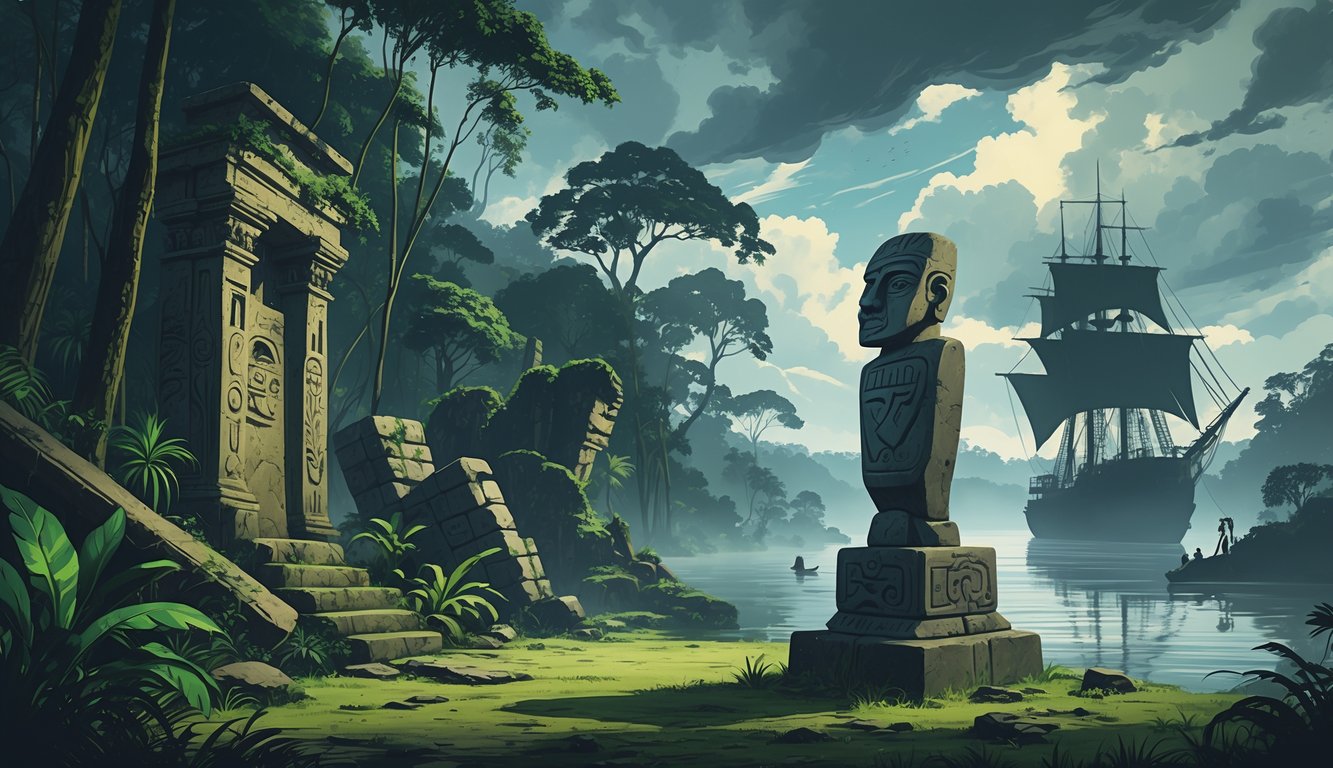
Researchers have found hundreds of massive, well-built tunnels in Brazil that date back at least 10,000 years. No one is sure who built them or why, making these paleoburrows a topic of great debate among scientists.
Mysterious urns and ancient human remains also appear in places that raise more questions than answers for explorers and archaeologists.
The Enigma of Brazil’s Ancient Civilizations
Brazil’s ancient history holds many mysteries, from unknown origins of early people to the hidden cities deep in the Amazon. Discoveries of strange ruins and rare artifacts raise questions about who lived in these areas and how they traveled across South America.
Unexplained Origins of Early Populations
Scientists are still trying to explain how the first settlers arrived in Brazil. Some believe early people crossed a land bridge from Asia to North America and then moved down into South America.
Others think there may have been sea crossings from Africa. Genetic studies have shown surprising links between some ancient Brazilian remains and people from far away places like Australia and Melanesia.
One example is the 11,500-year-old skeleton called Luzia Woman found near Belo Horizonte. Her skull shape is different from most Native South Americans, leading researchers to guess there may have been more than one ancient migration.
Despite some clues, the full answer to how Brazil’s first people arrived and where they came from is still missing.
Lost Cities of the Amazon
For many years, scientists believed the Amazon was too harsh for large settlements. Modern research has changed these ideas.
Archaeologists have found remains of ancient towns and large earthworks, including mysterious stone structures in the state of Amapá. Large circular patterns, ditches, and raised fields show people were living in organized communities thousands of years ago.
Researchers have also studied giant underground tunnels and ruins in Brazil. Some think these could be old burrows dug by extinct animals, while others believe people expanded these tunnels and used them for shelter or travel.
Stories about lost Amazon cities, like the legendary City of Z, continue to inspire new expeditions.
Prehistoric Migrations and Settlements
There is evidence that groups in ancient Brazil moved long distances and settled in new areas throughout South America. Tools and pottery styles found at different sites show how people spread their traditions.
Studies suggest some groups traveled by river, while others made long trips on foot. The climate and landscape shaped their journeys.
During periods of heavy rain, thick forests may have made travel difficult. In drier times, people could have moved more freely.
Ancient trade networks likely existed, letting people exchange resources like stone, shells, and food. These connections helped shape the culture of ancient Brazil and link it with other parts of South America.
Stonehenge of the Amazon: The Mystery of Amazonian Megaliths
In northern Brazil, a group of mysterious stone circles known as the Amazon Stonehenge has sparked intrigue. These ancient earthworks give a surprising look into the past and show that the region’s early people were more advanced than once believed.
Discovery and Significance of Amazon Stone Circles
The largest and best-known site is found near Calçoene in Amapá state and is often nicknamed the “Amazon Stonehenge.” This site contains over 100 granite blocks, some standing up to three meters tall.
Archaeologists have dated the stone circle to around 1,000 years ago. For many years, people thought the Amazon was mainly home to small, nomadic tribes, but these megaliths challenge that idea.
Researchers have discovered hundreds of massive earthworks in the Amazon, showing that ancient people lived and worked in the rainforest well before Europeans arrived. The existence of sites like Calçoene highlights a different view of Amazonian history.
Purpose and Astronomical Alignments
The true purpose of these Amazonian megaliths is still debated. Some archaeologists believe the stone circles had ceremonial uses or may have marked burial grounds.
A key observation is that some of the stones at Calçoene align with the sun during the winter solstice. This hints that the site might have served as a kind of early calendar or observatory, similar in some ways to the famous Stonehenge in England.
The idea of ancient Brazilians tracking the movements of the sun adds to the mystery. The exact uses remain unknown, leaving experts to wonder how much knowledge these early societies had about the skies and seasons.
Puzzling Ancient Artifacts
Hidden in Brazil’s earth, researchers have uncovered ancient objects that raise questions about how early people lived. These discoveries include both simple stone tools and fragile pottery shards, each with its own mysteries.
The Secrets Behind Stone Tools
Archaeologists in Brazil have found stone tools dating back thousands of years. These tools, made mostly of quartz or flint, show signs of shaping and sharpening.
Stone axes, scrapers, and arrowheads are just a few examples. Many of these objects were found near ancient settlements in Sao Luis.
Some date back up to 9,000 years, suggesting the land was home to organized communities far earlier than once thought. What puzzles scientists most is the fine craftsmanship of certain implements.
The tools often fit well in a human hand, with edges so sharp that they seem more advanced than their age would suggest. Their use in everyday life—hunting, building, and food production—helps paint a picture of early Brazilian society.
Not all sites agree on tool styles or methods, hinting at possible influence from other cultures or unique local traditions.
Investigating Pottery Shards
Pottery shards found at ancient Brazilian sites also tell a story. Buried under layers of soil, these ceramic pieces are usually decorated with lines, dots, or geometric patterns.
Some researchers think the designs held social or spiritual meaning. The colors and shapes of the pottery suggest a wide range of daily uses, from cooking to storing grains and liquids.
Pottery fragments discovered along the coast point to early trade or connection between different groups. For example, pieces found near Rosane’s Farm include both simple kitchen pots and fine ceremonial vessels.
Experts use these shards to track changes in habits and technology over time. Pottery styles sometimes change suddenly, which raises questions about contact with distant peoples or major cultural shifts.
Disappearance of the Indigenous Civilizations
Many ancient cultures in Brazil, including complex societies in the Amazon, have vanished or changed greatly over time. Researchers continue to investigate how factors like war, disease, and environmental shifts affected these groups.
The Marajoara Collapse
The Marajoara people lived on Marajó Island near the Amazon River delta between about 400 AD and 1400 AD. They built large earthen mounds, known as “tesos,” and created detailed pottery.
Their society had social classes, and the population may have reached tens of thousands. By the 1400s, most Marajoara settlements were abandoned.
Historians believe environmental changes, changing river patterns, or soil exhaustion may have contributed to the collapse. There is also evidence of conflict and possible shifts in trade routes, which weakened their ability to thrive.
Today, much of what is known about the Marajoara comes from archaeological digs.
| Feature | Details |
|---|---|
| Location | Marajó Island, northern Brazil |
| Time Period | 400-1400 AD |
| Achievements | Earthen mounds, advanced pottery |
| Collapse Cause | Likely mix of environment, conflict |
Isolated Amazonian Tribes and Vanishing Cultures
Before European contact, millions of Indigenous people lived in Brazil, speaking hundreds of languages. The arrival of outsiders brought diseases and violence, which caused dramatic drops in population.
Many whole groups disappeared forever. Some Amazonian tribes remained hidden. Others were assimilated or lost through forced integration and habitat destruction.
New discoveries, such as DNA studies of ancient remains like Luzio, confirm that the first residents of Brazil are related to today’s Indigenous peoples.
A long list of extinct Indigenous groups includes those wiped out by disease, war, or loss of land. Each vanished culture means lost languages, traditions, and histories.
The struggle for surviving groups to keep their identities remains one of Brazil’s ongoing challenges.
The Legend of the Lost City of Z
The Lost City of Z has fascinated explorers for over a century. Nestled somewhere in Brazil’s Amazon rainforest, this mystery includes dangerous journeys and clues from ancient history that spark suspense.
Exploration Attempts and Expeditions
Colonel Percy Harrison Fawcett, a British explorer, believed there was an ancient city in the deep forests of Brazil. He called it the Lost City of Z.
Fawcett thought the city had advanced buildings and culture, proving that the Amazon was home to an ancient and complex society. He led several expeditions into the Amazon during the early 1900s.
In 1925, he ventured into the Mato Grosso region with his son and a friend. The party vanished, and their disappearance only increased interest in the legend.
Stories of towering temples, treasures, and strange maps found in old records continued to attract more explorers. Even today, the fate of Fawcett and the city’s true existence remain unsolved.
You can learn more about these expeditions and the legend at this in-depth summary.
Modern-Day Discoveries Linking to the Myth
Today, scientists use satellites and new technology to reveal what lies beneath the trees in Brazil’s Amazon. Recent discoveries of huge earthworks, called geoglyphs, suggest ancient cities and roads once existed there.
Archaeologists found evidence of large ancient communities with complex society structures. These finds challenge past ideas that the area was always wild and unsettled.
Researchers still debate if Fawcett’s Z was real or just a legend. The myth continues to inspire, especially as new ruins are uncovered in the Amazon.
More details on these findings can be read in this overview of the true story.
Ancient Navigation in Brazil
Long before recorded history, people in Brazil used the country’s vast rivers and coastlines to travel and trade. Evidence of early navigation gives clues about how ancient groups explored South America’s landscapes.
Tracing Early Routes and Waterways
Brazil’s river systems, like the Amazon and São Francisco, stretch for thousands of miles. Early inhabitants likely used dugout canoes made from hollowed logs to navigate these winding waterways.
Archaeologists have found stone tools and ancient campsites along riverbanks. These finds support the idea that rivers were major travel routes.
Rivers also linked different tribes, making trade and communication possible, especially in the dense forest. In the rainy season, flooding helped people move goods longer distances.
Ancient travelers often followed the coast as well, using small boats to reach new areas. These routes helped people share pottery, food, and new customs across Brazil.
Theories on Pre-Columbian Seafaring
Some experts think that people reached Brazil from distant lands before Europeans arrived. There are debates about whether ancient sailors crossed the Atlantic Ocean or arrived by other means.
A few stone carvings and artifacts seem similar to those found in Africa or the Pacific. This leads to theories about long-distance journeys.
Researchers have studied old boat designs and wind patterns to understand if these ancient voyages were possible. There is little solid evidence for large-scale seafaring in this period.
The coastlines of Brazil provided access to rich resources. Today, the question of possible pre-Columbian seafaring remains one of Brazil’s fascinating mysteries.
The Mystery of the Giant Geoglyphs
Ancient geoglyphs found in Brazil have puzzled researchers for decades. These massive earthworks raise questions about their builders and why they were made.
Geometric Earthworks and Their Builders
The Brazilian Amazon holds hundreds of large geometric earthworks, called geoglyphs. Researchers discovered these shapes using aerial surveys and satellite images.
These shapes include circles, squares, and straight lines. Some stretch for hundreds of meters across.
Many of these geoglyphs are over 1,000 years old, dating to a period before Europeans arrived in South America. Ancient peoples used basic hand tools to build these shapes.
The exact group or groups who created the earthworks is not fully known. Evidence shows they lived in organized communities with farming skills and knowledge of large-scale construction.
Pottery and traces of ancient villages have been found near the geoglyphs. These finds support the idea of settled communities.
Scientists are still discovering new geoglyphs as more of the rainforest is studied. The ancient history of Brazil is deeper and more complex than once believed.
Interpretations and Purposes
Researchers have many ideas about why the geoglyphs were made. Some think they marked ceremonial spaces where people gathered for rituals or festivals.
Others believe they could have served as gathering points for trade or social meetings. Some suggest they marked boundaries.
The shapes often repeat in patterns, which hints at symbolic or religious meaning. There is little sign of everyday living inside the geoglyphs.
Some scientists also look at the arrangement of the geoglyphs and the way they align with the landscape. They point out that some lines may line up with the sun or stars, possibly for calendars or seasonal events.
The mystery remains a key question in Brazil’s ancient history. Researchers hope that new finds and better technology will give more answers in the coming years.
Sunken Cities Beneath Brazilian Waters
Hidden under the waters of Brazil, lost cities and relics spark curiosity and suspense. Unique discoveries and mysterious legends have led some to question what history may have missed.
Archaeological Findings in Flooded Regions
Researchers have explored the lost city of Canudos, now underwater in northeastern Brazil. Once a site of conflict in the late 1800s, the city was eventually submerged after the creation of a reservoir.
The ruins of Canudos remain beneath the water. On rare occasions, lower water levels expose its old structures.
Locals and visitors sometimes see church steeples and stone buildings emerging above the surface. Besides Canudos, Guanabara Bay near Rio de Janeiro has drawn attention.
In 1982, diver Robert Marx reported finding Roman-style amphoras at the bottom of the bay. This unexpected claim suggested an ancient presence in Brazil long before Columbus.
While the jars caused debate, some experts believe they may have come from later shipwrecks rather than a true sunken city. Others argue their origins are still unknown, keeping the mystery of Guanabara Bay alive.
Links to Ancient Legends
Many local legends tell of underwater ruins and ancient cities lost in Brazilian lakes and rivers. Stories often include treasure, vanished villages, or entire cities swallowed by sudden floods.
Some tales link the city of Canudos to prophecies and omens, passed down by generations. Local people say the city was cursed and destined to be lost under water.
In the Amazon, there are myths about ancient civilizations that built cities now hidden beneath thick jungle or submerged by changing rivers. These tales blend history and imagination, but they keep people interested in the possibility of new discoveries about Brazil’s ancient past.
Underwater archaeological finds, both real and rumored, continue to inspire explorers and storytellers.
Unraveling the Amazon’s Linguistic Riddles
Deep in the Amazon, the secrets of lost languages and ancient scripts still puzzle researchers. Brazil and other parts of South America hold many clues about old civilizations through their unique words, speech patterns, and mysterious symbols.
Deciphering Lost Languages
The Amazon region was once home to hundreds of different languages. Many of these languages are now extinct.
Experts have found only traces in carvings, pottery, and oral histories. Researchers have discovered pieces of unfamiliar scripts etched on stone and wood deep in the rainforest.
These symbols do not match any known system. Linguists must guess their meanings by comparing them to surviving languages in the area.
Efforts to collect and save native stories, songs, and oral traditions help keep these mysteries alive. Community members sometimes share old words passed down over generations.
Organizations and linguists are working with local people to record and study endangered Amazonian languages before they vanish entirely. Some of the greatest riddles still surround how tribes used these lost words to communicate across large distances.
Their trade routes and alliances depended on understanding many languages. Translation skills were very important.
Language Evolution and Cultural Connections
Languages in the Amazon changed as people moved, traded, and met others from different areas. In Brazil, you can still find groups who speak rare languages that are not related to Portuguese or Spanish.
Many words used today in Brazilian communities come from native Amazonian languages. These words describe local plants, animals, and places.
For example, names of rivers and towns often come from the Tupi-Guarani language family. Migration and contact between different tribes helped blend vocabulary and grammar.
Sometimes, a tribe would adopt parts of a neighbor’s speech if they lived close or traded often. Other words might disappear if people stopped using them or if new ideas came with outsiders.
Preserving these languages is important. Each one offers unique clues to history, culture, and how people lived.
For anyone interested in riddles and mysteries, the vast collection of Amazonian stories and expressions provides a fascinating look into Brazil’s past.
The Enduring Mystique of Brazil’s Historical Puzzles
Brazil’s unsolved mysteries spark both fascination and suspense. These puzzles influence people’s daily lives and shape national pride.
Many Brazilians feel a strong connection to the country’s ancient sites and mysterious discoveries. Stories about lost civilizations, stone carvings, and the jungle’s secrets appear in books, TV shows, and festivals.
Some local legends even come from real discoveries, like the ancient stone structures found in Amapá. Mysteries like these often spark conversations and inspire artists and musicians.
Teachers sometimes include these puzzles in lessons to get students excited about history. Writers set detective novels and adventure stories against the backdrop of Brazil’s enigmatic past.
Public art, crafts, and even street performances may feature symbols or characters inspired by Brazil’s historic riddles. This blending of mystery and daily life keeps old questions alive for both young and old.
Continuing Archaeological Investigations
Archaeologists in Brazil search for answers in remote places, from the dense Amazon to hilltops in the north. Recent finds include 24,000-year-old stone artifacts and huge stone circles.
These discoveries show that people still know little about ancient Brazilians. Researchers usually map the sites and uncover clues.
They use new technology like drones or 3D scanning. They look for patterns in where stones are placed or analyze markings to understand why these sites were built.
Thick forests and harsh weather make excavations challenging. Each discovery can change what people know about Brazil’s early societies.