Bangladesh, shaped by the long and complex history of the Bengal region in South Asia, is home to many unsolved mysteries. Some stories are rooted deep in the past, while others remain fresh in the memory of its people.
A few of the most intriguing mysteries include the unresolved deaths of famous film stars, like Salman Shah and Sohel Chowdhury. Their cases are still discussed today, as shown in this list of unresolved murder cases in Bangladesh.
Other mysteries connect to major events in the country’s journey toward independence and the secrets surrounding them.
The Disappearance of Ancient Bengal Civilizations
Several ancient civilizations once thrived in what is now Bangladesh. Many details about their rise and sudden disappearance remain unanswered.
Mysteries of Wari-Bateshwar
Wari-Bateshwar is an important archaeological site in central Bangladesh. This site shows evidence of an Iron Age settlement that may be over 2,500 years old.
Archaeologists have found ancient fort walls, silver coins, and beads here. These finds show signs of early urban life.
Very little is known about the people who lived there. The settlement disappeared long before records from the Gupta Empire or other kingdoms appeared.
The script on the coins and artifacts has never been fully decoded. Some remains hint at trade links to Southeast Asia.
The reasons for the site’s decline are unknown. Flooding, wars, or shifting trade routes could be possible causes, but no clear answer has been found. Learn more about the mysteries of ancient Bengal.
Lost Cities of the Vanga and Samatata
The ancient regions of Vanga and Samatata were centers of early civilization in Bengal. Texts from ancient India mention both areas as powerful kingdoms.
Vanga was located along the southern rivers, while Samatata lay in the southeast. Modern researchers believe these cities were important for trade and culture.
Finding their exact locations has proven to be challenging. No large ruins or city outlines have ever been uncovered.
River shifts and monsoon floods may have wiped away many traces of these cities. Their disappearance remains one of the most puzzling gaps in the ancient history of Bangladesh.
| Region | Known Strengths | Main Mystery |
|---|---|---|
| Vanga | Trade, warfare | Unfound remains |
| Samatata | Culture, trade | Disappearance of cities |
Archaeological Gaps in Varendra and Mahasthangarh
Varendra, in northwestern Bangladesh, includes the important site of Mahasthangarh. Mahasthangarh was once a thriving city.
It has ruins from different periods—including the Maurya and Gupta Empires. The city is one of the oldest archaeological sites in the region.
Despite many digs, historians have found big gaps in the record. Few everyday objects remain from the Iron Age or early Bangladesh history.
Ruins of city walls and the presence of Northern Black Polished Ware give clues about life and trade. Written records are rare.
How Mahasthangarh lost its power, and why Varendra faded as a major region, is still not clear. Floods, changing rulers, or new trade paths may have led to their decline, but the final answers are still missing.
Unsolved Assassinations and Political Conspiracies
Political assassinations have changed the course of Bangladesh’s history. These unsolved killings involve major national figures, court cases, and secret plots.
The Killing of Bangabandhu Sheikh Mujibur Rahman
Sheikh Mujibur Rahman, known as Bangabandhu, was the founding leader of Bangladesh. On August 15, 1975, a group of army officers assassinated him at his home in Dhaka along with most of his family members.
Many questions about the planning, motives, and backers of this assassination remain. Multiple trials failed to settle all doubts.
Some allege there were political figures and international forces behind the murder. For years, the killers lived abroad without facing justice, which raised more anger and suspicion.
The trial of Bangabandhu’s assassination faced many roadblocks and delays. Some believe efforts to solve the case were blocked by changes in government and shifting alliances.
Key Details:
- Victim: Sheikh Mujibur Rahman and family
- Involved: Army officers, suspected political conspirators
- Ongoing debates: Motives, international role, incomplete justice
Enigma Surrounding Ziaur Rahman’s Death
Ziaur Rahman, a military leader and president, was a major figure after independence. In 1981, he was assassinated in Chittagong during an attempted coup.
The killing shocked the nation and led to a wave of crackdowns and arrests. While several soldiers were tried and executed, theories about the real masterminds continue.
Suspicions linger about deep political plots involving rivals from the army and possible involvement of high-ranking politicians. His death ended a period of strict rule and brought more unrest to the country.
The event made a big impact on both the Bangladesh Nationalist Party (BNP), which he founded, and on national politics.
Summary Table:
| Item | Detail |
|---|---|
| Role | President of Bangladesh |
| Assassinated | 1981, Chittagong |
| Suspected Plots | Military coup, high-level conspiracies |
Political Intrigue Around Khaleda Zia
Begum Khaleda Zia, former prime minister and BNP leader, is linked to many political controversies. She is the widow of Ziaur Rahman and played a large role in shaping modern Bangladeshi politics.
Although she has not been assassinated, she has faced many threats, arrests, and court cases. There have been claims of conspiracies against her by the Awami League and other political opponents, especially during tense election periods.
At times, Khaleda Zia has survived attempts on her life and reports of plots, which have increased fears for her safety. Disputes over her arrests and the bans placed on her political work keep the public eye on possible hidden motives and power struggles.
This has deepened the divide between her supporters and the ruling party, fueling more conspiracy theories and mistrust among citizens.
The Bangladesh Liberation War’s Unanswered Questions
The Bangladesh Liberation War of 1971 changed the map of South Asia. Even today, historians and the public still debate many events, motives, and outcomes from the war.
Mysteries of the Mukti Bahini’s Operations
During the Bangladesh War of Independence, the Mukti Bahini were the main resistance fighters. Many details about their training, leadership, and exact numbers remain unknown.
Many operations happened in secret. Some stories are still only passed down as rumors or personal accounts.
Records show that the Mukti Bahini got training and support from India. However, it is unclear how much planning came from local commanders or outside advisors.
Lists of leaders are sometimes incomplete or disputed. Decisions taken by officers in key battles such as in Sylhet and Jessore still spark debates.
Historians continue to search for more documents and reliable witnesses. Understanding the full scope of the Mukti Bahini’s actions could answer many questions about their tactics and successes. More on their role can be found at the history of Bangladesh’s liberation war.
Accountability for War Crimes
The war involved many reported atrocities, including violence against civilians, especially in East Pakistan. Thousands of Bangladeshis lost their lives, and many more faced trauma that still affects families.
One critical mystery is why only some of the accused were brought to trial. After the victory, the new People’s Republic of Bangladesh tried to prosecute those responsible, but not all were held to account.
Some high figures from Pakistan, and local collaborators, escaped punishment. International organizations such as the United Nations and Commonwealth discussed responsibility, but the process was slow.
The political interests of countries like Pakistan and India, and involvement of other groups, affected accountability. There is debate about the extent of war crimes and the fairness of the trials. This remains a sensitive issue for many Bangladeshis and historians. More background is given in this detailed look at the conflict.
The Role of Regional and Global Powers
India supported the Bangladeshi fighters with training, weapons, and shelter, while Pakistan tried to control East Pakistan. Leaders such as Zulfikar Ali Bhutto in Pakistan made critical decisions about military strategy and diplomacy.
Global powers like the United States, Soviet Union, and China responded differently. Some took sides, and others tried to avoid involvement.
The Non-Aligned Movement and the Organization of Islamic Cooperation (OIC) also debated the issue in meetings. Meeting records show mixed reactions within the United Nations.
The recognition of the People’s Republic of Bangladesh as a country was delayed by some. Details about the quiet talks, agreements, or deals made during and after the war are not fully known.
Researchers are still examining records for clues about why certain actions were taken or ignored. Read more about this on the Bangladesh Liberation War timeline.
Enigmas of Bengal’s Medieval Dynasties
Medieval Bengal had flourishing kingdoms, grand empires, and shifting religious influences. Some of its dynasties left behind puzzles still debated by historians today.
The Disappearance of the Chandra Dynasty
The Chandra dynasty was important in southeastern Bengal during the 10th and 11th centuries. They supported both Buddhism and Hindu traditions, built temples, and were active in trade.
Yet, they vanished from the historical record without clear explanation. Only a few surviving inscriptions and ruins connect to the Chandras.
Their main city, Bikrampur, has yielded little direct evidence about their end. No large battles or invasions were documented that might explain their disappearance.
Theories include being overtaken by rivals or absorbed by the rising Pala dynasty. Many questions remain about how such a strong dynasty simply faded away.
Rise and Mystery of the Pala Empire
The Pala Empire became a powerhouse in Bengal and Bihar from the 8th to 12th centuries. It is famous for spreading Buddhism through grand monasteries and supporting art and education.
Despite well-known rulers like Dharmapala and Devapala, many facts about the Palas are still unclear today. Historians still debate the true origins of the first king, Gopala.
The Palas ruled a diverse population of Buddhists and Hindus and built alliances with other powerful regions. Records are scattered and sometimes contradict each other, making it hard to create a full timeline.
Even though the Pala Empire was influential and wealthy, much about its eventual decline remains a mystery. Their influence can be seen in old Buddhist monasteries and learning centers. Their legacy still shapes the region’s culture today. To learn more, visit this overview of ancient and medieval history in Bengal.
The Partition Puzzles: India, Pakistan, and Bengal
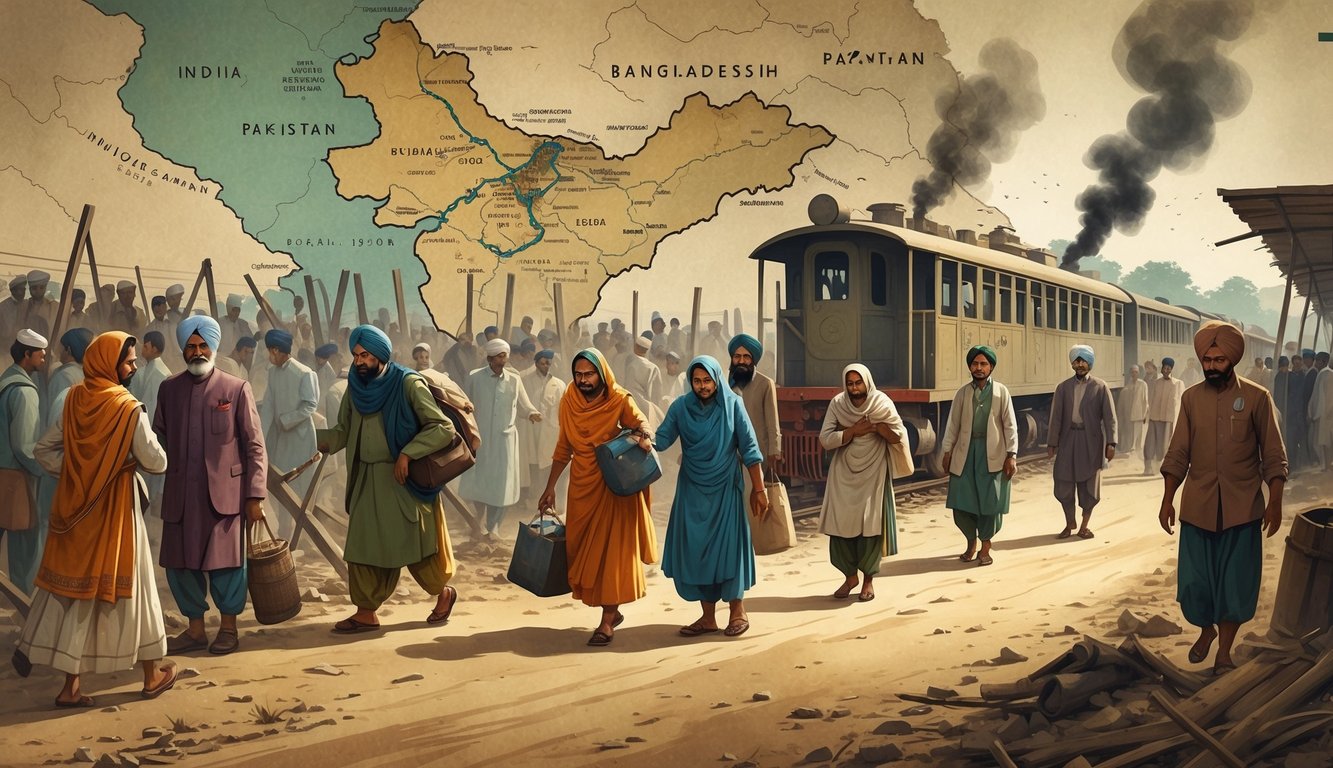
The history of Bangladesh is shaped by borders that have changed many times in the last 120 years. The movement of millions and the division of Bengal have left puzzles that still spark debate.
Border Anomalies After 1947
When British India split in 1947, the new boundaries often confused local communities. Villages in Bengal sometimes found themselves divided between two countries overnight.
This chaos created strange situations, such as enclaves—small patches of land belonging to one country but surrounded by another. Some people woke up in East Pakistan (now Bangladesh), while others became part of India, all without moving.
Life became very difficult for these people. They faced confusion about citizenship, police authority, and daily travel to work or school.
Disputes over these small regions continued for decades. Some were only settled as recently as 2015.
Borders shaped new nations but also separated families and communities in Bengal, Calcutta, and Dhaka. The hurried decisions during the creation of Pakistan and India had lasting effects.
To learn more about unresolved border issues, visit this BBC overview of partition challenges.
The Split of the Bengal Presidency
Before 1947, the Bengal Presidency was a large administrative area under British rule, with Calcutta and later Dhaka as centers. When the British left, they divided Bengal into West Bengal (India) and East Bengal (Pakistan).
Language, religion, and politics all played a role in this division. Many Hindu Bengalis ended up in India, while Muslim Bengalis became citizens of Pakistan.
More than 10 million people had to move, making it one of the largest migrations in history. Economic and political power shifted as Calcutta stayed important in India and Dhaka became the center of East Bengal.
The old unity of Bengal disappeared, replaced by two different systems. These changes raised questions about identity and belonging that still matter today.
For more information about this historic change, check the history of the Bengal Partition.
Impact of the 1905 Partition of Bengal
The first partition of Bengal happened in 1905, long before the split of 1947. The British divided Bengal into East Bengal and Assam (with Dhaka as the capital) and West Bengal (with Calcutta as the capital).
They claimed this was for better administration, but most locals saw it as a way to divide Hindus and Muslims. The move sparked protests and political activity.
Many people felt their identities were being pulled apart. The partition was so unpopular that the British reversed it in 1911, but the issues did not go away.
The region became more aware of religious and community differences, setting the stage for later conflicts. New political groups and stronger Bengali nationalism emerged.
For a deeper look at grassroots experiences and historical debates, visit this article on Bengal’s 1905 partition.
Colonial Era Mysteries and the East India Company
During colonial times, power shifted quickly in Bengal. The British East India Company changed politics, land ownership, and the lives of Bengal’s rulers and farmers.
The Battle of Plassey and Its Aftermath
The Battle of Plassey in 1757 changed Bengal and all of India. Robert Clive led the British East India Company to defeat the Nawab of Bengal, Siraj ud-Daulah.
The Company won by gaining support from powerful local landowners called zamindars. After the victory, the East India Company took control of Bengal’s wealth.
British officials soon controlled laws, tax collection, and the choice of local rulers. The Company’s policies hurt Bengal’s farmers.
Historians still debate how much famines, like the Bengal Famine of 1770, were caused by Company actions. The British reorganized trade to benefit themselves, often at the locals’ expense.
Company leaders made secret deals with Bengal’s elite and changed laws suddenly. Many records from this period are lost or private, making it hard to understand what really happened.
The full impact of the Battle of Plassey is explored in accounts of the East India Company.
The Fate of Bengal Nawabs
Before the British came, the Nawabs of Bengal were powerful rulers of a rich and independent region. The defeat at Plassey ended most of their authority overnight.
Afterwards, the Nawabs became figureheads with little real power. The Company controlled money, armies, and politics.
The zamindars gained more influence as the British worked with them to collect taxes and control land. The Nawabs’ palaces declined, and their families lost much of their former wealth and status.
Later, political groups like the Krishak Praja Party demanded better rights for farmers and changes to colonial land laws. Even today, the lost fortunes of the Nawabs and mysterious Company decisions interest historians.
For more on changes in Bangladesh’s leadership and land structure, the rise of the Company and decline of the Nawabs are central stories.
Religious Influences and Lost Practices

Bangladesh’s history includes changing religious ideas, disappearing rituals, and forgotten figures. Buddhism, Hinduism, and Sufism all left their marks, but many details about their traditions remain unclear.
Mysteries of Early Buddhism and Hinduism
Archaeological finds show that Buddhism and Hinduism thrived in what is now Bangladesh for centuries. Sites like Paharpur and Mahasthangarh reveal giant Buddhist monasteries, but many records and teachings have been lost.
Nalanda University in nearby India also influenced learning and religion in the region. Over time, Hinduism became dominant as Buddhist sites were abandoned or converted.
Ancient temples and sculptures raise questions. Why did Buddhism almost vanish? What rituals did early monks and priests practice that are now lost?
Few ancient texts have survived, so many old practices have faded away. Coins, statues, and ruins give clues about ceremonies, but much about daily religious life remains a puzzle.
Hidden Footprints of Sufis in Bengal
Sufi saints traveled across Bengal as early as the 13th century. They shared spiritual practices, built shrines, and influenced rural society.
Some Sufi leaders played key roles in the spread of Islam in Bangladesh, especially where records are scarce. Hundreds of mazars—Sufi tombs—dot the countryside, each with its own legends.
Many early Sufi texts about rituals and teachings are now missing or survive only in oral traditions. Mysteries remain about how Sufis blended local customs with their own practices.
Lists of Sufi songs and poems still exist, but historians often debate their exact meanings.
Geographical and Environmental Puzzles
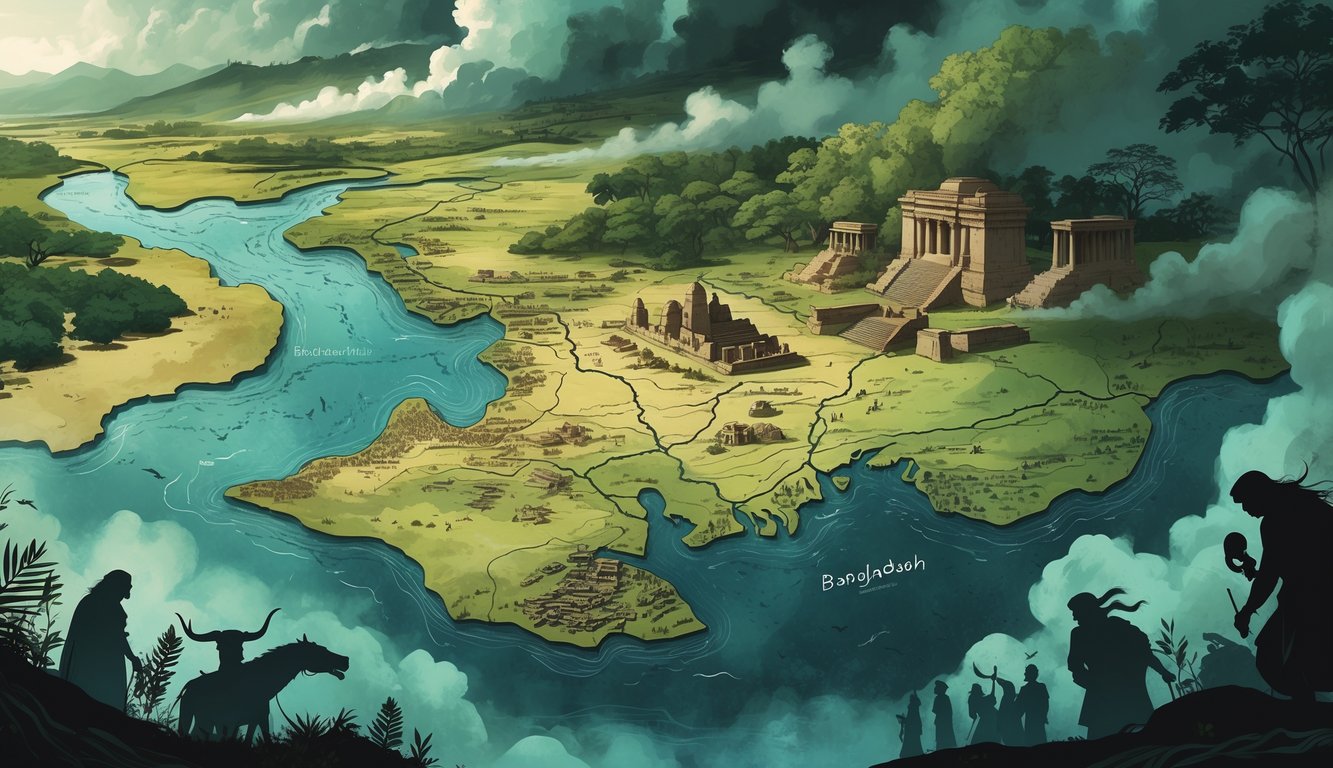
Bangladesh faces mysteries linked to its rivers, coastline, and changing weather. These puzzles have shaped where people live and how they use the land.
The Ganges Delta’s Shifting Pathways
The Ganges Delta, also called the Bengal Delta, is one of the world’s most dynamic regions. The Ganges and Brahmaputra rivers meet and branch into hundreds of waterways before reaching the Bay of Bengal.
Over centuries, these rivers have changed direction, sometimes overnight. This shifting has moved villages and even towns, making permanent settlements difficult.
Ancient structures and entire communities have been buried or washed away, leading to lost histories. Scientists still wonder why the rivers change course so often.
They study sediment and water flow patterns to find answers. Farming in the delta brings both good soil and the risk of floods and erosion.
These patterns continue to puzzle researchers and bring both hope and worry to people living there. Learn more about the complex interaction between rivers and land in the Environmental History of Bangladesh.
The Bay of Bengal and Lost Lands
The coast of Bangladesh along the Bay of Bengal hides stories of lands swallowed by water. Rising tides and strong cyclones have erased islands and shorelines.
Maps from a century ago look very different from those today. Archaeologists believe many ancient port cities and settlements may now lie underwater.
Storm surges and erosion happen quickly, so traces of once-thriving communities can vanish. People in coastal areas often have to move as the sea eats away their villages.
Villagers tell stories of temples and farmlands now buried under the sea or lost to mangrove forests. These changes show both natural forces and human adaptation.
Efforts to study the Bay of Bengal’s disappearing lands continue as the sea reshapes Bangladesh.
Climate Change Through History
Climate change has always affected Bangladesh. Shifting climate patterns have brought floods, droughts, and temperature swings.
Each event left its mark on the land and its people, shaping migration and farming. Scientists study tree rings, river sediments, and old documents to learn how people survived earlier climate swings.
Today, rising temperatures and changing monsoon patterns bring new worries. Bangladeshis use past knowledge as they face ongoing environmental changes.
The country remains an example of how people and nature adapt together. Read more about its unique geographical and environmental challenges.
Ethnolinguistic Mysteries of the Bengali People
The history of the Bengali people is shaped by many cultures and languages. Their identity has roots in both ancient migrations and the growth of the Bangla language.
Origins of the Bangla Language
Bangla is the main language of the Bengali people. It is an Indo-Aryan language that developed from Sanskrit.
Historians are still studying how Bangla branched off from other languages in the region. The earliest forms of Bangla can be traced back to around the 10th century.
These early forms show a mix of native and foreign influences. Bangla is now spoken by millions of people in Bangladesh and parts of India.
Its development connects to migration, trade, and cultural blending. The history of Bangla is closely tied to the Bengali identity.
Indo-Aryan and Dravidian Heritage
The roots of the Bengali people are complex. Most historians agree that the Bengali population is mainly of Indo-Aryan origin.
Indo-Aryan migrations shaped Bengal’s language and customs. These settlers mixed with older groups in the region.
Before the Indo-Aryans arrived, Bengal was home to Dravidian and Austroasiatic tribes. Dravidian influence appears in place names, folklore, and some local dialects.
Over time, Bengali culture blended these different groups. Key markers of this heritage include:
- Languages with mixed vocabulary
- Traditions and festivals
- Unique local customs
This layered history makes the ethnolinguistic background of Bengal an ongoing puzzle. New discoveries continue to add details to Bengali origins.
Unresolved Historical Connections with Neighbors
Bangladesh shares a long and complex history with nearby countries like Myanmar and Nepal. These relationships shaped trade, migration, religion, and culture in significant ways.
Ancient Ties with Myanmar and Nepal
People living in the area now called Bangladesh had early links with both Myanmar and Nepal. Archaeologists have found artifacts and ruins that point to ancient trade routes crossing these regions.
Some historians believe that the spread of Buddhism and Hinduism through South Asia connected these areas more closely. Old texts describe marriage alliances, exchanges of gifts, and shared stories.
Many details were lost due to war, natural disasters, and lack of written records. Today, researchers study pottery, coins, and temple remains to piece together these early connections.
Trade goods from Myanmar have turned up in ancient Bengal markets. Bengali folktales mention climbers and travelers from Nepal, but it is unclear how often these journeys happened.
Bengal’s Influence in South and Southeast Asia
Bengal once held a special place in South and Southeast Asia because of its powerful rulers and busy ports. During the Pala dynasty, Bengal became a center for Buddhist learning and attracted students and monks from distant lands.
Shrines and universities in Bangladesh have connections to places as far as Myanmar and Nepal. Many local stories describe Bengali merchants sailing to Myanmar’s coast to trade cloth, rice, and spices.
Buddhist art from Bengal spread to other regions and influenced temple designs and statues. Some historians believe these exchanges shaped religious practices across the region.
Maps from past travelers show trade routes crossing South Asia. Experts still debate how much those routes shaped modern culture.