In 1885, Canadian explorer Guillermo Farini claimed he found strange stone ruins deep in the Kalahari Desert. He described walls, arches, and signs of a lost civilization buried under the sand.
To this day, no one has confirmed proof of the so-called Lost City of the Kalahari.
The legend has fascinated historians, archaeologists, and adventurers for over a century. Some believe Farini saw natural rock formations, while others think shifting sands may still hide the remains of an ancient settlement.
Expeditions have reported conflicting findings, adding more mystery than answers.
The Kalahari Desert’s harsh climate, vast size, and remote landscape make exploration difficult. Modern tools like satellite imagery and ground-penetrating radar have renewed interest in the search.
Origins of the Lost City of the Kalahari Legend
Stories about the Lost City of the Kalahari mix local traditions, early explorers’ reports, and later expeditions into the desert. Some accounts describe stone ruins hidden under sand, while others suggest people misidentified natural formations.
Over time, these reports shaped one of southern Africa’s most enduring mysteries.
Early Accounts and Local Myths
Long before outsiders arrived, people living near the Kalahari Desert shared stories of ancient structures buried in the dunes. These tales spoke of stone walls, unusual rock shapes, and places avoided because of spirits or past events.
Some early European travelers in the 19th century heard these stories from local guides. They sometimes wrote them in journals or letters, blending them with their own observations.
The desert’s name comes from the Tswana word Kgalagadi, meaning “great thirst.” This dry environment made the idea of a city here seem unlikely, but the stories persisted.
Local myths became linked with rumors of lost wealth or forgotten civilizations. This mix of oral history and travelers’ notes inspired later expeditions.
William Leonard Hunt’s Discovery
In 1885, William Leonard Hunt, a Canadian-born entertainer known as “The Great Farini,” traveled through the Kalahari Desert in search of diamonds. While exploring rocky terrain, he claimed he found ruins of an ancient settlement.
Hunt described large stone blocks arranged in arcs and walls, some partly buried by sand. He believed these were the remains of a city once inhabited.
He later published his journey and observations in his book Through the Kalahari Desert. Readers became intrigued by his sketches and descriptions, even though he did not collect physical proof.
Some experts doubted his claims, but his vivid report spread the legend far beyond South Africa.
Guillermo Farini’s Expedition
Guillermo Farini is another name for William Leonard Hunt, which he used in his published works. Under this name, he presented his Through the Kalahari account in Europe and North America.
Farini’s expedition crossed difficult stretches of the desert. He documented unusual rock formations that, to him, looked like man-made structures.
In his public lectures, he showed photographs and illustrations to support his claims. These images sparked debate among archaeologists, geologists, and explorers.
Some argued the formations were natural, while others believed they could be remnants of a settlement hidden for centuries. Farini’s storytelling kept the discussion alive.
You can read more about Farini’s reported discovery in this detailed account.
The 1885 Expedition and Its Findings
In 1885, Canadian explorer William Leonard Hunt, also known as Guillermo Farini, crossed parts of the Kalahari Desert in search of diamonds. Instead of finding gems, he reported seeing what he believed were the remains of an ancient city.
His account sparked debate among explorers, archaeologists, and historians.
Journey Across the Kalahari
Farini began his trek in what is now South Africa, moving north toward areas in present-day Botswana. The Kalahari’s harsh climate, with little water and extreme heat, made the journey difficult.
He traveled with a small team, pack animals, and supplies. The group followed routes used by traders and hunters, moving through sandy terrain and rocky outcrops.
While searching for diamonds, Farini noticed unusual stone formations in a hilly region. These features stood out from the landscape and caught his attention.
His travel notes describe days of crossing dunes, thorny plants, and dry riverbeds before reaching the site. The location was far from any known settlements.
Description of the Ruins
Farini said the site contained walls, arches, and terraces built from large stone blocks. Some looked cut and placed with intention, while others seemed scattered, possibly from collapse or erosion.
He described the structures as weathered, with sand partly covering them. The layout made him think it was once a settlement, abandoned long before Europeans arrived.
In his writings, Farini compared the stones to building blocks rather than natural rocks. Later, some geologists suggested the “ruins” were actually natural weathering of dolerite.
His account inspired others to search for the lost city. Expeditions in the 20th and 21st centuries have visited the area, but no one has found clear proof of ancient habitation.
Photographs and Reports
Farini documented his findings with photographs and detailed reports. In these images, the stone formations appear in geometric shapes, which he said supported the idea of human craftsmanship.
He published his photographs with his expedition narrative, helping spread the story beyond Africa.
Modern researchers who examined the photos noted that many of the “blocks” could be natural rock fractures. A 1967 study by A. John Clement concluded that geological processes likely shaped the formations.
Farini’s images remain some of the few records of what he saw. They continue to interest explorers who hope to locate the site again.
Debates and Skepticism Over the Lost City
Many researchers doubt that a ruined city ever existed in the Kalahari Desert. Some point to natural rock formations that may have been mistaken for walls or structures, while others highlight the lack of physical evidence after more than a century of searching.
Geological Explanations
Geologists suggested that the “ruins” William Leonard Hunt described in 1885 could be weathered rock outcrops.
The Kalahari Desert contains sandstone and dolerite formations that can break into angular shapes. These can look like stacked blocks or walls from a distance.
Wind erosion and temperature changes cause layers of rock to split and crack. This natural process can create patterns that look like human-made structures.
Some researchers think Farini saw these features and believed they were ruins. Such formations are common in dry regions and can appear artificial under certain lighting.
Skeptics and Debunkers
Over the past 130 years, at least 30 expeditions have searched the Kalahari Desert for the alleged ruins. None have found clear evidence such as bricks, pottery, or tools.
Skeptics argue that if a city once stood there, some remains should still be visible. The lack of artifacts raises doubts about the story.
Some historians suggest Farini may have exaggerated his findings to gain attention. Others note that his descriptions sometimes changed, making them hard to verify.
Modern explorers using aerial surveys and satellite images have not found any structures matching Farini’s accounts. This strengthens the view that the “lost city” is a legend.
A.J. Clement’s Investigation
In the 1960s, South African researcher A.J. Clement studied reports and locations linked to the Lost City. He focused on the area between the Nossob River and Lehututu, where Farini said he saw the ruins.
Clement concluded the supposed walls and arcs were natural rock formations. His fieldwork supported earlier geological explanations.
He compared Farini’s notes with his own observations, finding that the shapes and alignments could be explained by erosion and fracturing. Clement’s findings, published in local journals, are still a key reference for those who doubt the city’s existence.
His work shifted the debate toward understanding the desert’s geology.
Theories on the Lost Civilization
Some researchers believe the ruins in the Kalahari Desert could be linked to known historical cultures. Others think they may be the remains of much older human settlements.
There is also debate over whether people ever built the structures reported.
Ancient African Kingdoms
One theory connects the supposed ruins to powerful African kingdoms that once thrived far from the desert. Civilizations such as Great Zimbabwe built impressive stone cities between the 11th and 15th centuries.
Supporters of this idea suggest that trade routes may have reached deeper into southern Africa than records show. If so, outposts or settlements could have existed in areas now part of the Kalahari.
Explorers like Guillermo Farini described stone walls and layouts that reminded them of known African ruins. Some think these could be remnants of a lost civilization tied to regional powers that later declined.
However, no one has confirmed a link between the Kalahari and any known African kingdom. Expeditions have not found the structures Farini claimed to see.
Prehistoric Societies
Another possibility is that the remains belong to prehistoric communities that lived in the region thousands of years ago. The Kalahari has evidence of early human activity, including stone tools and rock art.
These early societies were often hunter-gatherers, like the San people, but some may have tried more permanent settlements. Over time, wind and sand could have buried or worn down these sites.
If the ruins were built by such groups, they would be older than organized states like Great Zimbabwe. This could help us understand the shift from mobile to settled lifestyles in southern Africa.
Archaeologists note that without clear artifacts or dating, it is hard to connect the ruins to any specific prehistoric culture.
Natural Formations Versus Man-Made Structures
Some geologists argue the “ruins” might not be ruins at all. The Kalahari contains unusual rock formations shaped by erosion, temperature changes, and wind.
These natural patterns can look like walls, streets, or building foundations. In some cases, explorers may have mistaken them for the remains of a lost city.
For example, rock outcrops in parts of Namibia and Botswana form geometric shapes that look artificial from a distance. Without excavation, it is easy to misinterpret such features.
This theory is supported by expeditions that found no signs of human construction in the reported locations, as noted in studies of the Lost City of the Kalahari.
Modern Searches and Technology
In recent years, explorers have used advanced tools to search the Kalahari Desert for signs of the lost city. They combine remote sensing, on-the-ground surveys, and improved navigation to reach areas that were once hard to access.
Satellite and LiDAR Surveys
Researchers use high-resolution satellite images to scan large parts of the Kalahari Desert from afar. These images can reveal unusual shapes or straight lines that might point to man-made structures.
LiDAR (Light Detection and Ranging) has become a valuable tool in the search. Aircraft send laser pulses to create detailed 3D maps of the terrain.
LiDAR can sometimes spot buried walls or foundations under thin layers of sand. Researchers compare this data with old expedition maps to narrow down promising locations before starting expensive fieldwork.
Although no confirmed ruins have turned up, this method has ruled out many false leads and helped focus on smaller target zones.
Recent Expeditions
In the past two decades, several expeditions have mixed traditional fieldwork with modern mapping. Teams bring GPS equipment, drones, and ground-penetrating radar to check out sites spotted from aerial scans.
Some explorers have retraced the routes of earlier searchers like Guillermo Farini, who claimed to see ruins in 1885. Others focus on remote rocky outcrops and dry riverbeds, places that could have supported settlements long ago.
Researchers have used drone photography to inspect cliff faces and plateaus for signs of stonework. These missions have not confirmed a lost city, but they have provided useful geological and archaeological data.
Challenges of Desert Exploration
The Kalahari Desert’s harsh environment makes exploration slow and costly. High daytime temperatures, scarce water, and shifting sands can damage equipment and tire out crews.
Navigating the desert is difficult. Many places have no roads, and dunes change shape quickly, making maps unreliable.
Even with GPS, reaching a site often means long treks by foot or using special vehicles. Sandstorms can stop fieldwork for days.
Fine dust can jam drone motors, cameras, and LiDAR sensors. Teams must plan carefully, carry extra supplies, and prepare for delays.
For more on the history of expeditions and the mystery itself, see the background on the Lost City of the Kalahari.
Significance of the Kalahari Desert
The Kalahari Desert stretches across Botswana, Namibia, and South Africa. It is known for its semi-arid climate, unique wildlife, and long human history.
Geography and Environment
The Kalahari Desert is not completely barren. Instead, it is a vast semi-arid sandy savanna.
Rainfall is low and unpredictable, with yearly averages between 5 and 20 inches. Temperatures can be extreme.
In summer, daytime highs often go over 40°C (104°F). Winter nights can drop near freezing.
Much of the region has red sand dunes, dry riverbeds, and sparse grasslands. The Kalahari supports acacia trees and drought-resistant shrubs.
Large salt pans, like the Makgadikgadi in Botswana, show where ancient lakes once existed. These areas are important for migratory birds and other wildlife.
Historical Inhabitants
For thousands of years, the San people, also called Bushmen, lived in the Kalahari as hunter-gatherers. They used tracking skills, wild plants, and seasonal water to survive.
Later, Bantu-speaking farmers and herders moved into some areas. They brought cattle and grew crops where possible.
Archaeologists have found stone tools, rock art, and settlement remains across the desert. These finds show that people have lived in the area for tens of thousands of years.
Trade routes crossed the Kalahari in more recent centuries, linking communities across southern Africa. This movement shaped language, culture, and technology.
Cultural Importance
The Kalahari holds deep cultural value for its indigenous peoples. The San people’s traditions, stories, and rock art show their close connection to the land and wildlife.
Many cultural practices focus on water, which is rare and precious. Rituals, songs, and folklore often center on finding and saving water.
Today, parts of the Kalahari are protected as national parks, such as the Central Kalahari Game Reserve in Botswana. These parks help preserve both nature and culture, and attract researchers and visitors.
The desert’s landscapes and traditions continue to inspire art, literature, and exploration, including legends like the Lost City of the Kalahari.
Comparisons to Other Ancient African Cities
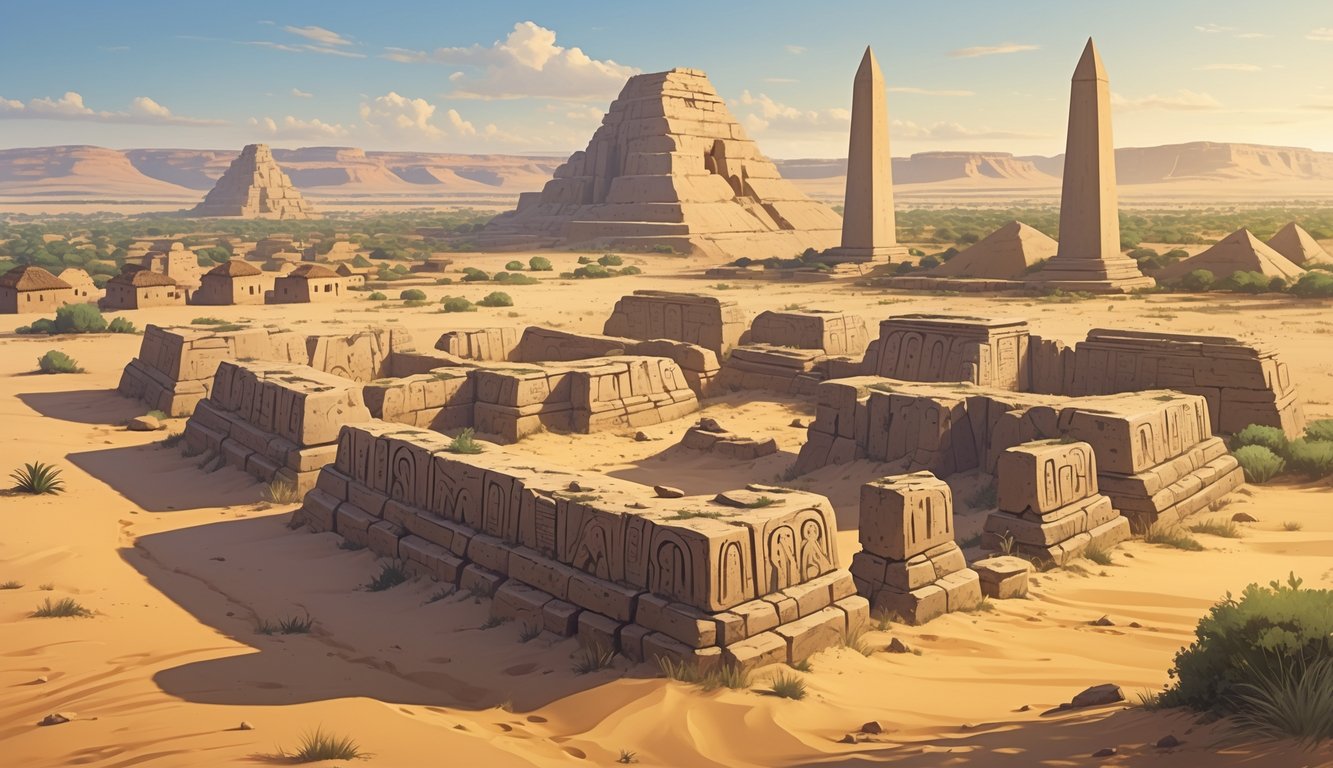
Some ancient African cities have left behind clear archaeological evidence. Others are known only through legend.
These places show how different environments shaped settlement patterns, architecture, and trade across the continent.
Great Zimbabwe
Great Zimbabwe was the capital of a powerful African kingdom from the 11th to 15th centuries. It is famous for its massive stone walls, some over five meters high, built without mortar.
The city was a center for trade, linking inland gold fields to coastal ports. Archaeologists have found imported goods like Chinese porcelain and Persian glass, showing its role in long-distance trade.
Its layout included the Great Enclosure, smaller residential areas, and ceremonial spaces. The skill and size of the stonework make it one of Africa’s most important ancient cities.
Great Zimbabwe’s decline may have been caused by environmental changes, shifting trade, or political problems. Unlike the Lost City of the Kalahari, its ruins are well-documented and easy for researchers to visit.
Kweneng and Other Desert Settlements
Kweneng was a large precolonial Tswana city in today’s South Africa. It thrived from the 15th to 19th centuries and covered over 20 square kilometers.
Its remains include stone-walled compounds, cattle enclosures, and pathways. LiDAR surveys have revealed thousands of structures hidden under plants.
Other desert settlements in southern Africa were usually smaller and adapted to dry conditions. Builders used local stone and mud and relied on seasonal water.
These inland sites had less access to trade than coastal or river cities. Still, they formed part of regional networks, moving livestock, salt, and goods between communities.
Kweneng’s visibility today stands in contrast to the uncertain location of the Lost City of the Kalahari, which has not been confirmed by physical evidence.
Impact on Popular Culture and Exploration
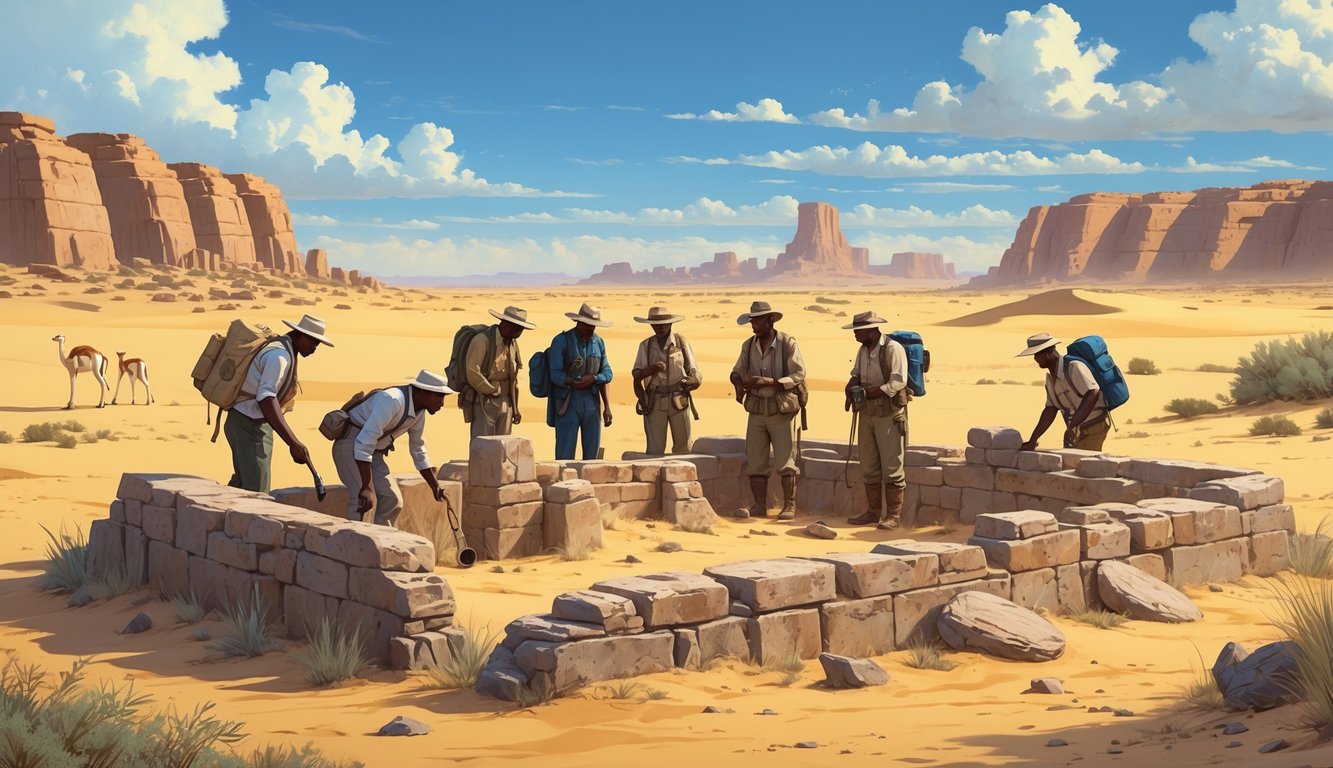
The story of the Lost City of the Kalahari has shaped how people imagine Africa’s deserts and ancient ruins. It has sparked real expeditions, inspired books and films, and kept researchers debating whether the city ever existed.
Influence on Later Explorers
In 1885, Canadian-born adventurer William Leonard Hunt, known as “The Great Farini,” claimed he saw stone ruins deep in the Kalahari Desert. His account inspired many to search for the site.
Over the next century, explorers led at least 30 expeditions into the desert, often facing harsh heat and scarce water. Historical records show that none of these journeys found clear evidence—no walls, carvings, or artifacts.
Some explorers thought shifting sands may have buried any remains. Others argued Hunt may have mistaken natural rock formations for ruins. His story kept the mystery alive for decades.
Media and Literature
The legend entered popular media through books, documentaries, and fiction. Laurens van der Post’s 1958 television film Lost World of the Kalahari brought the desert’s mystery to a wide audience, though it focused more on the San people than the alleged ruins.
Writers often set adventure stories against the backdrop of the lost city. This blend of fact and fiction blurred the line between archaeology and myth.
Academic works have examined how these stories shaped Western views of Africa. Travel magazines and online articles continue to revisit the tale, often with striking desert photos to attract readers.
Enduring Fascination
The legend lasts because it mixes mystery, history, and the challenge of survival in a harsh environment. The Kalahari’s vast sands make it easy to imagine a hidden city.
For many, the real appeal is the adventure of the search. Modern explorers still refer to Hunt’s descriptions, even though satellite images have found no clear signs of man-made structures.
This ongoing interest keeps the Lost City of the Kalahari alive in public memory as one of Africa’s most talked-about exploration mysteries.
Ongoing Mysteries and Unanswered Questions
The search for the Lost City of the Kalahari continues to raise questions about what lies beneath the sands. Archaeologists, explorers, and historians still debate whether reported ruins belong to a lost civilization or are just natural rock formations.
Unexplored Regions
Large parts of the Kalahari are still hard to reach because of rough terrain, little water, and extreme heat. These tough conditions prevent thorough surveys and leave possible sites undocumented.
Some explorers believe remote dunes and rocky outcrops might hide man-made structures. Guillermo Farini’s 1895 expedition reported unusual stone patterns he thought were ruins.
Later researchers questioned his findings, but no one has fully checked every suspected spot. Modern tools like satellite images and LiDAR mapping have found ancient settlements in other parts of southern Africa, such as the city of Kweneng.
Researchers could use similar methods to scan deeper into the desert without disturbing the land.
Potential for Future Discoveries
The chance of finding physical evidence remains. If the Lost City of the Kalahari exists, it could teach us about trade, migration, and settlement in the region.
Even small finds, like pottery pieces or worked stone, could prove people once lived in areas thought uninhabited. Researchers may compare geological formations to known building styles to tell natural features from true archaeological sites.
Improved mapping technology and local knowledge from the San people may guide future expeditions. Each new survey increases the chance of discovering whether the legendary city is real or just a story.
Conclusion
The story of the Lost City of the Kalahari combines history, mystery, and exploration.
In the late 19th century, explorers described ruins deep in the Kalahari Desert. These reports sparked decades of interest.
Some explorers, like the 1956 team from Natal, South Africa, faced tough conditions while searching for the site. They drove a truck called Kalahari Polka, which became part of the legend.
The Kalahari Desert covers about 850,000 square kilometers. Most of it lies in Botswana.
The harsh climate and remote terrain make searches difficult.
Key points for researchers and enthusiasts:
- No one has confirmed the city’s existence.
- Most accounts rely on second-hand reports or personal observations.
- Modern archaeologists have not found clear evidence.
Some people believe the reports describe natural rock formations, not ruins. Others think real ruins might still lie buried under the sand.
The debate continues.
Interest in the site appears in books, documentaries, and articles like this overview of the Lost City of the Kalahari.