Africa holds the deepest chapters of the human story. Fossils and genetic evidence show that modern humans evolved in Africa around 250,000 years ago.
The continent preserves clues that reveal how humanity began and adapted over millions of years. From the earliest upright walkers to the first Homo sapiens, Africa offers a unique window into our past.
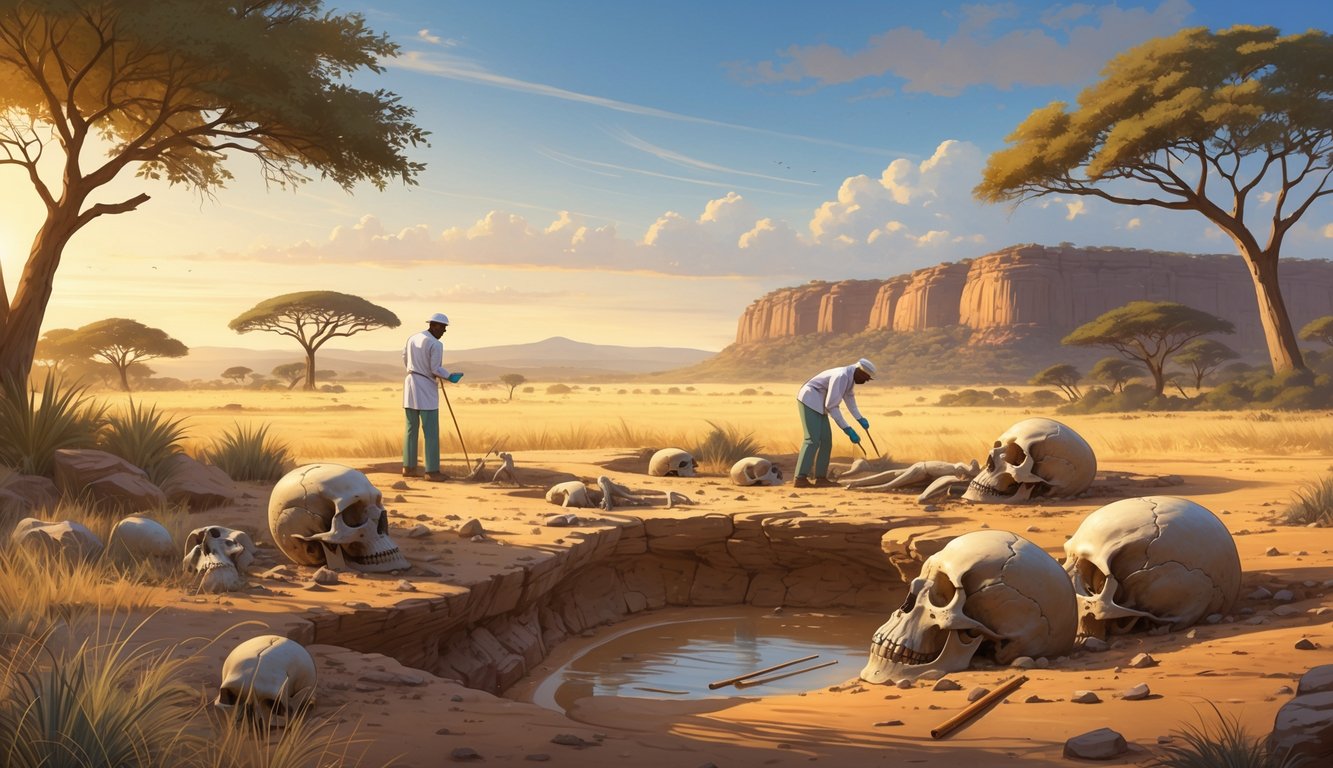
Scientists have uncovered skulls, bones, and tools in places like the Great Rift Valley in East Africa and the caves of South Africa. These finds connect ancient species to modern people.
Changes in climate, landscape, and behavior shaped human evolution. Each discovery adds to our understanding of how humans adapted over time.
Sites from Ethiopia’s Omo Kibish Formation to the Kalahari Basin reveal important pieces of the fossil record. Africa stands as an unmatched archive of human origins.
The African Roots of Humanity
Modern research finds the earliest evidence of Homo sapiens in Africa. Fossil discoveries and genetic studies show that human evolution began here long before people migrated elsewhere.
These findings connect all living humans to a shared origin in Africa.
Out of Africa Theory
The Out of Africa theory explains how modern humans spread across the globe. It says that Homo sapiens first evolved in Africa and later migrated to other continents.
Fossil evidence from sites like Omo Kibish in Ethiopia, dated to about 233,000 years ago, supports this idea. DNA studies also trace all living humans back to African ancestors.
Scientists have identified several migration waves out of Africa. The largest and most successful wave happened about 60,000–70,000 years ago.
These groups replaced or interbred with other hominins, such as Neanderthals, in Eurasia.
For more on this, see the African origin of humanity.
Defining Human Origins
Researchers define “human origins” as the appearance of anatomically modern Homo sapiens. These early humans had features like a rounded skull and smaller brow ridges, similar to people today.
The oldest known remains of our species come from the Omo Kibish Formation in Ethiopia. Richard Leakey’s team discovered these fossils in 1967, dating them to the late Middle Pleistocene.
Genetic analysis gives more evidence. Mitochondrial DNA studies point to a common maternal ancestor—sometimes called “Mitochondrial Eve”—who lived in Africa about 150,000–200,000 years ago.
This does not mean she was the only woman alive then, but her genetic line is the one found in all humans today.
Overview of Early Hominins
Before Homo sapiens, many early hominins lived in Africa. These species show the gradual changes that led to modern humans.
Some important examples include:
| Species | Approx. Age | Key Traits |
|---|---|---|
| Australopithecus afarensis | 3.9–2.9 million years ago | Bipedal, small brain size |
| Homo habilis | 2.4–1.4 million years ago | Simple stone tools |
| Homo erectus | 1.9 million–110,000 years ago | Larger brain, long-distance walking |
These species lived in varied African environments, from woodlands to open savannas. Adaptations like upright walking and tool use shaped the path of human evolution in Africa.
Paleoanthropology and Its Role
Paleoanthropology studies ancient humans and their ancestors using fossils, artifacts, and other evidence. It combines archaeology, anthropology, and paleontology to learn how early humans lived, evolved, and spread.
Researchers use careful excavation, precise dating, and fossil comparisons to build a timeline of human evolution.
Discovering Early Hominins
Researchers identify early hominins by studying fossilized bones, teeth, and sometimes footprints. These remains reveal traits such as brain size, walking posture, and jaw shape.
Important finds include Australopithecus afarensis, such as the famous “Lucy,” and early members of the genus Homo. These fossils help scientists trace the shift from ape-like ancestors to humans.
Paleoanthropologists often work in teams that include geologists and geneticists. This teamwork helps confirm species identity and evolutionary relationships.
Discoveries in Africa, including South Africa’s fossil-rich caves, have been central to mapping the human family tree.
Fossil Dating Techniques
Scientists date hominin fossils to place them in the correct time period. They use several methods to increase accuracy.
Common dating techniques include:
- Radiometric dating (e.g., potassium-argon) for volcanic layers above or below fossils.
- Luminescence dating for sediments exposed to sunlight.
- Stratigraphy to study the earth layers where fossils are found.
By comparing results from different techniques, researchers reduce errors. Volcanic ash layers in East Africa have allowed precise dating of Homo sapiens fossils to about 300,000 years ago, supporting the African origin of modern humans.
Major African Excavation Sites
Africa contains some of the most important paleoanthropological sites in the world.
Notable locations include:
| Site | Country | Key Finds |
|---|---|---|
| Olduvai Gorge | Tanzania | Early Homo tools and fossils |
| Sterkfontein Caves | South Africa | Australopithecus skeletons |
| Jebel Irhoud | Morocco | Early Homo sapiens remains |
These sites have yielded fossils that span millions of years. Excavations in West Africa are less common but may reveal new discoveries in the future.
Each site offers clues about diet, environment, and technology. These clues help scientists understand how early humans adapted to different landscapes.
Key Early Human Fossil Discoveries
Several fossil finds in Africa have given scientists clear evidence about early human species, their physical traits, and their behaviors. These discoveries reveal when abilities like walking upright or making tools first appeared.
Australopithecus afarensis and Lucy
In 1974, researchers in Ethiopia uncovered a partial skeleton of Australopithecus afarensis called “Lucy.” She lived about 3.2 million years ago and stood just over one meter tall.
Lucy’s pelvis and leg bones show that she walked upright. She also had long arms suited for climbing.
This mix of traits suggests she spent time both on the ground and in trees. The Australopithecus afarensis fossils show a stage between earlier ape-like ancestors and later humans.
The species lived in East Africa for nearly a million years, making it one of the longest-lasting early human relatives.
Homo habilis and Tool Use
Scientists found Homo habilis fossils mainly in Tanzania and Kenya, dating to about 2.4–1.4 million years ago. The name means “handy man” because the species is linked to some of the earliest known stone tools.
These tools, part of the Oldowan tradition, were simple but effective. They included sharp flakes for cutting and choppers for breaking bones.
Using these tools likely gave Homo habilis access to new food sources, such as marrow and meat. Compared to earlier species, Homo habilis had a larger brain, averaging about 610 cubic centimeters.
This increase may have supported problem-solving skills related to tool use and survival. More details are available from the Smithsonian’s Human Origins Program.
Jebel Irhoud Fossils
The Jebel Irhoud site in Morocco produced fossils of Homo sapiens that are about 315,000 years old. These remains include skulls, jaws, and stone tools.
The skull shape is more elongated than in modern humans, but the face is similar to ours. This suggests that some modern traits appeared earlier than scientists once thought.
The tools found at Jebel Irhoud are made from flint and show signs of heat treatment. This indicates control of fire and advanced tool-making skills.
These discoveries have reshaped timelines for the appearance of Homo sapiens in Africa, as described in Prehistoric Africa.
Omo Kibish and Herto Sites
In southern Ethiopia, the Omo Kibish Formation yielded fossils of early Homo sapiens dated to about 233,000 years ago. These are among the oldest known remains of our species.
The Omo I skull has a high forehead and rounded braincase, both hallmarks of modern humans. Its discovery in 1967 by Richard Leakey’s team provided strong evidence for an African origin of Homo sapiens, as noted in Human Origins – In Africa.
Nearby, the Herto site produced fossils about 160,000 years old. These skulls are slightly more robust than modern ones but still clearly belong to Homo sapiens.
Stone tools and animal remains found with them suggest hunting and butchering activities.
The Significance of the Great Rift Valley
The Great Rift Valley in East Africa holds some of the most complete records of early human history. Its unique geology, rich fossil sites, and changing environments help scientists understand how humans evolved and adapted over millions of years.
Geological Features
The Great Rift Valley is a vast geological trench that stretches from Lebanon to Mozambique. In East Africa, it runs through Ethiopia, Kenya, and Tanzania.
Tectonic plate movements pulled the region apart, creating deep valleys and high escarpments. Volcanic activity and earthquakes continue to shape the landscape today.
These processes exposed ancient layers of rock, making it easier for researchers to find fossils. According to New Scientist, the region’s volcanic ash layers also help date discoveries with high accuracy.
The valley contains lakes, such as Lake Turkana, formed in rift depressions. These water sources likely supported early human life and migration.
Key geological traits:
- Active faults and volcanic zones
- Layers of sediment ideal for fossil preservation
- Large freshwater lakes supporting biodiversity
Fossil Hotspots in East Africa
Several areas within the Great Rift Valley rank among the world’s most important fossil sites. In Ethiopia’s Middle Awash region, fossils span over 6 million years and show much of the timeline of hominin evolution.
Researchers found early Homo erectus and Australopithecus fossils in Kenya’s Lake Turkana Basin. In Tanzania’s Olduvai Gorge, scientists uncovered tools and remains that reveal details about early human behavior.
Erosion and tectonic activity often expose fossil-rich sediments in these regions. The Great Rift Valley has produced remains of species such as Australopithecus afarensis, Homo habilis, and Homo erectus.
Notable fossil regions:
- Middle Awash, Ethiopia
- Lake Turkana Basin, Kenya
- Olduvai Gorge, Tanzania
Environmental Impact on Evolution
The Great Rift Valley’s environment has changed dramatically over millions of years. Wet and dry cycles shifted the landscape from forests to grasslands and back.
These changes shaped food sources, migration patterns, and survival strategies. Fluctuations in climate may have encouraged adaptability in early humans.
Rainfall caused lakes to expand and shrink, altering resources for local populations. Volcanic eruptions sometimes disrupted habitats but also created fertile soils for plants.
Southern and South African Contributions
Southern Africa preserves some of the most informative fossil, archaeological, and genetic evidence for early human history. Researchers have uncovered remains, tools, and DNA clues that help explain how early humans lived and spread across the continent.
The Kalahari Basin Record
The Kalahari Basin contains a long sequence of archaeological sites from the Early to Late Pleistocene. Excavations have revealed stone tools, animal bones, and signs of controlled fire use.
Some sites show symbolic behavior, including engraved objects and pigment use, which may point to early cultural expression. Stratified layers allow scientists to connect artifacts with specific time periods.
Findings from the Kalahari Basin suggest that humans lived in this region for hundreds of thousands of years. These sites help track changes in technology, diet, and adaptation to shifting climates.
Sterkfontein and Rising Star Caves
The Sterkfontein Caves, part of the Cradle of Humankind near Johannesburg, have produced fossils of Australopithecus africanus and early Homo species. These remains date back over 2 million years and show both ape-like and human-like traits.
In the nearby Rising Star Cave system, researchers discovered Homo naledi, a small-brained hominin with primitive and modern features. They found the fossils deep in a chamber, raising questions about how they arrived there.
The Cradle of Humankind preserves fossils from several hominin species, making it one of the richest early human fossil sites. The caves continue to yield new finds that refine our understanding of human evolution.
Genetic Diversity in Southern Africa
Modern DNA studies show that southern African populations hold some of the highest levels of genetic diversity in the world. This diversity suggests humans have lived in the region for a long time.
Analyses of mitochondrial genomes indicate a southern African origin for anatomically modern humans, with a sustained occupation before migration to other parts of the world.
Groups such as the San carry ancient genetic lineages that help trace population history and movement patterns. This genetic evidence complements fossil and archaeological records, giving a fuller picture of early human origins.
Exploring West Africa’s Untapped Potential
West Africa holds important clues about early human history. Researchers are uncovering rare fossils, stone tools, and ancient DNA that may change how scientists view the evolution of Homo sapiens in Africa.
Challenges in Fossil Preservation
Fossil preservation in West Africa is difficult because of the tropical climate. High humidity, acidic soils, and heavy rainfall speed up the decay of bones and other organic material.
Dense vegetation makes it harder to locate potential sites. Erosion and human activity in many areas disturb the soil layers where fossils might exist.
West Africa has fewer exposed rock formations than East and South Africa. This limits the number of places where fossils naturally appear at the surface.
Researchers often use targeted excavations instead of surface surveys. These discoveries require more time, funding, and specialized equipment. Such obstacles have slowed paleoanthropology work in the region.
Recent Archaeological Finds
Despite these challenges, important finds have emerged. Scientists recovered the first ancient DNA from West Africa from human remains dating back thousands of years, offering rare genetic data from a tropical environment. This work, described in Nature, helps trace population movements across sub-Saharan Africa.
Archaeologists found Middle Stone Age tools alongside some of the oldest known Homo sapiens fossils. Early humans in the region used advanced techniques for shaping stone.
Researchers identified cultural differences between groups living in different parts of Africa during the same period. This suggests human development was not uniform across the continent.
Each new discovery adds to a growing picture of West Africa as an important, though less explored, part of human history.
Implications for Human Evolution
Findings from West Africa challenge the older idea that humans evolved from a single population in one location. Evidence now points to multiple populations across Africa contributing to the ancestry of modern humans, as discussed in research on African population diversity.
Interactions between groups living in distant regions, from Morocco to South Africa, shaped human evolution. West Africa’s role in this network is becoming clearer as more data emerges.
Ancient DNA and archaeological evidence suggest that cultural and genetic diversity in early Homo sapiens was greater than once thought. These insights help scientists better understand how different environments influenced human adaptation over time.
Genetic Evidence and Human Diversity
Genetic studies show that Africa contains the greatest amount of human genetic diversity on Earth. DNA from ancient and modern populations reveals long and complex histories of migration, mixing, and adaptation.
Mitochondrial Eve and Y-chromosomal Adam
Scientists use mitochondrial DNA, passed from mothers to children, to trace maternal ancestry. This research points to a common maternal ancestor, often called Mitochondrial Eve, who lived in Africa about 150,000–200,000 years ago.
The Y chromosome, passed from fathers to sons, reveals a common paternal ancestor known as Y-chromosomal Adam. He likely lived in Africa between 200,000 and 300,000 years ago, though not at the same time as Mitochondrial Eve.
These individuals were not the only humans alive in their eras. They represent the most recent people from whom all humans today inherited their maternal or paternal lines.
This genetic evidence shows that modern humans originated in Africa and later spread across the globe.
Patterns of Genetic Variation
Africa holds the highest levels of genetic variation in the world. DNA differences among African populations are greater than those between many non-African groups.
Humans have lived in Africa far longer than anywhere else, allowing more time for genetic diversity to build. Populations in eastern, southern, and western Africa each carry unique genetic markers.
These patterns reflect ancient separations and later mixing between groups. For example, research published in Human Molecular Genetics found deep population splits within Africa going back hundreds of thousands of years, along with evidence of interaction between regions.
This diversity is important for understanding human health. Many genetic traits linked to disease resistance or adaptation to climate are found in African genomes.
DNA and Population Migration
DNA evidence shows that modern humans began migrating out of Africa roughly 60,000–80,000 years ago. Studies of ancient genomes, such as those described in Ancient DNA research, reveal how early humans spread into Eurasia and interacted with other hominin species.
Before leaving Africa, humans moved widely within the continent. According to recent findings, Homo sapiens likely evolved from several connected populations across Africa rather than a single isolated group.
These movements created a web of genetic connections that still exists today. Traces of these ancient migrations appear in the DNA of modern African communities and people around the world.
Evolutionary Milestones in Africa
Key changes in human anatomy and behavior took place in Africa over millions of years. These changes included walking upright, creating tools, and developing more complex ways of living and thinking.
Fossil and archaeological finds give clear evidence of these steps in our evolutionary history.
Development of Bipedalism
Early hominins began walking on two legs between six and eight million years ago. Fossils like Australopithecus afarensis show pelvis and leg structures adapted for upright walking.
Walking on two legs freed the hands for carrying food, infants, and tools. It also allowed early humans to see over tall grass and travel longer distances.
Sites such as Laetoli in Tanzania preserve fossilized footprints from about 3.6 million years ago. These prints confirm that early species walked with a human-like gait.
This shift in movement style influenced diet, habitat use, and social behavior. It set the stage for advances in tool use and hunting.
Advancements in Tool Technology
The earliest known stone tools, found in Kenya, date to about 3.3 million years ago. Early humans likely used these simple flakes and cores to cut plants or process animal carcasses.
By 2.6 million years ago, Oldowan tools became common. These sharp-edged stones helped with slicing meat and breaking bones.
Around 1.76 million years ago, Homo erectus developed Acheulean handaxes. Making these symmetrical tools required planning and skill.
Archaeological evidence from East Africa shows that toolmaking spread as brain size and cognitive ability increased. Better tools meant better access to food and resources.
Behavioral Innovations
By about 300,000 years ago, early Homo sapiens in Africa showed signs of symbolic thought and culture. Fossils from Morocco reveal individuals with both modern and archaic traits.
Sites like Blombos Cave in South Africa contain engraved ochre and shell beads, suggesting early forms of art and personal adornment.
Evidence also points to improved hunting, use of fire, and more complex social networks. These behaviors show an ability to plan, cooperate, and share knowledge.
Such innovations gave humans a survival advantage and supported their later migration out of Africa into new environments.
The Emergence of Homo sapiens
Early Homo sapiens developed distinct physical traits and appeared in Africa hundreds of thousands of years ago. They shared the landscape with other human species.
Fossil and genetic evidence reveal when they lived and what they looked like. Researchers also learned how they interacted with related hominins.
Anatomical Features
Fossils show that early Homo sapiens had a high, rounded skull with a reduced brow ridge compared to earlier species. Their faces were smaller and flatter.
Their jaws were less robust. They also had smaller teeth than earlier hominins, which may reflect changes in diet and tool use.
These features set them apart from species like Homo erectus and Neanderthals. Brain size averaged around 1,300–1,500 cubic centimeters, similar to modern humans.
This larger brain supported complex thought and planning. It also allowed for advanced communication.
Posture and limb proportions suited long-distance walking and running. This physical build helped them travel between regions and adapt to different environments.
Timeline of Homo sapiens Fossils
Researchers found the oldest known Homo sapiens fossils in Jebel Irhoud, Morocco. These fossils date to about 300,000 years ago and show a mix of modern and archaic traits (Science News Today).
In East Africa, fossils from Omo Kibish in Ethiopia are about 195,000 years old. Remains from Herto, Ethiopia, are about 160,000 years old and are more anatomically modern.
By about 100,000 years ago, Homo sapiens lived in multiple parts of Africa. They inhabited both southern and eastern regions.
A simplified fossil timeline:
| Site & Country | Approx. Age (years) | Notable Features |
|---|---|---|
| Jebel Irhoud, Morocco | 300,000 | Mix of archaic and modern traits |
| Omo Kibish, Ethiopia | 195,000 | Fully modern skull shape |
| Herto, Ethiopia | 160,000 | Large skull with modern face |
Coexistence with Other Hominins
Homo sapiens did not evolve alone. They shared Africa with other hominins, including late-surviving archaic humans.
Outside Africa, they met Neanderthals in Europe and Denisovans in Asia. Genetic studies show they interbred with both groups, leaving small percentages of their DNA in modern populations (Live Science).
In Africa, genetic diversity was high. People moved and mixed between different groups (Biology Insights).
This diversity helped Homo sapiens adapt to varied climates and environments. Coexistence often meant competition for resources, but also occasional exchange of tools, ideas, and genes.
Africa’s Lasting Legacy in Human Evolution
The African continent holds the earliest known fossils of modern humans and their ancestors. Fossil evidence, genetic studies, and archaeological finds show that humans lived and evolved in Africa long before moving to other parts of the world.
Migration Beyond Africa
Early humans left Africa in several waves over hundreds of thousands of years. Fossils and tools show that some groups reached the Middle East more than 100,000 years ago.
Most of these early migrations did not create lasting populations. The most successful migration happened around 60,000–70,000 years ago.
These humans carried genetic traits still found in people today. They traveled along coastal routes, reaching South Asia, Southeast Asia, and later Australia.
Archaeological evidence, such as stone tools in Australia dated to at least 50,000 years ago, supports this timeline. Environmental changes, like shifting climates, influenced when and how these movements happened.
Global Impact of African Origins
Modern humans share a common origin in Africa. This means all people today are connected through deep ancestry.
DNA evidence confirms that populations outside Africa descend from small groups that migrated out during the most recent successful wave. This shared origin explains why genetic differences between populations are relatively small compared to the diversity within Africa.
Africa has the highest genetic variation in the world. This reflects its long history of human evolution.
Cultural and technological skills developed in Africa, such as toolmaking and symbolic art, spread with migrating groups. These skills influenced societies across Eurasia and later the Americas and Australia.
Ongoing Research and Discoveries
New fossil finds continue to refine our understanding of human origins. Researchers dated the Omo I fossils in Ethiopia to over 230,000 years ago. These fossils rank among the oldest known remains of modern humans.
Genetic advances reveal complex migration patterns. Some early migrations did not leave a lasting genetic legacy.
Scientists study ancient DNA to trace how humans adapted to new environments after leaving Africa.
Researchers in South Africa’s fossil-rich caves uncover species that lived alongside early humans. These discoveries show that human evolution followed a branching process with many related species sharing the African landscape.