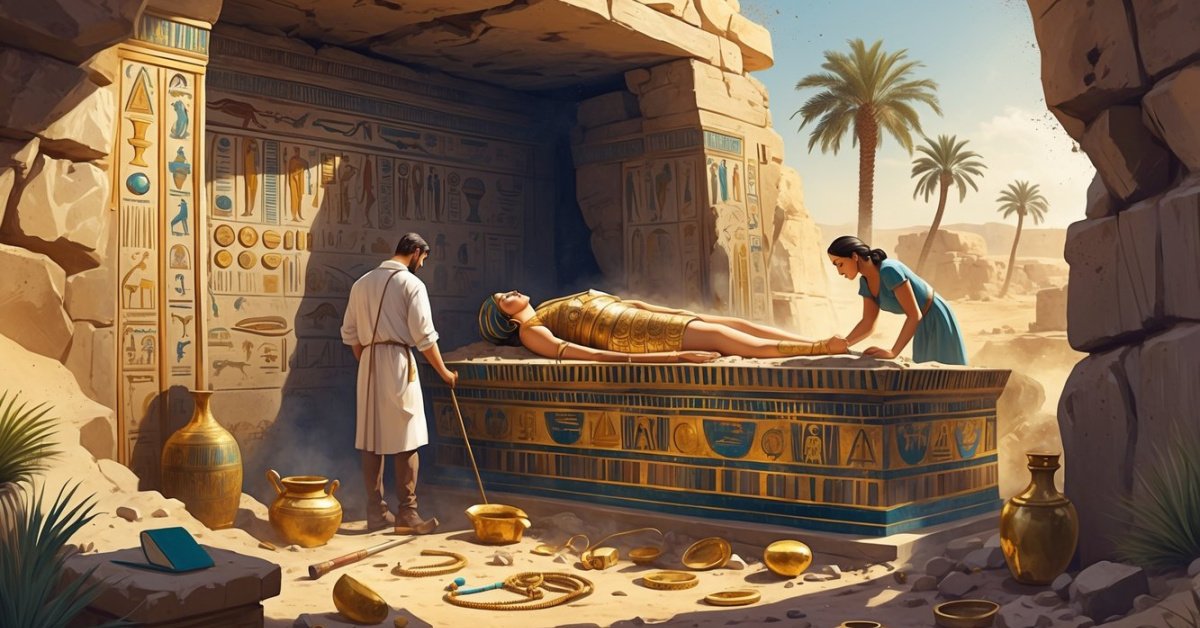
For over two thousand years, no one has found the resting place of Mark Antony and Cleopatra VII. Ancient accounts say they were buried together after their deaths in 30 BCE, but no confirmed tomb has turned up.
Archaeologists now think the joint burial may be near the ancient temple site of Taposiris Magna, west of Alexandria.
The story mixes history, politics, and love. Antony and Cleopatra’s final days unfolded during the collapse of their power and the rise of Octavian, later called Augustus.
Roman historians like Plutarch and Suetonius left clues about their burial. These accounts differ in detail, so researchers continue to debate and investigate.
Recent excavations at Taposiris Magna have uncovered artifacts from Cleopatra’s era. These finds have raised hopes that the tomb could be nearby.
The Mystery of the Lost Tomb
Archaeologists and historians have searched for the tomb of Antony and Cleopatra for centuries. Ancient writings offer clues, but changing landscapes and disasters have erased much of the evidence.
The location remains one of Egypt’s most enduring historical puzzles.
Why the Tomb Remains Undiscovered
Many believe the lost tomb is near or under modern Alexandria, where Cleopatra VII ruled. Much of the ancient city now lies beneath the Mediterranean because of earthquakes and coastal erosion.
Excavations at sites like Taposiris Magna have revealed temples, tunnels, and artifacts from her reign. Researchers have not found a confirmed burial chamber.
Kathleen Martinez has led digs at Taposiris Magna for nearly two decades, following clues from ancient records and architectural hints.
Modern buildings cover much of the possible burial area. This makes large-scale digs difficult without harming existing structures.
Key obstacles include:
- Geological changes – earthquakes, flooding, and shoreline shifts.
- Urban expansion – restricted excavation zones.
- Incomplete records – ancient sources are often vague or symbolic.
Historical Accounts of the Joint Burial
Ancient writers such as Plutarch and Suetonius recorded that after their defeat in 30 BCE, Octavian (later Augustus) allowed Mark Antony and Cleopatra to be buried together.
The accounts suggest a grand tomb, possibly decorated to reflect their royal status.
These writings say the burial happened in or near Alexandria, but they lack exact locations. Some descriptions may reflect political motives, making them less reliable.
Roman sources often focus on the political drama, not the practical details of the burial. Modern researchers must interpret brief mentions and compare them with archaeological finds.
A few texts hint at religious symbolism in their tomb, possibly linking them to Egyptian deities. This has led some to think the burial site could be within a temple complex.
Significance of the Discovery
Finding the tomb of Antony and Cleopatra would give direct evidence about their final days and burial customs during the late Ptolemaic period. It could confirm or challenge existing historical accounts.
The discovery could reveal how Roman and Egyptian traditions blended at the time. Artifacts inside might show details about their wealth, political alliances, and beliefs.
Such a find could also help map ancient Alexandria more accurately. It might lead to other important archaeological sites hidden beneath the modern city.
Mark Antony and Cleopatra: Their Final Days
In 30 BCE, political and military events in the eastern Mediterranean quickly turned against Mark Antony and Cleopatra VII. Their defeat in a major naval battle left them with few allies and growing threats from Rome.
The Fall of Alexandria
The turning point came after the Battle of Actium in 31 BCE. Octavian’s forces defeated Antony and Cleopatra’s combined fleet.
They retreated to Alexandria, their political and cultural center. By the summer of 30 BCE, Octavian advanced toward the city.
Antony tried to defend Alexandria with a smaller force. Morale was low, and many soldiers switched sides.
Cleopatra withdrew to her mausoleum, likely to protect her treasures and prepare for the worst. Antony’s forces collapsed when Octavian’s troops entered the city.
Alexandria, once the jewel of the Ptolemaic kingdom, fell under Roman control.
Death of Cleopatra VII and Mark Antony
Antony heard false news that Cleopatra had died. Distraught, he fell on his sword.
He was badly wounded but not immediately dead. Cleopatra had him brought to her, and he died in her presence.
Ancient accounts, including those by Plutarch, describe this as their final reunion.
Cleopatra’s own death followed soon after. Roman accounts claim she used an asp’s venom, though the exact method is uncertain.
She died at about 39 years old. Her eldest son, Caesarion, was captured and executed on Octavian’s orders.
Octavian’s Role in Their Fate
Octavian, later called Emperor Augustus, had pursued Antony and Cleopatra for years. Their alliance and relationship threatened his rise to power in Rome.
After Actium, Octavian moved quickly to isolate them. He cut off their supplies and persuaded allies to defect.
When Alexandria fell, Octavian allowed Antony and Cleopatra to be buried together, according to ancient historians like Suetonius and Plutarch.
With their deaths, Octavian took control over Egypt. He turned it into a Roman province and secured his position as Rome’s first emperor.
You can read more about their final resting place, which remains undiscovered.
Ancient Sources and Historical Narratives
Several ancient historians described the burial of Antony and Cleopatra, often with different details. Their records give insight into how Roman and Egyptian observers remembered the couple’s final days.
Plutarch’s Testimony
Plutarch, a Greek historian, wrote one of the most detailed accounts about Antony and Cleopatra’s deaths. In his Life of Antony, he said that Octavian allowed the two to be buried together after their suicides.
He described a joint burial in a grand tomb in Alexandria. This suggests Octavian showed some respect toward his defeated rivals.
Plutarch’s writings came from earlier sources, some possibly eyewitnesses. However, he wrote over a century after the events, so his account could mix history and later interpretation.
His testimony remains important for archaeologists because it gives a specific location—Alexandria.
Accounts by Cassius Dio and Suetonius
Cassius Dio, a Roman historian, also wrote about Antony and Cleopatra’s deaths. He said Octavian permitted their burial together, echoing Plutarch’s claim.
Dio focused more on the political implications. He saw Octavian’s decision as a move to show mercy after victory.
Suetonius, in his biography of Augustus, briefly mentioned Cleopatra. He noted that Octavian managed the burial arrangements.
Both writers agreed on the joint burial but did not give details about the tomb’s appearance or exact location.
Roman and Egyptian Perspectives
Roman accounts often told Antony and Cleopatra’s end as a moral lesson about ambition and loyalty. Their burial together symbolized the end of a failed alliance.
Egyptian traditions likely focused on Cleopatra’s role as the last ruler of the Ptolemaic dynasty. A joint tomb in Alexandria would have meant a lot to her subjects.
Roman historians shaped most of the surviving story, while Egyptian records from the period are scarce. This lack of local sources means much of the story depends on Roman writers.
Some modern historians point out that this imbalance makes it harder to confirm the tomb’s location and design.
Theories on the Tomb’s Location
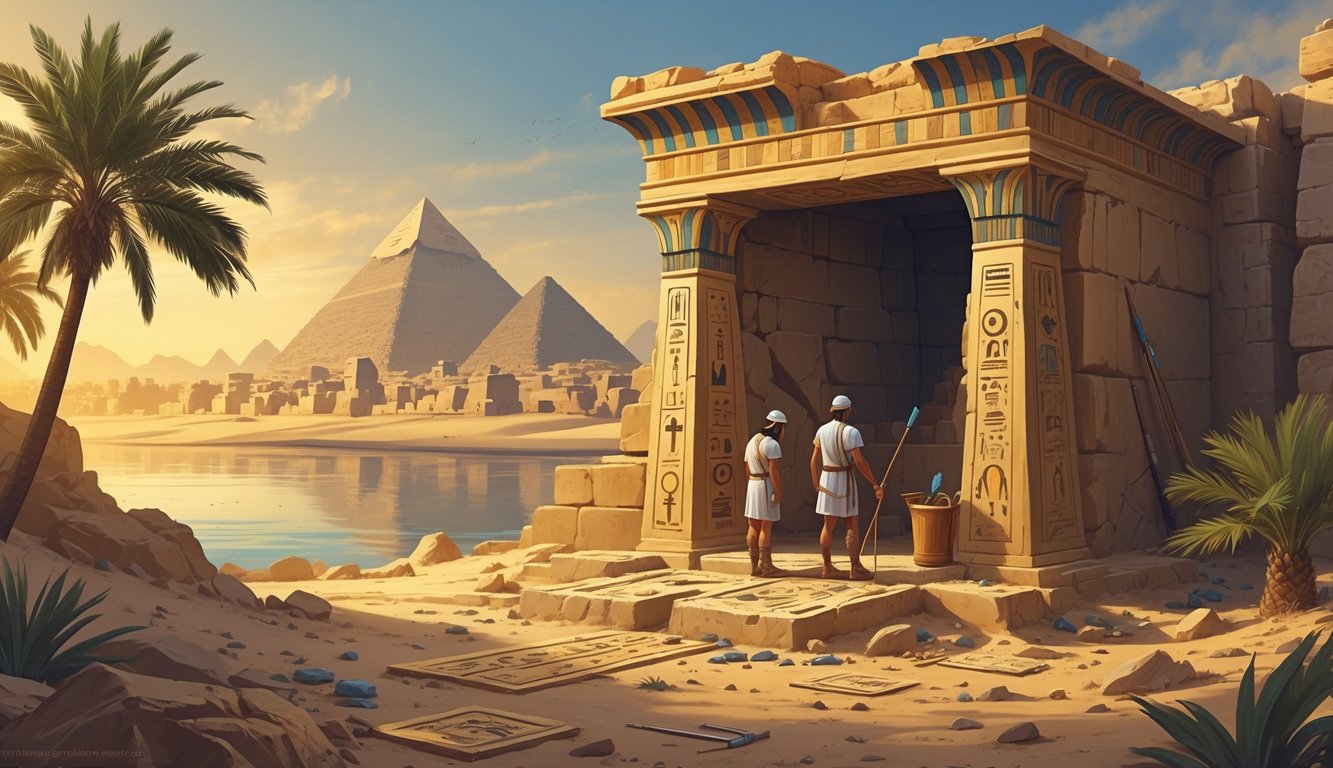
Historians and archaeologists have studied ancient records, geographic changes, and archaeological finds to narrow down possible sites for Antony and Cleopatra’s burial. Evidence points to a few main locations matching historical accounts from the late Ptolemaic period.
Alexandria and Its Submerged Ruins
Many believe the tomb lies in or near ancient Alexandria, where Cleopatra ruled in her final years. Ancient writers like Plutarch say Octavian allowed the pair to be buried together after their deaths in 30 BCE.
Large parts of the city’s royal quarter now lie underwater because of earthquakes and tsunamis. These submerged ruins include palaces, temples, and other Ptolemaic buildings that could hide the tomb.
Underwater archaeologists have found statues, columns, and sphinxes from the Ptolemaic period in Alexandria’s harbor. No definitive burial chamber has been located.
Excavation under the sea makes the search slow and difficult.
Taposiris Magna Hypothesis
Another strong theory centers on Taposiris Magna, a temple complex about 45 kilometers west of Alexandria. Archaeologist Kathleen Martinez has led excavations here since 2005, believing the site may hold the tomb.
The temple, built during the Ptolemaic period, was dedicated to Osiris, the Egyptian god of the afterlife. This connection has led some to think Cleopatra may have chosen it for symbolic reasons.
Excavations have revealed tunnels, burial shafts, and artifacts from the era, including coins with Cleopatra’s image. Recent finds have fueled speculation that the site could be the final resting place of the royal couple.
More exploration is ongoing, as detailed in updates on the Taposiris Magna excavations.
Other Proposed Sites
Some researchers suggest locations beyond Alexandria and Taposiris Magna. These include inland necropolises and lesser-known temple complexes from the Ptolemaic period.
A few theories place the tomb in a hidden crypt within the Nile Delta, where shifting sediments may have concealed it. Others point to smaller coastal settlements that once held royal estates.
While these ideas have less archaeological support, they remain part of the discussion due to gaps in the historical record. As with many ancient mysteries, the lack of evidence keeps multiple possibilities open, as noted in studies of Cleopatra’s lost tomb.
Taposiris Magna: Excavations and Discoveries
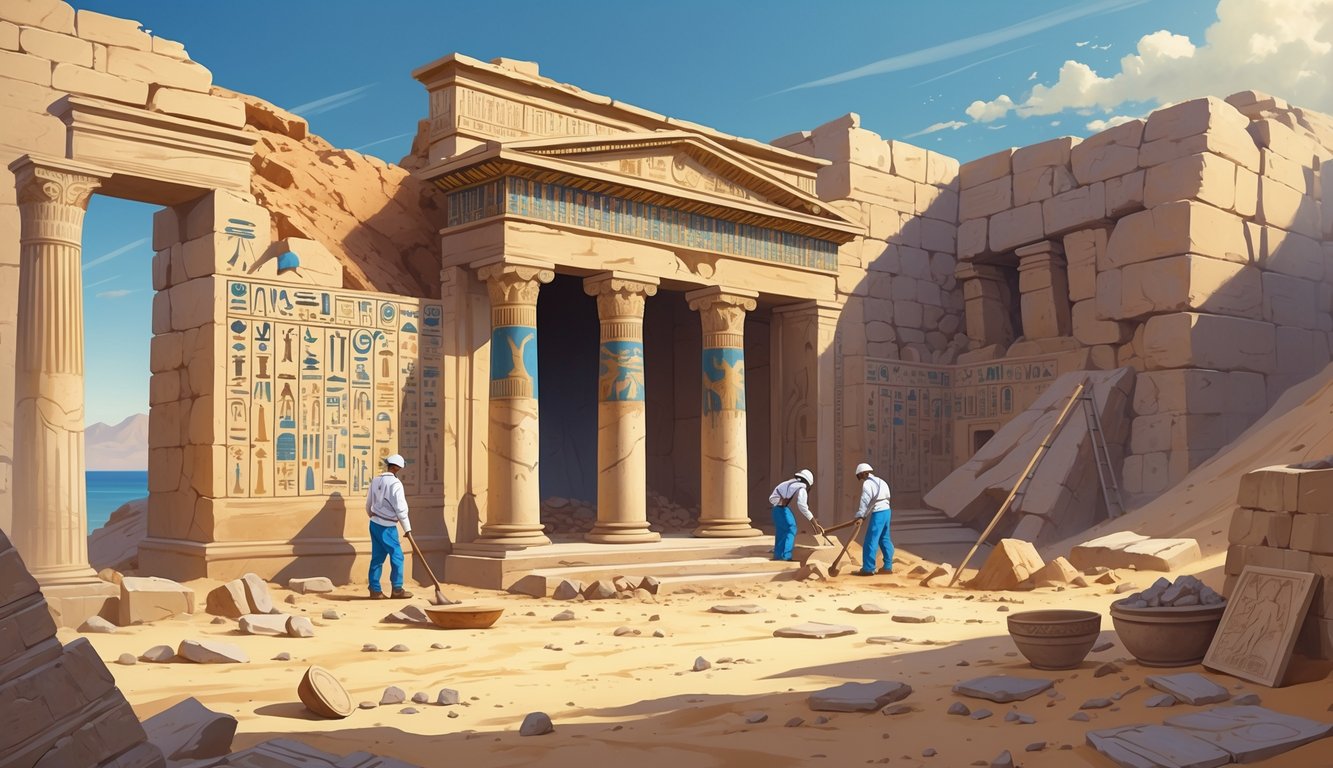
Archaeologists have spent years studying the ruins of Taposiris Magna on Egypt’s northern coast. The site has revealed a mix of architectural remains, human burials, and artifacts connected to the final years of the Ptolemaic dynasty.
Temple of Isis and Its Importance
Ptolemy II Philadelphus built Taposiris Magna around 270 BCE. He dedicated the temple to the goddess Isis, who was important in Egypt and the Mediterranean.
The temple’s location, about 30 miles west of Alexandria, placed it near Cleopatra’s capital. This has sparked interest in its possible link to her burial place.
Dr. Kathleen Martinez and her team have explored the temple’s underground structures. They uncovered a tunnel carved from bedrock, which has attracted attention for its precise engineering.
Some believe this tunnel could lead to hidden chambers. The Egyptian Ministry of Tourism and Antiquities has supported ongoing work at the site.
Their teams have documented architectural features that show a blend of Egyptian and Greek styles. This mix reflects the Ptolemaic era’s cultural diversity.
Artifacts and Mummies Unearthed
Excavators found coins with Cleopatra’s image, statues of deities, and amulets linked to Isis worship. These discoveries suggest the temple remained active during her reign.
Teams also uncovered several mummies in nearby tombs. While none belong to Cleopatra or Mark Antony, the burials provide clues about people connected to the temple.
Some mummies were wrapped in linen and covered with gold leaf, showing the wealth of certain individuals. Others had simple grave goods, indicating different social statuses.
Archaeologists cataloged pottery, jewelry, and ritual objects. Many items were used in temple ceremonies, showing that Taposiris Magna was an important religious center.
Controversies and Debates
Some experts doubt that Cleopatra’s tomb is at Taposiris Magna. They argue that ancient texts suggest she was buried in Alexandria, possibly in a royal mausoleum now lost beneath the modern city.
Others question whether the tunnel and chambers connect to royal burials. They note that similar structures in Egypt served religious purposes instead.
Debates continue over how to interpret the artifacts. While coins and statues link the site to Cleopatra’s time, critics warn that such items circulated widely.
The site continues to attract attention from scholars and the public, keeping the discussion and excavations active.
Underwater Archaeology in Alexandria
Archaeologists have mapped large parts of Alexandria’s ancient harbor. They revealed sunken royal quarters, temples, and port facilities from the Ptolemaic period, when Cleopatra VII ruled Egypt.
Franck Goddio’s Underwater Expeditions
French underwater archaeologist Franck Goddio has led exploration in Alexandria’s eastern harbor for decades. His team from the European Institute of Underwater Archaeology used sonar mapping, GPS, and diving surveys to locate submerged ruins.
They documented streets, columns, and statues that stood in the royal district. Many finds were buried under sand and silt, requiring careful excavation.
Recovered artifacts include inscriptions, sphinxes, and ceremonial objects from the Ptolemaic dynasty. These discoveries help clarify the city’s layout before earthquakes and subsidence caused parts of it to sink.
Discovery of Antirhodos Island
The remains of Antirhodos Island lie beneath Alexandria’s harbor, about 6 meters underwater. Ancient writers described it as part of the royal quarter and possibly the site of Cleopatra’s palace.
Goddio’s team identified stone foundations, port structures, and large blocks that match Ptolemaic building styles. They also found imported granite columns, suggesting the island held important buildings.
Artifacts from the island include gold coins, fine pottery, and statues. These finds indicate the island’s high status and its connection to Ptolemaic Alexandria’s political and cultural life.
Ptolemaic Structures Beneath the Sea
Submerged Ptolemaic structures in Alexandria’s harbor include temple foundations, harbor walls, and monumental gateways. Builders used limestone and granite, with features similar to those at inland sites like Taposiris Magna.
Some structures show earthquake damage, with fractured columns and displaced blocks. Others remain intact, preserved by water and sediment.
A table of notable finds:
| Structure Type | Approx. Date | Notable Features |
|---|---|---|
| Temple foundation | 3rd c. BCE | Carved relief fragments |
| Harbor wall | 2nd c. BCE | Massive limestone blocks |
| Monumental gateway | 1st c. BCE | Granite columns, decorative capitals |
These submerged remains help researchers understand the scale and complexity of Alexandria’s royal and religious architecture during the Ptolemaic era.
Modern Search Efforts and Notable Figures
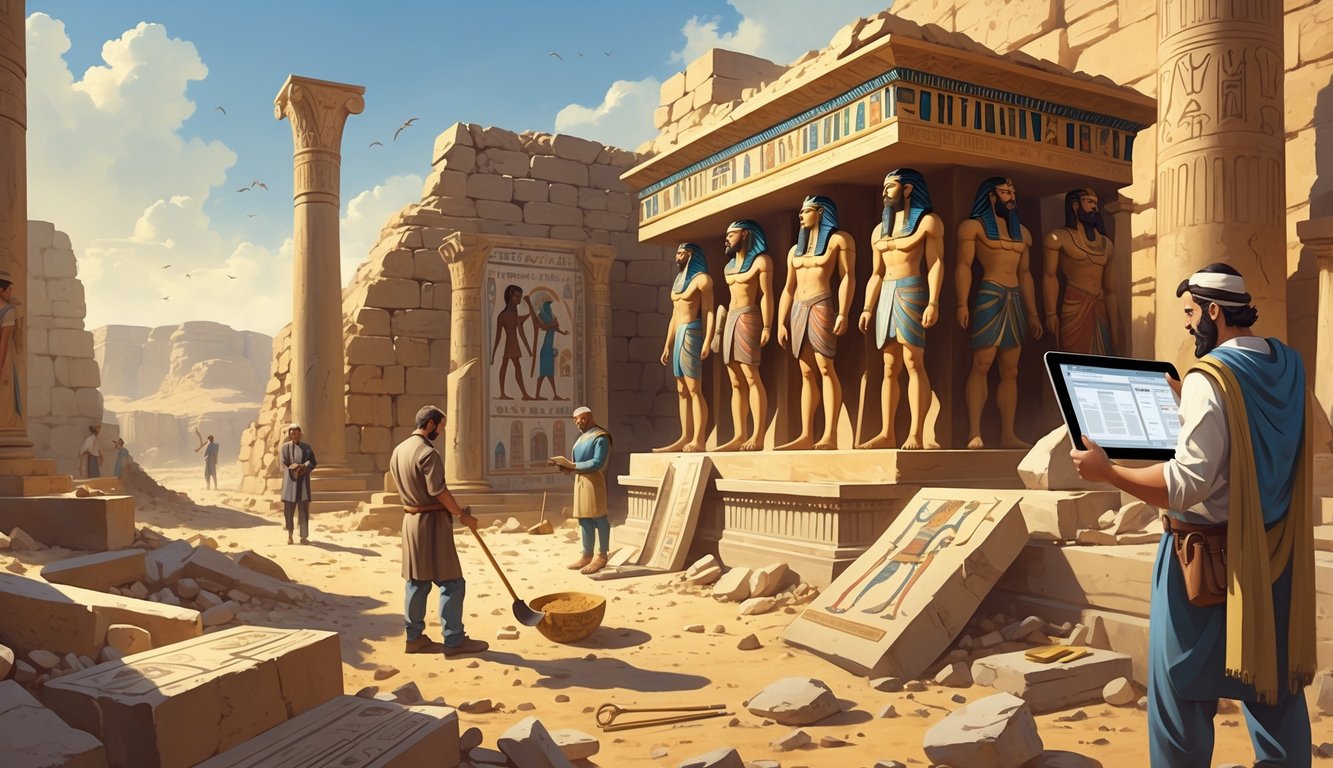
Recent searches for Antony and Cleopatra’s burial site combine traditional archaeology with advanced technology. Leading archaeologists and Egyptologists guide digs, interpret finds, and plan research strategies.
Kathleen Martínez’s Investigations
Dominican archaeologist Kathleen Martínez has led a persistent search for Cleopatra’s tomb since 2005. Working with Egypt’s Ministry of Antiquities, she focuses on the temple complex at Taposiris Magna, west of Alexandria.
Martínez believes the temple may hold the joint burial of Cleopatra and Mark Antony. She bases her theory on ancient texts that suggest the queen chose a sacred site linked to Isis.
Her team uncovered coins with Cleopatra’s image, statues, and burial shafts. In 2022, she announced the discovery of a 1,300-meter tunnel beneath the temple, which some experts think could lead to hidden chambers.
This tunnel discovery has renewed interest in the site and expanded excavation plans.
Zahi Hawass and the Egyptian Team
Egyptologist Zahi Hawass, former Minister of Antiquities, has also searched for the tomb. He leads teams exploring sites in Alexandria and the surrounding coastal region.
Hawass believes the tomb could be near the ancient city’s royal quarter, much of which now lies underwater due to earthquakes and subsidence. His team examines both land and submerged ruins for clues.
In 2023, Hawass announced plans to investigate new areas inland after reviewing historical accounts and underwater surveys. He coordinates with other archaeologists to compare findings and refine search locations.
Use of Ground-Penetrating Radar
Ground-penetrating radar (GPR) has become a key tool in the search. GPR sends radar pulses into the ground to detect buried structures without digging.
At Taposiris Magna, GPR surveys have found anomalies beneath the temple floor and nearby areas. These readings help archaeologists choose where to dig and protect fragile remains.
GPR is also used in coastal surveys to map submerged ruins near ancient Alexandria. Combined with sonar scans, it helps researchers find potential tomb structures that may have shifted or collapsed over time.
Funerary Practices and the Ptolemaic Dynasty
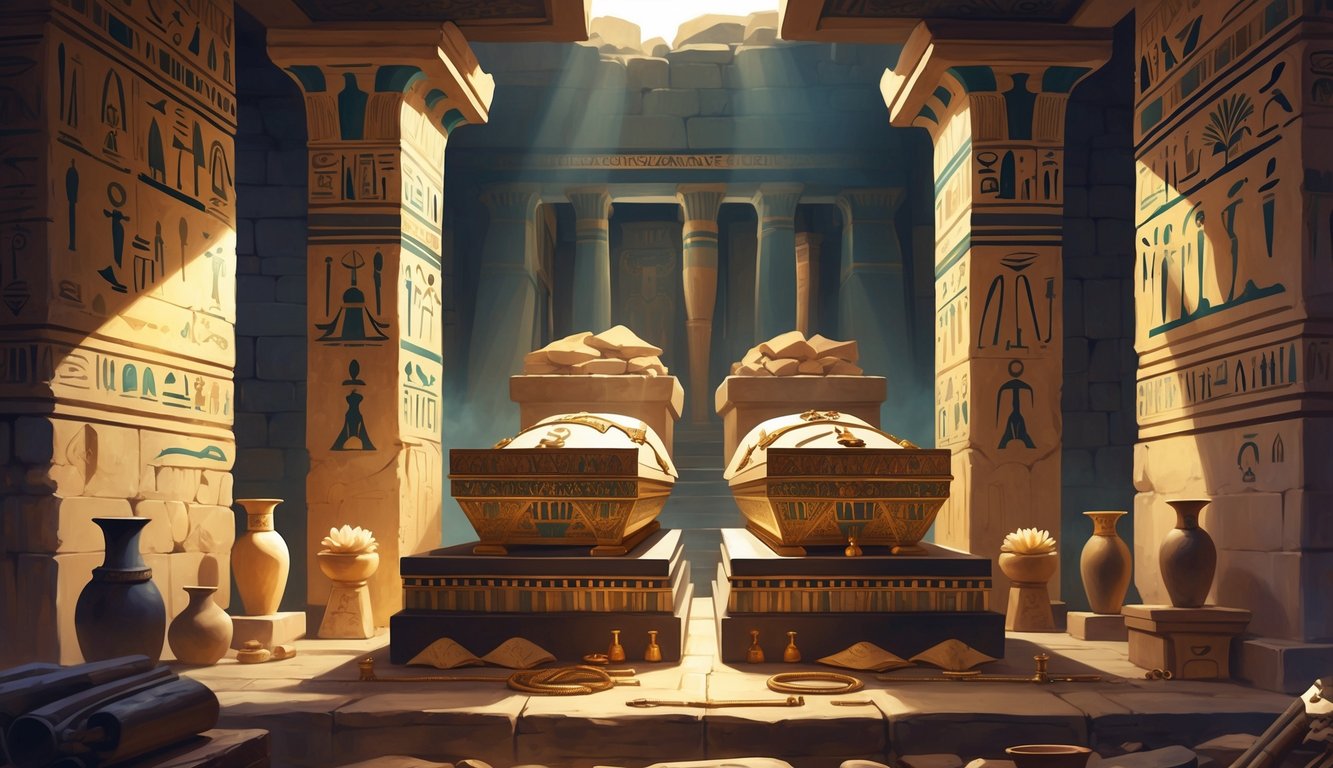
Burial customs in the Ptolemaic Kingdom of Egypt blended Egyptian traditions with Greek influences. Royal tombs reflected political power, religious beliefs, and the desire for status in the afterlife.
Architecture, grave goods, and rituals all honored the dead and preserved their memory.
Royal Burials in Ancient Egypt
Egyptian rulers built elaborate tombs to protect their remains and possessions. In earlier dynasties, pharaohs used pyramid complexes, but by the Late Period, rock-cut tombs and temple-like structures became common.
During the Ptolemaic dynasty, royal burials kept strong religious meaning. Mummification remained central, focusing on preserving the body for eternity.
Rituals drew from the Book of the Dead and earlier funerary texts. Greek influence changed some burial aspects.
Ptolemaic rulers sometimes used Greek-style portraiture on funerary masks, mixing it with Egyptian symbols. This blend reflected their dual identity as Macedonian Greeks and Egyptian pharaohs.
Mausoleum Architecture
The Ptolemaic period saw grand mausoleums rise in key cities. Builders combined Greek and Egyptian design elements, such as columns, courtyards, and decorated chambers.
A royal mausoleum served as both a tomb and a symbol of political legitimacy. In Alexandria, the possible burial site of Alexander the Great influenced later royal tombs.
Monumental size and fine stonework projected authority. Some mausoleums included chapels for offerings and festivals.
Priests performed rites in these spaces to honor the deceased and maintain their cult. The blend of architectural styles mirrored the cultural fusion in Ptolemaic Egypt.
Ptolemaic Burial Traditions
Burial practices during the Ptolemaic dynasty kept many ancient Egyptian customs while adding new ones. Mummification became more elaborate, sometimes using gilded masks and painted cartonnage.
Grave goods included amulets, jewelry, and daily items. This practice, which had declined earlier, revived under the Ptolemies, possibly due to Greek traditions of placing personal objects with the dead, as described in Ptolemaic burial customs.
Funerary art evolved with painted mummy portraits influenced by Hellenistic realism. These appeared alongside traditional Egyptian motifs.
This combination reflected the multicultural society of the Ptolemaic Kingdom, where Greek settlers and native Egyptians shared and adapted each other’s rituals.
The Enduring Legacy of Antony and Cleopatra
Their political choices shaped the last years of the Ptolemaic Kingdom and affected Rome’s expansion into Egypt. Their lives and deaths became part of history and popular culture, mixing real events with later interpretations.
Impact on Roman-Egyptian Relations
Mark Antony’s alliance with Cleopatra tied Egypt’s fate to Roman politics. Their partnership aimed to secure power in the eastern Mediterranean.
After their defeat by Octavian in 31 BCE, Egypt became a Roman province. This ended nearly 300 years of Ptolemaic rule and put its wealth and grain supply under Roman control.
Ancient writers like Plutarch described their joint burial as a final act of unity. It also marked the end of Egypt as an independent kingdom and the start of direct Roman rule.
This change affected trade, military presence, and cultural exchange between Rome and Egypt.
Cultural Depictions Through History
Artists, playwrights, and filmmakers have retold their story for centuries. From Shakespeare’s Antony and Cleopatra to modern films, their relationship is shown as both romantic and tragic.
In paintings, Cleopatra often appears in political or dramatic moments, while Antony is shown as a loyal but doomed Roman general. These portrayals reflect the values of the times in which they were created.
Modern media continues to adapt their story, sometimes focusing on historical facts and other times on drama. These versions keep their names familiar to audiences far removed from the events of 30 BCE.
Myth Versus Reality
Ancient Roman writers like Suetonius and Plutarch wrote their accounts after the deaths of Antony and Cleopatra. They often supported Octavian, which introduced political bias into their descriptions.
Writers may have exaggerated Cleopatra’s image as a seductress to undermine her political skill. They also amplified Antony’s reputation as a reckless commander to justify Octavian’s victory.
Archaeologists continue to search for their undiscovered tomb. New discoveries could provide fresh insight into their true history.
Future Prospects in the Search for the Tomb
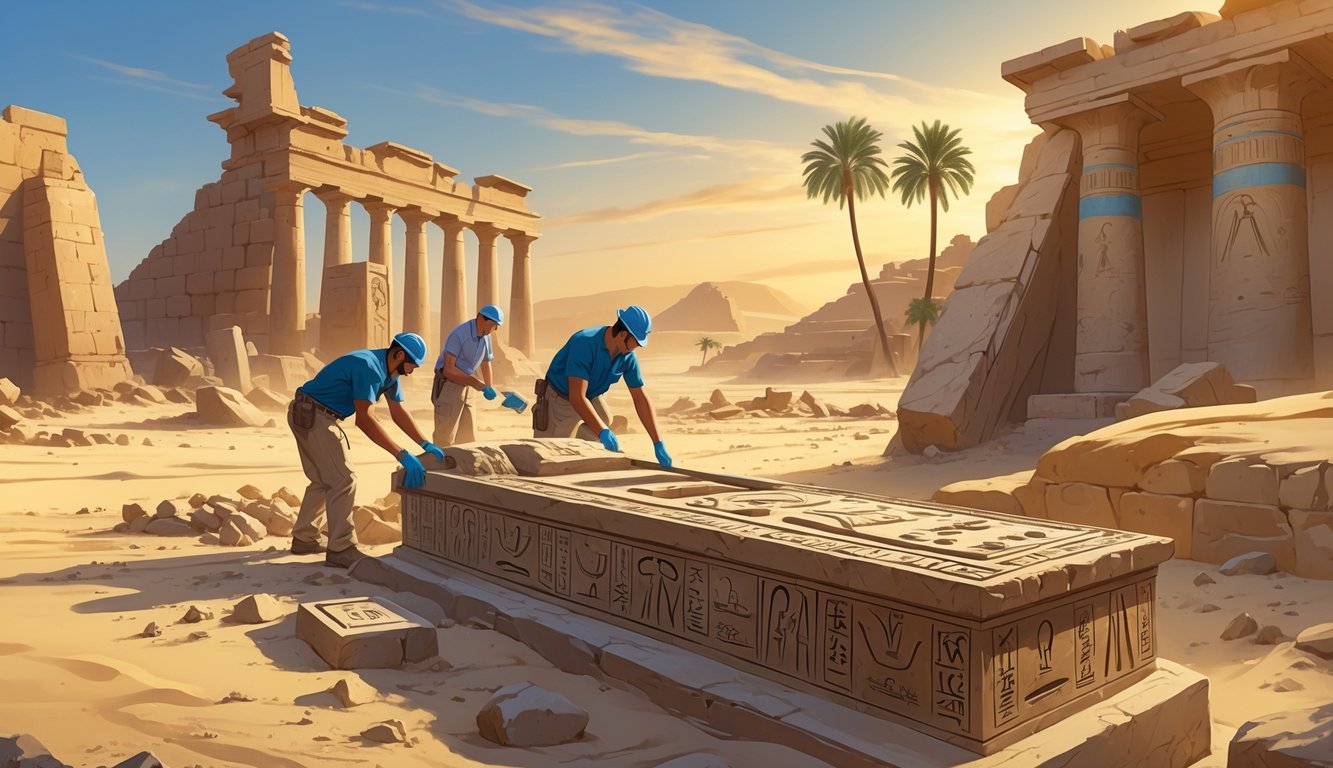
Archaeologists actively explore the ancient site of Taposiris Magna. Recent findings suggest a possible link to the burial place of Antony and Cleopatra.
Researchers use new tools and cross-border cooperation to increase the chances of discovery. Confirming the burial site would add significant historical value.
Advances in Archaeological Technology
Modern tools help teams investigate areas that were once out of reach. Ground-penetrating radar (GPR) detects underground structures without digging.
3D mapping creates clear models of tunnels and chambers, which helps plan excavations.
At Taposiris Magna, a team led by Dr. Kathleen Martinez mapped a tunnel beneath the temple complex using precision instruments. The design features match those of ancient royal burials.
Dr. Martinez works in cooperation with the Egyptian Ministry of Tourism and Antiquities.
Remote sensing tools help survey coastal areas nearby. Underwater scanning checks submerged ruins, since earthquakes and sea-level changes have altered the landscape.
Combining land and marine archaeology increases the chances of finding hidden structures.
International Collaborations
Specialists from several countries join the search. Dominican archaeologists and Egyptian experts share excavation and analysis work.
These partnerships bring together skills in ancient history and geological surveying.
International funding pays for advanced equipment and training for local teams. The ongoing project benefits from academic exchanges.
Researchers from Europe, the Americas, and the Middle East help study and preserve artifacts.
The Egyptian Ministry of Tourism and Antiquities coordinates permits and ensures finds stay in Egypt for conservation. This cooperation also supports cultural heritage tourism, which helps fund further excavations.
What Discovery Would Mean for History
Finding the joint tomb of Antony and Cleopatra would give direct evidence about their burial practices. This discovery could confirm ancient accounts of their deaths in 30 BCE.
Researchers could examine artifacts such as inscriptions, jewelry, or ceremonial items to learn about their political and personal lives. Coins or statues might show how people portrayed them during their time.
Historians would gain a better understanding of the Roman-Egyptian transition period. They could compare written records with physical evidence from this famous royal couple.