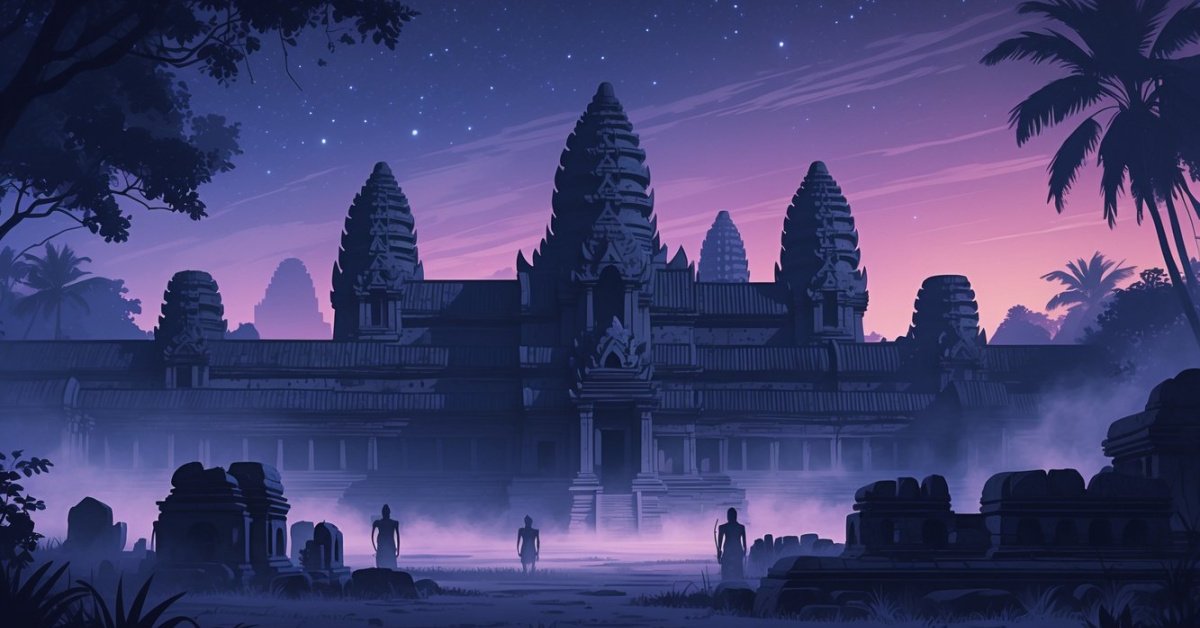
Angkor Wat is famous for its vast stone temples and deep Khmer history. Some people believe its walls hide more than ancient carvings.
Locals talk about a “Ghost Fort” inside the complex, a place full of mystery. The Ghost Fort refers to spots where people have heard strange sounds, seen shadowy figures, and noticed unexplained activity.
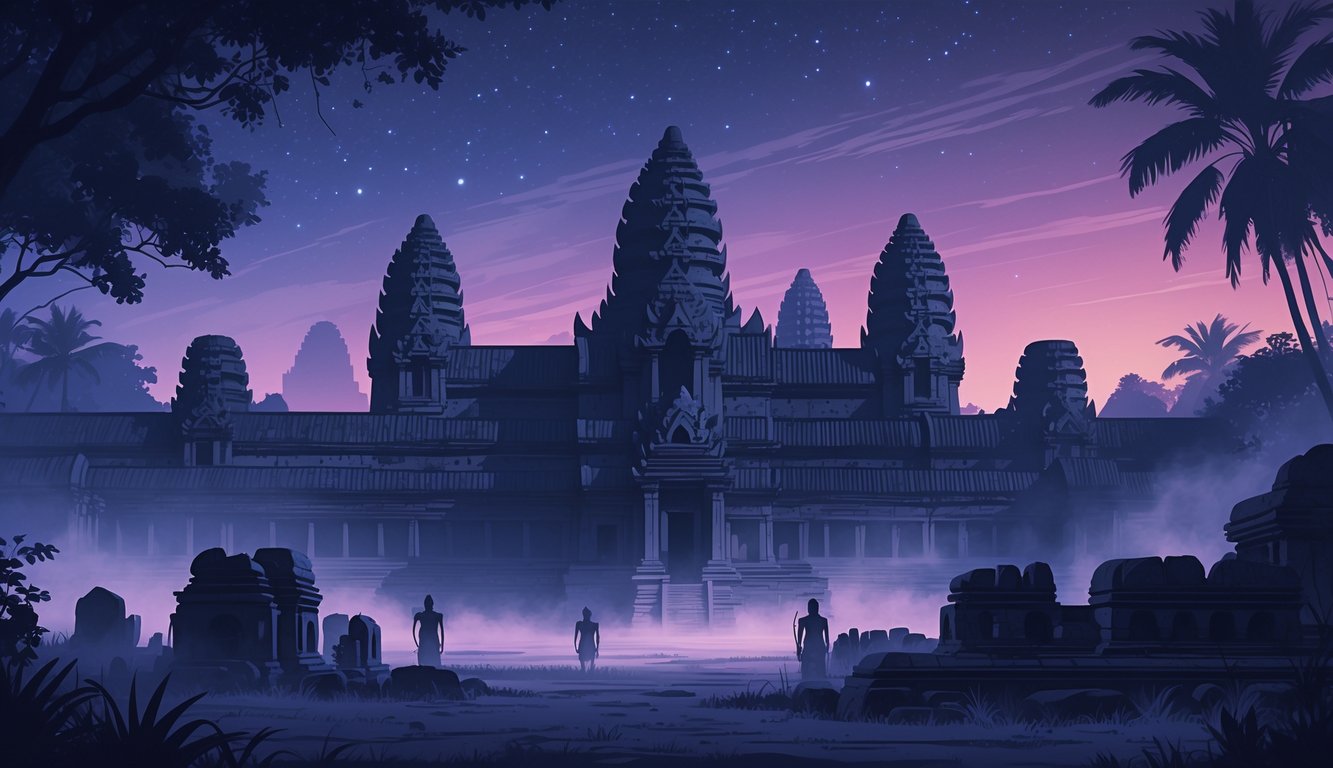
These stories mix with old beliefs about spirits guarding sacred places. Visitors who walk the quiet corridors after sunset often feel watched.
Others say they have seen faint shapes moving among the ruins. Many of these tales echo local legends and folklore about temple guardians and restless souls.
When people explore the Ghost Fort, they step into a place where history, culture, and mystery come together. From the beehive towers to dark chambers, each area offers a chance to discover if the hauntings come from spiritual tradition, natural atmosphere, or something else.
Unveiling the Ghost Fort of Angkor Wat
The Ghost Fort is a little-known part of Angkor Wat that mixes quiet ruins with local ghost stories. Visitors describe silent stone corridors, unusual carvings, and places where few tourists go.
These features help build its reputation as a place of mystery and old spiritual beliefs.
Origins of the Ghost Fort Legend
The name “Ghost Fort” does not appear in official Cambodian history. Local oral traditions gave it this name.
Elders in nearby villages tell stories of spirits guarding certain temple sections. Some legends connect the Ghost Fort to the temple’s change from Hinduism to Buddhism in the late 12th century.
This shift left some shrines empty, which may have led to ghost stories. Folklore often blends with real events.
War and neglect damaged parts of Angkor Wat. People living close by sometimes stayed away, believing these places were cursed or watched by unseen forces.
Unlike the main towers, the Ghost Fort area remains unrestored. Its worn stones and overgrown paths add to its mysterious feel.
Location and Architectural Features
The Ghost Fort sits in a cluster of outer galleries and partly collapsed walls on Angkor Wat’s western side. These sections are far from the main tourist routes.
The stone here looks darker, likely from age and moss. Narrow passageways lead to small rooms with faded carvings.
Some show battle scenes, while others display celestial dancers. Visitors sometimes notice broken symmetry—walls that lean or carvings that seem unfinished.
This may show that builders stopped work during political unrest.
A table of key features often mentioned:
| Feature | Description | Possible Cause |
|---|---|---|
| Dark stone color | Deep grey to black surface | Weathering, moss, lichen |
| Uneven walls | Slight tilts in structure | Foundation shifts |
| Faded carvings | Hard to see details | Erosion over centuries |
Historical Accounts of Hauntings
Travelers’ journals from the 19th century mention strange experiences. French explorers wrote about sudden cold spots and heavy silence in certain corridors.
Local monks tell visitors about hearing footsteps when no one is there. Some monks also mention faint chanting at night, which they link to lingering spiritual energy from years of worship.
Recently, some tourists have posted online about feeling watched in the area. These stories are personal and unverified, but they add to the Ghost Fort’s reputation.
No physical evidence supports supernatural claims. The quiet, shadowy setting makes it easy to see why these stories last.
Famous Hauntings at Angkor Wat
Visitors and staff have reported strange encounters in the temple grounds. Some see human-like figures in dark corridors or hear unexplained sounds echoing through the stone halls.
Many incidents match old local stories passed down for generations.
Reported Apparitions and Sightings
Several people describe a “ghost guard” who appears near the main entrance. Witnesses say he wears traditional Khmer military clothing and disappears if anyone comes near.
This figure connects to legends about temple protectors. Others see robed monks walking quietly through empty galleries.
These monks often appear in closed areas. Some visitors have captured faint, human shapes in photos.
In a few cases, the images show figures standing in doorways where no one was present.
Eerie Phenomena in the Temple Complex
People often report unexplained sounds such as footsteps on stone, chanting in empty rooms, and the faint clang of metal. These sounds usually happen early in the morning or late in the evening.
Temperature changes are another common detail. Some say certain corridors feel suddenly cold, even during Cambodia’s hot weather.
Rarely, visitors see flickering lights or glowing orbs in dark areas. Some blame camera effects, while others think these are linked to the temple’s haunted reputation.
Eyewitness Testimonies
Local guides share personal stories while leading tours. One guide heard soft chanting behind him, but found the hallway empty.
A photographer set up near a bas-relief and felt a light tap on his shoulder. No one was there, but his camera later showed a blurred figure in the background.
Tourists sometimes feel watched while exploring quiet towers. Some leave quickly because of a strong sense of unease.
The tale of the Mysterious Ghost Guard of Angkor Wat is one of the best-known stories among locals and visitors.
Mythology and Spiritual Beliefs
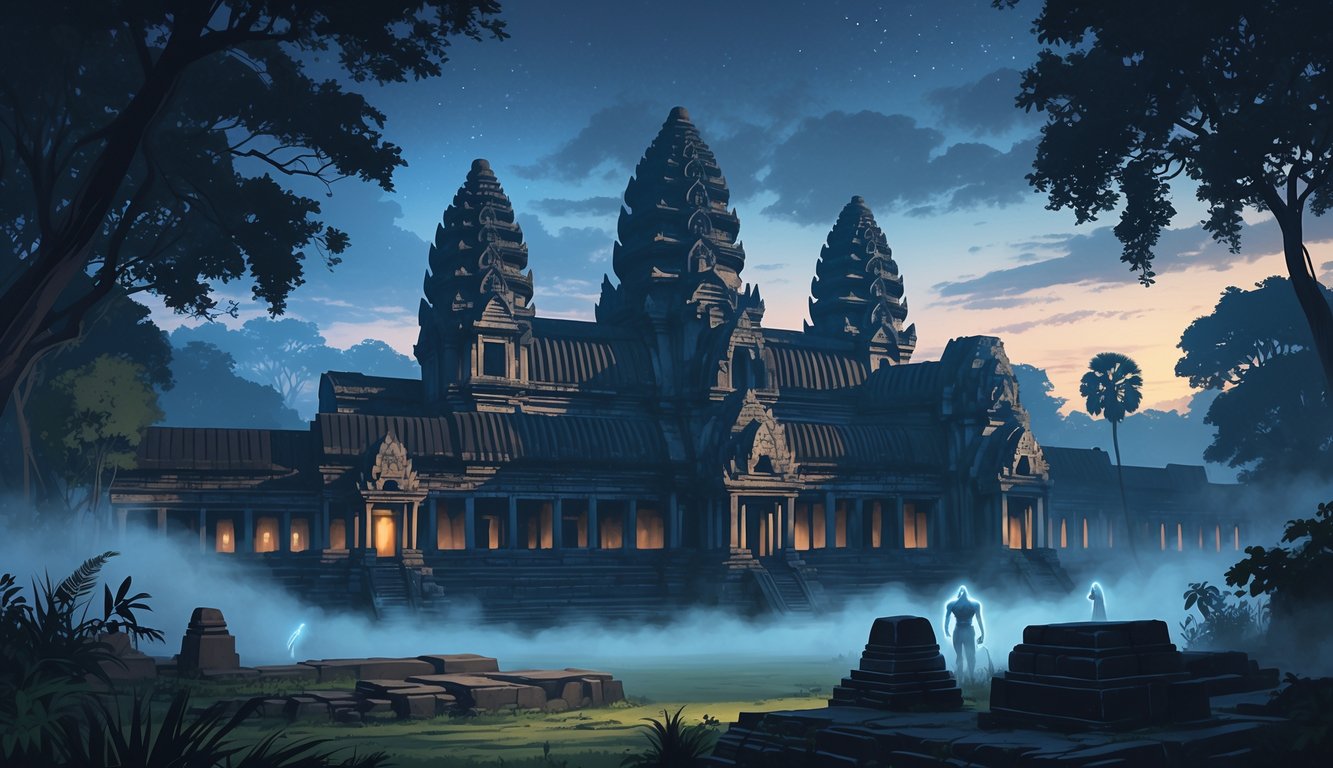
Angkor Wat’s design and carvings show the religious changes that shaped Cambodia. Its art combines Hindu and Buddhist traditions, showing both mythic battles and symbols of the universe.
Hindu and Buddhist Influences
Builders first created Angkor Wat in the early 12th century as a Hindu temple for Vishnu. Its layout represents Mount Meru, the mythical home of the gods.
By the 14th century, the Khmer Empire followed Buddhism. The temple became a Buddhist site, but Hindu images remained.
This mix gave Angkor Wat a unique spiritual identity. Visitors today see Hindu epics carved next to Buddhist scenes.
For example, bas-reliefs of the Ramayana stand near carvings of the Buddha’s life. This shows how the Khmer people kept old traditions while embracing new ones.
Gods, Demons, and the Battle for Amrita
One famous carving shows the Churning of the Ocean of Milk. In this Hindu story, gods (devas) and demons (asuras) worked together to get amrita, the nectar of immortality.
They used the serpent Vasuki as a rope and wrapped it around Mount Mandara. By pulling back and forth, they churned the ocean to release treasures and the nectar.
This scene fills a wall in the temple’s eastern gallery. The carving shows rows of gods and demons pulling the serpent while celestial beings watch.
The story stands for balance between opposing forces. It also shows the Khmer belief in working together, even with rivals, to reach a bigger goal.
Symbolism in Temple Carvings
Angkor Wat’s carvings are more than decoration. They act as a spiritual map.
Many show apsaras (celestial dancers) as symbols of beauty and grace. Battle scenes, processions, and mythical creatures teach moral lessons.
For example:
| Symbol | Meaning |
|---|---|
| Lotus Flower | Purity and spiritual awakening |
| Naga (serpent) | Protection and connection between worlds |
| Apsara | Joy, harmony, and blessings |
The temple’s symmetry and alignment with the sun and moon also have spiritual meaning. This shows the Khmer people wanted to connect human life with the universe.
Local Legends and Folklore
Many Cambodians believe Angkor Wat holds spiritual energy because of its long history. Visitors often hear about ghost sightings, strange sounds, and customs to keep spirits calm.
These beliefs connect deeply with Cambodia’s culture and religion.
Cambodian Ghost Stories
Locals sometimes talk about shadowy figures seen near dark corridors at night. Some claim to hear footsteps echoing when no one else is around.
A few stories mention monks who died centuries ago still wandering the grounds. Others tell of soldiers from ancient battles who appear briefly before vanishing.
People often share these stories during evening gatherings or with tourists on tours. Not everyone believes them, but they add to the temple’s reputation.
Superstitions Surrounding Angkor Wat
Many Cambodians follow certain customs when visiting the temple to avoid upsetting spirits. Some do not point at sacred carvings, believing it brings bad luck.
Visitors often bring small offerings like incense, flowers, or fruit. They place these near statues or shrines to honor spirits and ancestors.
Some older residents believe that visiting Angkor Wat after dark brings bad luck. This belief encourages people to respect the temple during the day.
Role of Spirits in Khmer Culture
In Khmer culture, spirits—called neak ta—protect places like temples. People pray to these spirits for safety, health, or guidance.
These beliefs mix with Buddhism and older animist traditions. Monks sometimes hold ceremonies to bless the grounds and keep away harmful spirits.
In rural areas, families may ask spiritual leaders for advice before big events, such as weddings or building a new home. This shows how important spirit beliefs remain.
At Angkor Wat, the idea of spirits guarding the temple helps keep it important in Cambodia’s culture. It is still a living part of the country’s spiritual heritage, much like the local legends tied to its carvings and structures.
Paranormal Investigations and Findings
Visitors and researchers have carried out night surveys, recorded strange sounds, and reported odd visual events at Angkor Wat. These activities often focus on certain temple rooms, stone corridors, and quiet areas where strange reports are most common.
Modern Ghost Hunts
Teams like Josh Gates’ Destination Truth crew explored Angkor Wat for one of the first televised paranormal surveys. They visited public and restricted areas and interviewed local guides who shared stories about temple spirits.
Some investigators focus on the quietest corners, away from crowds. This helps them listen for faint voices, footsteps, or other unexplained noises.
Nighttime visits are popular because the darkness and cooler air make it easier to spot odd sights. Investigators take careful notes and use time-stamped logs to match events with the environment.
Use of Technology in Investigations
Paranormal teams often bring infrared cameras, digital audio recorders, and EMF (electromagnetic field) meters to Angkor Wat. These tools help them detect temperature changes, capture faint sounds, and measure energy fluctuations in stone corridors and open courtyards.
Teams use thermal imaging to spot sudden cold or hot spots that might indicate unusual activity. Infrared systems let them document movement in low-light areas without disturbing the setting.
Some groups use LiDAR mapping to reveal hidden structures or chambers, similar to technology used in archaeological projects at the site. LiDAR helps them identify locations where they might focus their investigations.
Controversies and Skepticism
Many researchers question the validity of paranormal claims at Angkor Wat. Skeptics say that reported sounds often come from wildlife, shifting stone, or changes in temperature and humidity.
Historians point out that the temple’s spiritual significance and local ghost legends may affect how visitors interpret ordinary events. Psychological factors like expectation and suggestion can strongly shape experiences.
Some critics say TV investigations focus more on entertainment than on solid evidence. They warn that without controlled experiments, it is hard to separate real anomalies from environmental or human-made causes.
Haunted Sites Within Angkor Wat
Visitors often focus on the temple’s grand towers and carvings. Some areas also draw attention for their quiet atmosphere and unusual reports.
These locations connect to specific historical uses, architectural features, and stories that have lasted for centuries.
The Inner Sanctuary
The Inner Sanctuary stands at the heart of Angkor Wat. It once held the main statue of Vishnu, a key figure in the temple’s original Hindu purpose.
Many travelers notice a drop in temperature here, even on hot days. Some say this happens because of the thick stone walls and limited airflow.
Others believe the coolness connects to the site’s long history of religious rituals and offerings. Monks and caretakers say people often feel watched in the sanctuary.
Its narrow space, dim light, and worn steps create a sense of isolation. The walls still show traces of soot from old oil lamps, adding to the mood.
Hidden Corridors and Chambers
Narrow corridors and small chambers sit beneath and behind the main walkways, away from the usual tourist path. Some areas served as storage, while others may have been meditation rooms.
These spaces are often dark, with uneven floors and steep steps. Visitors on special tours sometimes report hearing faint sounds—like soft footsteps or whispers—with no clear source.
Historians say temple guards or priests might have used these chambers. The lack of airflow and echoing stone can distort sound, which might explain some experiences. Still, their hidden nature encourages stories about spirits guarding temple secrets.
The Western Gallery
The Western Gallery displays some of Angkor Wat’s most detailed bas-reliefs. These carvings show historical battles and scenes from Hindu epics.
The long, shaded hall often feels cooler and quieter than other parts of the temple. Some visitors claim to see fleeting figures in the corners of their vision as they walk its length.
Researchers say the play of light and shadow from the open colonnades can create illusions. The mix of intricate carvings, deep shadows, and centuries of human activity has made the Western Gallery a popular spot for reports of unusual sightings, as described in The Ghosts of Angkor Wat.
Atmosphere and Unexplained Phenomena
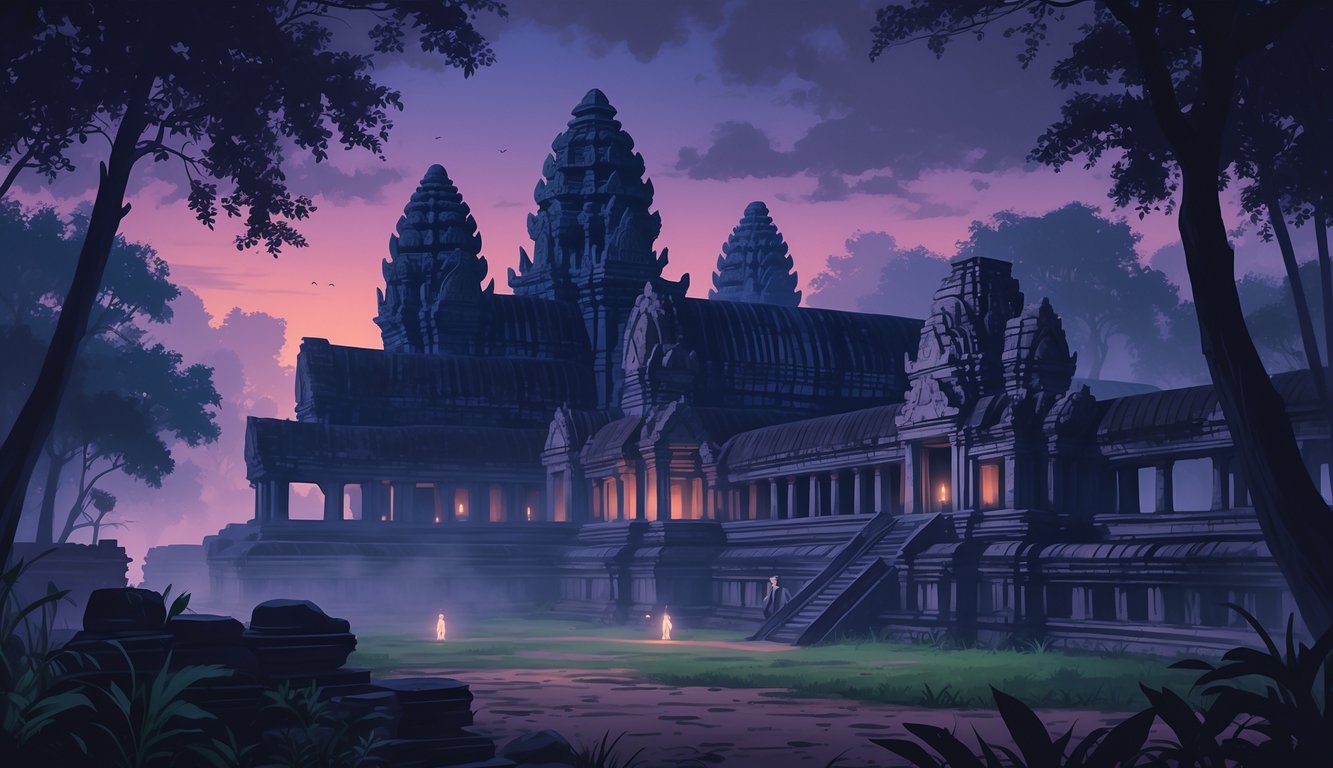
Visitors often describe a mix of quiet beauty and unsettling moments while exploring Angkor Wat at dawn or dusk. Some report sensory changes, and others notice visual effects that seem tied to the temple’s structure and surroundings.
Eerie Silence and Sensations
In certain parts of Angkor Wat, especially near less-visited galleries, the usual sounds of birds and insects fade. This sudden drop in ambient noise can make the air feel heavy and still.
Some travelers say they feel a light, cool breeze even when the weather is hot and still outside the stone corridors. Others mention a faint smell of incense, even though no offerings are visible nearby.
These sensations often happen in shadowed areas where sunlight struggles to reach. The thick stone walls and narrow passageways may trap cooler air, but the timing and location of these changes can feel unusual.
Guides sometimes point out that silence is strongest in sections linked to ancient ceremonies. This adds to the site’s reputation for strange energy.
Unusual Light and Shadow Play
The temple’s design creates precise alignments between doorways, columns, and the sun’s position. At certain times of day, sharp beams of light cut through dark halls.
Shadows from the carved bas-reliefs can look almost three-dimensional. In dim light, the figures of warriors or dancers may appear to shift as the sun’s angle changes.
During sunrise, the main towers form a distinct silhouette that some visitors find haunting. On cloudy days, the reduced light can make carvings seem darker and more pronounced, giving the impression of movement.
Some travelers exploring before full daylight have reported seeing brief flashes or glints, possibly from dew or polished stone catching the light. These moments, while explainable, often feel memorable and oddly timed.
Cultural Interpretations of Hauntings
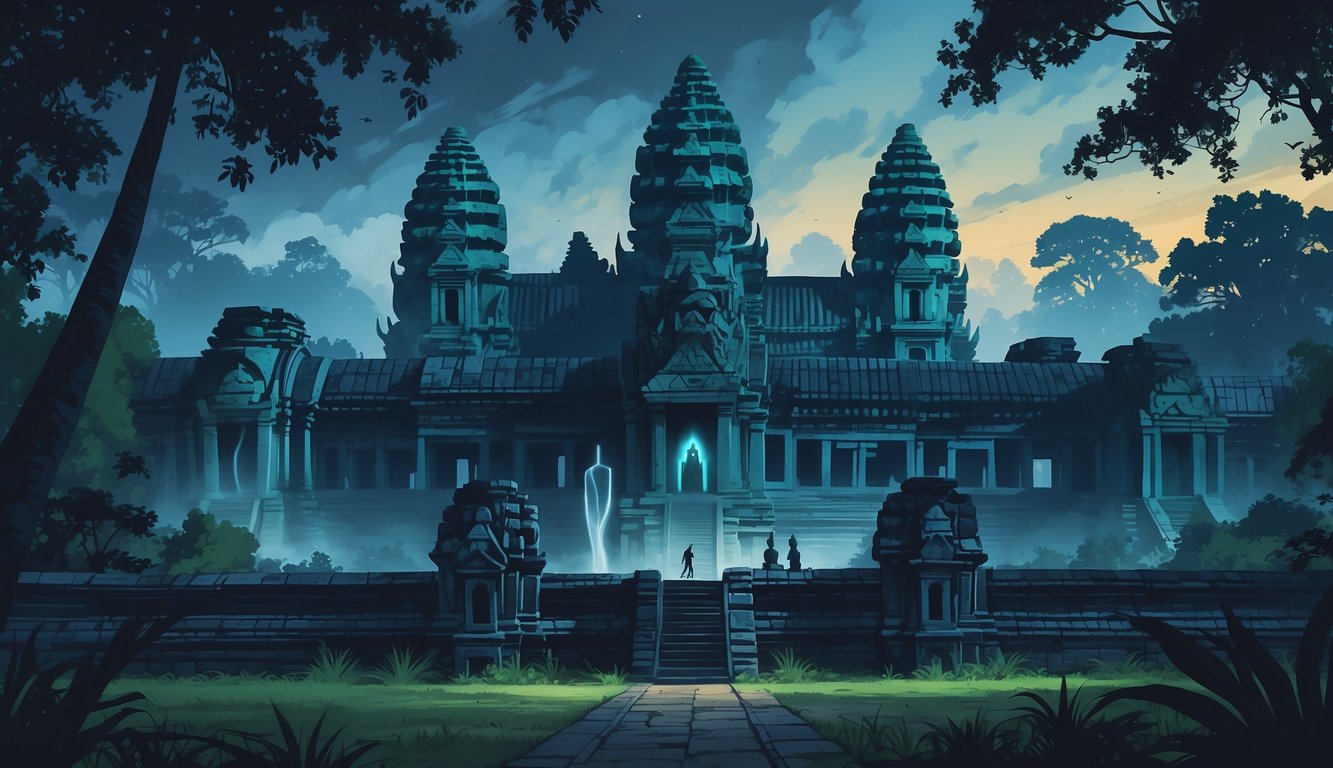
At Angkor Wat, beliefs about spirits connect to Cambodia’s history, religion, and daily life. Many people see the site as both an archaeological treasure and a place where the dead and living share space.
Traditional Rituals and Offerings
Local villagers often bring incense, flowers, and food to certain spots within the temple grounds. They offer these items to honor spirits believed to linger in the ancient stone corridors.
Some families perform Bong Thom ceremonies, where monks chant and bless the area to invite peace. This is especially common during Pchum Ben, a Cambodian festival for honoring ancestors.
People place offerings at shrines, near statues of deities, or at the base of large trees thought to hold spiritual energy. They believe these acts can prevent illness, misfortune, or unexplained disturbances.
Visitors may also see small bowls of rice or fruit near carvings. These offerings are part of a living tradition that treats the temple as a sacred home for both gods and ghosts.
Perspectives of Local Monks
Monks at Angkor Wat often explain hauntings through a Buddhist lens. They describe spirits as preta—restless beings trapped by past actions.
Monks encourage compassion rather than fear. They believe chanting and merit-making can help these spirits move on.
Some monks use ghost stories as moral lessons. They teach about impermanence and the results of one’s deeds.
Monks often stress that the temple’s energy comes from centuries of prayer and devotion, not just its age or history. This view blends spiritual belief with cultural respect for the site’s long past.
Impact on Tourism and Popular Culture
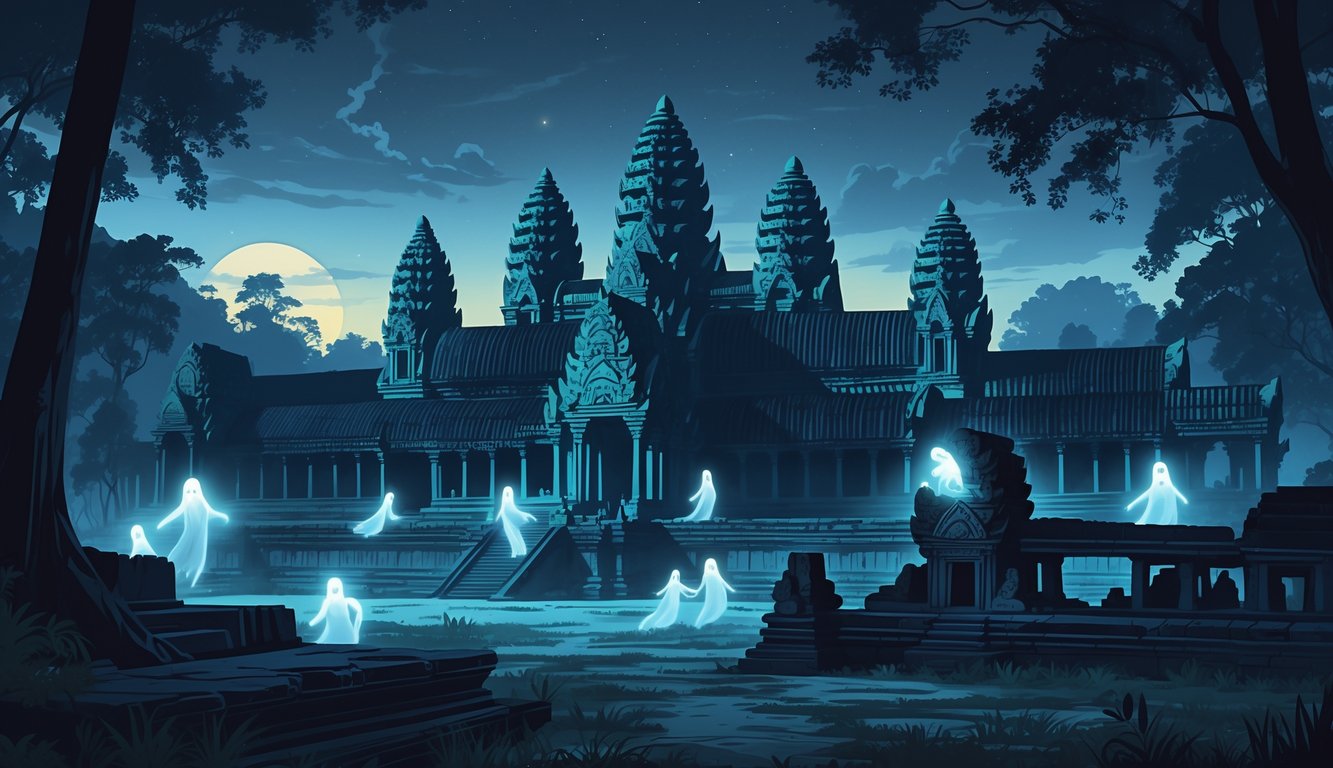
Stories of ghost sightings at Angkor Wat have drawn curious travelers and inspired creative works. These accounts shape how visitors plan their trips and how artists and writers portray the temple in modern culture.
Haunted Tours and Experiences
In Siem Reap, some local guides offer nighttime walking tours that focus on Angkor Wat’s ghost legends. These tours often combine history with reported paranormal events, like unexplained sounds or shadowy figures.
Visitors sometimes join these tours for the atmosphere, not just for ghost stories. The dimly lit temple grounds and historical storytelling create a unique experience.
Local businesses have adapted by selling themed souvenirs, such as illustrated ghost story booklets or handmade charms. Hotels may promote “haunted history” packages that include guided visits to lesser-known temple areas at dusk.
These experiences help the local economy by encouraging tourists to explore beyond the main daytime attractions. They also spread visitor traffic more evenly across different hours.
Depictions in Media and Literature
Writers and filmmakers use Angkor Wat’s ghost stories to add mystery to their works. Documentaries sometimes feature interviews with locals who claim to have seen spirits, blending oral history with visuals.
Novels set in Cambodia may include supernatural elements tied to the temple’s past. These stories often highlight the contrast between the grandeur of the ruins and the eerie quiet of certain areas.
Television travel shows sometimes feature “haunted Angkor” segments for audiences interested in paranormal tourism. Video games inspired by Southeast Asian history may include fictional versions of the temple with ghostly guardians or cursed relics.
These depictions keep Angkor Wat in global pop culture, attracting history enthusiasts and fans of supernatural themes.
Preserving the Mystique of Angkor Wat
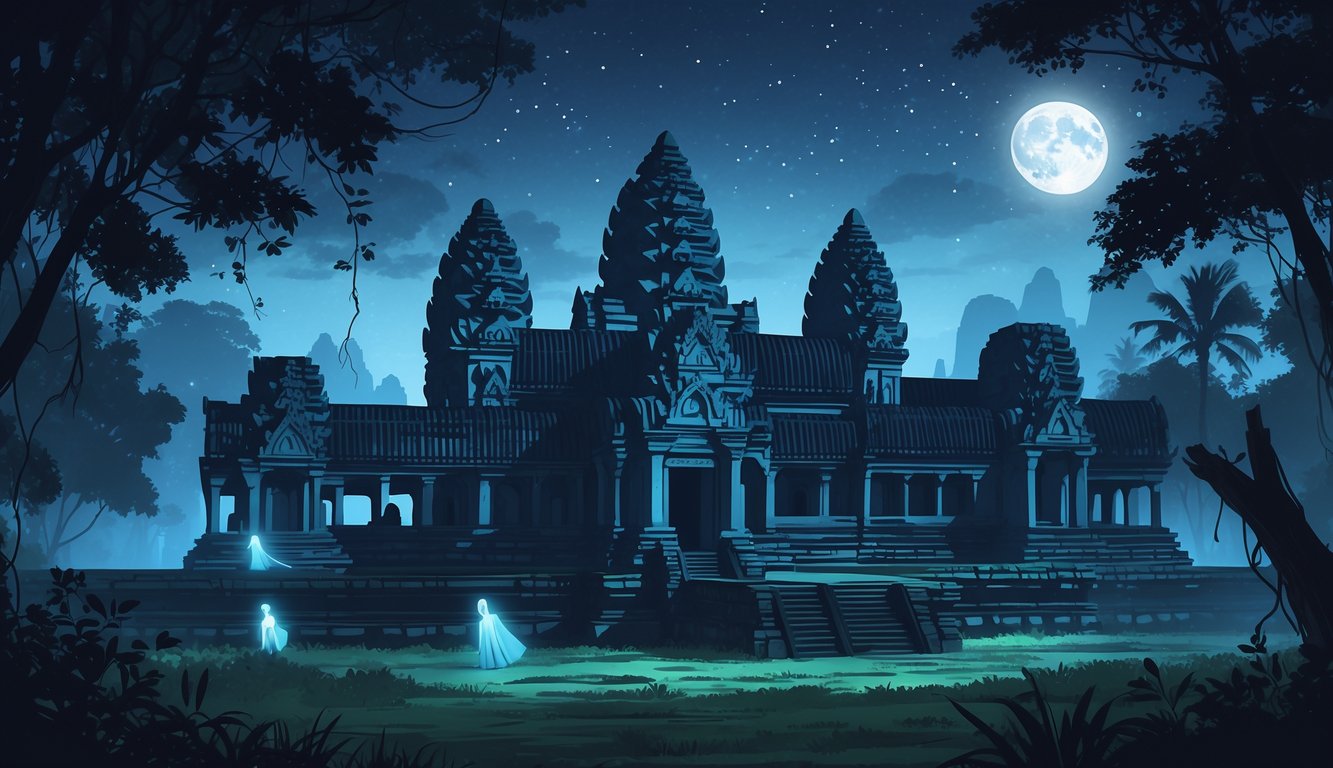
Angkor Wat is more than an ancient temple. It stands as a living heritage site.
Preserving Angkor Wat protects its history and the sense of mystery that attracts visitors worldwide. Teams from Cambodia, Japan, and Germany repair stone carvings and stabilize structures.
They also manage how visitors move through the site. These efforts help maintain the temple’s unique atmosphere and prevent further damage.
Preservation work often targets detailed stone reliefs that show battles, religious stories, and daily life. Weather, plant growth, and human touch threaten these carvings.
Key priorities include:
- Structural stability of towers and walls
- Protection of carvings from erosion
- Visitor management to reduce wear on pathways
| Preservation Area | Current Efforts | Main Challenges |
|---|---|---|
| Stone Restoration | Cleaning and repairing blocks | Weathering and moss growth |
| Carving Protection | Barriers and guided tours | Tourist contact and fading details |
| Site Management | Controlled entry points | Overcrowding during peak seasons |
From the 15th to 19th centuries, Theravada Buddhist monks cared for Angkor Wat. Their stewardship kept much of the site intact as other parts of Angkor fell into ruin.
Modern teams continue this tradition through archaeological and preservation projects. New technology like LiDAR scanning helps researchers map hidden structures in the forest.
These discoveries reveal more about the temple’s past and guide restoration plans.