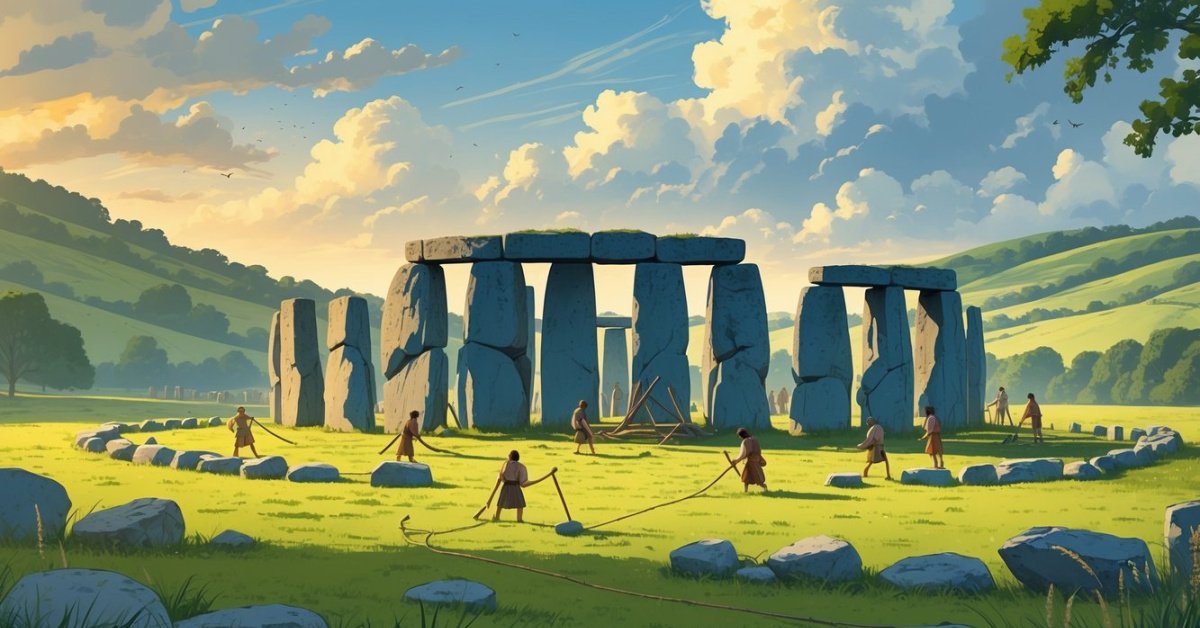
Stonehenge stands on the Salisbury Plain and has fascinated people for thousands of years. Its massive stones, arranged in a unique pattern, continue to spark debate.
Archaeologists agree that builders constructed Stonehenge in stages between 3000 and 2000 BC. Its exact purpose remains a mystery.
Researchers have traced the stones to distant regions of Britain, including southwest Wales. This makes its construction an impressive achievement for its time.
Some people believe Stonehenge served as a ceremonial site. Others think it functioned as an ancient calendar or burial place.
Stonehenge sits among other prehistoric monuments in southern England. Its design, materials, and alignment with the sun show careful planning and deep meaning for its builders.
Recent research into the origins of the bluestones continues to reveal new details about Stonehenge. Each discovery helps us understand more about ancient communities in Great Britain.
The Enigma of Stonehenge’s Origins
Stonehenge sits on Salisbury Plain in England. Its builders arranged massive stones in a circular layout.
Archaeologists have studied Stonehenge for centuries. They continue to uncover clues about its builders, purpose, and construction process.
First Theories and Early Legends
Early written accounts connected Stonehenge to myths instead of archaeology. Medieval writers claimed the wizard Merlin magically brought the stones from Ireland.
Others believed giants carried the stones across the sea. In the 17th and 18th centuries, antiquarians suggested Stonehenge was a Roman temple or a Danish monument.
These ideas reflected the limited knowledge of prehistoric Britain at the time. By the 19th century, scholars began linking Stonehenge to the Neolithic people who lived in the region thousands of years ago.
This shift came from studying burial mounds, tools, and pottery found nearby. Today, most historians agree that the earliest theories were based on legend, not evidence.
These stories still form part of Stonehenge’s cultural history. They show how people once tried to explain its origins.
Ancient Civilizations and Builders
Farming communities in the late Neolithic period built Stonehenge. These people lived in organized villages and had advanced stone-working skills.
They likely belonged to the same cultural groups that created other megalithic sites in Europe. Some researchers connect them to the Beaker culture, which influenced Britain during the Bronze Age.
The builders transported smaller bluestones from Wales. They brought larger sarsen stones from a local area about 15 miles away.
Recent studies suggest the Altar Stone may have come from Scotland, not Wales. This finding challenges earlier beliefs (read more).
Their work required cooperation, planning, and engineering knowledge. This shows the society could organize large projects without written records or metal tools.
Timeline of Construction
Archaeological evidence shows that Stonehenge took shape over more than 1,000 years.
- c. 3000 BCE – Builders created a circular earthwork and ditch.
- c. 2500 BCE – They erected large sarsen stones in the outer ring and inner horseshoe.
- c. 2000–1500 BCE – Smaller stones were rearranged, and burial activity increased.
Radiocarbon dating confirms construction began in the late Neolithic period and continued into the early Bronze Age. The site’s purpose likely changed over time, serving as a ceremonial center, burial ground, and meeting place.
Location and Setting in Great Britain
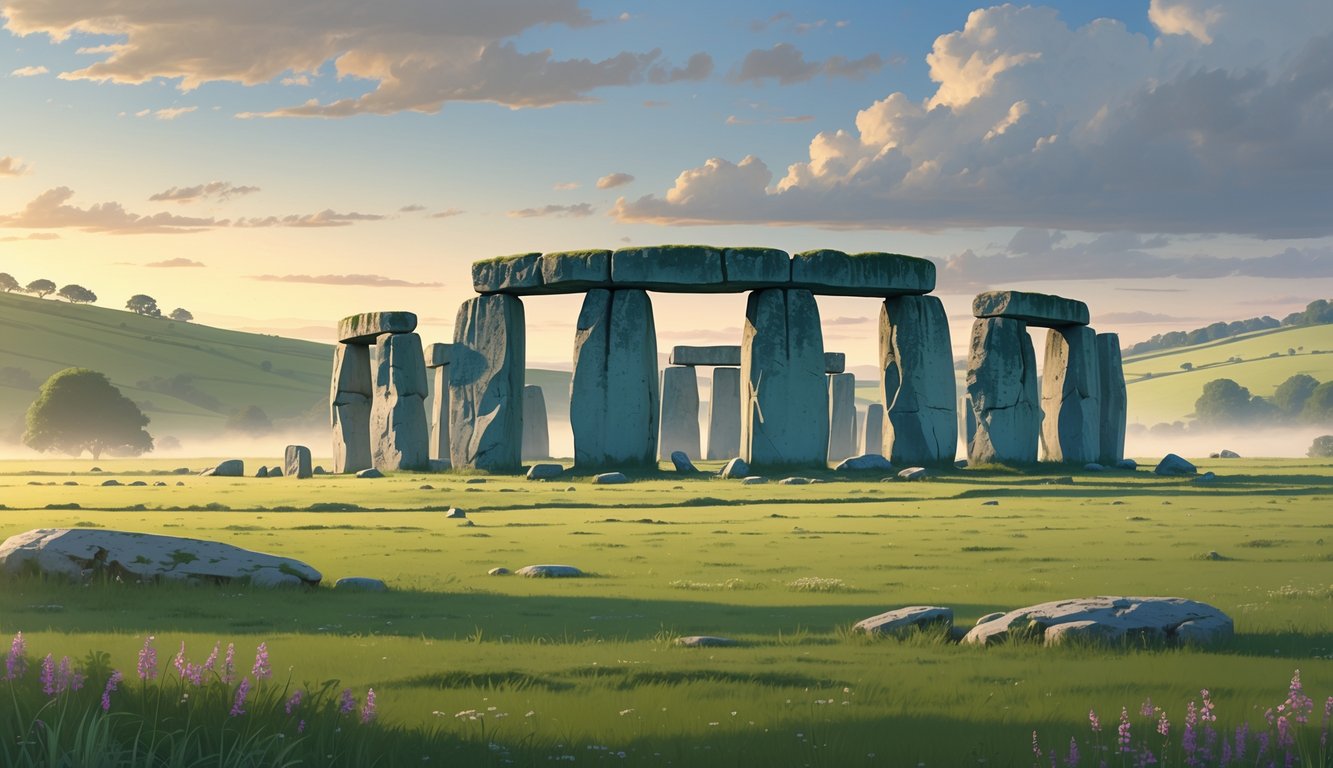
Stonehenge stands in southern England on open chalk grassland. This land has supported human activity for thousands of years.
Its location offers wide views across the plain. Stonehenge has always been a prominent landmark.
Wiltshire and Its Landscape
Stonehenge is in Wiltshire, about 8 miles (13 km) north of Salisbury. The monument sits on the Salisbury Plain, an area known for its open skies and little tree cover.
This landscape provided a stable, dry foundation for building. The chalk soil made it easier to dig deep holes for the stones.
People have used the surrounding grassland for farming and grazing for a long time. In prehistoric times, small communities likely relied on the land for food and resources.
Stonehenge’s central position in southern England may have made it a convenient meeting place. Today, the area is still mostly rural.
The monument is protected as a UNESCO World Heritage Site. Visitors can see the same wide, open views that ancient builders saw.
Surrounding Archaeological Sites
The land around Stonehenge contains many other prehistoric features. These include burial mounds (barrows), earthworks, and ancient settlements.
Many of these sites date from the Neolithic and Bronze Age. This shows the area was an important center for thousands of years.
Some barrows appear as grassy mounds, while others are only found through archaeological surveys. Many likely held the remains of important people, giving the site ceremonial and social significance.
Nearby monuments, such as Woodhenge and the Avenue that links Stonehenge to the River Avon, point to a larger ceremonial landscape. English Heritage says these features formed a network of ritual spaces.
Archaeologists use modern techniques to study this area. They continue to uncover new details about how ancient people used these sites together.
The Stone Circle: Structure and Layout
Stonehenge’s design combines earthwork engineering with precise stone placement. Builders shaped the ground to form a circular enclosure and set massive stones in patterns that align with the sun.
Henge and Ditch Features
The monument includes a henge—an earthwork with a circular bank and an inner ditch. This ditch is about 100 meters in diameter.
Archaeologists think builders used simple antler picks and wooden tools to dig the ditch. Inside the bank and ditch, they created Aubrey Holes—a ring of pits that may have held wooden posts or stones.
These features show the site went through several construction phases. The bank rises gently from the plain, and the ditch is about 2 meters deep in some places.
Builders aligned the entrance to face the midsummer sunrise. This suggests they planned the henge for both practical and ceremonial reasons.
Arrangement of Standing Stones
The stone circle has two main types of stones: large sarsen stones and smaller bluestones. The sarsens, weighing up to 50 tons, form an outer ring topped with horizontal lintels.
Inside this ring, builders placed a horseshoe-shaped group of sarsens. Within that, they set the bluestones, which came from the Preseli Hills in Wales—over 150 miles away.
Many stones remain in place, though some have fallen. The arrangement creates sightlines toward the midsummer sunrise and midwinter sunset.
Today’s visitors can still see this alignment from the monument’s central axis. You can view detailed Stonehenge maps and layouts for more information.
Types of Stones Used in Stonehenge
Builders used two main kinds of stones at Stonehenge. Each type has a different origin, size, and role in the monument’s design.
The larger stones form the main structure. The smaller stones add variety and came from far away.
Sarsen Stones: Origin and Characteristics
The sarsen stones are the largest at Stonehenge. Most stand over 4 meters tall and weigh about 25 tons.
They form the outer circle and the inner horseshoe. Geochemical studies show that 50 of the 52 remaining sarsens came from West Woods in Wiltshire, about 16 miles from the site.
This discovery ended decades of uncertainty about their origin. Read more about this finding here.
Sarsen is a very hard sandstone. Its strength made it suitable for the massive lintels and uprights.
Builders shaped these stones with mortise-and-tenon joints, which locked them together. Moving them required large teams, wooden sledges, and possibly greased tracks or rollers.
Key facts:
| Feature | Detail |
|---|---|
| Height | ~4–7 meters |
| Weight | Up to 30 tons |
| Material | Silcrete sandstone |
| Origin | West Woods, Wiltshire |
Bluestones: Journey from Preseli Hills
The bluestones are smaller, averaging 2 meters in height and weighing up to 4 tons. They sit inside the sarsen circle in an oval or arc.
Geologists traced their origin to the Preseli Hills in southwest Wales, about 150 miles from Stonehenge. This means they traveled much farther than the sarsens. Learn more about their source here.
Bluestones include several rock types, such as dolerite, rhyolite, and volcanic ash. Their varied colors and textures set them apart from the sarsen stones.
Researchers debate how people transported the bluestones. Some think humans used sledges and boats along the coast and rivers. Others believe glaciers may have carried them closer during the Ice Age.
Notable details:
- Origin: Preseli Hills, Pembrokeshire
- Material: Dolerite and other igneous rocks
- Distance moved: ~150 miles
Construction Techniques and Transportation
Neolithic people used simple but effective building methods to create Stonehenge. They shaped, moved, and set massive stones with basic tools, careful planning, and teamwork.
Engineering Feats of the Neolithic People
Builders worked with two main types of stones: sarsens and bluestones. Sarsens, weighing up to 25 tons, came from the Marlborough Downs about 20 miles away.
Bluestones, each weighing 2–4 tons, came from the Preseli Hills of Wales, over 140 miles away. Builders used a post-and-lintel system, placing horizontal stones on top of upright ones.
They cut holes to create mortise-and-tenon joints, which locked the stones together. This design gave the monument stability even without metal tools.
Archaeologists think builders used wooden sledges, ropes made from plant fibers, and wooden rollers to move stones short distances. For lifting, they may have built earthen ramps and used levers to raise stones.
The circular layout’s precision suggests builders measured distances with ropes or wooden rods. Alignments with the solstices show they understood the sun’s movement well.
Theories on Moving the Stones
Moving the bluestones from Wales remains one of the biggest puzzles. Some researchers think people transported them by land, dragging them on sledges over logs.
Others believe people used waterways, floating the stones on rafts along rivers and the coast.
For the sarsens, evidence shows that people dragged them across the chalk landscape. Teams of 20–40 people can move a multi-ton stone using sledges on greased tracks, as experiments demonstrate.
Researchers using LIDAR and isotope analysis have traced the origins of many stones and found possible ancient paths leading to the site. Archaeological studies help explain how Neolithic people completed such a large-scale transport project without using wheels.
Some early theories suggested supernatural help, but modern research shows that human ingenuity and teamwork made the construction possible.
Key Figures and Early Research
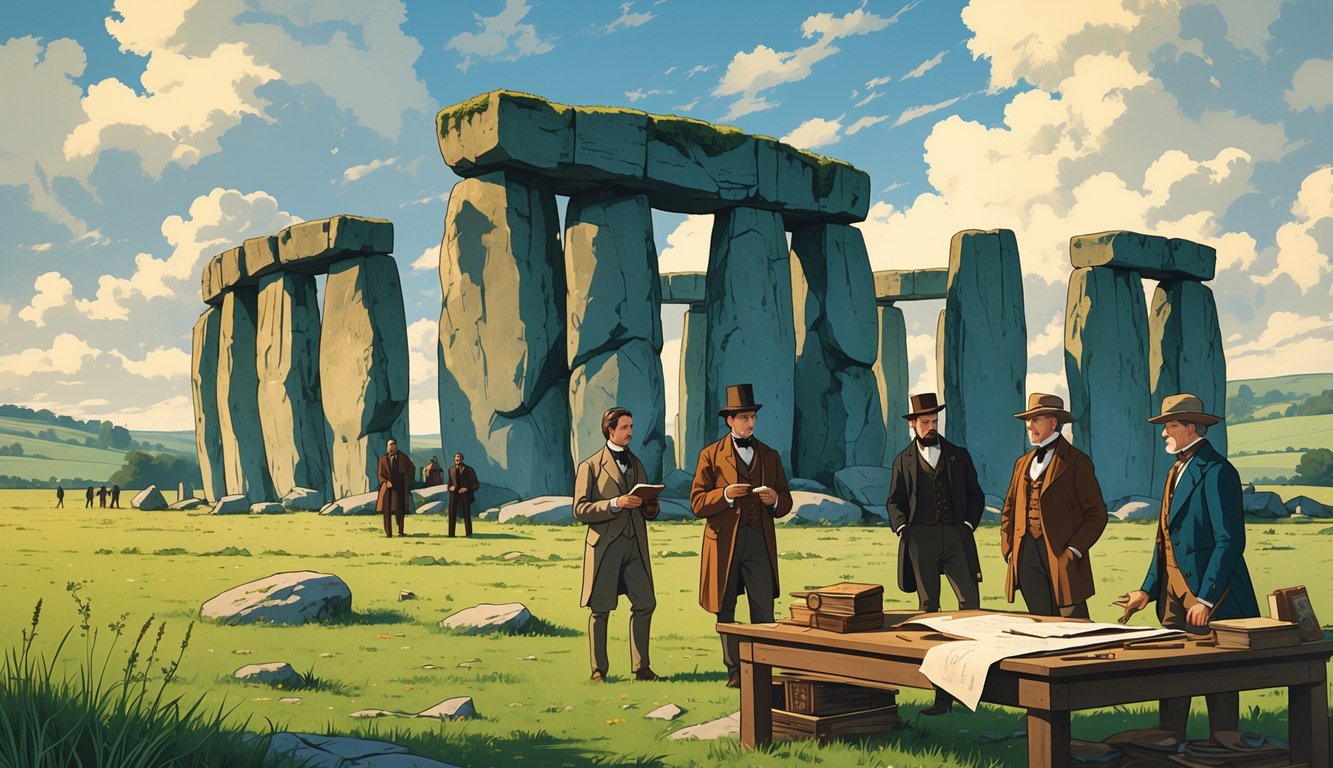
Researchers began studying Stonehenge by observing the site and recording its layout. Early investigators drew and described visible features.
Later, archaeologists used evidence from the ground to learn how people built and changed the monument over time.
John Aubrey’s Discoveries
In the 17th century, John Aubrey became one of the first people to record Stonehenge in detail. He visited in 1666 and sketched the positions of the stones.
His drawings are among the earliest known surveys of the monument. Aubrey also found a ring of shallow pits now called the Aubrey Holes.
Modern excavations show that people dug these pits during the earliest phase of Stonehenge, possibly to hold wooden posts or stones. Aubrey’s notes linked Stonehenge to other ancient monuments, hinting at a wider prehistoric landscape.
His careful mapping provided a foundation for later archaeologists. Aubrey’s work remains important because he recorded features that have since eroded or changed.
Without his records, some early details of the site might have been lost.
Antiquarian Studies and Modern Archaeology
In the 18th and 19th centuries, antiquarians expanded on Aubrey’s work. William Stukeley and others made more accurate surveys and proposed ideas about the builders’ culture and purpose.
Antiquarians mostly observed and compared sites without digging. This preserved Stonehenge but left many questions.
By the 20th century, archaeologists began excavating, using carbon dating, and analyzing soil. Researchers from places like University College London found clues about the stones’ origins, including sources in southwest Wales.
These advances revealed different construction stages and ceremonial uses over thousands of years. Early sketches and modern science together have created a clearer picture of Stonehenge’s history.
Purpose and Uses Through History
Stonehenge played several roles for the people who built and visited it. Evidence shows people used it to observe the sky and hold important ceremonies, including those for the dead.
Astronomical Alignments and Solstices
Researchers have found that some stones line up with the sunrise during the summer solstice and the sunset during the winter solstice. These alignments show the builders tracked seasonal changes.
The Heel Stone is a clear example. On the summer solstice, the sun rises directly above it when viewed from the center of the circle.
This helped mark the longest day of the year. Such alignments may have guided farming schedules.
Knowing when the days would grow longer or shorter helped communities plan planting and harvesting. Modern visitors still gather at Stonehenge each June to watch the sunrise on the summer solstice.
You can read more about its alignment with solstices and seasonal cycles.
Burial Mounds and Rituals
Archaeologists have found burial mounds and cremated human remains near Stonehenge. Some burials date back to the earliest phases of the monument.
These finds show people respected the dead at the site. The presence of grave goods, such as pottery or tools, suggests people believed in an afterlife.
The area around Stonehenge contains dozens of round barrows. Many are visible today as grassy mounds.
They form part of a wider ceremonial landscape. Some researchers think the monument’s role changed over time.
It may have started as a cemetery and later became a place for large gatherings and rituals. This view is supported by archaeological studies of the surrounding earthworks and burial sites.
Stonehenge in Ancient Beliefs and Folklore
People have connected Stonehenge to ancient rituals, seasonal events, and spiritual traditions. Its design and location show it held cultural meaning for those who built and visited it.
Archaeological evidence and historical writings reveal how myths and beliefs shaped its reputation over time.
Druids and Mythological Associations
Many people connect Stonehenge with the Druids, the priestly class of the Iron Age Celts. Archaeologists have shown that Stonehenge was built more than a thousand years before the Druids lived in Britain.
This means the Druids did not build it, though they may have used it for ceremonies later. Legends also tie Stonehenge to magical origins.
One medieval story claims the wizard Merlin brought the stones from Ireland using supernatural power. Other myths link it to ancient giants or gods, showing how later generations imagined its creation.
Some researchers suggest ancient Britons may have viewed the site as a sacred meeting place. The alignment of the stones with the solstices could have reinforced its role in seasonal festivals and stories.
These beliefs helped cement its place in British folklore.
Healing Theories and Pilgrimage
Another idea is that Stonehenge was a center for healing. This theory comes from the discovery of human remains with signs of illness or injury.
People may have traveled long distances to seek cures or spiritual comfort at the site. The smaller bluestones, brought from Wales, were believed by some to have special properties.
Their journey across great distances suggests people valued them for more than building material. Researchers have compared Stonehenge to pilgrimage sites in other ancient civilizations.
People may have gathered for both ritual and healing purposes. This combination could explain why Stonehenge attracted visitors for centuries.
For more on myths and historical interpretations, see Debunking the myths about Stonehenge and the Stonehenge & Celtic mythology connection.
Recent Discoveries and Ongoing Mysteries
Researchers have traced some of Stonehenge’s stones to locations hundreds of miles away. New tests on key stones have revealed surprising origins that raise fresh questions about the people who built the monument.
New Archaeological Evidence
A recent study found that the large Altar Stone at the center of Stonehenge likely came from northern Scotland, not Wales as previously thought. This means people may have transported it over 500 miles, which would have required significant planning and effort.
Mineralogical testing matched the stone’s unique composition to rocks in Scotland’s northeast. These results differ from earlier findings that linked most of the smaller bluestones to the Preseli Hills in Wales.
Researchers at Curtin University led this study. They suggest the builders may have gathered stones from distant regions for symbolic reasons.
Some experts think Stonehenge could have served as a unifying monument for communities across Britain. You can read more about the Scottish origin theory in this report.
Unanswered Questions
Even with these discoveries, many details remain unclear. Archaeologists still do not know the exact route used to move the Altar Stone from Scotland to Wiltshire.
Moving a multi-ton stone without modern tools would have been a major challenge. It is also uncertain why the builders chose stones from such distant places when local materials were available.
This raises questions about trade, cultural exchange, and shared beliefs during the Neolithic period. Researchers continue to study whether Stonehenge’s layout and the variety of stone origins symbolized unity among different regions.
The findings have deepened the mystery, as seen in this archaeological update.
Stonehenge’s Legacy in Modern Britain
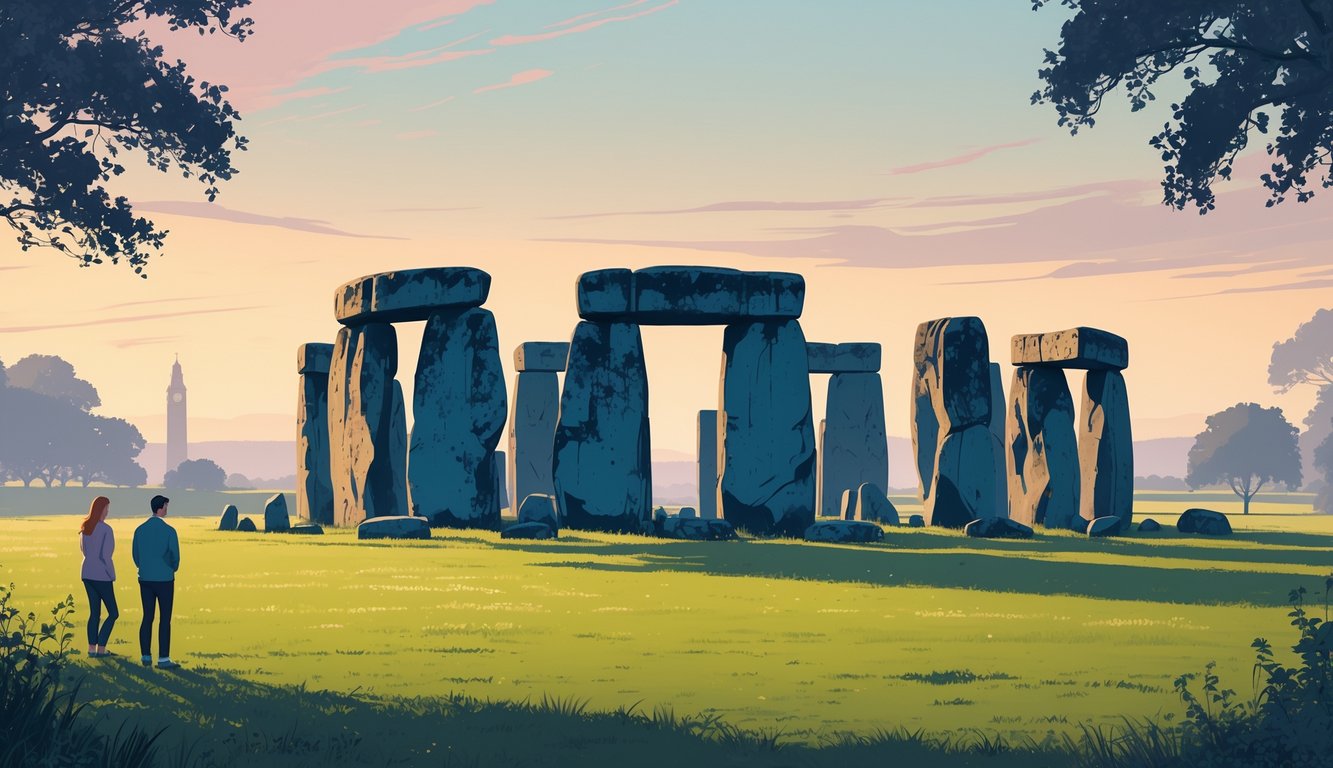
Stonehenge continues to shape life in England as a major heritage site and a focus for cultural gatherings. People work to preserve its ancient stones and the surrounding landscape for future generations.
Cultural Impact and Tourism
Stonehenge attracts over a million visitors each year, making it one of England’s most visited landmarks. Tourists come to see the massive stone circle and learn about its prehistoric origins.
Events such as the summer and winter solstices draw crowds, including modern druids and visitors who want to witness the sunrise or sunset alignments. These gatherings have become part of the site’s living tradition.
Local communities benefit from tourism through hotels, restaurants, and guided tours. The visitor centre offers exhibitions, reconstructed Neolithic houses, and interactive displays to help people understand the monument’s history.
Stonehenge is also a UNESCO World Heritage Site, paired with nearby Avebury. This status raises its profile around the world and supports educational and cultural exchange.
Preservation Efforts
English Heritage manages Stonehenge. They ensure that its stones, earthworks, and surrounding land stay protected.
Staff set strict access rules. These rules limit how close visitors can get to the stones on most days to reduce wear and erosion.
Archaeologists regularly monitor the site. They use tools like 3D scanning to check for changes in the stones’ condition.
Conservation teams manage vegetation. They also prevent damage from weather and tourism.
Preservation efforts cover more than just the stone circle. Teams protect the wider landscape, including ancient burial mounds, to keep the historical context.
Universities and research groups work with English Heritage. They help uncover new information and guide preservation strategies.
Public education campaigns encourage respectful visits. This helps keep Stonehenge safe for future study and enjoyment.