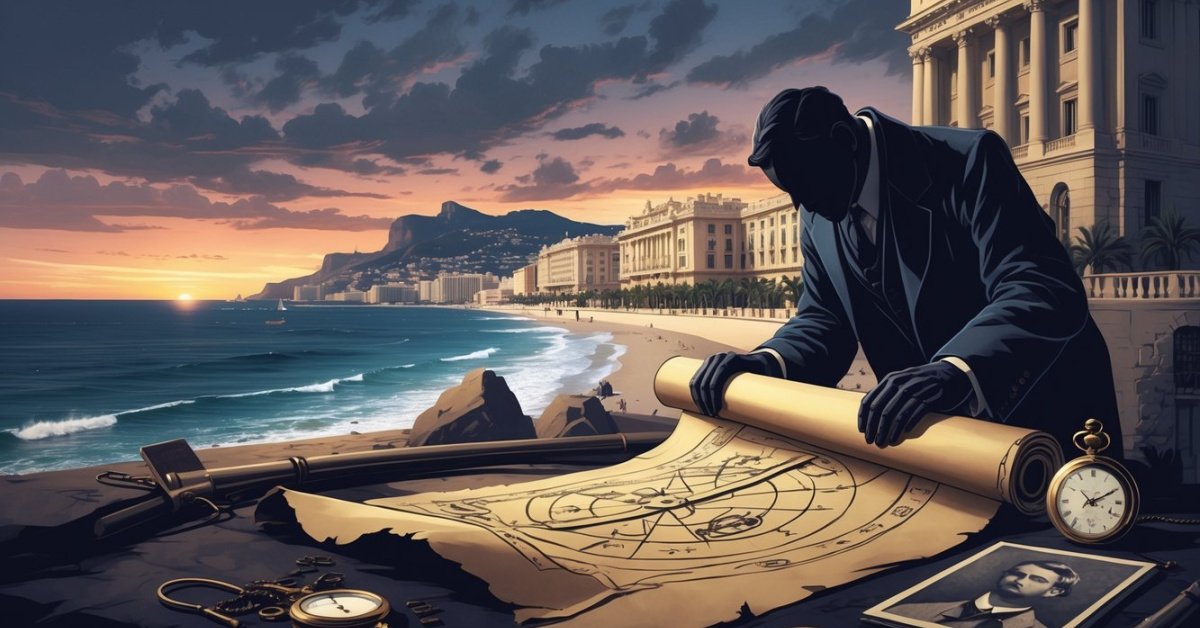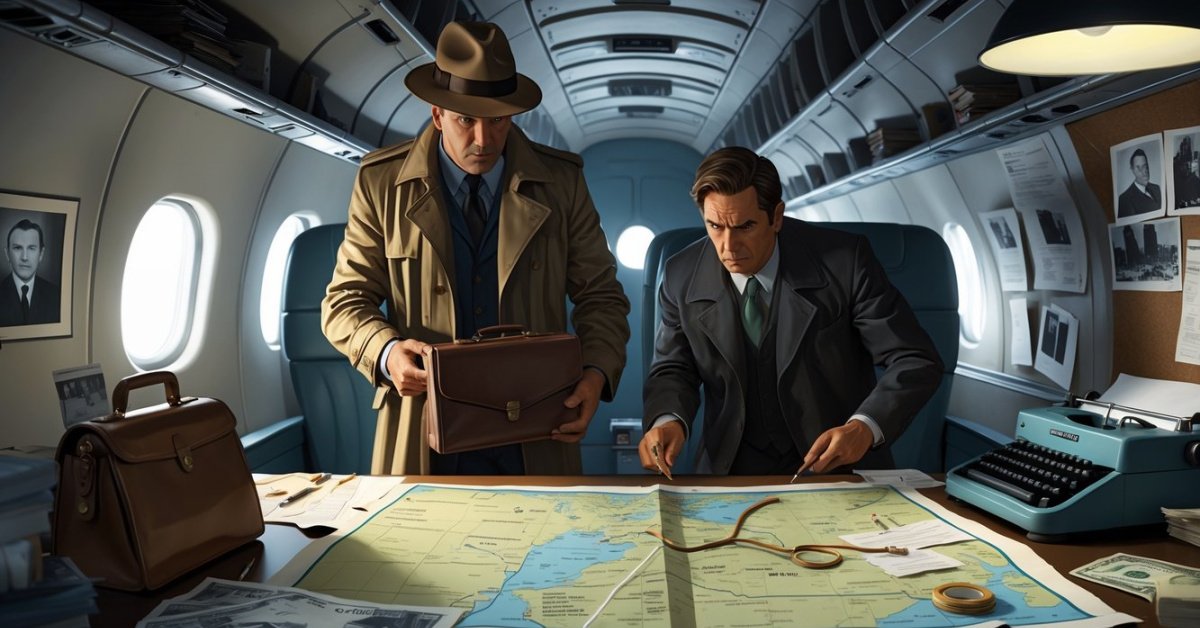
On November 24, 1971, a man using the name D.B. Cooper hijacked a Boeing 727. He collected $200,000 in ransom and parachuted into the night over the Pacific Northwest.
No one has confirmed his identity or found him. This case remains the only unsolved plane hijacking in U.S. history.
The mystery has fueled decades of investigation and debate.
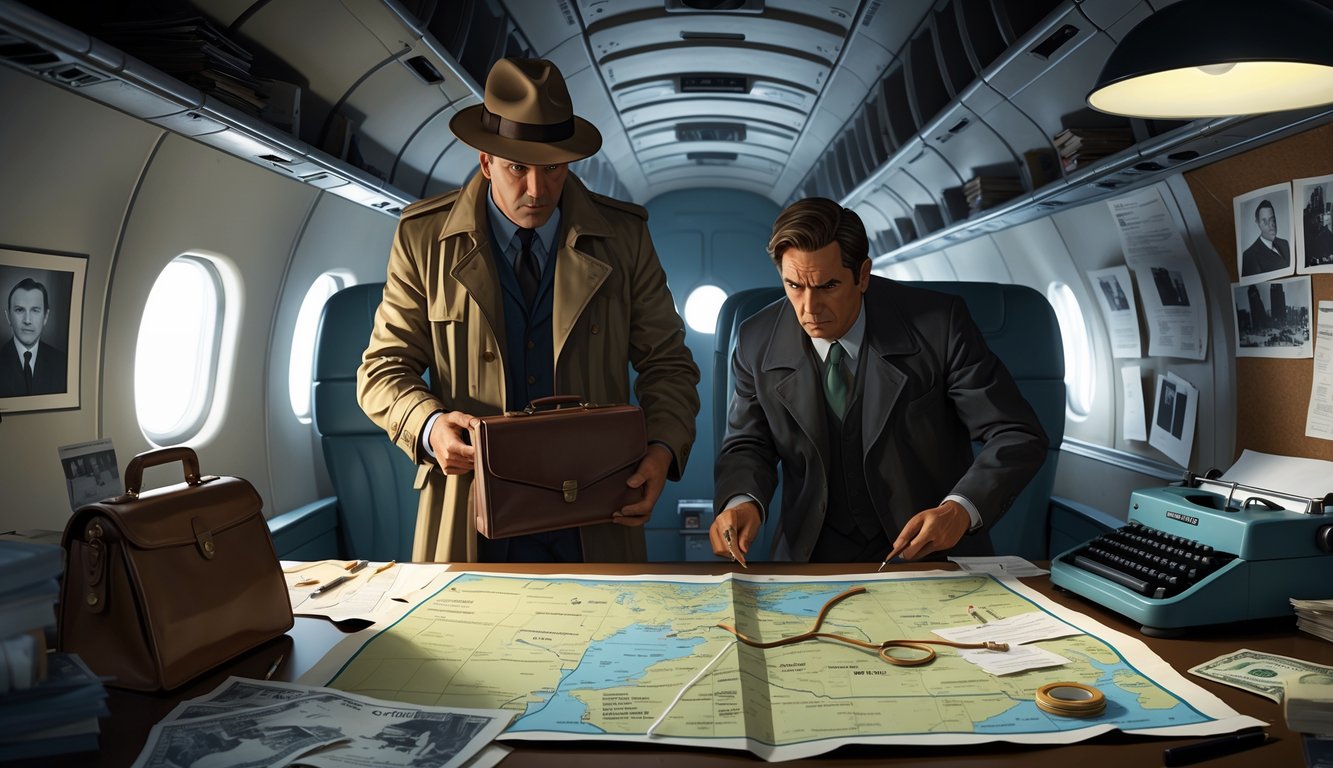
The FBI compiled extensive case files as new clues emerged, including potential DNA on Cooper’s tie. Each lead has sparked fresh hope of solving the case.
Shows like Expedition Unknown retraced his escape route and explored new evidence that could reveal his identity.
The story blends true crime, aviation history, and a daring getaway. Experts and amateur sleuths still puzzle over the case.
Details like a parachute found in an outbuilding and theories linking him to ex-military pilots keep the chase alive.
The Infamous Plane Hijacking
On November 24, 1971, Dan Cooper boarded a Northwest Orient Airlines Boeing 727. He carried out what became the only unsolved plane hijacking in U.S. history.
He calmly took control, secured a ransom, and vanished without leaving evidence of his fate.
Timeline of the Hijacking
The hijacking began in the afternoon when Cooper boarded Flight 305 in Portland, Oregon. He wore a dark suit, black tie, and sunglasses.
Shortly after takeoff, he handed a note to a flight attendant claiming he had a bomb. He then showed a briefcase with wires and red sticks.
The plane landed in Seattle about two hours later. The FBI brought $200,000 in cash and four parachutes to meet his demands.
After receiving the ransom, Cooper ordered the crew to fly toward Mexico City at low altitude and slow speed. Somewhere over southwest Washington, he lowered the rear stairs and parachuted into the night.
No one found a confirmed trace of him. The case remains an enduring aviation mystery.
Key Events on Flight 305
Cooper stayed polite and calm throughout the flight. Witnesses said he never raised his voice or harmed anyone.
He told the crew to keep the cabin lights low and close the window shades. This reduced visibility from outside the plane.
The Boeing 727’s rear airstair was key to his escape. This feature allowed him to exit the plane mid-flight without being seen.
After takeoff from Seattle, he gave specific instructions about speed, altitude, and landing gear. He wanted the plane to fly at 10,000 feet with the landing gear down.
He sent the crew forward to the cockpit before jumping. When they landed hours later, Cooper and the money were gone.
The Ransom Demand
Cooper demanded $200,000 in $20 bills and four parachutes—two main and two reserve. He wanted civilian parachutes, not military ones.
The FBI delivered the money in a canvas bag. Agents recorded each bill’s serial number for tracking.
Cooper’s request for four parachutes was unusual. Investigators think he did this to make authorities believe he might take a hostage, so they would not sabotage the gear.
The crew handed over the ransom while the plane sat on the tarmac in Seattle. After securing it, Cooper released the 36 passengers in exchange for the cash and parachutes, keeping only the crew.
Most of the money has never been recovered. Some bills surfaced years later along the Columbia River, deepening the D.B. Cooper mystery.
Who Was D.B. Cooper?
In November 1971, a man using the name D.B. Cooper hijacked a Northwest Orient Airlines flight, collected a ransom, and parachuted into the night. His real identity remains a mystery.
The Alias and Identity
The name “D.B. Cooper” was not the hijacker’s real name. He bought his ticket as Dan Cooper, which matched the name of a Belgian comic book character.
A press error changed “Dan” to “D.B.,” and the incorrect version stuck in public memory.
The FBI investigated over 1,000 suspects, including veterans, pilots, and criminals. None matched Cooper. Even fingerprints from the plane did not lead to a match.
Some researchers think the hijacker had aviation or parachuting experience. Others argue he may have been a skilled amateur who took a risk.
Physical Description and Behavior
Witnesses described Cooper as a white male, likely in his mid-40s, around 5 feet 10 inches tall, with an average build. He had short, dark hair and no facial hair.
He wore a dark suit, white shirt, and black tie—an outfit that blended in with business travelers. He also wore sunglasses during most of the flight.
Cooper stayed calm and polite throughout the hijacking. Flight attendants reported that he spoke in a low, even voice and never raised it.
He smoked cigarettes and drank bourbon while giving instructions to the crew. His calm behavior suggested confidence, but it is unclear if that came from training or personality.
Origins of the Name
The “D.B. Cooper” name became famous because of a mistake. Early news reports confused the suspect’s alias with another man named D.B. Cooper who was not involved.
The real ticket name—Dan Cooper—may have come from a French-language Canadian comic series about a Royal Canadian Air Force pilot. This link led some investigators to explore whether the hijacker had connections to Canada or French-speaking regions.
The name choice hinted at planning, but it has never provided a definitive lead in solving the D.B. Cooper mystery.
The Parachute Escape
D.B. Cooper left the Boeing 727 mid-flight using parachute gear from the plane’s emergency supplies. Weather, altitude, and the type of parachute affected the escape.
Cooper’s Parachute Choices
Cooper demanded four parachutes from authorities before the plane took off again from Seattle. Two were main parachutes, and two were reserve chutes.
He picked one main parachute for the jump and took a reserve chute with him. Reports later showed the reserve was a non-functional training model, possibly chosen by mistake or to mislead investigators.
The main parachute was a civilian sport model, not military issue. It was less durable in harsh conditions but easier to control.
Investigators believe the chute may match a recently recovered modified parachute found on property linked to a former suspect.
He left behind one functional main chute and the second reserve. The choice raised questions about his parachuting experience and whether he planned for a safe landing or a quick getaway.
Jump Execution and Conditions
Cooper jumped from the Boeing 727’s rear airstair at night over rural Washington. The aircraft flew at about 10,000 feet and roughly 170 knots to meet his demands.
It was raining, and temperatures at altitude were near freezing. Winds were strong, and visibility was poor.
The 727’s rear stair design allowed a parachute jump without being torn away by the jet’s wake. Few hijackers had used this method before.
Search teams later focused on wooded areas and riverbanks along the flight path. The exact landing site remains unknown, and no confirmed parachute was recovered until decades later when new evidence reignited the case.
FBI Investigation and Case Files
The FBI spent decades trying to identify the man known as D.B. Cooper. Agents reviewed thousands of tips, tracked leads across the U.S., and examined evidence, but the suspect’s identity stayed unknown.
Initial Response and Search
The hijacking took place on November 24, 1971. After Cooper parachuted from the Boeing 727, the FBI launched one of the largest manhunts in U.S. history.
Agents worked with local police, state troopers, and military aircraft. Search teams combed rural Washington and Oregon, focusing on areas near the Columbia River.
The search faced many challenges. Bad weather, rough terrain, and uncertainty about Cooper’s jump location limited results.
No one found a confirmed trace of Cooper or most of the ransom money. In 1980, $5,800 in decaying bills surfaced near the river.
Investigators collected the hijacker’s black tie and clip from the plane. These items became key pieces of evidence for forensic analysis, including chemical testing years later.
Suspects and Interviews
Over the years, the FBI investigated more than 1,000 potential suspects. Leads came from public tips, criminal records, and even deathbed confessions.
The newly released FBI case files detail interviews with unusual suspects, including a man in a wheelchair and people involved in ransom hoaxes.
Agents compared suspects’ physical descriptions, handwriting samples, and fingerprints to witness accounts from the flight crew. Some suspects were ruled out due to alibis or mismatched evidence.
Richard Floyd McCoy committed a similar hijacking in 1972 but was later excluded. Others, like Robert Rackstraw, drew media attention but never led to charges.
Case Closure and Reopening
By July 2016, the FBI closed its active investigation to focus on current cases. The bureau kept its evidence, including the tie, for possible future testing.
In 2025, the release of 472 new pages of FBI files revealed more about suspects, false leads, and forensic work.
These documents renewed discussion about whether new technology could solve the case. Some researchers think chemical residue on the tie or new witness analysis might still uncover the hijacker’s identity.
Key Evidence and Clues
Investigators gathered information from cash found years later, items left on the aircraft, and newly uncovered materials that may connect to the suspect. Each discovery has helped narrow possible identities and timelines, while also raising new questions about what happened after the hijacking.
Recovered Ransom Money
In 1980, a young boy found a rotting package of $20 bills along the Columbia River in Washington. The serial numbers matched part of the $200,000 ransom given to D.B. Cooper in 1971.
Sand buried the money, which suggests it had stayed there for years. The location was about 20 miles from Cooper’s jump area, but no one knows how it got there.
FBI experts noticed water damage and decay on the bills. This discovery proved some of the ransom was not spent, but Cooper’s fate remains a mystery.
Physical Evidence from the Plane
After the hijacking, FBI agents collected several items from the Boeing 727 cabin. Cooper left a black clip-on tie on his seat.
Forensic experts later searched the tie for DNA and microscopic particles. Some particles matched materials from certain manufacturing sites, which helped point to industries Cooper may have worked in.
Agents also collected cigarette butts and fingerprints, but these did not lead to a confirmed match. Investigators examined the parachutes Cooper took, but they never recovered them after the jump.
Recent Discoveries
In recent years, independent researchers have found new items that might link to the case. One example is a parachute and harness found in North Carolina, which some believe could be connected to Cooper’s escape.
Another lead came from titanium particles on Cooper’s tie, traced to a steel plant in Pennsylvania. This detail suggests he may have worked in or visited industrial environments.
Investigators have also checked weather data, flight path records, and possible landing zones. These efforts aim to match new clues with known facts from 1971.
Theories and Suspects
Over the years, investigators and amateur sleuths have reviewed flight records, ransom details, and recovered evidence to explain what happened to D.B. Cooper. Some ideas focus on whether he survived the jump, while others try to identify him through similar crimes or personal connections.
Popular Theories
One major theory claims Cooper did not survive the parachute jump. Supporters point to the poor weather, darkness, and remote wilderness, which made landing safely difficult.
Former FBI agent Ralph Himmelsbach believed this outcome was most likely.
Another well-known theory suggests Cooper escaped and lived undetected. Some believe he planned the jump route carefully and had survival skills to handle the terrain.
This idea is fueled by the 1980 discovery of $5,800 in decayed ransom bills along the Columbia River.
A smaller group suspects the hijacking was a copycat or part of a larger scheme. Newly released FBI files mention unusual leads, including a man in a wheelchair and a possible fake ransom plot.
These details appear in FBI case file summaries.
Notable Suspects
Richard McCoy Jr., a convicted hijacker, is often named as a top suspect. He committed a similar crime in 1972 and escaped using a parachute.
Some investigators believe new evidence ties him to the Cooper case, as discussed in reports linking McCoy to the 1971 hijacking.
Other suspects include Vietnam veteran Duane Weber, who allegedly confessed to his wife before his death, and Robert Rackstraw, a former Army pilot with a history of fraud. Neither man was ever charged.
Several lesser-known suspects were investigated and cleared due to lack of evidence, mismatched descriptions, or solid alibis. The FBI officially closed the case in 2016, leaving all these names unproven.
The Pacific Northwest Connection
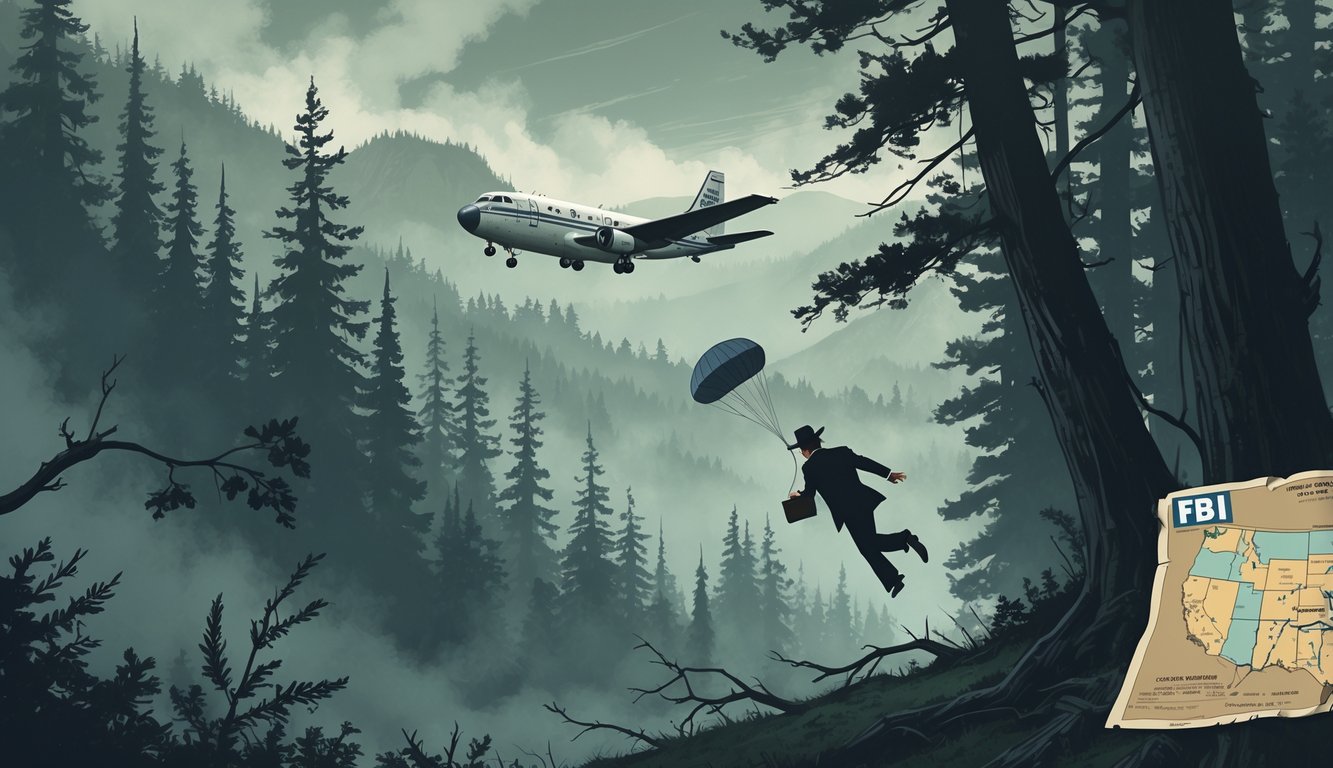
The hijacking of Northwest Orient Flight 305 took place in a region with dense forests, rugged terrain, and unpredictable weather. These conditions shaped both the escape possibilities and the search efforts that followed.
Geography of the Escape
The Pacific Northwest’s landscape includes thick evergreen forests, snow-capped mountains, and fast-moving rivers. In 1971, much of this area was remote and hard to reach, especially in late November when rain and wind were common.
Investigators believe D.B. Cooper parachuted into a rural zone between Seattle and Portland. The Boeing 727’s flight path crossed areas near the Lewis River and Mount St. Helens, where visibility was low at night.
Cold temperatures and rough terrain made survival challenging. Steep slopes, uneven ground, and limited road access forced search teams to use helicopters and boats.
The region’s geography also created many hiding spots. Logging roads, abandoned cabins, and deep valleys could hide a person for days or weeks.
Local Investigations
Law enforcement agencies in Washington and Oregon worked with the FBI to track leads. Deputies interviewed residents living near the suspected drop zone, asking about unusual activity or strangers passing through.
In British Columbia, a new clue appeared when a handwritten letter signed “D.B. Cooper” arrived at a Vancouver newspaper days after the hijacking. This extended the investigation north of the U.S. border.
Search teams combed riverbanks and forest trails. They found no parachute or body, but in 1980 a boy discovered $5,800 in decayed bills along the Columbia River, matching the ransom serial numbers.
Local pilots, hunters, and hikers also joined the search, offering tips based on sightings or unusual finds in remote areas. Despite these efforts, no confirmed trace of Cooper ever turned up.
Media and Cultural Impact
The D.B. Cooper hijacking has influenced entertainment, journalism, and public discussion for decades. It has inspired books, films, and television programs that explore the facts and the many theories about his identity and fate.
D.B. Cooper in Popular Culture
Writers, filmmakers, and musicians have often used D.B. Cooper as a symbol of mystery and escape. His story appears in novels, comic books, and song lyrics.
Television series such as Prison Break and Leverage have referenced the case. Some stories show Cooper as a clever outlaw, while others focus on the danger he posed to passengers.
The case features in popular culture overviews that track how his image has changed over time. In these portrayals, Cooper’s parachute jump often serves as the dramatic climax.
Public fascination continues because only $5,880 of the ransom was ever recovered. This detail keeps the mystery alive in books, podcasts, and online forums.
Documentaries and TV Shows
Many documentaries have examined the hijacking, each offering different suspects and theories. The History Channel aired a special that linked Cooper to Robert Rackstraw, a former pilot and paratrooper.
The Travel Channel’s Expedition Unknown with Josh Gates investigated the case on location. They reviewed FBI files, interviewed experts, and tested parachute jumps similar to Cooper’s escape.
Streaming platforms have also released series that re-examine evidence using modern forensic tools. These programs often include interviews with retired agents and amateur sleuths who have spent years studying the case.
Some productions focus on the cultural legacy, while others aim to solve the mystery. In both cases, the mix of fact and speculation keeps audiences engaged.
Expedition Unknown: Cracking the D.B. Cooper Case
In 2017, Expedition Unknown aired an episode about the decades-old mystery of D.B. Cooper. The show followed explorer Josh Gates as he retraced the hijacker’s path and worked with independent investigators to review evidence and search for physical clues.
Josh Gates’ Investigation
Josh Gates started by reviewing the FBI’s official findings and speaking with experts who had studied the case for years. He met with citizen sleuths who had gathered their own research and physical evidence.
The team explored areas along the suspected flight path, including wooded terrain and riverbanks where items linked to the hijacking were reportedly found. Gates also looked at historical documents and witness accounts to better understand the timeline.
He tested theories about how Cooper could have survived the parachute jump. This included checking weather data from the night of the hijacking and studying the type of parachutes used.
The process combined on-site exploration with interviews and archival research. Viewers saw the challenges in solving the case.
New Insights from the Show
The episode revealed new clues that had not been widely discussed before. For example, Gates examined a piece of foam material found in the suspected landing zone and consulted experts to see if it could be connected to Cooper’s parachute gear.
He also looked into alternative suspect profiles, comparing them to known facts from the FBI file. This included reviewing handwriting samples, personal histories, and possible motives.
Some findings suggested Cooper may have landed in a different area than previously believed. By combining fieldwork with forensic analysis, Expedition Unknown: Cracking the D.B. Cooper Case provided fresh perspectives that encouraged further investigation.
Legacy of the Unsolved Plane Hijacking
The 1971 hijacking by the man known as D.B. Cooper changed how airlines and law enforcement approached air travel. It became one of the most recognized unsolved cases in U.S. history and influenced both policy and public fascination.
Impact on Aviation Security
Before 1971, passengers could board commercial flights without metal detectors or bag screening. The Cooper case showed how easily someone could carry weapons onto a plane.
In response, U.S. authorities introduced mandatory passenger screening in early 1973. This included:
- Walk-through metal detectors
- X-ray scanning for carry-on bags
- ID checks before boarding
Airlines also added “Cooper vanes” to Boeing 727 aircraft. This mechanical device stopped the rear stairway from being lowered during flight — the same method Cooper used to parachute away with $200,000.
The FBI kept the investigation open for decades, hoping new technology would reveal Cooper’s identity. Even after closing it in 2016, the case remains a reference point in aviation security history.
Enduring Mystique
Books, documentaries, and amateur investigators have kept the hijacking alive because no one has solved it. Cooper’s calm manner and precise demands set him apart from other criminals. He vanished into the night, which made him an unusual figure.
Over the years, people have suggested theories about whether he survived or died in the wilderness. Some researchers have found new clues, like recently examined evidence, but no one has confirmed them.
This case stands out in U.S. history because it remains the only unsolved plane hijacking in the country. The story continues to capture attention more than 50 years later.