Mongolia is known for its vast steppes and rich culture. Stories from a powerful past make it a land of intrigue.
Some of the world’s biggest historical mysteries are hidden in Mongolia, including the secret location of Genghis Khan’s final resting place and the unknown purpose behind the ancient Mongolian Arc wall system. These puzzles have attracted historians, archaeologists, and adventure seekers for centuries.

The story of Genghis Khan’s tomb is especially famous. Many believe it could be located in the Khan Khentii Strictly Protected Area, sometimes called the “Forbidden Zone,” which is off-limits to most people.
This adds even more mystery and keeps people guessing about what secrets lie within the remote Mongolian wilderness. Other mysteries include ancient graves from before Genghis Khan’s time and stone walls whose original purpose is still a topic of debate.
The Enigmatic Wall System in Eastern Mongolia

The Mongolian Arc is a monumental wall system that stretches hundreds of kilometers across eastern Mongolia. Archaeologists have used advanced technology and fieldwork to learn about its size, structure, and possible purpose.
Discovery and Remote Sensing Insights
Local findings led to the discovery of the Mongolian Arc, but remote sensing methods expanded the research. Remote sensing data showed the wall’s impressive length—about 405 kilometers—cutting an arc across eastern Mongolia.
These technologies let experts analyze the wall system from above and find key sites without disturbing the ground. Researchers from the Hebrew University of Jerusalem mapped the network and found 34 structures like gates and towers.
The wall and its trench appear in valleys, open plains, and rugged landscapes. Satellite images helped specialists realize this wall system was larger and more complex than they thought.
Remote sensing also helped plan archaeological field surveys and identify areas for closer study.
Geographic Information Systems Applications
Geographic Information Systems (GIS) helped researchers understand the Mongolian Arc’s layout and its relationship to the environment. They entered data from satellite images and field surveys into a GIS to create detailed maps.
These maps showed how the wall connected to water sources, settlements, and travel routes. Tables comparing land elevation and wall positioning revealed that the wall often used natural barriers for extra protection.
GIS data also showed how the wall affected animal movement and plant growth over time. This technology helps historians around the world access precise information about the structure, as documented in the Journal of Field Archaeology.
Construction Techniques and Materials
Archaeological surveys found that builders constructed the Mongolian Arc mainly between the 11th and 13th centuries A.D. They used local materials like earth, stone, and sometimes wood.
Workers dug trenches beside the earthen wall, possibly for defense or as a water barrier. They compacted layers of soil and mixed materials for stability.
Some sites have well-preserved stone foundations, but other sections show erosion, likely from environmental impacts over time. Researchers noticed a repeated pattern, with small structures at certain intervals.
The wall’s design shows knowledge of military defense and regional geography.
| Material Used | Purpose |
|---|---|
| Earth | Main wall body |
| Stone | Foundations, reinforcements |
| Wood | Gates and roofs |
Purpose and Function Hypotheses
Experts still debate why builders constructed the monumental wall system. Some think it served for military defense, protecting trade routes or marking boundaries.
Others believe its gaps and structure hint at other uses, such as guiding animal herds or controlling resources. Recent studies found intentional openings, suggesting the designers had more than defense in mind.
Archaeologists also think the wall helped manage interactions between groups and controlled the movement of people, animals, or goods. Building such walls would have required organized labor and a strong authority in medieval Mongolia.
Researchers are still studying how the wall changed the environment, such as water flow and the landscape.
Burial Mysteries and Monumental Sites
Mongolia’s ancient history is filled with unanswered questions. Puzzling burial mounds and enormous stone monuments reveal how people lived and what they believed.
Secrets of Shoroon Bumbagar
Shoroon Bumbagar is one of Mongolia’s largest burial sites, dating back to the 7th and 8th centuries. The site includes a massive tomb built for an important Turkic noble.
Its size, design, and rich decorations make it a remarkable example of ancient Mongolian architecture. Archaeologists found well-preserved murals and carved stone doors inside the tomb.
These murals show scenes of daily life, animals, and processions. Many items, including golden objects and ceramics, were discovered, showing connections between the Turkic rulers and China.
Some artifacts from Shoroon Bumbagar are now in the National Museum of Mongolian History. Experts still debate who was buried there and why certain symbols appear so often.
Noyon Uul Burial Mounds
The Noyon Uul burial mounds in Tuv Province are ancient tombs created by the Xiongnu people over 2,000 years ago. Early 20th-century excavations uncovered precious items like silk, jewelry, and decorated weapons.
Key finds at Noyon Uul include:
- Well-preserved textiles
- Carved wooden objects
- Gold and silver artifacts
Noyon Uul’s burial customs show the skill and wealth of the Xiongnu. Some tombs had horses buried next to their owners.
Researchers still have questions about burial traditions and the identities of those buried here. You can read more about these burial mounds at Mongolian biggest archaeological discoveries.
Unexplained 34 Structures
Archaeologists have found 34 unusual stone structures in Mongolia, arranged in patterns unlike other known sites. These formations, mostly on the steppes, look like lines, circles, or squares.
The purpose of these structures remains unclear. Some experts think they were for tribal ceremonies, while others suggest they marked important routes.
Their age is uncertain, but some believe they may be thousands of years old, created by early nomadic groups. No clear connection with the well-known burial mounds or monuments has been found.
The mystery of who built the 34 structures and their meaning continues to puzzle archaeologists. Read more about these unexplained 34 structures.
Artifacts and Unsolved Origins
Tombs and monuments across Mongolia have produced thousands of artifacts, from golden jewelry to ancient weapons. Museums and private collections hold many of these pieces.
Some of the most important objects include decorated cups, ancient scripts, and personal ornaments. Experts study these items to learn about the technologies, trade, and art of past Mongolian cultures.
Many artifacts are beautiful and rare, but their origins are not always clear. Written records often do not link them to specific people or places.
The meaning of certain symbols and designs remains a mystery. Researchers hope new discoveries will reveal more secrets.
Unraveling the Mongol Empire’s Historical Gaps
Mongolia’s past holds mysteries about powerful rulers, missing tombs, and ancient nomads. Many secrets still lie hidden under the vast steppes and mountains.
Genghis Khan’s Lost Tomb
Genghis Khan, the founder of the Mongol Empire, changed history with his leadership and military skill. However, nobody has ever found his final resting place.
Historians believe he died in 1227, but his tomb’s location remains unknown. Legends say that those who buried him were killed to keep the site a secret.
Many think he is buried somewhere in Khentii Province, but no clear evidence has been found despite modern technology. Teams search for clues every year, hoping to solve this ancient puzzle.
The search also brings attention to Mongolia’s cultural heritage and the traditions of nomadic tribes.
Unknown Nomadic Leaders
Mongolia’s history includes many nomadic leaders before and after Genghis Khan. Most are forgotten, and records about their chiefs are missing or unclear.
Tribes like the Naiman, Merkit, and Tatar helped shape ancient civilizations by creating trade routes and defending their lands. Some leaders ruled for decades, but little is known about their lives or deaths.
Nomads moved often, relied on oral traditions, and faced constant wars, which made it hard to keep written records. Archaeologists use old maps, burial mounds, and tools to piece together the lives of these unknown chiefs.
Much about these early Mongols remains hidden.
Legacy of Ancient Nomads
Ancient nomads shaped Mongolia’s culture through music, art, and herding traditions. Their skills in horseback riding and archery made them strong in battle and influenced later generations.
Nomadic tribes lived in yurts and moved seasonally to find fresh grass. Their way of life helped the Mongol Empire expand quickly.
Artifacts, petroglyphs, and ancient wall systems like the Mongolian Arc show their connection to the land. Experts study these legacies to understand how ancient civilizations survived in harsh environments.
This research helps explain why Mongolia’s cultural heritage is unique and important.
Interpreting Ancient Written Sources

Historians piece together ancient Mongolian history from rare written accounts. These sources are sometimes incomplete or lost, making research challenging.
Missing Historical Records
A major obstacle for historians is the loss of many original Mongolian written records. Natural decay, wars, and political changes have created gaps in the official accounts.
Even famous works like the Secret History of the Mongols may be only a fraction of what once existed. Scholars rely on translations or copies made much later.
Sometimes, people from other cultures influenced or edited these copies for political reasons. This makes it hard to know what truly happened at the time.
Historians compare timelines, foreign records, and oral traditions to fill in the blanks. Studying what is missing is as important as examining what remains.
Insights from Ancient Scripts
When researchers discover original texts, the scripts themselves hold important secrets. The Secret History of the Mongols is one of the oldest written records from Mongolia.
It provides details about politics, society, military life, and family ties during the 13th century. This text reveals the deeds of Genghis Khan and his descendants, as well as customs, laws, and beliefs of the Mongolian people.
Much of the writing uses poetic or symbolic language, which can be tricky to understand. Researchers compare translations from Chinese, Russian, and Mongolian to get more accurate meanings.
This process helps uncover everyday realities and rare events recorded in ancient Mongolian scripts. For a closer look at what these sources reveal, see the study of the Secret History of the Mongols.
Transition Period Mysteries
Periods of change, such as the rise or fall of dynasties, often create confusion in the historical record. During these transitions, people might abandon or alter old ways of writing and record keeping.
New rulers coming to power could lead to the loss or destruction of important documents. For Mongolia, the shift from tribal groups to an empire under Genghis Khan marked a big change in leadership and historical recording.
Later, foreign influences mixed with Mongolian writing styles. This makes it harder for historians to separate original events from later interpretations.
Researchers use both surviving records and outside accounts to piece together what happened.
Technologies Transforming Mongolian Archaeology

New technologies are changing how archaeologists find, record, and study sites in Mongolia. These tools help researchers discover hidden ruins, gather data quickly, and work together in teams from different fields.
Remote Sensing Data Collection Advances
Remote sensing makes it much easier to map and analyze large areas of the Mongolian steppe. High-resolution satellite images and drone photography have become common tools for archaeologists.
This technology lets them find ancient walls, settlements, and burial grounds without disturbing the ground. Researchers now use LiDAR scanning and Structure-from-Motion to create 3D models of archaeological sites.
These models show the landscape’s features in great detail, which helps in places where grass or sand covers ruins. Geographic Information Systems (GIS) let scientists organize and examine all of this data.
GIS helps them look for patterns and relationships between different sites. Thanks to remote sensing, they can find artifacts and ruins spread over large distances, sometimes from their computers at home.
For a more technical view, the use of drone mapping and LiDAR in Mongolia is discussed in the Mongolian Archaeology Project.
Archaeological Field Surveys
Field surveys are essential for checking what remote sensing finds. Teams of archaeologists visit locations in person to confirm, document, and sometimes dig.
These field surveys help researchers gather samples of pottery, bones, and metal tools. Modern surveys use GPS devices and tablets to record data in real time.
They add this information straight into digital maps. This speeds up the process and reduces errors that can happen with handwritten notes.
Survey teams sometimes use machine learning to spot likely sites based on remote sensing images. This saves time because archaeologists can focus on the most promising areas.
Many field survey projects work to document Mongolia’s endangered ancient sites before erosion or development destroys them.
Role of Multidisciplinary Projects
Multidisciplinary teams are changing how Mongolian archaeology works. These projects include archaeologists, geographers, computer scientists, and drone operators.
By working together, they can tackle complex questions that a single field cannot answer. For example, combining climate data with ancient settlement maps helps explain why people moved or changed how they lived.
Computer experts build tools that sort or match images, which speeds up the discovery of new places and artifacts. Many international research groups now partner with Mongolian institutions.
They use digital techniques to keep detailed records and share discoveries worldwide. These collaborative projects, such as the Mongolian Archaeology Project, show how teamwork and technology lead to a better understanding of Mongolia’s history.
Environmental Impacts on Ancient Structures
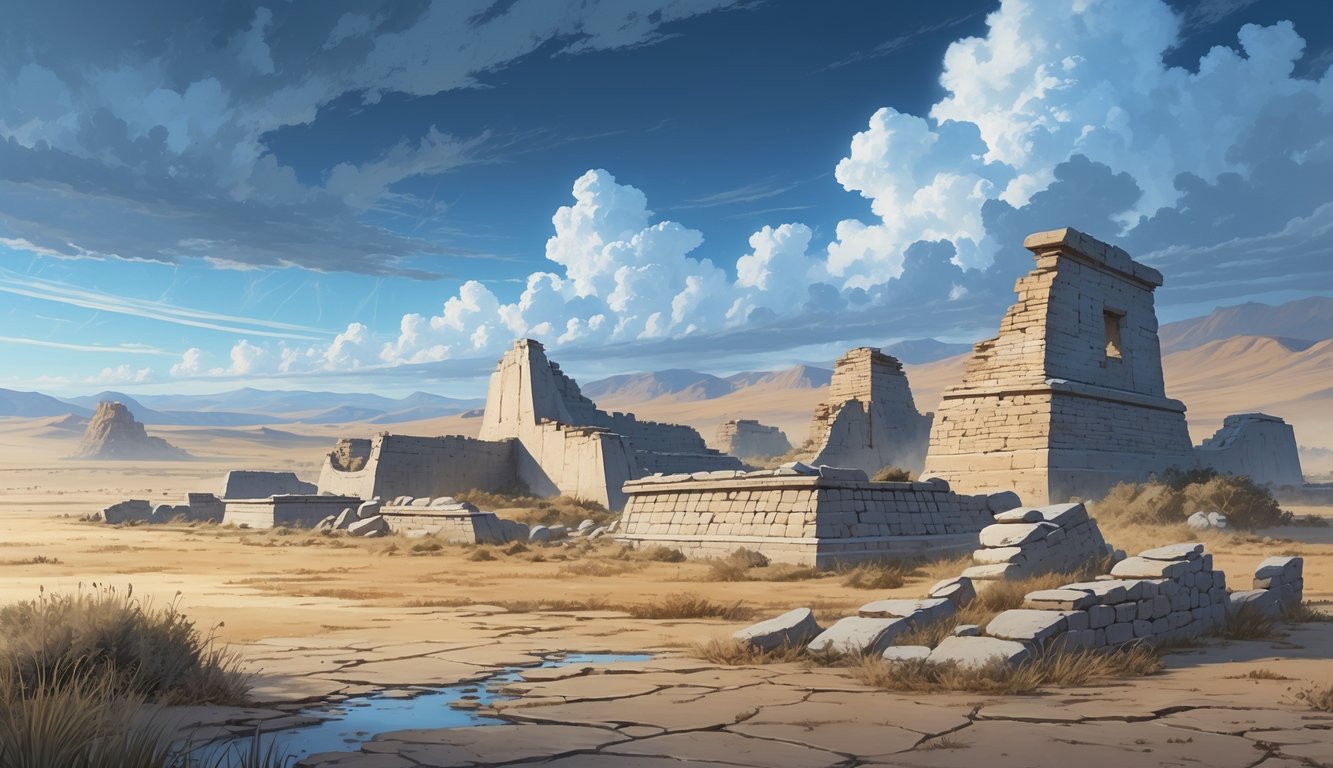
Ancient sites in Mongolia face damage from changing weather, shifting temperatures, and human activity. Many historic walls, burial grounds, and artifacts are at risk because of how their construction interacts with the environment.
Climate and Structural Resilience
Mongolia’s harsh climate greatly affects the strength and survival of ancient structures. The region experiences extreme temperature swings, dry winds, and periods of intense freeze and thaw.
Walls and burial sites built from stone or packed earth can crack and erode when water seeps in and then freezes. Strong winds pick up grit and sand, wearing down surfaces over hundreds of years.
Long dry spells followed by sudden rain make this damage worse, as water quickly finds its way into small cracks. Some ruins, such as the Mongolian Arc wall system, were carefully constructed to last.
Even these strong structures face challenges from today’s changing climate. Conservationists look for ways to strengthen these sites while keeping their original features intact.
Preservation Challenges
Preserving Mongolia’s ancient structures faces new threats every year. Climate change speeds up thawing in frozen ground, loosening ancient stones and exposing artifacts.
Looters also put fragile sites in danger as they search for valuables, often breaking into burial mounds and causing lasting harm. Loss of plant cover from overgrazing or fires adds to the threat, leaving walls and remains exposed.
Experts work with local communities to protect key places, but there are limits. Creating boundaries, using signs, and applying modern materials to support old walls are common strategies.
Sustainable solutions need careful planning so that history can remain safe for the future. For more on these challenges, see how climate change and looters threaten Mongolian archaeology.
Artifacts and Material Culture Queries
Artifacts uncovered across Mongolia tell stories of daily life and ancient societies. These discoveries raise questions about how people made and used items like textiles and metalwork.
Many pieces still puzzle researchers.
Analysis of Textiles
Mongolian archaeologists often find textile remnants in ancient tombs and settlements. These fabric pieces, sometimes made of wool or felt, help experts learn about weaving skills, trade, and local resources.
Some textiles show bright colors or complex patterns, raising questions about dye sources and cultural symbols. For example, felt carpets found among Xiongnu artifacts display unique designs.
Researchers still debate what the patterns mean.
A table of key textile mysteries:
| Artifact | Material | Riddle |
|---|---|---|
| Felt carpets | Wool/felt | Unknown pattern meanings |
| Burial cloths | Linen/wool | Origins of dye and weaving styles |
| Patchwork robes | Silk | Trade routes linking China |
Mysteries in Metalwork
Ancient Mongolian metalwork includes jewelry, tools, and weapons. Some items have markings or shapes that do not match known cultures, puzzling experts about their creators.
Scholars study the mix of metals to learn if local people or neighbors made the items. For instance, bits of ornate gold jewelry from early nomadic tribes feature symbols that have not been fully explained.
The Shoroon Bumbagar tomb, belonging to an Uyghur aristocrat, had metal and gold treasures with designs experts are still studying.
Ideas for further study include:
- Testing metal origins using modern labs
- Matching tool markings to specific artists
- Decoding symbols engraved in personal items
Unidentified Finds
Not every artifact fits a known type. Archaeologists in Mongolia sometimes dig up small clay objects, bone pieces, or shaped stones that do not match any familiar tools or decorations.
Some of these could be children’s toys, ritual items, or pieces of broken art. Pottery found in Mongolia over 11,000 years old has surprised experts and made them rethink ancient human history.
Lists of mysterious finds include:
- Pottery fragments with unknown use
- Small bone carvings with mysterious shapes
- Metal tools that do not match any known use
Cultural Exchange and the Spread of Ideas
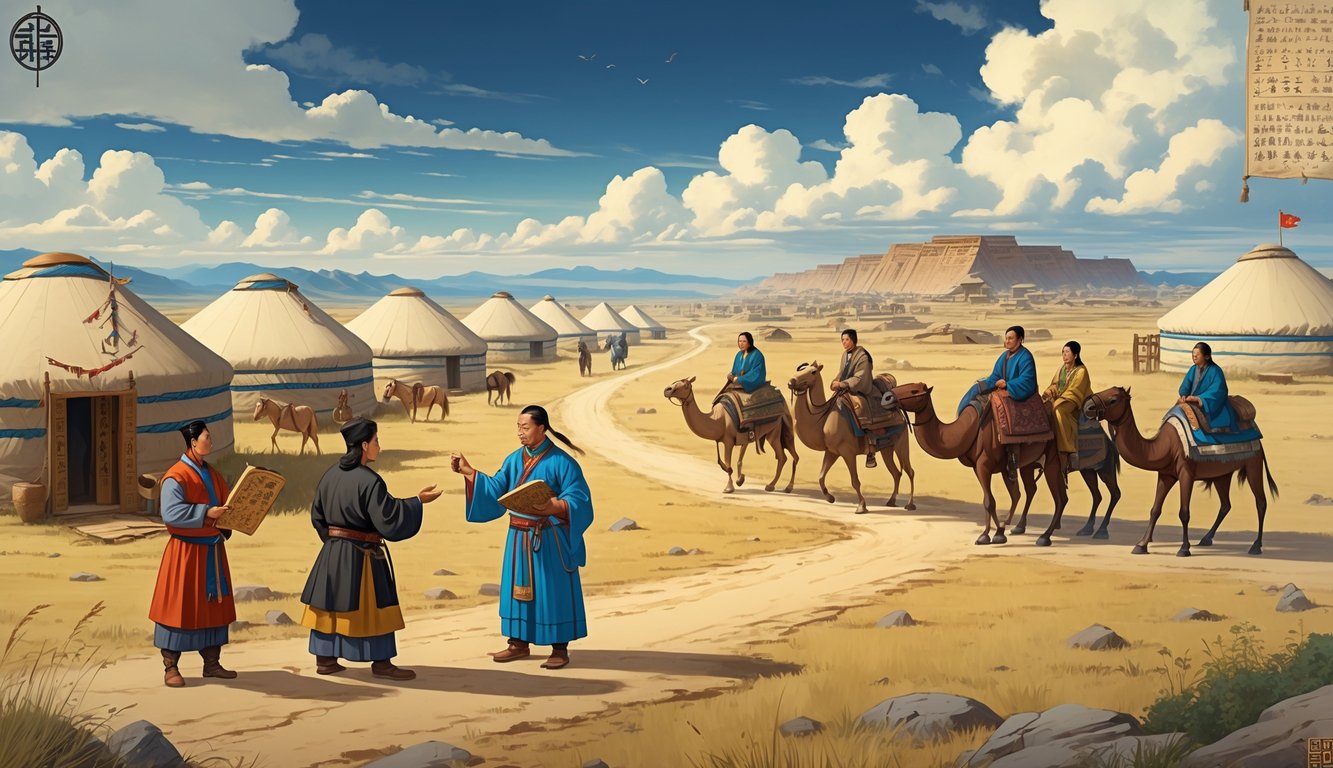
Mongolia played a key role in sharing ideas, technology, and beliefs between East and West. The movement of people and goods across the region changed daily life, religion, art, and science.
Evidence from the Mongolian Arc
Archaeologists have found objects in Mongolia from as far away as China, Persia, and Europe. Items such as ceramics, coins, and glassware show that trade routes through the Mongolian Arc allowed people to exchange goods, knowledge, and culture.
Mongol leaders welcomed many cultures and religions. They invited skilled workers, scholars, and artists from conquered lands.
This led to the spread of technologies like printing and papermaking. Local people in Mongolia soon learned new farming methods, metalworking skills, and even cooking styles from other cultures.
Mongol rule also brought about religious tolerance. Buddhism, Islam, and Christianity spread into Mongolia and mixed with native beliefs.
This multicultural environment is well described as Mongol multiculturalism.
Influence across Central Asia
The Mongol Empire controlled huge areas of Central Asia. Their vast network of roads and communication increased the movement of traders, diplomats, and scientists.
Trade linked cities from the Black Sea to China, connecting different groups and boosting the exchange of ideas. This process is often called the “Pax Mongolica” because it allowed for safe travel and strong communication between cultures.
Europe benefited from new knowledge about medicine, astronomy, and math that came from the East. The spread of technology and culture was so important that future empires copied the Mongols’ methods for building roads and keeping peace.
As a result, Central Asia remained a crossroads for cultural exchange long after the Mongol Empire faded. The influence across Central Asia is clear in the art, language, and traditions still found in the region today.
International Collaborations in Mongolian Archaeology
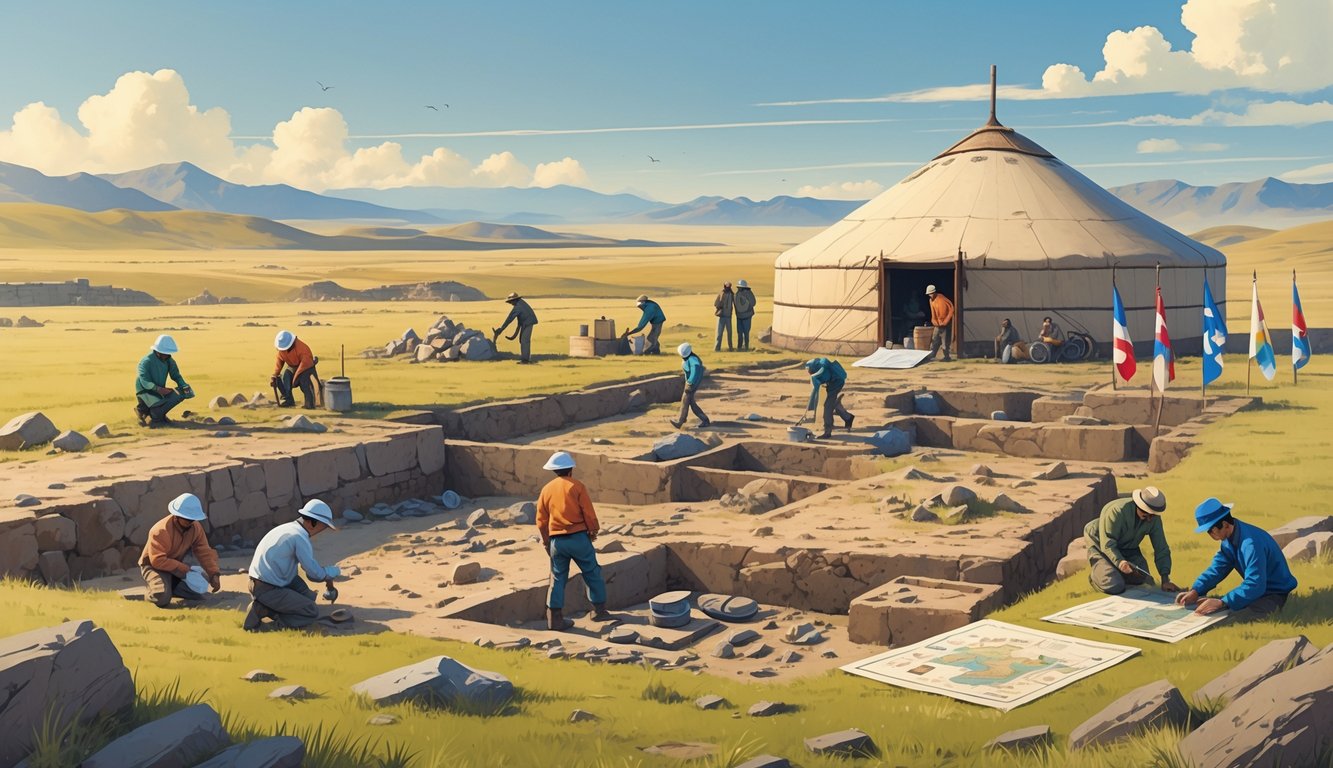
Foreign researchers and universities have played a major role in solving Mongolia’s archaeological mysteries. Several important discoveries about Mongolian walls, tombs, and ancient cities have come from these international efforts.
These collaborations help experts better understand Mongolia’s history.
Key Contributions of the Hebrew University of Jerusalem
Researchers from the Hebrew University of Jerusalem have partnered with local teams in Mongolia to study unique ancient sites. Their work on the Mongolian Arc, a 405-kilometer-long wall, has attracted special attention.
Archaeologists are still not sure why this wall was built or exactly when it was constructed. The Hebrew University brought new tools and technology, such as advanced mapping and dating methods, to these projects.
These methods made it possible to gather more accurate information about the wall’s age, structure, and location. Their cooperation has opened new questions about who built the Mongolian Arc and what its real purpose was.
This partnership has encouraged more joint research between Mongolia and other countries. By working together, researchers have uncovered details that would not have been possible alone.
Studies Published in the Journal of Field Archaeology
Many important findings from Mongolian digs appear in the Journal of Field Archaeology. This journal is well-known among archaeologists for sharing careful research and detailed discoveries.
Published reports cover excavations of old palaces, graves, and the mysterious Shoroon Bumbagar tomb, built by the ancient Uyghur tribe. These articles show how partnerships between Mongolian archaeologists and international experts—like those from the Hebrew University—lead to deeper, more factual studies.
The Journal helps these teams share their results with scientists around the world. Their work highlights discoveries that spark more exploration and invite new teams to Mongolia.
Preserving Mongolia’s Historical Legacy
Mongolia’s cultural identity connects closely to its artifacts, traditions, and historic figures. Museums and global partnerships protect, display, and share these treasures so that locals and people worldwide can learn about Mongolia’s past.
Role of the National Museum of Mongolian History
The National Museum of Mongolian History is one of the most important places for protecting and celebrating Mongolia’s heritage. Located in Ulaanbaatar, it holds thousands of items that show the country’s story, from ancient times to today.
Key collections include early stone tools, traditional clothing, and artifacts from the time of Genghis Khan. Visitors can see detailed displays about the Mongol Empire, nomadic life, and changes in modern Mongolia.
The museum also hosts workshops, lectures, and educational programs for students and researchers. By preserving rare items and running outreach efforts, the museum helps keep traditions alive.
It inspires pride and curiosity in Mongolians. The museum also helps travelers and scholars understand how the nation’s history connects to the present.
For more on the ways cultural practices and history are shared in Mongolia, see this overview of Mongolia’s historical knowledge.
Global Significance of Mongolian Heritage
Mongolia’s heritage reaches far beyond its borders. Artifacts and traditions from Mongolia have shaped global art and literature.
Museums like the famous Hermitage Museum display Mongolian artifacts. International interest in Genghis Khan, the Mongol Empire, and Mongolian crafts has led to exhibitions around the world.
These exhibitions introduce foreign audiences to the achievements of Mongolia’s leaders. They also showcase the culture’s enduring values.
Cultural exchanges and exhibition loans bring Mongolia’s story to a global audience. Partnerships help include Mongolia in the world’s shared memory.
These connections teach respect for diversity and history. Mongolia remains important both at home and wherever its legacy is known.
Learn how Mongolia’s nomadic heritage is honored today.