Every state has its secrets, and South Dakota is no exception. From unsolved murders to vanishing people, the state holds stories that have puzzled families, towns, and police for decades.
There are mysteries going back as far as the 1940s and as recent as the last decade. Some cases, like Arnold Archambeau and Ruby Bruguier’s disappearance, have even appeared on national television.
Other stories involve chilling cold cases and strange crimes that still keep the state’s small towns guessing. These mysteries show a different side of South Dakota, far from the peaceful prairies and quiet towns many people know.
The Enduring Legacy of Unsolved Mysteries

Unsolved mysteries in South Dakota continue to capture attention. These cases influence local beliefs and create lasting effects for those living nearby.
How Unsolved Mysteries Shape South Dakota Culture
People in South Dakota often pass down stories of unsolved mysteries through families and at community gatherings. Many share legends about missing persons, unexplained events, and mysterious deaths.
These tales create a shared sense of curiosity and sometimes fear that becomes part of the local culture. True crime stories, including those about vanished residents or unsolved murders, inspire books, news segments, and online discussions.
Local historians sometimes research old police files, hoping to find answers. Teachers may use these cases in class to teach about research or justice.
Local events, like guided tours or lectures, highlight these mysteries. Towns sometimes hold storytelling nights focused on these cases.
Impact on Families and Local Communities
Families of missing persons or murder victims in South Dakota live with many unanswered questions. The lack of closure can make healing very hard.
For some, every new discovery or rumor can bring hope, but also fresh pain when questions remain unanswered. Communities often unite to help search for clues or remember the victims.
Memorials, anniversaries, and public gatherings honor the individuals at the center of these unsolved crimes. Some local organizations work to raise awareness or help families cope.
Rumors and speculation can sometimes create tension or distrust in small towns. People may wonder if answers are being hidden or if justice will ever be found.
Despite this, the shared experience of loss often brings neighbors together. This builds stronger connections in the face of uncertainty.
Infamous Cold Cases of South Dakota
South Dakota has faced unsettling disappearances and unsolved murders. These cases involve missing persons and tragic deaths that have left many searching for answers for years.
Tina Marcotte Disappearance
Tina Marcotte vanished in the summer of 1994. She was a 30-year-old Rapid City resident and left work one night but never made it home.
Her vehicle was found near the parking lot with a flat tire. A key suspect was never charged, and the case remains open.
Despite efforts by police and the community, no one has found confirmed sightings or concrete leads. Family and investigators still urge anyone with information to come forward.
This case shows the challenges law enforcement faces in South Dakota when a missing persons case goes cold. Details from Tina’s case can be found in listings of South Dakota cold cases.
Rachel Cyriacks Vanishing
Rachel Cyriacks disappeared near Mitchell in 2013. She was last seen leaving her job, and her truck was later found abandoned on a rural road.
At the time, Rachel had recently separated from her husband, which made authorities look into her personal life. The investigation has covered multiple counties, but her fate is still unknown.
Despite extensive searches and interviews, authorities have not been able to determine what happened to her. The vanishing of Rachel Cyriacks is one of South Dakota’s most discussed missing persons cases.
Alicia Hummel Murder
Someone found Alicia Hummel murdered near the Missouri River in Clay County in June 2015. She was a 29-year-old preschool teacher and was last seen alive around the Vermillion area.
Her death was ruled a homicide, but the case remains unsolved. Friends described Alicia as kind and dependable, which made her murder even more disturbing for the local community.
Police found limited evidence at the scene and have not named any suspects. Alicia’s case highlights the difficulty of solving some unsolved murders in South Dakota, especially when there are few witnesses or clues.
Chilling Homicides and Unsolved Murders
South Dakota has been shaken by violent crimes that still impact communities today. Some of these cases gained national attention due to their brutality and the deep mysteries that surround them.
Robert Leroy Anderson’s Crimes
Robert Leroy Anderson caused fear across South Dakota in the 1990s. He targeted women, leading to the 1994 disappearance of Larisa Dumansky and the 1996 murder of Piper Streyle.
Anderson used his job as a delivery driver to learn about victims’ routines. He planned his crimes carefully and kept journals.
He even built tools for kidnapping. Law enforcement connected him to both cases through evidence found in his home and car.
Anderson’s trial revealed chilling details about his actions. He was sentenced to death but died by suicide in prison before his sentence could be carried out.
His crimes are still discussed in true crime circles. These homicides left a lasting mark on South Dakota’s history.
Gitchie Manitou Murders
The Gitchie Manitou murders happened in November 1973. Five teenagers were camping at Gitchie Manitou State Preserve.
Three brothers, Allen, James, and David Fryer, attacked the group. The Fryer brothers shot and killed four of the teens.
The last victim, a teenage girl, was kidnapped and assaulted but survived. Her testimony helped police quickly identify and arrest the killers.
This case is one of the most talked-about true crime stories in South Dakota. The violence shocked the state.
The Gitchie Manitou murders are remembered for the cruelty shown to innocent victims and the tragedy faced by their families.
Mysterious Disappearances and Missing Persons
South Dakota has faced several puzzling disappearances over the years. Some of the most discussed cases involve missing persons from both cities and rural areas.
Unexplained Cases from Sioux Falls
Sioux Falls, the largest city in South Dakota, has a few missing person stories that still cause concern in the community. One of the more recent publicized disappearances is Morgan Ten Eyck, who vanished in 2006.
Her case remains unsolved to this day. Police and search teams looked for any sign of her, but no definite clues were found.
The mystery has led to yearly reminders and renewed searches. Residents continue to hope for answers.
Sioux Falls’ population density and busy city life do not guarantee safety. Cases like Ten Eyck’s highlight the anxiety families feel when loved ones go missing.
Community groups and law enforcement still ask for tips each year, keeping the search alive for missing persons.
Challenging Cases in Rural Towns
Rural areas in South Dakota have their own set of challenges when it comes to missing persons. Small towns often lack resources for large-scale searches or complex investigations.
This sometimes leaves families and friends with more questions than answers. One notable case is the disappearance of Rachel Cyriacks from Woonsocket in 2013.
Search parties covered farmland and remote roads, but no trace was found. The limited local law enforcement means outside agencies often have to step in.
Another rural mystery is Sharon Baldeagle, who went missing in 1984 from north of Rapid City. Her case is still unsolved and represents the difficulties of investigating cases where few people witness anything.
These stories are reminders that missing persons cases can deeply affect South Dakota’s smallest communities.
Law Enforcement and the Pursuit of Answers
Law enforcement teams in South Dakota have played a big part in facing difficult mysteries across the state. Their work often depends on teamwork, technology, and help from the public.
Role of Local and State Investigators
Local police and the South Dakota Division of Criminal Investigation (DCI) often work together on tough cases. The DCI brings statewide knowledge and tools that smaller police departments may not have.
Many cases also get support from national agencies like the FBI, especially when cases cross borders or need extra resources. Coordination between these groups includes sharing tips, leads, and evidence.
They contact families, look for new witnesses, and check old case files for missed details. Sometimes, law enforcement asks community members to help, using tips from the public to make progress in unsolved cases.
Cold case units, like those in Pierre, South Dakota, hold meetings and collaborate closely to keep old investigations active. One of their main goals is to keep hope alive for families looking for answers.
Public awareness campaigns are another important tool. They remind the community of open cases and encourage people to come forward.
For more information about these efforts, see how the Cold Case Unit in Pierre operates.
Advancements in Investigative Techniques
Technology has changed how investigators solve crimes in South Dakota. Newer tools such as DNA tests and forensic analysis help law enforcement find suspects, even in decades-old mysteries.
Advances in DNA technology have solved cases that were stuck for years due to lack of evidence. Police departments now use online databases and DNA matching to compare evidence from old crime scenes with samples from across the country.
Digital records and social media also help find leads, track suspects, and gather new information. Special laws and community programs, like Savanna’s Act, focus attention on missing and murdered Indigenous women.
These initiatives improve communication between police groups and families. They make sure cases get the attention they deserve.
Increased public engagement and newer lab tools give investigators better chances to close unsolved cases. Read more about these changes and why DNA technology is so important in South Dakota’s cold case investigations.
Haunting Mysteries on the Pine Ridge Indian Reservation
Pine Ridge Indian Reservation in South Dakota is a place marked by both tragedy and stories of lingering spirits. Tales of missing persons and unexplained events tie into its difficult history and ongoing struggles for justice.
Notable Cases Involving Native Communities
Many Lakota families on the Pine Ridge Reservation have faced heartbreak over missing loved ones. Some cases stay open for decades.
The reasons people vanish are often unclear. The aftermath of the Wounded Knee Massacre, where hundreds of Lakota people lost their lives, left emotional scars that some residents say contribute to haunting stories today.
Ghost stories and urban legends are common here. People report sightings of spirits near historic sites.
One story is about “Walking Sam,” a spirit that appears during times of grief and tragedy. These stories often mix real, tragic history with local beliefs.
For more on these haunting tales, see these spooky stories from Pine Ridge and learn about how oral traditions keep them alive.
Barriers to Justice and Awareness
Unsolved cases and missing persons investigations face huge challenges on Pine Ridge. Poverty and understaffed local police make searching difficult.
Vast stretches of isolated land add to the challenge. Many families feel law enforcement does not give their cases enough attention.
Reporting problems also add to the mystery. Sometimes, people do not report missing persons right away or details get lost in paperwork.
Community members often raise awareness on their own. Outside help can be slow.
Even today, these historical mysteries and unsolved tragedies drive people on Pine Ridge to keep asking for answers.
The Role of DNA Evidence in Solving Old Mysteries
DNA evidence has changed how law enforcement investigates cold cases in South Dakota. New technology helps connect people and events to crimes from decades ago.
There are still limits to what DNA can prove.
Breakthrough Cases with New Technology
Recent advances in DNA testing have made it possible to solve crimes that once seemed impossible. Cases dating back to the 1970s or 1980s can sometimes be cracked when old evidence like hair, bones, or blood is retested with new methods.
Labs use techniques such as forensic genealogy, where DNA from an old crime scene is compared to public family trees. DNA helped identify relatives of a missing person in a case where detectives matched DNA to human remains decades later.
This process brought answers to families who waited years for the truth, as described in DNA detectives solving decades-old mysteries.
Law enforcement in South Dakota and across the country now rely on computerized DNA databases. This has led to arrests even in very old cases, including those involving unidentified remains.
Limitations and Ongoing Challenges
Even with improved technology, DNA evidence is not always a perfect solution. Sometimes, samples from crime scenes are too damaged or small to provide a clear match.
Other times, DNA can show that a person was present, but it cannot explain what happened or if a crime even took place. Chain of custody and contamination also present risks.
The cost and time involved in testing can delay answers for families. Privacy concerns and legal barriers sometimes limit what can be done with genetic data.
As a result, while DNA is a powerful tool, some mysteries in South Dakota remain unsolved, waiting for better methods or new information.
The Influence of South Dakota’s Geography on Mysteries
Geography shapes the way mysteries unfold in the Mount Rushmore State. The state’s vast wilderness and tight-knit communities both play unique roles in why some cases have stayed unsolved for decades.
Remote Wilderness and Its Challenges
South Dakota is filled with open prairies, forests, winding rivers, and rugged badlands. The dense Black Hills alone cover over 5,000 square miles.
These areas offer places to hide and make searches extremely difficult. Bad weather, thick woods, and little cell service often slow down rescue or search teams.
In winter, heavy snow can quickly cover any clues, making evidence hard to find. Many mysteries in the state begin in places with few people.
Missing persons cases sometimes go cold because vast stretches of land have little or no traffic. The land swallows up traces of what happened.
When law enforcement investigates over such a broad area, it is easy to miss small clues. This challenge is one reason several unsolved murders and missing persons cases in South Dakota continue to puzzle authorities and families.
Small-Town Secrets and Isolation
Many South Dakota towns are small, often with fewer than a thousand people. In these places, everyone knows each other.
Sometimes, people are reluctant to talk to outsiders or police about local events. This can keep important information hidden for years.
Long-standing relationships might cause people to protect friends or family, even when a crime occurs. Lack of resources in small town police departments can make it tough to investigate complex cases.
Local forces may not have the staff or technology to solve certain mysteries. Isolation also means fewer witnesses or leads.
The culture of tight-knit communities and their distance from larger cities adds to the challenge. Small-town mysteries might become decades-long puzzles with few answers, like those described among South Dakota’s most puzzling unsolved cases.
True Crime Communities and Public Engagement
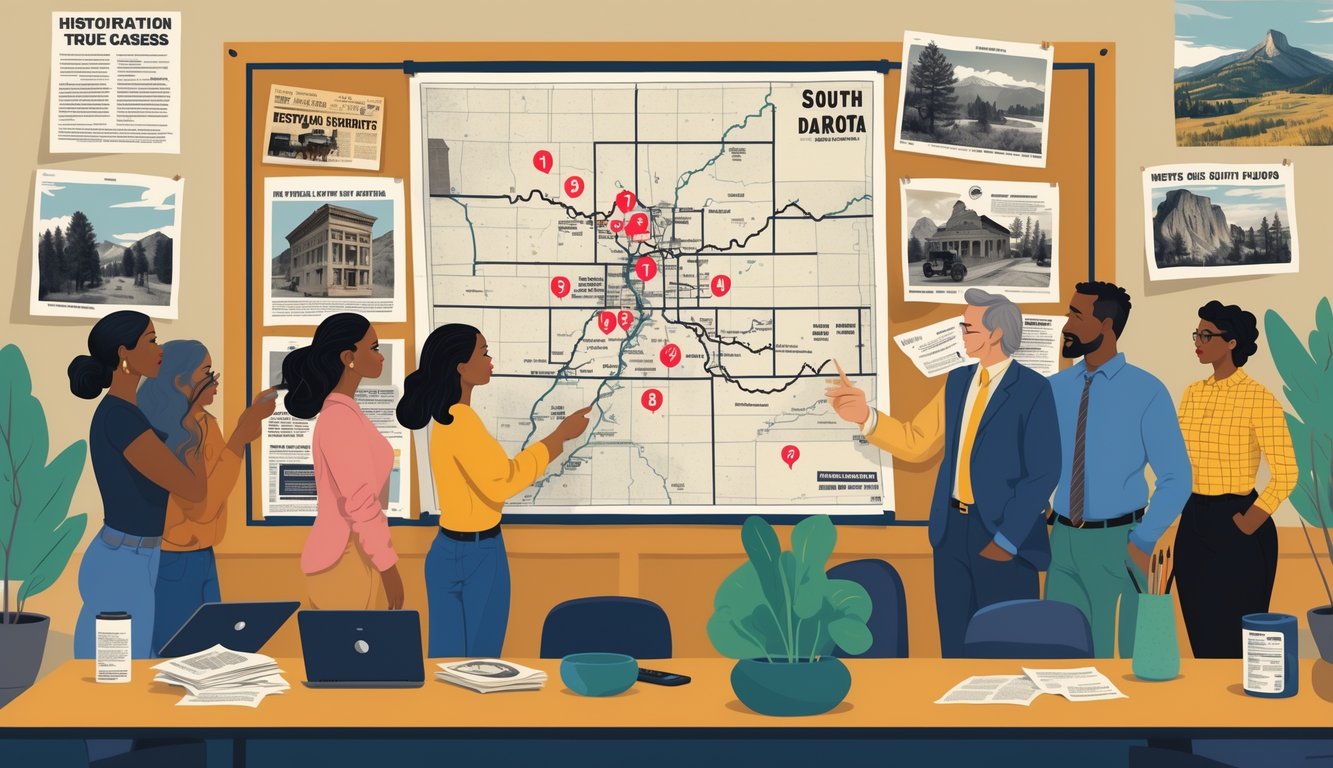
People in South Dakota have become more involved in true crime stories and cold cases as new details come to light. Media coverage and local efforts have kept interest strong and made a difference in raising awareness.
Media’s Role in Keeping Cases Alive
Local newspapers, TV stations, and podcasts play a big part in reporting on unsolved crimes and historical mysteries in South Dakota. These media outlets bring attention to lesser-known cases by sharing victim stories and interviewing experts.
They revisit cold cases. Documentaries and online articles draw in viewers, helping cases like South Dakota’s most notorious true crime stories stay in the public eye.
Coverage on social media has also grown. Facebook groups and online forums bring people together.
These platforms help spread information quickly and encourage others to share tips or memories. Media not only keeps the conversation going but also motivates some to get involved.
Community-Led Investigation Efforts
South Dakota residents often work together in hopes of finding answers to old crimes. They organize community meetings, social media groups, and dedicated websites.
Volunteer search parties and fundraising events are common. Families of victims sometimes organize their own awareness campaigns.
Some communities keep missing persons cases active by hosting annual remembrance walks or distributing flyers with case information. By working together and sharing information, locals create support networks for affected families.
Community involvement sometimes sparks new leads. This makes it an important part of the South Dakota true crime landscape.
The Ongoing Fascination With Historical Mysteries
Historical mysteries keep people curious and spark ongoing questions. The stories behind these mysteries can involve missing people, strange monuments, and cases that remain unsolved for many years.
Why Some Cases Remain Unsolved
Some mysteries in South Dakota have never been solved because of lost evidence or changing stories over time. In the case of old unsolved crimes, there were often no security cameras and very few written records.
The harsh weather and large, open spaces in South Dakota also make it easy for clues to disappear. Details of cases like the unsolved murders in South Dakota show how important small pieces of evidence can be.
If something is missed, investigators may never find out what happened. Certain mysteries also stay unsolved because people who might have known something chose to stay silent.
Sometimes, historic tensions in the area kept witnesses from coming forward. This leaves families and communities with unanswered questions.
What the Future Holds for South Dakota Mysteries
New technologies help people look at old mysteries with fresh eyes. DNA testing, internet databases, and advances in forensic science give hope that even long-standing cold cases may someday be solved.
Community involvement also plays an important role. More people are raising awareness about mysteries, like the Missing and Murdered Indigenous Women crisis mentioned in South Dakota cold cases.
This extra attention can bring new tips and support to investigators. Legal efforts, such as Savanna’s Act, change how authorities handle these cases.
Families keep pushing for answers. They hope that a breakthrough may finally come.