Oregon has always been a place filled with secrets and curious stories. From disappearances that have left families wondering for decades to baffling events that drew attention far outside the state, these unsolved mysteries continue to interest people today.
People are fascinated by these strange tales, whether it’s unexplained crimes, missing persons, or odd happenings that no one ever explained. Some of the most well-known cases still keep law enforcement and local communities searching for answers, such as Oregon’s cold cases that remain unsolved.
Each story is different, but all show that even quiet places can hide secrets that never fade away. Learning about these mysteries gives us a glimpse into Oregon’s past and how these stories shaped the state’s history.
Oregon’s Most Infamous Cold Cases
Some of Oregon’s oldest and most mysterious cold cases involve disappearances and unsolved murders that still puzzle investigators and families. These true crime stories highlight missing persons and murders that remain open.
The Disappearance of Kyron Horman
Kyron Horman, a 7-year-old boy, disappeared on June 4, 2010, after his stepmother dropped him off at Skyline Elementary School in Portland. He was last seen at a school science fair, but he never made it to class that morning.
A large search effort involved local law enforcement, volunteers, and national media. Despite these efforts, no trace of Kyron has ever been found.
The mystery has led to many rumors and theories, but nobody has been charged. What happened to Kyron remains unknown. See more about this unsolved case at Oregon Cold or Unsolved Cases.
The Lava Lake Murders
In 1924, three fur trappers—Edward Nichols, Dewey Morris, and Roy Wilson—were found murdered near Lava Lake in Central Oregon. The case shocked the community because of the brutality and the remote location.
The men had been missing for months. When their frozen bodies were finally found under the ice, it was clear they had been tied up, shot, and dumped in the lake.
Investigators found no motive and few clues. Despite a lengthy investigation, police never arrested any suspects.
The Unsolved Case of Deborah Atrops
Deborah Atrops, a 29-year-old woman, vanished in November 1988 after leaving work and dropping off her child with her estranged husband. Her car turned up abandoned in Tigard, but Deborah was missing.
A week later, someone discovered her body in the trunk, and it was clear she had been murdered. Police suspected foul play, but the crime scene did not provide enough evidence to charge anyone.
Friends and family still seek answers, and her unsolved case remains featured among Oregon’s cold cases.
Historic Unsolved Murders in Oregon
Oregon has a long and sometimes mysterious past when it comes to murder cases. Some of these cases still haunt the communities where they happened and continue to raise questions years after the crimes took place.
The Lane County Homicide Mystery
In Lane County, one historic homicide left both police and citizens searching for answers. A body was discovered in a remote area, sparking a widespread investigation.
Despite many leads and tips, the identity of both the victim and the killer remained unknown. Detectives checked missing person reports but found no clear matches.
After an autopsy, only a few details about the victim’s age and possible cause of death could be released. Lane County’s tight-knit community got no closure as years went by with no arrests.
Key facts:
- Location: Lane County, Oregon
- Evidence: Sparse, little forensic material
- Case status: Unsolved
Many in the area still wonder if the murderer lived nearby or was just passing through.
Diane Downs and her Controversial Case
In 1983, Diane Downs drove her children to a Springfield, Oregon hospital, claiming a stranger tried to carjack her and shot them. Her story quickly caught the attention of the police and people across the country.
When investigators looked closer, several details did not add up. Evidence suggested Diane might have been involved in the shootings.
Eventually, Downs was arrested and found guilty of attempted murder, assault, and murder.
Notable points:
- Year: 1983
- Victims: Her three children
- Result: Diane Downs sentenced to life in prison
The Roy Wilson & Dewey Morris Story
Roy Wilson and Dewey Morris were both found dead in Oregon in the late 1940s. Their murder case became famous because investigators had almost no clues to follow.
Both men were known in the logging communities, and their deaths shocked friends and families. Police tried to piece together the last days of both men, focusing on their work, relationships, and recent movements.
Despite searching the area and questioning many people, detectives hit a wall with no clear suspect. There were few witnesses, and nothing valuable seemed to have been stolen.
Quick facts:
- Victims: Roy Wilson & Dewey Morris
- Location: Rural Oregon
- Crime: Double homicide, possible robbery motive
The Murder of Edward Nickols
Edward Nickols’ murder in Oregon is another example of a homicide that has remained unsolved for decades. Police found Nickols dead in his home.
There were no obvious signs of forced entry, and most valuables were untouched. Investigators believed he may have known his killer.
Detectives interviewed neighbors and friends but found very little useful information. Home security in that era was basic, so there were no cameras or alarms to catch a suspect.
Essential details:
- Victim: Edward Nickols
- Location: Oregon
- Investigation: No arrests, case remains unsolved
Vanished Without a Trace: Missing Persons Cases
Oregon has a history of baffling missing persons cases that remain unsolved. These cases stir both fear and curiosity as families and communities keep searching for answers.
Mysterious Disappearances in the Deschutes National Forest
The Deschutes National Forest has been the site of several strange missing persons cases over the years. Dense woods, deep river canyons, and remote areas make search efforts very difficult.
Hikers and campers have vanished without leaving clues behind.
Key details:
- Dense forests make it easy to get lost.
- Sudden weather changes increase the danger.
- Few personal items have been found.
One notable incident involved a young camper who went missing on a day hike and was never found, despite large search teams. In some cases, even search dogs and helicopters could not locate any trace of the missing people.
The wide space and natural hazards of Deschutes add to the challenge of these disappearances.
The disappearances in this region are sometimes compared to nationwide stories about people who vanished without a trace. Locals have come up with many theories, but most questions remain unanswered.
Unexplained Cases in Clatsop County
Clatsop County, with its rugged coastline and forests, has its own list of unsolved missing persons cases. People have left for short trips or simple errands and did not return, leaving family and investigators puzzled.
Important points:
- Coastal fog can disorient even experienced hikers.
- The county’s mix of wild land and small towns makes searches complex.
- Some missing persons had no known reason to disappear.
A few missing persons in this area were last seen near water or hiking alone. In some cases, cars were found abandoned but there was no sign of the person.
Local law enforcement and volunteers have spent weeks searching these areas, but many missing persons remain unaccounted for.
Stories from Clatsop County draw attention along with other unsolved disappearances throughout history. This ongoing mystery keeps residents concerned and continues to fuel search efforts year after year.
The Role of Evidence and DNA Technology
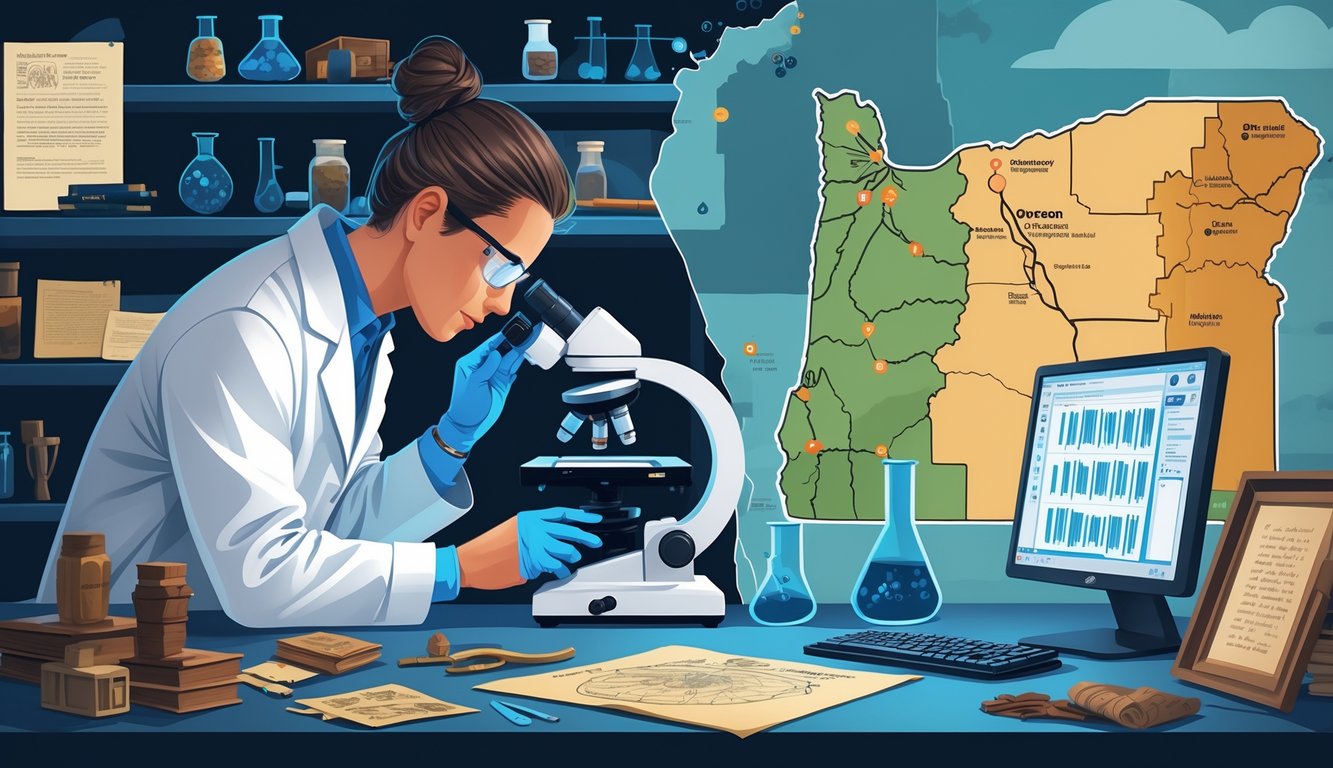
Finding the truth behind Oregon’s biggest historical mysteries often depends on the types of evidence investigators can gather and analyze. From DNA to physical objects, every detail can make a difference in old and new cases.
Advances in DNA Evidence for Cold Cases
DNA technology has become a key tool in solving cold cases. It allows investigators to test small bits of material left at crime scenes, like hair or skin cells.
When a DNA sample matches someone in a database, it can connect suspects to unsolved crimes even after decades. One famous breakthrough in the United States came when detectives used DNA to solve crimes from the 1950s.
In Oregon, DNA evidence and electronic fingerprint processing have played big roles in unraveling mysteries the police struggled with for years. Cold cases in Marion County and other places have benefitted from the ability to revisit old evidence with new techniques.
Sometimes, even trace evidence that seemed useless before can now be tested for DNA and linked to a suspect. You can read more about how DNA evidence helped solve difficult cases at NPR’s coverage of cold cases.
Investigative Innovations in Oregon
Oregon detectives use many different methods to investigate crimes and mysteries. Besides DNA, they rely on fingerprint analysis, physical evidence, and even historical records in local museums.
The Oregon State Police works closely with local sheriff’s offices to share new technology and knowledge. Lists and databases help connect the dots between missing people, suspects, and evidence.
Teams often ask for help from the public, using tips to find leads or look at old clues in new ways. Authorities use specialized computer systems to compare and analyze evidence and DNA samples.
Physical evidence, including biological or trace material, can link a scene to a person or object. With each technological improvement, investigators find new ways to unlock the secrets of both recent crimes and Oregon’s biggest historical mysteries.
You can find more stories about Oregon’s baffling cold cases and the role of evidence in these investigations.
Serial Killers in Oregon’s History
Oregon has seen several cases involving serial killers. True crime enthusiasts and investigators study these cases to understand the state’s history and crime patterns.
Patterns and Profiles
Serial killers in Oregon come from different backgrounds, but some common themes stand out. Many hid in small towns or forests, using rural areas to avoid being noticed.
Some killers, like Ted Bundy, began their crimes in the Pacific Northwest and moved between states. Bundy’s crimes were linked to both Oregon and Washington.
Another example is Jerry Brudos, who murdered several women near Salem in the late 1960s.
Key features of Oregon serial killer cases:
- Victims often disappeared while hiking or traveling
- Crimes happened near rural highways or isolated communities
- Many cases remained unsolved for years, creating lasting mystery
Linking Cases Across the Pacific Northwest
Many serial killers who operated in Oregon also committed crimes in nearby states. Patterns connect cases in Washington, Oregon, and parts of Idaho.
Law enforcement agencies work together to solve cases involving suspects who move across state lines. Some notorious figures from Oregon, like Randall Woodfield, targeted victims in different parts of the Pacific Northwest.
Lists like the 10 Most Notorious Oregon Serial Killers show how multi-state crimes shape the region’s history.
Unresolved Mysteries from the Past
Oregon’s history is full of secrets that remain open to this day. Some cases end with more questions than answers, leaving families and communities searching for the truth.
Decades-Old Unsolved Cases
Throughout Oregon, some mysteries have gone unsolved for decades. One well-known example is the “Oregon Coast Killings,” where multiple skeletal remains were found in 1992 near Newport.
Three families have waited more than thirty years for answers, but the identities of those responsible are still unknown. Even with forensic advancements, many murder and missing person cases in Oregon stay unresolved.
In places like dense forests or deserted highways, evidence can disappear fast, making investigations more difficult. A list of Oregon’s cold cases shows how many families are still hoping for closure.
Some cases are so baffling that they lead to rumors involving unusual suspects and motives. Stories have included everything from government cover-ups to secret cults, as attention remains on Oregon’s biggest mysteries.
The Puzzle of Burnt Food and Other Oddities
Not all unresolved cases in Oregon are linked to violence. Some mysteries involve the everyday, like the strange theme of burnt food found at certain old crime scenes.
Detectives in past decades sometimes reported scorched pots and pans in abandoned homes after a disappearance. They wondered if a hurried event or accident took place.
Common oddities in these unresolved cases include:
- Appliances left running
- Burnt dishes on stoves
- Meals half-prepared but never finished
These details might seem small, but they stick with investigators. Strange patterns like burnt food often leave people wondering if there was a rushed escape or something more sinister at play.
Details like these turn ordinary objects into clues. Even the smallest detail can hold a key to unsolved mysteries in Oregon’s history.
Local Law Enforcement and Unsolved Crimes
Oregon’s cold cases have challenged police and captured the attention of people across the state. Many of these mysteries still shape how law enforcement and the public work together in the search for justice.
Efforts by Oregon State Police
The Oregon State Police play a key role in investigating historic unsolved cases. They use modern forensic tools, including DNA testing, to revisit old evidence and look for new clues.
This work has helped turn up leads in several cases that date back decades. They also create detailed case files and share them with local agencies and the public when needed.
This cooperation makes it easier to compare evidence and chase down suspects who may have moved across county or state lines. Authorities regularly review cold case files to make sure each one gets a fresh look.
Major unsolved cases, such as the Lava Lake murders, are often listed on public databases and state police websites to keep them in the public eye.
Community Participation in Cold Case Investigations
Community involvement is important to solving unsolved crimes in Oregon. Family members, friends, and local residents often provide tips that lead to new information or remind police to keep investigating.
Public interest stories in newspapers, social media posts, and true crime websites help keep cases alive. Some cases, like the Cowden family disappearance, have received ongoing attention from Oregon residents and the wider public.
Law enforcement sometimes asks for help by sharing bulletins and anonymous tip lines. Volunteers and advocacy groups partner with the police in hopes of resolving cases that are decades old.
Community curiosity often brings forward witnesses who were silent before, making a real impact on investigations. You can learn about some of Oregon’s most puzzling cases where the public’s help remains vital by visiting sites focused on Oregon cold cases.
Notorious Cases by County
Oregon counties have seen some chilling and mysterious events over the years. Some places are remembered for cases that shocked locals and puzzled investigators for decades.
Jackson County’s Most Puzzling Mysteries
Jackson County is known for more than just quiet towns and scenic beauty. It has seen mysterious disappearances and unsolved crimes that still cause concern today.
One case that stands out is the unsolved disappearance of a young woman in the late 20th century. Her car was found on the side of the road, but there was little evidence left behind.
Local law enforcement followed many leads. Over time, the case grew cold.
Jackson County has also seen other puzzling cases that keep people talking. This makes it a focus among Oregon’s cold cases.
Media, Public Interest, and True Crime in Oregon
Oregon’s true crime stories have sparked strong public curiosity and ongoing media coverage. Cold cases and unsolved crimes often gain new life when covered by documentaries, news, and online communities.
The Impact of True Crime Coverage
Television series, podcasts, and online articles have brought Oregon’s biggest mysteries to a wide audience. Many residents follow real-life crime shows or read news stories about unsolved cases.
Shows and documentaries often profile chilling events, such as disappearances and unresolved murders, and share facts about victims and investigations. For example, true crime documentaries from Oregon have become popular choices for those who want to learn more about local mysteries.
Local news outlets and bloggers list details about cold cases, sometimes sharing new evidence or leads. These stories can draw attention from both inside and outside the state.
As true crime grows in popularity, more people become invested in the history and outcome of these cases. Some fans even attend public events or forums to learn more about unresolved crimes.
Raising Awareness for Oregon Cold Cases
Increased coverage has played a key role in keeping unsolved cases in the public eye. Websites and blogs update readers on Oregon’s cold cases and highlight stories that still affect families today.
Lists often include the names, photos, and circumstances of victims who have not yet found justice. Public interest has motivated authorities to re-examine evidence and sometimes use new technology, like DNA testing.
Tips from the public, encouraged by media attention, may help investigators find answers. Efforts to raise awareness include sharing missing person posters, hosting events, or inviting people to share information through tip lines.
Looking Forward: The Future of Cold Case Investigations

Advances in forensic science are changing how Oregon’s oldest mysteries get solved. Teams are combining new tools and focused efforts to bring answers to unsolved cases that have lasted decades.
New Technology and Justice Initiatives
DNA technology has become a vital tool in cold case investigations. With faster and more accurate methods, even old evidence can now be tested for new clues.
Genetic genealogy uses DNA from crime scenes to find relatives and narrow down suspects. This method is key for cases that went cold before DNA testing existed.
Oregon now uses databases that store and compare DNA evidence. These databases connect local, state, and federal investigators, increasing the chance of finding new matches.
Justice initiatives are also growing. Local and state agencies work together and share findings, making it easier to reopen cases.
Nonprofits and national programs like Project: Cold Case help police by sharing tips and resources. The public can now submit information directly online, allowing more people to help solve difficult cases.
Ongoing Efforts and Unsolved Mysteries
Many Oregon cold cases, like the disappearance of Kyron Horman, still draw attention from investigators and the community.
Investigators often revisit old interviews and evidence with fresh eyes. New labs now re-test physical evidence that once seemed unhelpful.
Police departments use updated databases. They also rely on advanced software to search for connections that investigators might have missed before.
Public interest remains crucial. Websites encourage people to share tips, keep victims remembered, and bring attention to Oregon’s cold or unsolved cases.
Volunteers and advocates push for justice. Their efforts sometimes lead to new information or renewed action by authorities.
Lists and summaries of cold cases continue to be updated as more details and developments come in.