
Many people think of Iowa as a peaceful place, but it has its share of puzzling events and unanswered questions from the past. Some of the biggest historical mysteries in Iowa include unsolved murders, unexplained disappearances, and events that still leave experts searching for answers.

Stories like the Villisca Axe Murders, where an entire family was killed in their home over a century ago, continue to capture attention. Cases such as the baffling disappearance of TV news anchor Jodi Huisentruit and other Iowa cold cases add layers to the state’s list of mysteries.
Iowa’s history is full of unanswered questions. These mysteries draw in anyone curious about the hidden side of the Hawkeye State.
The Villisca Axe Murders
The Villisca axe murders are one of Iowa’s most talked-about unsolved mysteries. Eight people were killed with an axe, and the crime scene shocked the small town of Villisca.
Overview of the 1912 Crimes
On the night of June 9, 1912, someone entered the Moore family home in Villisca, Iowa. The attacker used an axe to kill all six Moore family members and two visiting children.
The victims included Josiah and Sarah Moore, their four children, and guests Lena and Ina Stillinger. Everyone was murdered while they slept.
The crime scene showed the killer acted carefully and tried to avoid making noise. The murder weapon, Josiah’s own axe, was left at the house.
Neighbors found the bodies the next morning after noticing the family hadn’t been seen all day. The news spread quickly, and crowds gathered at the scene.
You can read more about this tragedy at the Villisca axe murders Wikipedia page.
Unsolved Theories and Suspects
The Villisca axe murders remain unsolved. Over a hundred years later, no one has been convicted.
Law enforcement at the time investigated several suspects, but they had limited evidence. Some of the main suspects included a traveling preacher, a local businessman, and a man known for similar crimes in other states.
Each suspect had some connection to the family or the area. Investigators struggled to prove any one suspect was guilty, and forensic tools were basic in 1912.
Theories range from a personal grudge to random violence by a serial killer. If you want to read about the different theories, this article covers the major suspects.
Haunted Reputation and Modern Impact
The Moore house is now known as the Villisca Axe Murder House. People believe it is haunted because of the violent crimes that took place there.
Visitors report strange sounds, moving objects, and cold spots in the house. Some people book overnight stays to experience the spooky atmosphere themselves.
Villisca still attracts attention from ghost hunters, history fans, and anyone fascinated by unsolved mysteries. The house is featured in documentaries and books, and it remains a big part of Iowa’s true crime history.
Today, the Villisca Axe Murder House is one of the most famous crime sites in the United States.
Disappearance of Jodi Huisentruit
Jodi Huisentruit was a young news anchor in Mason City, Iowa who vanished in 1995. Her case is one of the most well-known cold cases in the state and has drawn the attention of law enforcement, media, and the community for decades.
Timeline of Events in Mason City
On June 27, 1995, Jodi Huisentruit was expected at KIMT-TV to anchor the morning news. She called her producer around 4:00 a.m. to say she was running late.
By 7:00 a.m., Jodi had not arrived for her shift. Police found her red Mazda Miata in the apartment parking lot with personal items, like her blow dryer and red heels, scattered nearby.
Neighbors heard a scream earlier that morning, and her car key was found bent. Signs in the area pointed to a struggle.
Key Moments:
- 4:00 a.m.: Jodi called work, saying she overslept
- 7:00 a.m.: Jodi reported missing after failing to appear
- Morning: Police arrived and found evidence suggesting abduction
You can find more details about the events in Mason City from this article.
Investigation Developments and Leads
Law enforcement and Crime Stoppers of Central Iowa followed hundreds of leads over the years. They interviewed neighbors, searched the area, and tried to track down anyone who may have seen something.
A table of key investigation actions:
| Action | Details |
|---|---|
| Interviews | Dozens of residents, coworkers, witnesses |
| Physical Evidence | Torn clothes, key, scattered belongings |
| Searches | Nearby forested areas and local waterways |
| Public Appeals | Calls for information and anonymous tips |
Despite the efforts, Jodi was never found. There have been rumored suspects and theories, but no arrests have been made.
The Mason City Police and state authorities still treat it as an active missing person case. You can read more about the investigation from Crimesolvers Central.
Ongoing Search and Community Efforts
The community in Mason City has kept Jodi Huisentruit’s story alive for thirty years. Annual vigils are held on the anniversary of her disappearance.
Local organizations, family, and friends work to bring attention to the cold case. FindJodi.com and Crime Stoppers of Central Iowa continue to ask for new tips.
There are billboards, podcasts, and social media campaigns sharing her story. These efforts help bring in new leads and remind the public of Jodi’s story.
As of 2025, the case remains unsolved. Learn more about the latest efforts and updates from this update page.
The Kidnapping of Lyric Cook-Morrissey and Elizabeth Collins
Lyric Cook-Morrissey and Elizabeth Collins were abducted while riding their bikes in Evansdale, Iowa in July 2012. Despite major search efforts, the case remains one of Iowa’s most haunting unsolved mysteries.
Case Background in Polk County
Lyric Cook-Morrissey, age 10, and her cousin Elizabeth Collins, age 8, disappeared on July 13, 2012. The cousins set out for a summer bike ride and never returned.
Their bikes and a purse were later found near Meyers Lake. Although the kidnapping happened in Evansdale, law enforcement agencies across Iowa, including those in Polk County, joined the search and investigation.
The case quickly attracted attention because of both girls’ young ages and the fear it brought to the community. The remains of both girls were discovered months later in a remote area.
The families and authorities were left with many unanswered questions. The girls’ abduction remains listed among Iowa cold cases.
Key Evidence and Investigative Hurdles
Investigators gathered several key pieces of evidence, but progress was slow. The abandoned bikes and purse were carefully examined, but they did not provide enough forensic leads.
Law enforcement received numerous tips from the public. However, none led to a breakthrough.
The wooded area where the cousins’ bodies were found made collecting physical evidence difficult. Weather and time made it harder to preserve important clues.
Police also looked at similar missing person and abduction cases in the region for leads. Despite reviewing hundreds of tips and potential suspects, the case still has not been solved.
Efforts continue as part of the Iowa cold cases database.
Public Appeals and Case Updates
After their abduction, law enforcement made repeated public appeals for information. Family members and local residents participated in searches, vigils, and fundraisers to keep attention on the case.
Their stories were shared through posters, news coverage, and social media. Authorities offered rewards for tips that could help solve the case.
Major news outlets and true crime documentaries like “Taken Together: Who Killed Lyric and Elizabeth?” brought renewed attention to the girls’ disappearance and murder.
Investigators continue to follow up on new leads and encourage the public to come forward with any information. The community is still hoping for answers and justice in the disappearance and deaths of Lyric Cook-Morrissey and Elizabeth Collins.
For more details, see this update on the unsolved case.
Rhonda Knutson’s Mysterious Death
Rhonda Knutson’s murder shocked a small Iowa community and has gone unsolved for years. The case stands out for its violent nature and the lack of clear answers.
Circumstances Surrounding Her Case
Rhonda Knutson was only 22 years old when someone killed her in Williamstown, Iowa. She worked the overnight shift at the Phillips 66 convenience store on September 7, 1992.
Her manager found her body early in the morning in a back room. The autopsy showed that she had been bludgeoned to death with a blunt object.
The violent death stunned local residents and investigators. No major suspect was identified in the early stages, despite interviews and searching for clues at the scene.
People in the quiet town and surrounding Chickasaw County became anxious. Even law enforcement officers were questioned to rule out any involvement in the crime.
The attention was intense, but little progress was made over the next weeks and years.
Leads and Unanswered Questions
The murder of Rhonda Knutson remains an Iowa cold case. There were reports of a suspicious man seen near the store, but police never confirmed his identity.
Possible links to other crimes have been discussed over time. For example, an accused serial killer was later investigated for Rhonda’s case, but no charges were filed.
Family, friends, and police never stopped hoping for new information. Despite several leads and tips, no one has been arrested for the murder.
The unanswered questions still trouble those who remember Rhonda. Residents continue to share her story, hoping for a breakthrough in the investigation of this unsolved mystery.
The Murder of Ashley Okland
Ashley Okland’s case is one of the most talked about unsolved mysteries in Iowa. Her shocking murder left her loved ones and local law enforcement searching for answers.
The case remains unsolved to this day.
Details of the Unsolved Crime
Ashley Okland was a 27-year-old real estate agent. Someone killed her on April 8, 2011, while she was showing a model townhouse in West Des Moines, Iowa.
A coworker found her inside the townhouse with gunshot wounds and called 911. Paramedics arrived but could not save her.
The crime happened during daylight hours. This added confusion about why no witnesses came forward.
Okland’s murder took place in a developing residential area that was usually quiet. There was no sign of forced entry.
Her personal belongings, such as her purse and phone, were left untouched at the scene. Investigators believed robbery was not a motive.
The lack of evidence and witnesses made the case extremely hard to solve. Her killing deeply affected the local real estate community.
There is still a large reward offered for information to help break the case.
Investigation Overview
Law enforcement in West Des Moines worked closely with state investigators to find Ashley Okland’s killer. They interviewed colleagues, friends, and people in the neighborhood.
The investigation reached several dead ends. Detectives collected physical evidence at the scene, including shell casings.
They processed digital records from Okland’s phone, hoping to learn more about her last moments. No strong suspects were ever publicly named.
The state cold case unit has reviewed her file. Authorities encourage anyone with information to come forward.
The Edward Kriz Cold Case

Edward Kriz’s murder is one of Iowa’s most widely discussed cold cases. Decades after the crime, his killer has never been found.
Crime Scene and Initial Investigation
Edward Kriz owned George’s Buffet Tavern with his wife Bernice in Iowa City. On a November evening in 1962, they decided to walk to Hamburg Inn No. 2 for coffee and a sandwich.
As they left the diner, a masked man confronted them outside. The man attempted an armed robbery.
Kriz resisted, leading to a struggle. The attacker shot him twice.
He collapsed at the scene and died minutes later. The masked suspect ran across a nearby yard, got into a small foreign car, and sped away.
Police arrived quickly and started interviewing witnesses. A University of Iowa student had seen the suspect fleeing.
Despite following several leads, officers could not identify the shooter. Over fifty years later, the case is still open.
You can find more about the case at Iowa Cold Cases.
Recent Tips and Developments
Detectives kept the Edward Kriz cold case in their files, hoping new information would surface. The original investigators, along with Kriz’s wife and key officials, have since passed away.
Each year, the Iowa City Police Department still accepts tips from the public. Police take any credible clue seriously.
They have worked with local media to encourage community members to come forward if they know anything about the killing. No major new evidence has broken the case in recent years.
The investigation remains active. Details on how the crime unfolded and calls for witnesses are spotlighted in posts like “Right Place, Wrong Time”: Murder of Edward Kriz 1962.
Current police notices on how people can report tips are available through the Iowa City Police Department.
Tammy Zywicki’s Abduction and Murder
Tammy Zywicki was a college student whose disappearance and murder shocked Iowa and the nation. The cold case remains unsolved decades later.
Her family and authorities are still searching for answers.
Timeline Leading to Her Disappearance
Tammy Jo Zywicki was born in 1971 in Pennsylvania. She grew up in South Carolina before moving to New Jersey.
In August 1992, at age 21, she was driving back to Grinnell College in Iowa for her senior year. She had spent the summer studying abroad in Spain.
On August 23rd, her white Pontiac broke down near LaSalle, Illinois, as she traveled along Interstate 80. Passersby last saw her with her vehicle around 3 p.m.
She was reportedly seen with a tractor-trailer driver who stopped to help. Her mother reported her missing when she did not arrive.
Nine days later, on September 1st, Tammy’s body was discovered in a rural area in southwest Missouri. She was wrapped in a blanket and showed signs of violence.
The long gap and distance between her disappearance and the location of her body left many questions. This timeline has haunted investigators for decades.
Her case remains among Iowa’s major cold cases.
Interstate Connections and Ongoing Search
Tammy’s case stands out because it crosses several states and involves several law enforcement jurisdictions. She disappeared in Illinois, but her body was found in Missouri.
She was an Iowa student, making coordination more difficult. Her disappearance is one of the most notable missing person cases with interstate ties in the Midwest.
Over 30 years later, police are still interested in finding out what happened. New DNA techniques may offer fresh leads.
Investigators once considered a now-dead trucker as a suspect, but there has never been an arrest. The case continues to get attention from the media and true crime researchers.
Tammy’s family and authorities remain determined to solve the mystery and bring closure.
Historic Cases and the Rise of Iowa Cold Cases

Iowa has seen dozens of unsolved crimes that still puzzle families and law enforcement. Famous cases get a lot of media attention.
The true crime trend keeps interest alive.
Notable Unsolved Iowa Homicides
Many of Iowa’s most talked-about cold cases remain open even decades later. The Villisca axe murders stand out in state history.
In 1912, someone killed eight people, including six children, in their sleep. No one was ever charged.
Another well-known mystery is the 1995 disappearance of Jodi Huisentruit, a TV news anchor in Mason City. Police are still investigating her case, but no trace has been found.
Many cases involve all ages, from children to adults. They span both rural towns and cities.
Local projects and websites track hundreds of open cases to keep these mysteries in the public eye.
List of infamous cases:
- Villisca axe murders, 1912
- Jodi Huisentruit disappearance, 1995
- Ashley Okland homicide, 2011
Influence of True Crime and Media
Iowa’s unsolved homicides have gained more attention thanks to true crime documentaries, podcasts, and news profiles. Shows and websites highlight these stories and bring new leads to law enforcement.
The public’s growing interest in true crime has helped detectives re-examine old evidence. Websites like Iowa Cold Cases and features in local news keep people updated on progress or changes in investigations.
News coverage inspires volunteers and families to set up their own campaigns to seek justice. Social media spreads details faster and helps gather information that police might have missed the first time.
Some cases are even re-opened years later because of the attention. New technology can play a role in searching for answers.
Public involvement and media spotlight have become a big part of solving Iowa’s mysteries.
Crime Solving in Modern Iowa
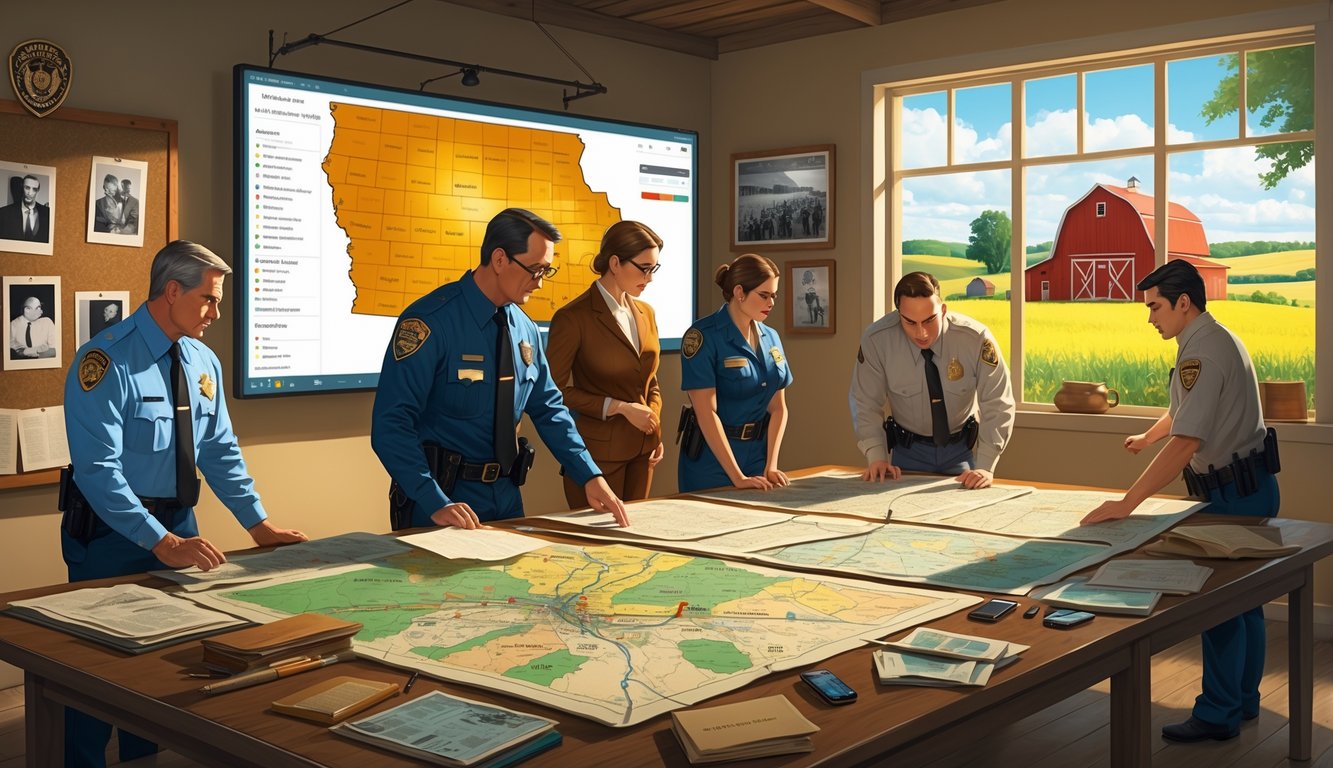
Solving crimes in Iowa today relies on teamwork between police, new technology, and community help. Programs connect law enforcement and people in the community to work toward answers in unsolved crimes.
Law Enforcement and Investigative Tools
Law enforcement across Iowa uses advanced tools to look into cold cases and new crimes. Police departments rely on DNA analysis, digital forensics, and criminal databases.
These tools help officers find clues that might have gone unnoticed in the past. The Iowa Attorney General’s Cold Case Unit has brought new hope to long-unsolved mysteries using up-to-date forensic science.
Officers now use fingerprint matching software, surveillance video analysis, and cell phone records to track suspects or piece together events. Collaboration between state investigators and local police means more resources are available for tough cases.
Investigators often work with federal agencies for extra support, especially in serious or complex crimes. As new methods develop, Iowa police continue to review evidence in older cases.
Role of Crime Stoppers of Central Iowa
Crime Stoppers of Central Iowa helps bridge the gap between law enforcement and the public. The group allows people to share tips about crimes either online or over the phone while staying anonymous.
This confidentiality makes it easier for people with information to speak up. Rewards are sometimes offered for information that leads to an arrest or solves a case.
Crime Stoppers provides an easy way for citizens to take an active role in keeping their communities safe. Community members can find more information about ongoing cases and submit tips through the Crime Stoppers website.
By partnering with the police, Crime Stoppers has played a role in solving some of Iowa’s most infamous unsolved crimes. This helps bring justice and closure to families.
Iowa’s Historic Mysteries Beyond Crime

Some of Iowa’s most puzzling stories do not center only on crime. They include unknowns from the Prohibition Era, strange local legends, and courtroom drama that left more questions than answers.
These mysteries have fascinated both locals and historians for decades.
Myrtle Cook and the Prohibition Era
Myrtle Cook played a big part in Iowa during Prohibition. She was a well-known leader who strongly supported the ban on alcohol.
Cook pushed for strict rules and enforcement, making her a target for those who disagreed with her stance. Her death in 1925 shocked the community.
Someone found her shot in her own home in Vinton. The case led to rising tension between “wets” and “drys,” and rumors swept across Iowa.
People debated whether her death was a murder or suicide. To this day, new facts or confessions have not surfaced, leaving the case unsolved and controversial.
Legends of Model Townhouse in Dubuque
Dubuque has many old buildings. The story of the Model Townhouse stands out.
This historic property has sparked talk for over a hundred years. Strange stories link to its past.
Some believe the house has hidden passages or buried treasures. Others say the noises and shadows are reminders of tragic events.
Local tales continue to grow. Residents and visitors often share their own odd experiences, adding to the legend of the Model Townhouse.
A few researchers have tried to dig deeper using old records and blueprints. Many questions remain unanswered, keeping the mystery alive.
Murder Charges and Noteworthy Trials in Adair
The small town of Adair became famous for a murder case that made local headlines. A well-respected resident faced serious charges after a confrontation turned deadly.
The trial gripped the town. People filled the courthouse, and newspapers reported on each update.
Many residents doubted the fairness of the proceedings. People questioned the evidence, and witnesses gave conflicting stories.
When the court announced the verdict, not everyone believed the truth had come out. Years later, some still wonder if the case was ever truly solved.
For more information on Iowa’s unsolved cases, visit Iowa’s historic cold cases.